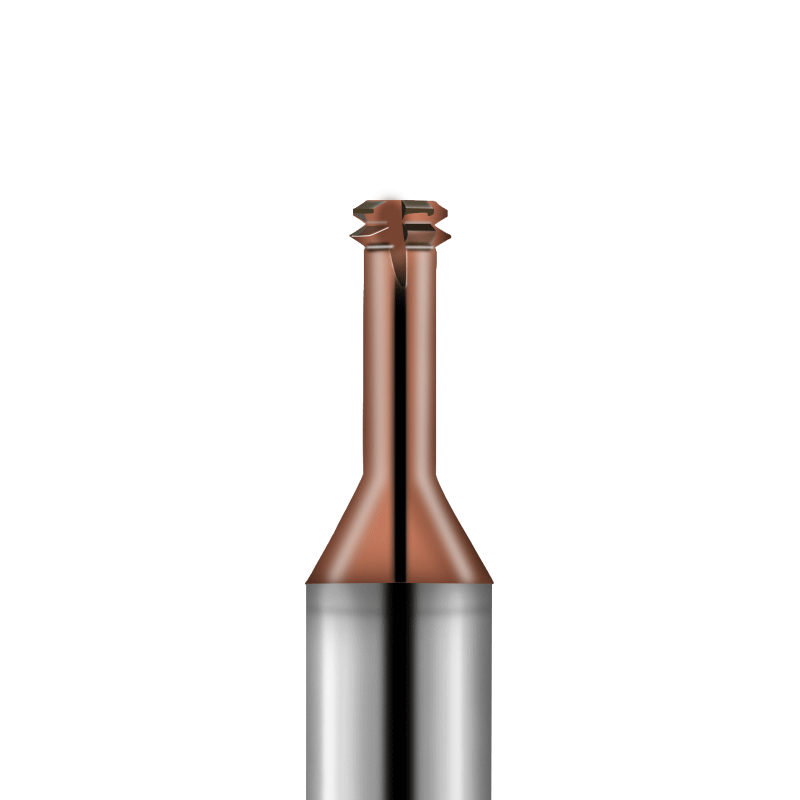
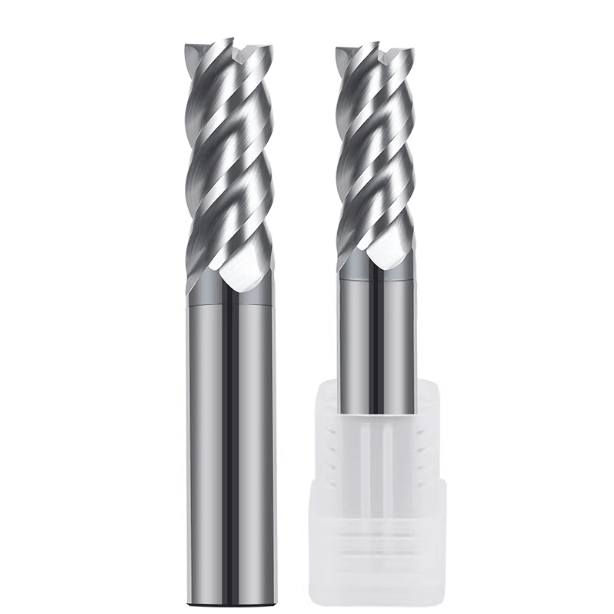
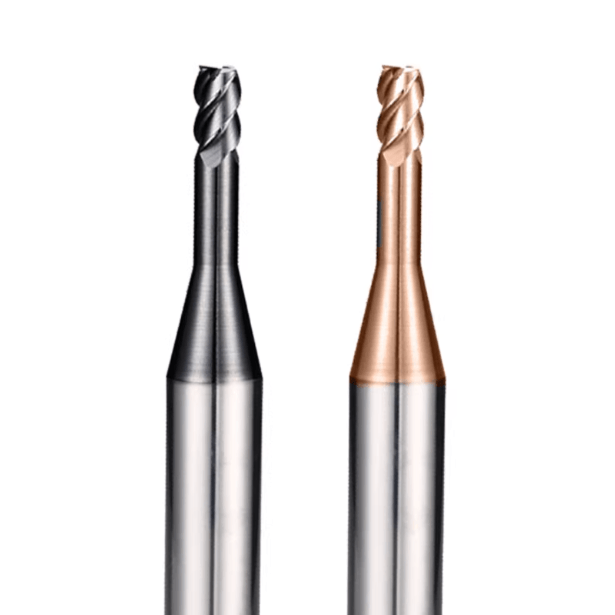
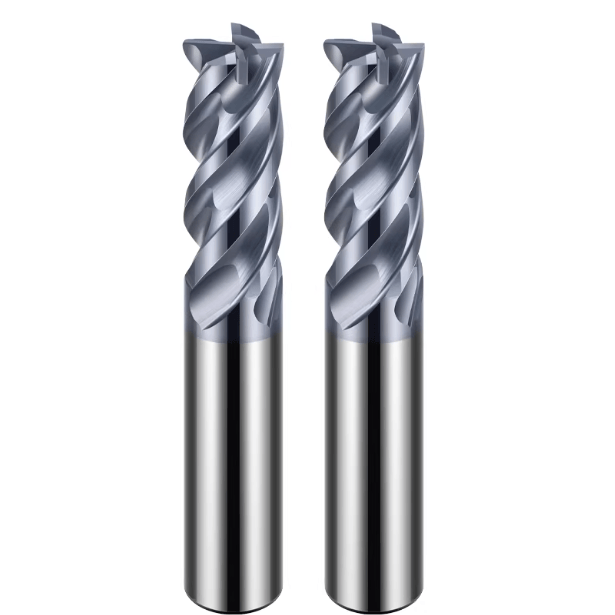
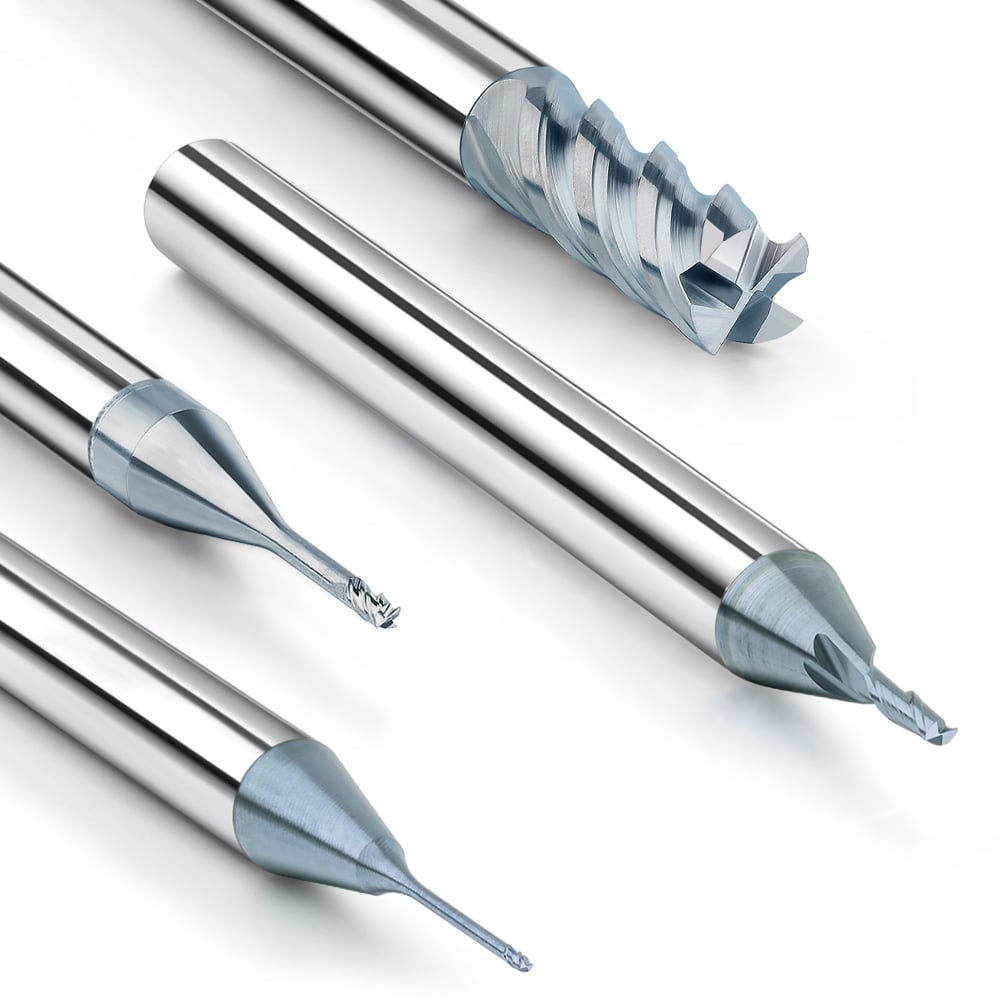
Titanium alloys, due to their high strength, low density, and excellent corrosion resistance, are widely used in high-end manufacturing fields such as aerospace, medical, and mold making. However, their low thermal conductivity and high chemical reactivity make controlling cutting temperature challenging, leading to rapid tool wear and placing extremely high demands on end mill geometry and process parameters. Selecting the right 2 flute vs 4 flute end mills for titanium involves balancing chip removal efficiency, rigidity, surface quality, and tool life—a key challenge in titanium alloy machining.
The cutting characteristics of titanium alloys create distinct performance differences between tools with different flute counts. 2 flute end mills typically offer larger chip removal space and better heat dissipation, making them ideal for roughing and high-speed cutting. In contrast, 4 flute end mills, with higher rigidity and multi-flute engagement, provide excellent surface finish and dimensional stability during semi-finishing and finishing stages. Understanding these differences requires considering cutting parameters and analyzing how key geometric factors such as helix angle, rake angle, and core thickness, in combination with end mill flute design, affect cutting forces and thermal load distribution.
In titanium alloy manufacturing, the tool life difference between 2 and 4 flute end mills is a critical concern. Proper control of cutting speed, feed rate, and cooling methods, combined with advanced coatings and optimized tool geometry, can significantly extend tool life and reduce tool change costs. Companies engaged in mass production or high-precision machining often collaborate with OEM 2-flute & 4-flute end mill manufacturers to customize flute counts, coatings, and cutting edge geometry, achieving higher machining stability and economic benefits.
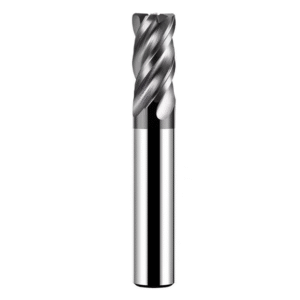
Challenges and Key Points in Titanium Alloy Machining
Titanium alloys are a classic difficult-to-machine material. Their unique physical and chemical properties make tool material selection, cutting edge design, and cutting parameter control crucial factors affecting machining quality and efficiency. The high strength-to-weight ratio, low thermal conductivity, and strong chemical reactivity generate high temperatures and intense friction during cutting, leading to accelerated tool wear, edge chipping, and deterioration of surface finish.
Selecting the right number of flutes (2-flute vs 4-flute) and optimizing end mill flute design are essential for managing cutting heat, improving chip evacuation, and extending tool life. During different machining stages—roughing versus finishing—2-flute and 4-flute end mills each provide specific advantages in chip space, rigidity, and thermal stability. Understanding titanium alloy cutting behavior and stress distribution on the tool is foundational to developing effective tooling strategies.
Low Thermal Conductivity and Work Hardening of Titanium Alloys
Titanium alloys have a thermal conductivity roughly one-sixth that of steel. Heat generated during cutting tends to concentrate at the tool edge and chip interface rather than dissipating into the workpiece, causing rapid temperature rises, edge softening, oxidation, and chipping.
Moreover, significant work hardening produces a hardened layer on the cut surface, increasing cutting resistance and wear intensity. This demands high heat resistance, sharp cutting edges, and strong coating adhesion. 2-flute end mills, with wide flutes and ample heat dissipation, are particularly suitable for high-speed roughing. 4-flute end mills have less chip space but higher rigidity, making them ideal for finishing or thin-wall machining of titanium alloy parts.
Main Factors Affecting Tool Life: Cutting Heat, Chip Adhesion, Vibration
Tool life is primarily influenced by cutting heat, chip adhesion, and vibration.
-
Cutting Heat: Insufficient cooling allows tool edge temperatures to exceed material limits, accelerating wear and plastic deformation.
-
Built-Up Edge (BUE): Titanium alloys adhere to tool surfaces, forming a BUE that tears the cutting surface and causes chipping, reducing surface quality.
-
Chatter and Vibration: The low elastic modulus of titanium alloys promotes vibration and resonance, causing fluctuating tool loads and shortening tool life.
Optimizing end mill flute design, cooling strategies, and cutting parameters, combined with the proper flute count (2 vs 4), balances chip removal, rigidity, and tool stability, maximizing machining efficiency and economy.
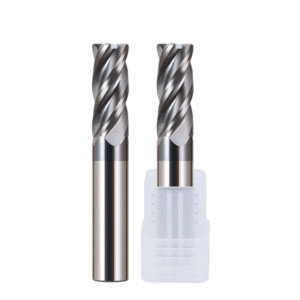
How End Mill Flute Design Affects Titanium Alloy Machining Performance
Flute design is a core factor influencing cutting efficiency, tool life, and surface quality. The flute shape affects cutting edge arrangement, chip removal, heat dissipation, and vibration. Key parameters include flute width, helix angle, core thickness, rake angle, and cutting edge geometry.
In roughing, large chip space and heat dissipation are prioritized; in finishing, rigidity and surface finish are critical. Optimized flute design ensures stable performance during high-load cutting, deep grooves, and high-speed machining, extending service life and reducing defects.
The Role of Flute Geometry in Heat Dissipation and Chip Removal
-
Wider flutes provide ample chip space, reducing BUE formation and edge wear.
-
Helix angle controls cutting force direction and magnitude; larger angles improve surface finish but may reduce rigidity.
-
Core thickness enhances structural strength, suitable for deep grooves and thin walls.
-
Rake angle affects chip detachment and cutting temperature.
Proper parameter matching maximizes tool life and machining stability in roughing, semi-finishing, and high-speed titanium cutting.
Structural Differences Between 2-Flute and 4-Flute End Mills
-
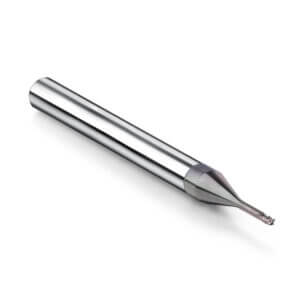
2-flute: Large inter-flute spacing, high groove volume, excellent chip removal—ideal for high-speed roughing and deep cuts.
-
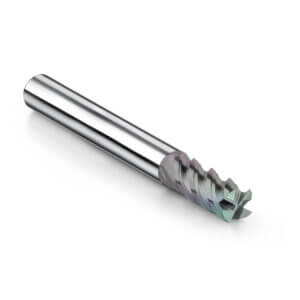
4-flute: Higher rigidity, smoother cutting forces, finer surface finishes—ideal for finishing and contour machining; limited chip space requires cooling and parameter optimization.
These differences contribute to tool life differences between 2- and 4-flute end mills and impact overall machining efficiency. Engineers select flute count based on stage, material thickness, and complexity.
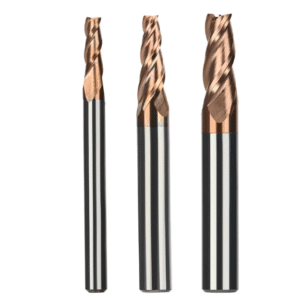
Performance Comparison of 2 Flute and 4 Flute End Mills in Titanium Alloy Machining
Selecting the appropriate number of flutes on an end mill directly impacts machining efficiency, tool life, and part surface quality in titanium alloy manufacturing. Comparing 2 flute vs 4 flute end mills for titanium helps engineers make informed decisions for roughing and finishing operations. Due to titanium’s high strength and low thermal conductivity, 2-flute and 4-flute tools show significant differences in chip evacuation efficiency, cutting stability, heat distribution, and vibration control. Understanding these differences is essential for optimizing cutting strategies, extending tool life, and ensuring dimensional accuracy and surface quality.
Differences in Cutting Efficiency and Feed Rate
2-flute end mills have larger inter-flute spacing and wider flutes, allowing rapid chip removal and reduced heat buildup. This provides a significant advantage in roughing and high-feed machining. They can remove more material in a shorter time while reducing chip buildup and cutting forces.
In contrast, 4-flute end mills have more cutting edges but narrower flute width and limited chip evacuation space. They are better suited for finishing, thin-wall machining, and complex contour cutting. In these applications, 4-flute tools deliver smoother feed and a more uniform cutting load, improving surface finish and contour accuracy. By understanding the characteristics of each machining stage, engineers can choose the optimal 2-flute vs 4-flute end mills for titanium, balancing efficiency and quality.
Heat Dissipation Capacity and Tool Life Performance
Cutting heat is a critical factor affecting tool life difference between 2- and 4-flute end mills. Two-flute tools, with wider chip removal channels, offer superior heat dissipation, reducing cutting edge temperature, wear, chipping, and built-up edge formation. This leads to longer and more stable tool life during high-load roughing.
Four-flute end mills, while more rigid, accumulate heat faster. Maintaining performance requires optimized cutting parameters, effective cooling strategies, and proper coating selection. Recognizing these heat management differences allows engineers to maximize tool life for both roughing and finishing operations.
Surface Quality and Dimensional Accuracy Comparison
The number of flutes directly affects surface roughness and dimensional accuracy. 2-flute end mills facilitate smooth chip flow and minimize cutting vibration, making them suitable for rapid material removal. However, the smaller number of cutting edges engaged per unit length may result in slight surface waviness.
4-flute end mills engage more cutting edges per unit length, producing a more uniform distribution of cutting forces. This improves surface finish, contour accuracy, and machining consistency. In aerospace, medical, and high-end mold manufacturing, engineers typically select 2-flute tools for efficient roughing and 4-flute tools for finishing to ensure both surface quality and dimensional stability.
Tool Life Difference Analysis Between 2-Flute and 4-Flute End Mills
In titanium alloy machining, tool life is a core indicator affecting both production efficiency and machining costs. Analyzing the tool life difference between 2- and 4-flute end mills for titanium helps engineers understand how tools with different flute counts perform under high-temperature, high-stress cutting conditions. High cutting temperatures, chatter, chip adhesion, and insufficient tool rigidity all accelerate tool wear.
Two-flute end mills, with larger chip evacuation channels and faster heat dissipation, typically have longer tool life during roughing. In contrast, four-flute end mills, offering higher rigidity and more uniform cutting forces, accumulate heat more quickly during high-load, long-duration cutting, requiring optimized coatings, cooling, and cutting parameters to extend their life. Understanding edge wear patterns, heat accumulation, and tool life optimization strategies is essential for efficient, cost-effective titanium alloy machining.
Edge Wear Patterns and Heat Concentration Effects
Titanium’s low thermal conductivity and high strength make rapid heat conduction difficult, leading to localized high-temperature zones on the cutting edge. This is especially pronounced in multi-flute tools, such as 4-flute end mills, where heat concentration accelerates edge wear, chipping, and chatter.
Two-flute end mills, with wider flutes and fewer cutting edges, provide smoother chip removal, more uniform heat distribution, and lower edge temperatures, resulting in longer tool life during high-load roughing. Understanding these wear and heat patterns is crucial for selecting 2 flute vs 4 flute end mills for titanium and optimizing tool life.
Role of Coatings and Cooling in Extending Tool Life
Coatings play a vital role in prolonging tool life. TiAlN, DLC, and AlTiN coatings improve wear resistance, thermal stability, and anti-adhesion properties, reducing built-up edge formation. When combined with efficient cooling strategies, such as high-pressure cooling, MQL, or through-tool coolant, cutting edge temperatures decrease, and chip evacuation improves.
The tool life difference between 2-flute and 4-flute end mills becomes more pronounced under high-speed cutting or deep-grooving conditions. Optimizing coatings and cooling strategies significantly extends tool life and machining stability.
Common Tool Life Optimization Strategies
-
Reducing Depth of Cut: Lowers cutting edge load and peak forces, preventing excessive wear.
-
Controlling Cutting Temperature: Adjust spindle speed, feed rate, and cooling method to minimize heat accumulation.
-
Optimizing Feed Rate: Ensures uniform cutting forces, reducing chatter and edge stress.
Combined with flute design, appropriate flute count, and coating optimization, these strategies maximize tool life and stability, enabling high-efficiency titanium alloy machining.
How OEM Customized Tools Improve Titanium Alloy Machining Efficiency
Standardized tools often struggle to meet the efficiency and life requirements under varying titanium machining conditions. OEM 2-flute & 4-flute end mills for titanium allow companies to optimize flute number, helix angle, rake angle, and coating combinations according to specific machining scenarios. Customized tools improve machining efficiency, extend tool life, and enhance surface quality.
OEM customization ensures higher stability and reliability for deep-groove, thin-walled, or complex contour parts, making it an effective strategy for aerospace, mold, and medical device manufacturing.
Advantages of OEM Customization in Tool Design
By tailoring end mill flute design, helix angle, tool diameter, core thickness, and coating, OEM customization enables uniform cutting force, smooth chip removal, and rapid heat dissipation. Two-flute end mills maintain high material removal rates during roughing, while four-flute end mills achieve superior surface quality and dimensional accuracy during finishing. OEM customization also allows tip geometry and coating optimization for specific process requirements.
Typical Applications of Customized 2-Flute and 4-Flute End Mills
Aerospace parts often use OEM 2-flute end mills for deep-groove roughing, maximizing chip evacuation and thermal stability. OEM 4-flute end mills are ideal for finishing thin-walled mold parts or complex contours, ensuring smooth cuts and improved surface finish. Customized flute designs and coatings reduce tool change frequency and machining defects, achieving both longer tool life and higher machining consistency.
Choosing a Reliable OEM End Mill Supplier
Key factors:
-
Material Consistency and Machining Accuracy: Stable hardness, toughness, and microstructure.
-
Flute Design Expertise: Experience in 2- and 4-flute tool customization.
-
Coating and Heat Treatment: High-performance coatings like TiAlN, DLC, and precise heat treatment.
-
Technical Support: Guidance on cutting parameters, tool life analysis, and custom upgrades.
A reliable OEM supplier ensures maximum tool performance, reduced costs, and improved machining stability in titanium alloy machining.

Practical Techniques for Using 2-Flute and 4-Flute End Mills in Titanium Alloy Machining
Even with the right 2-flute or 4-flute end mills for titanium alloy, proper machining strategies and techniques are crucial to ensure tool life, machining efficiency, and part quality. Based on years of CNC experience, engineers optimize production by focusing on three key areas: cutting parameters, cooling and lubrication methods, and tool wear monitoring.
By considering flute design, cutting force control, thermal management, and smooth chip evacuation, tool stability can be maintained during high-speed cutting and deep-grooving operations, maximizing the advantages of 2-flute and 4-flute end mills in titanium alloy milling.
Cutting Parameter Optimization Recommendations
Cutting parameters directly affect tool life, surface finish, and dimensional accuracy. In titanium alloy machining:
-
2-flute end mills are ideal for roughing. Use higher spindle speeds, moderate feed rates, and larger depths of cut to fully utilize chip evacuation and heat dissipation advantages.
-
4-flute end mills are suitable for finishing. Apply lower spindle speeds, stable feed rates, and shallower depths to ensure surface quality and contour accuracy.
Optimizing feed rate, depth of cut, and spindle speed helps reduce chatter and heat buildup while improving cutting stability. These guidelines provide practical reference parameters for the effective use of 2-flute vs 4-flute end mills for titanium alloy.
Cooling and Lubrication Strategies: High-Pressure Cooling, MQL, and Through-Hole Cooling
High-temperature titanium milling requires appropriate cooling and lubrication:
-
High-Pressure Cooling: Delivers strong fluid flow to rapidly remove heat and evacuate chips. Ideal for deep grooves and high-feed roughing.
-
MQL: Reduces tool-chip adhesion and heat accumulation. Suitable for finishing or small-to-medium parts.
-
Through-hole Coolant: Direct coolant flow from inside the tool improves heat removal and chip evacuation, ideal for complex contours and deep holes.
Choosing the right cooling method should consider flute design, flute count, coating, and machining process characteristics, ensuring extended tool life, improved stability, and optimized surface finish.

Balancing Efficiency and Tool Life in Titanium Alloy Machining
Titanium alloys’ high strength, low thermal conductivity, and work-hardening behavior place extreme demands on cutting tools. This article analyzes 2-flute vs 4-flute end mills, including flute design, tool life differences, cooling and lubrication strategies, and OEM customization.
Comparative studies of roughing, finishing, and complex contour machining provide engineers with scientific strategies to maximize efficiency, extend tool life, and achieve high-quality part surfaces.
Roughing: Prioritize 2-Flute End Mills
For high-feed, deep-cut roughing, 2-flute end mills excel in chip removal and heat dissipation. Wide flutes and ample spacing enable rapid chip evacuation, reduced heat buildup, and stable cutting under heavy loads. Proper depth-of-cut and feed rate control further extends tool life and reduces machining risks.
Finishing and Complex Contours: Use High-Rigidity 4-Flute End Mills
4-flute end mills provide high rigidity, smooth feed, and uniform cutting forces, improving surface finish and dimensional accuracy in finishing operations. Optimized flute geometry, helix angle, and cutting parameters enable precise, stable machining for thin-walled or complex contour parts.
Combining OEM Customization and Coating Optimization
OEM-customized tools allow optimization of flute shape, flute count, helix angle, and coatings to improve wear resistance and thermal stability. Combined with effective cooling strategies, tool life and machining efficiency can be maximized.
By applying both 2-flute and 4-flute end mills, customized designs, and optimized operating strategies, manufacturers can achieve a balanced solution of high efficiency, low cost, superior surface quality, and extended tool life in titanium alloy machining.