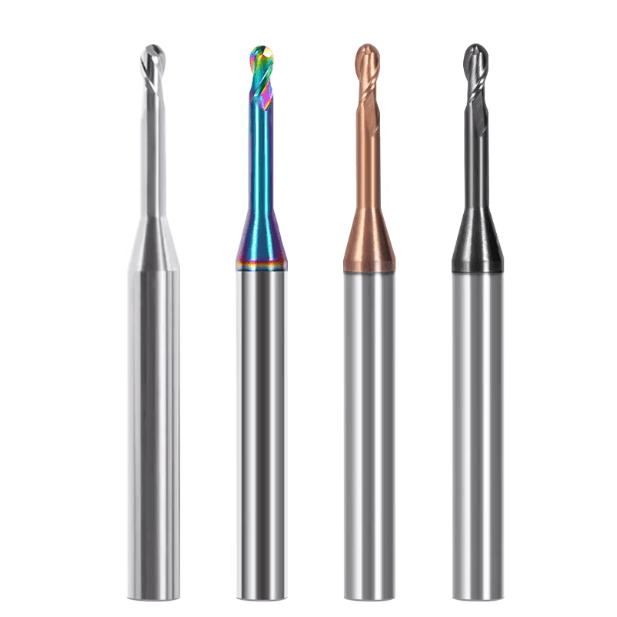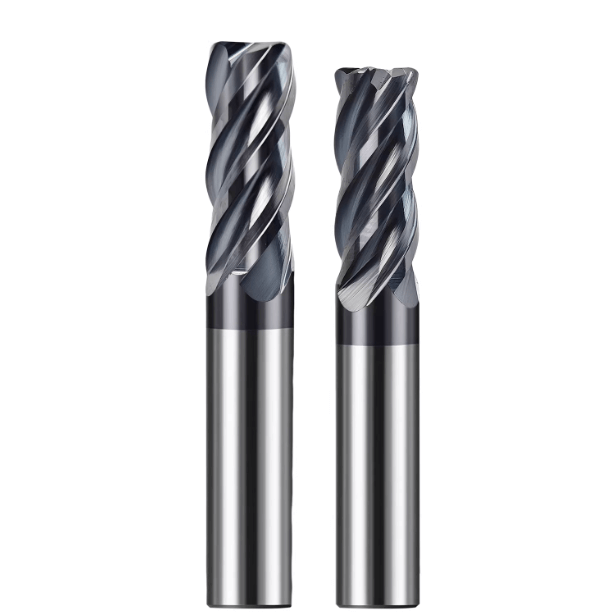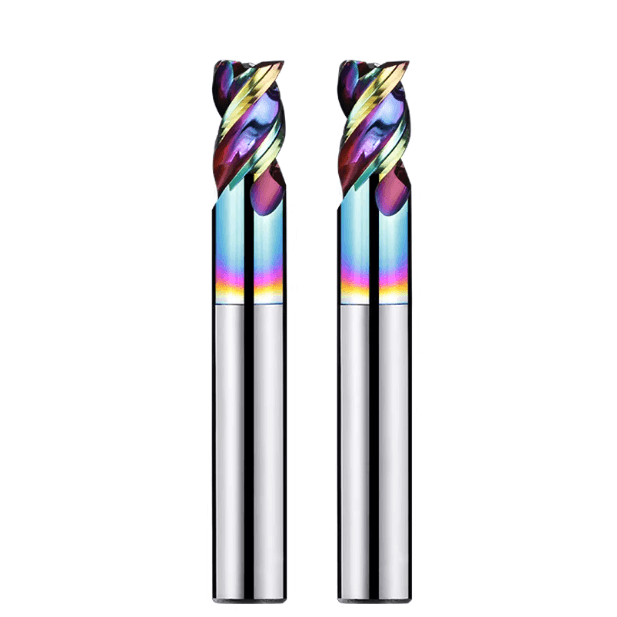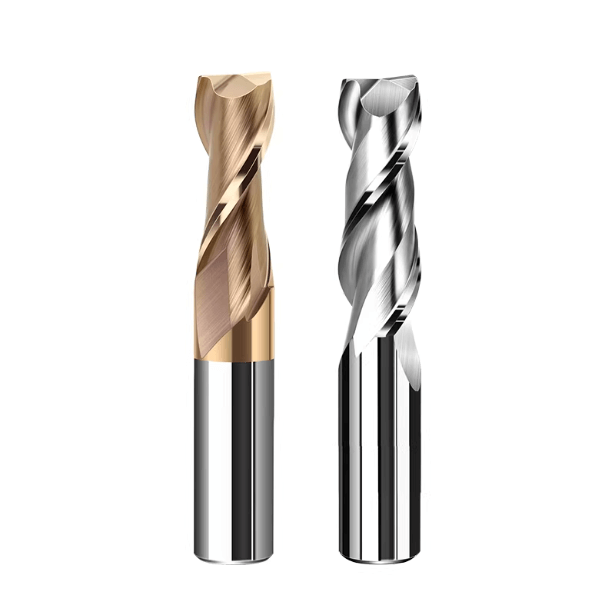
We frequently receive the question: “Is it really reliable to use a 2-flute end mill on steel workpieces?” This is a recurring concern, especially when customers who are accustomed to 2-flute end mills for aluminum attempt to use the same tool on medium-to-low carbon steel or stainless steel. In deep-slot or small-diameter applications, they often encounter vibration, poor chip evacuation, and premature cutting-edge wear—all of which directly affect machining efficiency and surface finish quality.
In our experience, deciding between a 2-flute and a 4-flute end mill is more than counting flutes. It requires assessing the material, slot depth, and machine rigidity. For example, when using a 2-flute roughing end mill for steel, we carefully consider the tool diameter, wavy cutting-edge design, and coating properties to optimize chip evacuation, reduce heat generation, and prevent tool breakage. In high-speed or deep-slot scenarios, we often find that adjusting cutting parameters is just as important as selecting the tool itself.
As a carbide end mill 2-flute manufacturer, we continually refine helix angles and cutting-edge strength based on real-world customer feedback. Only through accumulated practical experience can we guide clients to make informed decisions when using a 2-flute end mill on steel.
So, in your steel machining operations, are you confident about when to stick with a 2-flute tool and when it’s necessary to switch to a higher-flute-count end mill?

When Do We Actually Use 2-Flute End Mills for Machining Steel?
From our practical experience, the 2-flute end mill is not a universal solution—but in certain steel machining scenarios, its larger chip evacuation space and stable cutting edge provide distinct advantages. We often see clients try to apply the same 2-flute end mills from aluminum directly to steel, resulting in vibration or poor surface finish. In such cases, we first evaluate the slot depth, cutting width, and steel hardness. This allows us to decide whether to continue using a 2-flute end mill or adjust cutting parameters, avoiding premature wear or edge chipping while maintaining efficiency.
For small-diameter tooling or deep-slot machining, we generally favor 2-flute roughing end mills. The larger flute volume allows chips to exit smoothly, preventing clogging. Across multiple client projects, we’ve observed that with optimized spindle speeds and feed rates, 2-flute tools often outperform 4-flute end mills in deep-hole or complex-contour steel machining, while also being easier to manage in terms of tool life.
The Most Common Tool Selection Challenges When Transitioning from Aluminum to Steel
Clients frequently attempt to use the same 2-flute end mills that work well on aluminum parts directly on steel parts—often with poor results. The primary challenges involve vibration, ineffective chip evacuation, and heat accumulation. We advise clients to first consider the steel type and intended cutting depth, because steel cutting forces are significantly higher than aluminum. Without sufficient tool rigidity or proper cutting parameters, even carbide tools can experience edge chipping.
Additionally, tool diameter relative to slot depth is often overlooked. When machining deep slots with small-diameter 2-flute end mills, it may be necessary to reduce feed rates or employ multi-pass (layered) cutting strategies. Otherwise, poor chip evacuation can lead to surface scratches and accelerated tool wear. Real-world case studies help clients avoid repetitive trial-and-error and improve machining stability.
A Real-World Application Case: Machining Steel with Small-Diameter Tools
In one precision component project, we used a 3mm 2-flute end mill to machine deep slots in medium-carbon steel. The goal was to maintain high cutting speed while preserving tool life and surface quality. By carefully controlling cutting depth, adjusting feed rates, and leveraging the coating properties of our high-performance carbide tools, we completed a continuous machining run exceeding 10 hours without significant edge chipping.
We’ve also observed that small-diameter 2-flute tools are more stable than 4-flute alternatives. More flutes increase cutting resistance and amplify force fluctuations, especially on steel, which can worsen machine vibration. Based on this, we often recommend 2-flute roughing end mills for similar conditions, paired with optimized cutting strategies to balance efficiency and tool life.
Experience with 2-Flute End Mills on High-Speed Spindle Machines
On high-speed machining centers, we have tested 2-flute end mills across steels of varying hardness. Our experience shows that helix angle and cutting-edge design are crucial for stability. Adequate chip evacuation and cutting-edge strength reduce heat buildup and maintain tool life. Conversely, excessive flutes can increase friction and accelerate wear.
We adjust cutting parameters and tool coatings based on the project. For medium-carbon steel high-speed milling, we select a carbide 2-flute end mill with a thin coating for wear resistance while preserving sharpness. Multiple client projects confirmed that a well-chosen 2-flute end mill can handle high-speed steel machining, provided cutting strategies and tool selection are validated in practice.

The Real Difference Between 2-Flute and 4-Flute End Mills in Steel Machining
In our daily experience, choosing between 2-flute and 4-flute tools involves balancing chip removal, cutting stability, and surface quality—not just counting flutes. Customers using 4-flute tools in steel often experience rapid wear or groove heating due to poor chip evacuation. In these cases, we recommend switching to a 2-flute roughing end mill based on slot depth and width to ensure smooth chip removal and reduce heat concentration at the cutting edge.
For high-speed or light cuts, 4-flute tools offer advantages in surface finish and cutting-force distribution but require rigid machines and precise cutting parameters. Insufficient machine rigidity can cause 4-flute tools to chatter in deep or narrow steel slots. Conversely, 2-flute tools provide more chip space and stable cutting forces, which is why we often recommend them for deep-slot applications.
The Impact of Chip Evacuation Space
Chip evacuation is critical for steel machining stability. 2-flute tools have larger flute volumes than 4-flute tools, which is particularly important for deep slots or high cutting depths. In one stainless-steel deep-slot project, we used 2-flute end mills and observed smooth chip flow even at slightly higher feed rates, with no clogging—improving machining continuity and extending tool life.
4-flute tools, by comparison, have limited chip space under the same conditions. Inadequate evacuation leads to elevated cutting-edge temperatures, surface discoloration, or premature chipping. Therefore, in small-diameter or deep-slot machining, we favor 2-flute tools and adjust feed and speed based on material to maintain smooth chip removal.
Differences in Cutting Stability vs. Tool Rigidity
2-flute roughing end mills, despite higher per-flute cutting forces, tend to exhibit less overall vibration at the cutting tip, leading to better stability in deep-slot steel machining. We have validated through multiple projects that, with reduced cutting depth and layered passes, 2-flute tools maintain stability without chatter or deflection.
4-flute tools can provide uniform cutting forces in shallow slots or face milling but are prone to chatter in deep slots or small diameters if machine rigidity is insufficient. We advise clients to select flute count based on their specific machine and slot depth rather than assuming higher flute count always gives better surface finish.
Surface Finish vs. Tool Wear
While 4-flute tools can yield slightly better surface finishes in shallow cuts or finishing operations, they also wear faster in deep-slot steel machining. Clients using 4-flute end mills in medium-carbon steel deep slots sometimes experienced edge chipping after only a few hours, causing scratches. In contrast, 2-flute tools wear slower; the surface finish may be slightly rougher but remains acceptable for assembly or subsequent operations.
We weigh flute count against machining requirements: for high-efficiency roughing or deep-slotting, we prioritize 2-flute roughing end mills. For shallow slots or finishing, with rigid machines, 4-flute tools can achieve better surface quality. This trade-off maximizes tool life while meeting precision requirements.
Why Clients Prefer 2-Flute End Mills for Deep Slotting
Clients generally favor 2-flute tools for deep-slot steel operations due to chip evacuation efficiency and vibration control. Deep slots accumulate chips; limited evacuation space in 4-flute tools can raise cutting-edge temperatures, causing edge chipping or breakage. Switching to 2-flute tools with step-cutting and proper feed rates resolves these issues.
2-flute tools also distribute cutting forces more evenly, avoiding uneven load seen with higher-flute tools. In small-diameter deep slots, we optimized helix angle and feed strategy, ensuring stability and extended tool life. This approach is widely adopted among clients facing similar steel machining challenges.
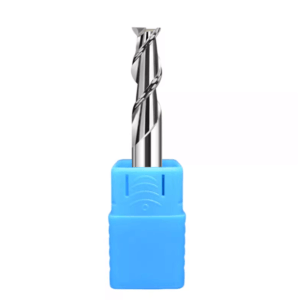
In Which Steel Machining Scenarios Do We Recommend Using 2 Flute End Mills?
From our extensive experience over the years, we do not indiscriminately select 2-flute end mills for every steel machining task. Instead, we assess factors such as material hardness, slot depth, and machining complexity. For low-carbon steels and structural steels, 2-flute end mills consistently perform with high stability in shallow-to-medium cutting depths and continuous deep-slot operations.
In one project involving mechanical structural components, we used a 4mm-diameter 2-flute tool for multi-stage deep-slot machining. Even at high feed rates, chip evacuation remained smooth, and tool life was extended. Experiences like this allow us to quickly and accurately assess the suitability of 2-flute tools for specific client projects, helping them avoid common issues such as tool tip chipping or excessive heat generation.
Conversely, for scenarios involving variable steel thickness or irregular slot widths, we value the flexibility of 2-flute end mills. Compared to higher-flute tools, two-flute cutters allow better control over cutting forces and vibration during deep slots or irregular contours. We frequently advise clients to select 2-flute roughing end mills while considering machine rigidity and required machining depth, striking an optimal balance between efficiency and stability—a strategy validated across multiple projects.
Application Experience in Machining Low-Carbon and Structural Steels
Across numerous projects, we observed that 2-flute end mills provide distinct advantages in chip evacuation and wear resistance. This is particularly true at medium cutting depths, where the tool maintains stable cutting action without chipping due to excessive cutting resistance.
In one case, machining mechanical frame components with 2-flute carbide tools resulted in approximately 20% longer tool life compared to 4-flute tools, while surface finish fully met specifications. We also noted that low-carbon and structural steels generate significant cutting-force fluctuations; higher-flute-count tools in such scenarios often suffer vibration or chatter. By fine-tuning feed rate and spindle speed, we maximize the inherent advantages of 2-flute cutters in chip evacuation and stability, guiding clients toward optimal parameter selection.
Chip Evacuation Advantages in Deep and Narrow Slot Machining
In deep or narrow slot machining, smooth chip evacuation is critical. Two-flute roughing end mills provide larger flute space, enabling rapid chip removal and minimizing clogging and cutting-heat accumulation.
For example, in a deep-slot stainless steel project, the 2-flute tool prevented tool-tip chipping and machining interruptions often caused by chip accumulation. Combining deep-slot machining with a layered cutting strategy—reducing cutting depth appropriately—allows even small-diameter tools to fully leverage two-flute advantages. Practical experience has repeatedly shown this approach to be more reliable than simply increasing flute count.
Stable Performance in High-RPM Machining with Small-Diameter Tools
For small-diameter steel components on high-speed spindles, 2-flute end mills demonstrate superior stability. Multi-flute cutters often amplify cutting-force fluctuations, causing vibration and premature wear. Two-flute cutters distribute forces more evenly, and when combined with optimized helix angles, maintain tool stability and machining continuity.
For instance, using a 2mm 2-flute carbide end mill, we achieved prolonged continuous machining of steel components without chipping by adjusting feed rate and cutting depth. These practical results allow us to provide clients with reliable recommendations for high-precision small-component machining.
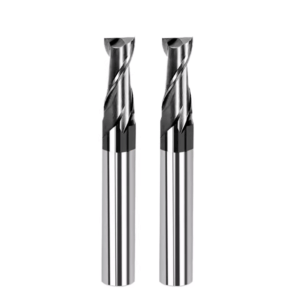
When We Do Not Recommend Using a Two-Flute End Mill for Machining Steel
Two-flute end mills are not suitable for every steel machining scenario. High-hardness mold steels present substantial cutting forces and concentrated heat. In these cases, a 2-flute tool may experience tip chipping or premature wear, particularly during deep-slot or high-feed operations. For steels exceeding 45 HRC, we advise caution and often recommend higher-flute-count cutters or reinforced cutting-edge designs to distribute load more effectively.
In heavy-duty cutting or deep-cut operations, two-flute tools bear disproportionately high cutting forces. If tool diameter is small or machine rigidity insufficient, vibration or machining errors can occur. In one client project, using a 2-flute tool for deep cuts increased wear rates compared to a 4-flute cutter and reduced surface finish quality. In such cases, we recommend four-flute roughing cutters or wavy-edge designs.
Common Issues in Machining High-Hardness Mold Steels
Clients machining high-hardness mold steels frequently encounter tip chipping, excessive heat, and force fluctuations. Two-flute designs concentrate loads, reducing tool life. We collaborate with clients to evaluate hardness, slot depth, and material removal rates, determining if switching to higher-flute-count or coated tools is necessary.
During precision deep-hole machining, continued use of two-flute cutters can lead to uneven wear and surface scratches. We recommend using two-flute tools only for roughing under layered cutting and small material removal rates; finishing should use four-flute or specialized tools to meet surface and dimensional accuracy requirements.
Tool Rigidity Challenges in Heavy-Duty Cutting
Heavy-duty and deep-cut operations place extreme demands on tool rigidity. Two-flute tools concentrate cutting forces on each edge, risking chatter or tip chipping if machine or tool-holding rigidity is insufficient. Observing client high-volume steel machining, we noted decreased efficiency and increased tool/machine maintenance costs.
We assess tool-to-machine rigidity compatibility, cutting depth, and diameter. Even recognizing the advantages of 2-flute roughing end mills, we sometimes recommend switching to four-flute or larger-core tools for stability. This trade-off is distilled from years of practical experience and ensures smooth operations.
Tool Selection for High-Quality Surface Finish Requirements
For high-surface-finish requirements, two-flute tools may not be optimal. While they excel in chip evacuation and deep-slotting, fewer cutting edges leave more pronounced tool marks. For finishes requiring Ra 0.8 or lower, we recommend higher-flute-count or specialized finishing tools.
In one mold steel project, after roughing with a two-flute tool, we switched to a four-flute or differential-pitch finishing tool. Surface roughness improved significantly while tool life remained economical. This emphasizes balancing chip evacuation advantages with machining objectives rather than relying solely on lower-flute-count benefits.

Practical Experience with 2 Flute Roughing End Mills in Steel Machining
Roughing stages demand high chip evacuation and cutting stability. Two-flute roughing end mills excel in deep slots or high material-removal scenarios. Wavy-flute geometry and optimized tooth profiles enable rapid chip evacuation, minimizing accumulation and heat. Across multiple projects, 2-flute roughing tools maintained stable cutting performance while extending tool life.
Tool diameter, tooth profile, and helix angle influence cutting-load distribution and chip evacuation efficiency. In large-scale steel projects, we optimized depths and tooth profiles to achieve high efficiency while preventing vibration and edge chipping. These experiences guide optimal roughing tool strategies based on material and machine capabilities.
The Impact of Roughing Tool Tooth Profile on Chip Evacuation
Tooth profile directly affects chip evacuation. Straight-flute tools tend to clog under heavy loads, whereas wavy-tooth 2-flute roughing end mills segment and evacuate chips smoothly, reducing tip overheating. In medium-carbon steel deep-slot projects, we observed improved evacuation, longer continuous machining, and more consistent surface finishes.
Optimized tooth profiles also balance cutting loads, reducing vibration. This allows higher feed rates in heavy cuts without compromising tool life or precision, a principle we have consistently applied in steel machining.
The Advantages of Wavy-Flute Structures in Heavy Steel Machining
Wavy-flute 2-flute roughing end mills distribute cutting forces uniformly, segment chips effectively, and provide larger evacuation channels, reducing wear. In large medium-carbon steel workpieces, tool life increased by 15–20% without efficiency loss.
The wavy design also mitigates vibration during continuous deep-slot machining, critical for small-diameter tools. In precision mechanical components, these tools allowed greater cutting depths and feed rates while maintaining stability, improving overall machining efficiency.
Case Studies: Optimizing Rough Machining Efficiency for Clients
In one large mold steel project, conventional 2-flute tools led to frequent replacements due to poor chip evacuation. Switching to a wavy-edge 2-flute roughing end mill, with optimized helix angles, cutting depth, and layering strategy, increased tool life by 25% and reduced machining time by 15%, maintaining surface quality.
In another medium-carbon steel project, high-speed rough machining with small-diameter tools was achieved using an optimized 2-flute roughing end mill. Adjusted cutting parameters enabled continuous, long-duration machining without chipping. These cases demonstrate that efficient rough machining depends on both tool selection and tailored cutting strategies integrated with machine capabilities.

Why Many Customers Prefer 2-Flute End Mills for Aluminum, Yet Rarely Use Them for Steel
Based on our extensive machining experience, we have observed that customers generally choose two-flute cutting tools when machining aluminum. This is because aluminum machining imposes stringent requirements for chip evacuation. The two-flute design of an end mill for aluminum provides larger flute space, facilitating rapid chip removal and reducing issues such as chip adhesion and built-up edges. This capability allows customers to maintain high efficiency during high-speed operations while also extending tool life. Across numerous aluminum projects, we have consistently found that two-flute cutters perform with high stability during deep slotting or small-diameter machining.
However, these advantages do not automatically translate to steel machining. Steel requires higher cutting forces and generates concentrated heat. Without adjusting cutting parameters, two-flute cutters are prone to tip chipping and excessive vibration. We advise customers not to simply apply their aluminum machining practices to steel components. Instead, tool selection and cutting parameters must be tailored to the steel’s hardness, slot depth, and the rigidity of the machine tool. This explains why two-flute end mills are less commonly used in steel than in aluminum.
Differences in Chip Evacuation Requirements Between Aluminum and Steel Machining
During aluminum machining, we observe that chips are soft and tend to stick to the tool. If chip evacuation is inefficient, built-up edges form on the cutting edge, compromising surface finish and reducing tool life. Customers often select 2-flute end mills for aluminum because the ample flute space ensures smooth chip removal, even during deep slots or high-feed operations.
In contrast, machining steel generates hard chips, higher cutting forces, and elevated temperatures. Using the same two-flute aluminum tool for steel can lead to poor chip evacuation, high cutting-edge temperature, and edge chipping. Across multiple projects with medium-carbon and mold steels, we have observed that clients must carefully re-evaluate tools—considering flute count, tooth geometry, and coating—to achieve stable machining.
The Impact of Flute Count on Cutting Heat and Tool Life
In steel machining, the number of flutes directly affects cutting heat distribution and tool life. Two-flute tools concentrate cutting forces on each edge, increasing tip wear if cutting depth and feed rate are not properly controlled. Our tests show that four-flute end mills, while offering less flute space, distribute heat more evenly in shallow slotting or finishing operations, extending tool life.
For aluminum, a two-flute design helps dissipate heat quickly. In steel, this advantage is less pronounced. We recommend using a 2-flute roughing end mill for rough cuts and a four-flute or wavy-edge tool for finishing, balancing tool life and machining efficiency.
Lessons Learned: Tool Adjustments When Transitioning from Aluminum to Steel
Clients often struggle when moving from aluminum to steel machining. Standard 2-flute aluminum tools are prone to vibration or edge chipping in deep slots or heavy-duty cuts. We advise adjusting key parameters: flute count, helix angle, cutting depth, and feed rate, while selecting carbide substrates and coatings designed for steel.
In one medium-carbon steel project, a client initially planned to use a standard aluminum tool. After testing, we recommended a 2-flute roughing end mill with a wavy-edge design, reduced cutting depth, and layered cuts. Tool life and stability improved significantly without sacrificing efficiency. This demonstrates that tool selection and cutting parameters must be adapted to material and machining conditions rather than relying on aluminum practices.
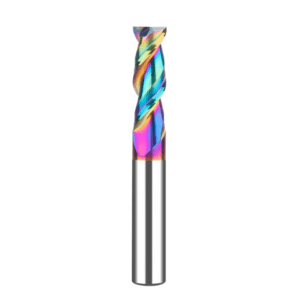
As a Manufacturer of 2 Flute Carbide End Mills: Our Practices in Tool Design for Steel Machining
In our R&D and manufacturing experience, steel machining imposes stringent design requirements. As a carbide end mill 2-flute manufacturer, we tailor geometric parameters based on machine rigidity, material type, and workpiece geometry. Tool substrate and coating selection are critical to ensure stability. We choose carbide substrates based on steel hardness and cutting volume and optimize coating thickness to withstand high loads.
We also focus on 2-flute performance in deep-slot and small-diameter machining. Tool geometry, helix angle, and wave-edge designs affect chip evacuation, vibration control, and heat distribution. By performing process simulations and trial cuts with clients, we refine parameters to ensure high efficiency in steel roughing operations.
The Impact of Tool Substrate Material on Steel Machining Stability
Tool substrate material significantly affects machining stability. High-performance carbide substrates resist deformation under high forces and temperatures, reducing tip chipping during deep slots or heavy cuts. Optimized high-density carbides improve stability and tool life compared to standard carbides.
We pair substrates with coatings suited to steel type to enhance wear resistance and thermal stability. For batch processing of steel components, these combinations maintain chip evacuation and cutting stability, even at high cutting volumes. Material selection is not about cost—it determines cutting stability and efficiency.
The Practical Trade-off Between Cutting-Edge Strength and Sharpness
Balancing cutting-edge sharpness and strength is critical in steel machining. Overly sharp edges reduce cutting force but are prone to chipping; blunt edges increase force, vibration, and reduce surface finish. Through tests, we adjust cutting edge geometry and helix angle to maintain sharpness while enhancing tip strength, optimizing efficiency and tool life.
For deep slots in medium-carbon steel, we slightly reinforce the edge to resist chipping under heavy loads while maintaining sufficient sharpness for chip evacuation. This expertise, gained over years, ensures stable and reliable production for our clients.
Common Tool Parameter Adjustments Made During Customer Testing
On-site testing often involves adjusting helix angle and effective cutting length to match slot depth and width, optimizing chip evacuation and minimizing vibration. Cutting edge chamfer and sharpness are fine-tuned to balance forces and tip strength.
Cutting depth and feed rate are adjusted according to machine rigidity and machining load. Recording tool wear and surface quality during test cuts guides further optimization. This data-driven approach continuously refines tool design and enhances client process reliability.
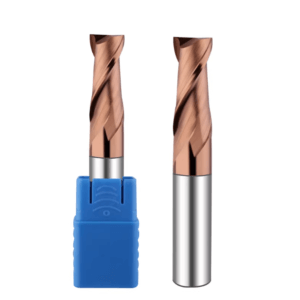
Recommendations for Tool Selection in Steel Machining
Based on our experience, there is no universal standard for tool selection. Optimal choices depend on workpiece material, geometry, machine capability, and machining strategy. First, identify the operation type—roughing, finishing, deep slotting, or shallow slotting—then select based on flute count, cutter diameter, and chip evacuation.
We encourage engineers to assess their machining conditions: workpiece hardness, slot depth relative to cutter diameter, machine rigidity, and spindle speed. For medium-carbon or mold steel deep slots, a 2-flute roughing cutter with step-cutting may be ideal. For shallow finishing with strict surface requirements, a four-flute cutter may be better. Engineers can exchange insights with us based on specific machining conditions, drawings, or material specifications to make optimal decisions.
Choosing Between 2-Flute and 4-Flute Cutters Based on Machining Type
For roughing or deep slotting on steel, we prioritize 2-flute roughing end mills. They provide greater chip evacuation space and balanced cutting forces, minimizing tip chipping and chatter. Experience shows extended tool life and high efficiency in medium-carbon and structural steels.
For shallow slot finishing or strict surface finish requirements, 4-flute end mills offer more balanced cutting forces and superior finishes, provided machine rigidity and cutting parameters are sufficient.
Selecting the Right Number of Flutes Based on Cutter Diameter and Slot Depth
Small-diameter deep-slot machining benefits from 2-flute tools for smooth chip evacuation and minimal vibration. In projects with 2–4 mm diameters, four-flute tools had higher force fluctuations, lower stability, and shorter tool life.
Large-diameter parts or shallow grooves may use more flutes for improved surface quality and cutting balance. Flute count and helix angle are fine-tuned according to groove depth-to-diameter ratio to optimize force distribution and tool life.
Matching Tools Based on Machine Rigidity and Spindle Speed
High-speed spindle machining of small-diameter steel favors 2-flute tools with optimized helix angles and coatings for stability and heat management. These tools better control vibration and facilitate smooth chip evacuation.
Machines with high rigidity and medium-diameter or shallow grooves may benefit from 4-flute tools for superior surface finish. Matching tool selection to machine rigidity and spindle speed prevents premature wear and chatter, ensuring stable and efficient operations.