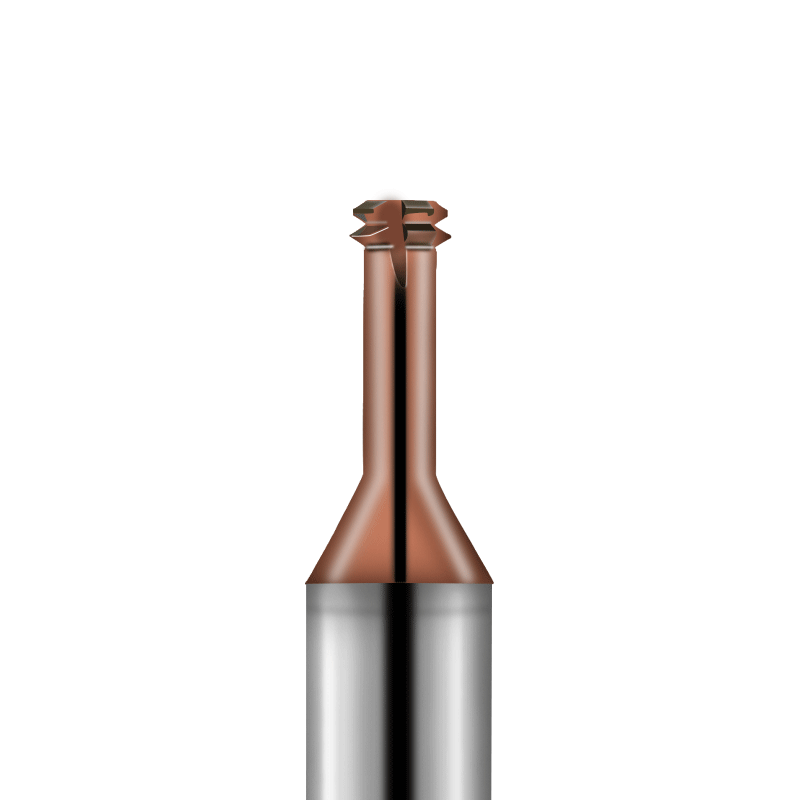
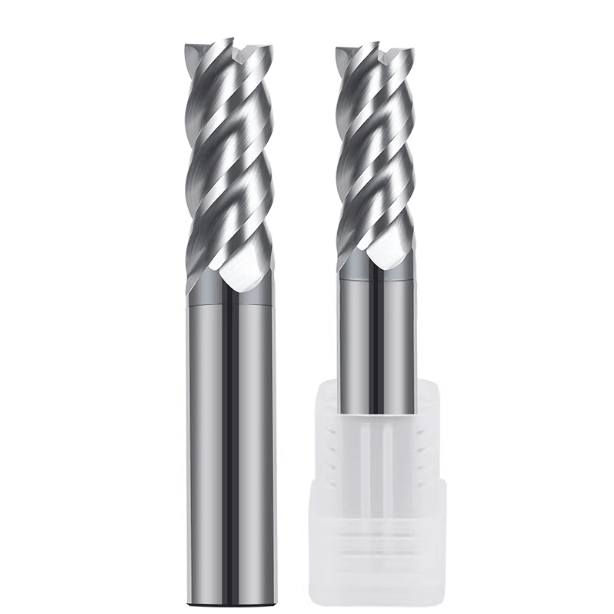
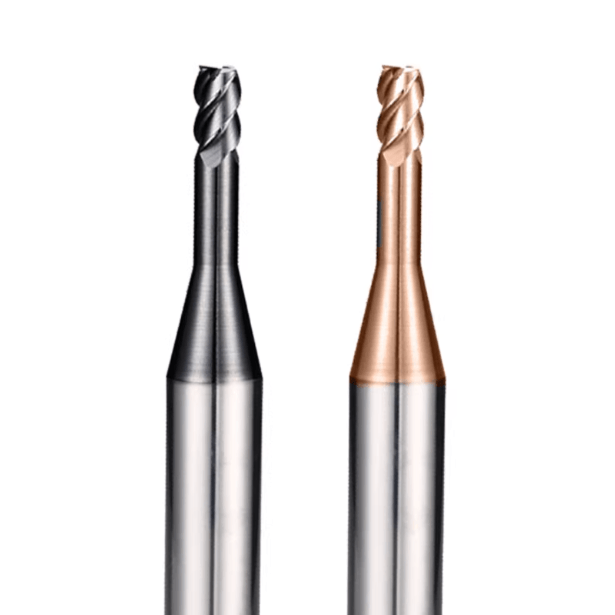
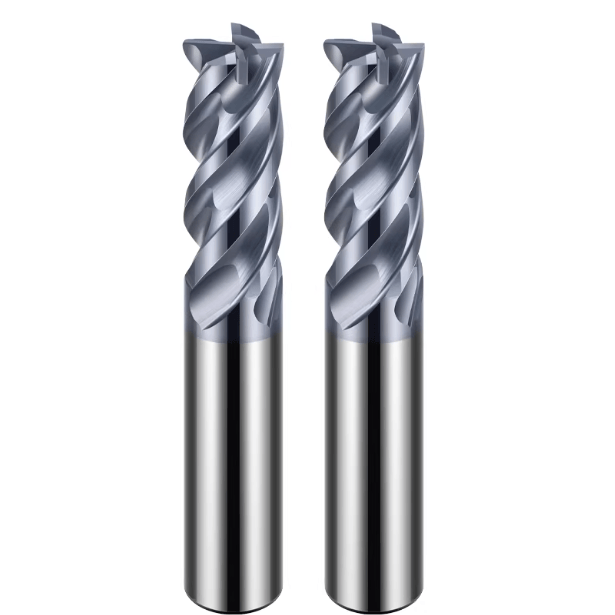
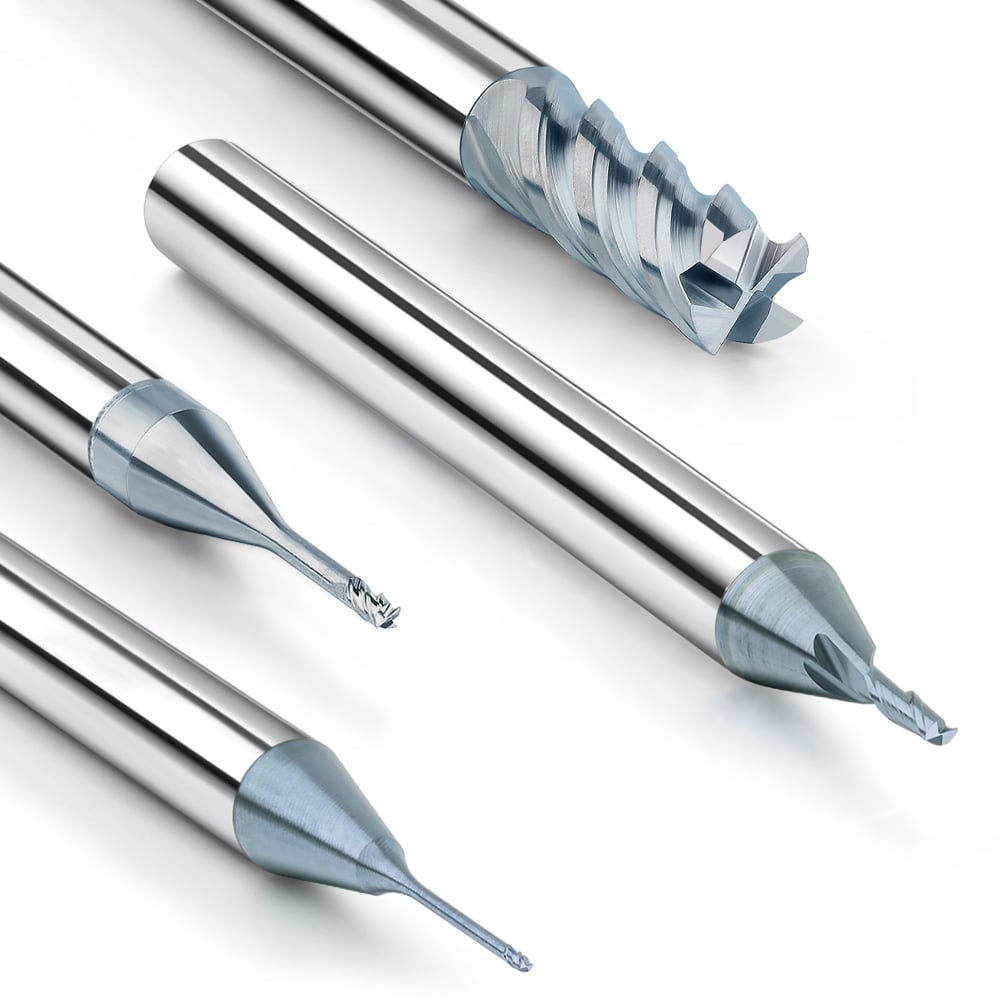
Hardened steel is widely used in mold manufacturing, precision components, and high-end mechanical structures due to its strength, hardness, and excellent wear resistance. However, these materials impose strict demands on machining tools, and standard tools often fail to provide long-term, stable cutting performance. Carbide end mill cutter tools, featuring an integral carbide structure and superior wear resistance, have become the preferred solution for machining hardened steel.
In practice, solid carbide end mill cutters offer higher rigidity and lower cutting deformation, ensuring smoother operations. By optimizing cutting edge geometry, helix angles, and tool design, these cutters can effectively control cutting forces and vibrations, reduce tool chipping and wear, and maintain stable machining dimensions and surface quality.
Selecting the right carbide end mill cutter for different steel grades and machining conditions can extend tool life and optimize efficiency. For example, during semi-finishing, tools with more flutes can distribute cutting loads evenly, while reinforced edges in finishing tools maintain high precision and surface quality. Combined with rational cutting parameters and tool arrangements, carbide end mill cutter tools reduce per-piece costs while ensuring accuracy and improving overall productivity.
Furthermore, working with a reliable carbide end mill cutter manufacturer is critical. High-quality manufacturers ensure consistent tool quality and provide professional advice on machining hardened steel. From tool design and material selection to coating treatment, these manufacturers help users achieve high reliability and machining stability even in complex operations.
Core Requirements for Carbide End Mill Cutters in Hardened Steel Machining
Tools for high-hardness steel must possess exceptional rigidity and wear resistance to withstand large cutting forces. High-quality solid carbide end mills maintain edge stability, preventing wear caused by repeated friction. Optimized tool geometry and coatings extend tool life while maintaining dimensional accuracy, ensuring surface finishes meet strict requirements. Choosing the right solid carbide end mill cutter reduces tool changes and production downtime, enhancing overall efficiency.
Cutting stability is also critical for precision. Tools must endure instantaneous impacts and vibrations during machining. Insufficient rigidity or rapid edge wear can degrade surface quality and dimensional consistency. By selecting proper materials, coatings, and cutting parameters, carbide end mill cutter tools maintain stable cutting across various conditions. Professional guidance from experienced manufacturers can further ensure optimal tool selection and machining strategy.
Challenges of High-Hardness Materials to Tool Rigidity and Wear Resistance
Hardened steel’s high strength and hardness impose extreme cutting stress and heat. Standard tools often suffer edge chipping, rapid wear, or breakage. Solid carbide end milling cutters, with integral carbide structure and micro-grain strengthening, maintain edge integrity under high-load conditions. Edge reinforcement and advanced coatings enhance wear resistance, preventing tool failure during high-speed or deep cutting.
High-temperature zones often develop during machining, causing localized friction and heat accumulation. Insufficient tool rigidity may lead to chatter, dimensional deviations, and surface roughness issues. Selecting appropriate carbide end mill cutters and optimizing edge geometry and cutting design reduces force fluctuations, improves rigidity, and ensures high-precision machining in complex cavities and deep holes.
The Importance of Cutting Stability for Carbide End Mill Cutter Tools
Cutting stability directly affects tool life, accuracy, and surface finish. High-quality carbide end mill cutter tools can maintain stable cutting despite force fluctuations, vibration, and thermal effects, reducing wear and chipping risk. Proper selection of flutes, helix angles, and cutting parameters minimizes vibrations, ensuring consistent machining paths and accurate dimensions.
Stable cutting also enhances production efficiency. A steady process allows higher speeds and feed rates while reducing machine load fluctuations. During semi-finishing and finishing, pairing high-performance solid carbide end mills with appropriate cooling strategies maximizes tool life and productivity, lowering processing costs and improving reliability.
Analysis of Common Causes of Tool Failure under Thermal Concentration Conditions
Rapid heat buildup at cutting edges can cause thermal concentration zones. Tools lacking heat resistance or proper edge design may experience rapid wear, chipping, or breakage. Solid carbide cutters with advanced coatings reduce heat-related damage and maintain hardness, extending tool life.
Excessive cutting depth, high side cutting, or uneven feed rates worsen thermal concentration and wear, especially in complex cavities or deep holes. Optimized cutting parameters and high-quality carbide end mill cutter selections control heat accumulation, preventing premature tool failure and ensuring safe, efficient, and stable machining.
Advantages of Solid Carbide End Mill Cutters in Hardened Steel Machining
Solid carbide tools provide major advantages in machining hardened steel due to their high hardness, rigidity, and wear resistance. Their uniform material structure allows solid carbide end mill cutters to withstand high cutting forces and instantaneous impacts, reducing tool deformation and cutting-induced vibrations. This results in improved machining dimensional accuracy. In deep holes, mold cavities, or complex contour operations, the stable tool rigidity ensures smooth cutting while preventing surface scratches and burrs.
High-quality solid carbide tools also incorporate coating treatments and edge reinforcement technology, maintaining stable cutting performance even under continuous operations or elevated temperatures. Selecting the right tool types and matching cutting parameters can extend tool life, reduce downtime, and enhance machining efficiency. Working with a reliable carbide end mill cutter manufacturer ensures consistent quality, high precision, and reliable performance in high-hardness steel applications.
High Rigidity Performance Provided by Solid Carbide Structure
Solid carbide materials feature a high elastic modulus and excellent wear resistance, allowing minimal deformation during machining. Compared to multi-piece or welded tools, solid carbide end mills maintain stable cutting edges and minimize cutting-induced vibrations under deep or high-speed cuts. This rigidity is particularly important for complex cavities and precision parts, ensuring dimensional accuracy and high-quality surfaces.
High-rigidity tools also improve cutting efficiency. They allow greater depths of cut and feed rates while maintaining stability. For continuous machining of hardened steel, solid carbide end mill cutter tools reduce tool wear and processing costs, supporting efficient, long-term production.
Stability of Solid Carbide End Milling Cutters in Intermittent Cutting
Machining hardened steel often involves intermittent cutting or complex contouring, which exposes tools to impact and vibration. Solid carbide end mills, with reinforced edges and integral construction, maintain stability in these conditions, reducing edge chipping and localized wear. By optimizing cutting parameters and tool layouts, smooth material removal is achievable without reducing feed rates, enhancing process consistency.
Stable intermittent cutting directly improves surface quality. High-rigidity, wear-resistant solid carbide tools minimize chatter marks and maintain dimensional accuracy. Selecting optimized solid carbide end mills combined with proper machining strategies ensures reliable and efficient production for complex cavities, grooves, and contours.
Comparison of Actual Machining with Welded or Indexable Tools
Solid carbide end mills outperform welded or indexable tools in hardened steel machining. Welded tools often deform or chip under high-hardness conditions due to microscopic material interface defects. Indexable tools may vibrate during thin-wall or deep-hole operations. In contrast, solid carbide end mill cutter tools reduce cutting force fluctuations and improve machining consistency thanks to their homogeneous structure and reinforced edges.
For high-precision or deep-cavity applications, solid carbide cutters withstand higher loads, reducing tool change frequency and lowering production costs. Combined with proper cutting parameters and tool arrangement, carbide end mills deliver higher efficiency and stability, clearly surpassing welded or indexable tools in practical machining.
Key Design Factors of Carbide End Mill Cutters in Hardened Steel Machining
Tool design strongly affects cutting efficiency, dimensional accuracy, and tool life. Parameters such as edge geometry, helix angle, and tip structure must be optimized for high cutting forces and intermittent impacts. Well-designed geometry reduces vibrations, lowers surface roughness, and improves machining consistency.
Tool reinforcement, including edge strengthening, micro-chamfering, and coatings, maintains wear and chipping resistance under high-load, high-temperature conditions. Optimized carbide end mills perform effectively across roughing, semi-finishing, and finishing stages, reducing tool changes and downtime, thereby improving overall machining efficiency.
The Influence of Number of Flutes and Helix Angle on Cutting Load
The number of flutes and helix angle are critical for cutting force management and tool life. More flutes distribute load evenly, reducing stress per flute and lowering the risk of wear or edge chipping. For deep grooves or complex contours, additional flutes improve stability and minimize vibration effects on part accuracy.
Helix angle selection is equally important. A larger angle enhances chip evacuation, reduces heat accumulation, and improves surface finish. Smaller angles increase rigidity and stability under high cutting forces. Optimizing flutes and helix angles balances efficiency and stability across all machining stages.
Differences in the Application of Tool Tip Structures in Hardened Steel
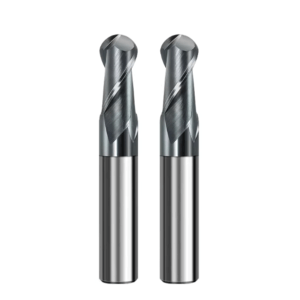
Tool tip geometry greatly influences machining performance and surface finish. Flat-bottom tools are ideal for roughing straight grooves and square cavities, tolerating high cutting forces. Radius tools in semi-finishing and finishing stages reduce impact, extend tool life, and improve fatigue resistance. Ball nose cutters are best for curved surfaces, ensuring smooth finishes and preventing contour jumping.
Choosing the appropriate tip structure based on part geometry and machining stage, combined with high-quality carbide end mill cutter tools and optimized cutting parameters, improves cutting force distribution, reduces vibrations and edge chipping, and ensures high-precision machining.
The Role of Micro-Chamfering and Edge Strengthening in High-Hardness Materials
Micro-chamfering and edge strengthening enhance tool durability. Micro-chamfering allows edges to withstand higher impact, reducing chipping and vibration. Edge reinforcement increases local strength, helping solid carbide end mills remain stable during deep or intermittent cutting.
Combined with coatings, these design improvements enhance wear resistance and thermal stability, maintaining performance and surface quality under high-temperature and high-load conditions. For semi-finishing and finishing hardened steel, optimized carbide end mill cutter tools from experienced manufacturers reduce costs while achieving high efficiency, precision, and reliability.
Applications of Solid Carbide End Mill Cutters in Different Hardened Steel Machining Conditions
In machining hardened steel of varying hardness levels, selecting the right tool and machining strategy is critical. Solid carbide end mill cutters provide high rigidity and wear resistance, making them suitable for semi-finishing, finishing, and complex contour machining. By adjusting tool geometry, flute count, and helix angle, stable cutting and precise dimensional accuracy can be achieved. Proper tool path planning and cutting parameter optimization effectively control cutting forces and vibrations, ensuring high-quality surfaces and extended tool life.
For different steel hardness grades, tool coatings and edge-strengthening technologies should also be considered. High-quality carbide end mill cutter tools can maintain stability even in deep holes, complex cavities, and multi-directional cutting, minimizing tool wear and chipping. Partnering with a reputable carbide end mill cutter manufacturer ensures optimized tool solutions for specific machining conditions, delivering both efficiency and reliability.
Semi-Finishing Strategy for HRC 45–50 Mold Steel
For HRC 45–50 mold steel, semi-finishing requires balancing cutting efficiency and tool longevity. Selecting a solid carbide end milling cutter with an appropriate number of flutes and medium helix angle distributes cutting loads, reduces wear, and mitigates vibration-induced deviations. Proper cutting depth and feed rate further enhance tool stability while maintaining machining speed.
Tool path planning is critical in semi-finishing. Layered strategies and optimized cutting paths reduce intermittent cutting and local overloads, minimizing the risk of chipping. Combined with high-quality carbide end mill cutter tools, these strategies ensure smooth cutting and uniform surface quality, creating a stable reference surface for finishing.
Finishing Tool Selection for HRC 50–55 Hardened Steel
For steel with HRC 50–55, finishing tools must balance wear resistance and cutting stability. Solid carbide end mill cutters with reinforced edges and wear-resistant coatings maintain dimensional accuracy and surface quality, even under low-volume, high-speed cutting. Tools with moderate flute counts and optimized helix angles reduce vibration and cutting impact, lowering chipping risk.
Finishing-stage cutting parameters require precise control. Shallow depths of cut, uniform feed rates, and optimized tool paths maintain machining consistency while limiting heat buildup. Solutions from high-quality carbide end mill cutter manufacturers ensure high stability and reliability in finishing high-hardness steel, achieving high-precision surfaces for complex parts.
Tool Path Coordination of Solid Carbide End Milling Cutters in Complex Cavity Machining
In complex cavity machining, tool path planning is critical to efficiency and surface finish. High-rigidity solid carbide tools, combined with layered cutting, optimized cutting direction, and depth of cut, reduce uneven forces and vibrations, ensuring cavity dimensional accuracy. Solid carbide end mill cutter tools withstand multi-axial cutting forces while maintaining edge integrity.
Intermittent cutting and deep grooves are common in complex cavities. Rational coordination of tool paths and cutting parameters minimizes chipping and wear. Using high-performance tools from experienced manufacturers ensures high efficiency and consistency in multi-stage machining, achieving precise and reliable results.
Parameter Control of Carbide End Mill Cutter Tools in Hardened Steel Machining
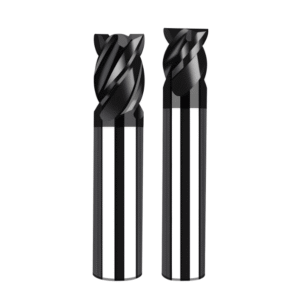
Precise control of cutting parameters is essential for high-hardness steel. Spindle speed, feed rate, depth of cut, and radial depth of cut directly affect tool life, wear, and machining quality. Optimized combinations of high-performance solid carbide end mill cutters and cutting strategies maintain stability and quality while improving efficiency.
Parameter optimization should consider material hardness, machining stage, and tool geometry. Proper matching reduces downtime and tool replacement frequency, enhancing overall cost-effectiveness. In semi-finishing, finishing, and complex contour machining, parameter control is fundamental to achieving consistent, high-precision results.
Balancing Spindle Speed and Feed Rate in High-Hardness Materials
Finding the right spindle speed and feed rate balances cutting force and tool longevity. Excessive spindle speeds cause localized overheating, accelerating wear and chipping, while low speeds increase cutting force and vibration. Solid carbide end mill cutter tools allow higher feed rates while maintaining stable cutting, optimizing production efficiency.
Flute count, helix angle, and tool geometry further influence this balance. High-rigidity tools maintain stability under high-load cutting, minimizing vibrations and tool runout, ensuring dimensional accuracy and surface quality.
Safe Range for Cutting Depth and Radial Depth of Cut
Cutting depth and radial depth of cut affect tool stress and stability. Excessive depths increase tool load, overheating, and edge chipping; insufficient depths reduce efficiency. Considering tool rigidity and wear resistance, reasonable cutting depths maintain stable cutting in high-hardness materials.
Controlling radial depth is especially important for deep grooves and complex cavities. Optimized radial depth reduces tool load, improves chip evacuation, and limits heat accumulation. Properly applied with high-quality carbide end mill cutter tools, this ensures long tool life and consistent surface finish.
Application Experience of Dry Cutting and Minimum Quantity Lubrication (MQL)
Dry cutting and MQL strategies control heat and wear in hardened steel machining. High-rigidity solid carbide tools maintain stability under dry cutting, while MQL reduces frictional heat, prolonging tool life and improving surface quality.
MQL also enhances chip evacuation, reduces clogging and vibration, and improves cutting stability. Combined with high-quality solid carbide tools and optimized tool paths, dry cutting and MQL achieve a balance of efficiency, precision, and cost-effectiveness in complex part machining.
Common Hardened Steel Machining Problems and Carbide End Mill Cutter Solutions
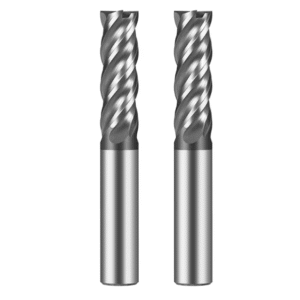
Tool chipping, abnormal wear, and vibration are frequent in high-hardness steel machining, affecting efficiency, part accuracy, and surface finish. High-performance solid carbide end mill cutters, combined with optimized cutting parameters and strategies, mitigate these issues. Edge strengthening, micro-chamfering, and coating technologies help maintain stable cutting, ensuring reliable machining results.
Partnering with experienced carbide end mill cutter manufacturers provides optimized solutions, including flute count, helix angle, tool tip structure, and cutting parameters, reducing wear and downtime while ensuring dimensional stability and surface quality.
Causes and Improvement Methods for Tool Chipping
Tool chipping often results from impact, excessive cutting force, or insufficient rigidity. High-quality solid carbide end mills improve impact resistance and reduce chipping risk. Optimizing flute count, helix angle, cutting parameters, and tool paths further minimizes chipping during intermittent or deep-groove machining.
Edge strengthening and coatings extend tool life under thermal and mechanical stress. Combined with high-rigidity tools and stable cutting strategies, users can achieve consistent machining with minimal chipping.
Impact of Abnormal Wear on Machining Dimensional Stability
Abnormal wear reduces cutting efficiency, affecting dimensional accuracy and surface quality. High-temperature, high-load machining accelerates edge wear, especially in deep holes or complex cavities. Wear-resistant coatings and high-strength solid carbide tools control wear, maintain force balance, and ensure accuracy.
Monitoring tool wear and timely parameter adjustments further stabilize machining. Optimizing cutting depth, radial depth, and feed rate allows high-quality carbide tools to perform reliably over long-term production.
Practical Solutions for Tool Vibration and Poor Surface Quality
Vibration during deep grooves, complex contours, or intermittent cuts causes surface scratches, burrs, and dimensional deviations. Solid carbide tools with reinforced edges, optimized flute count, and helix angle reduce vibration. Combined with optimized tool paths and uniform feed, machining stability and surface quality are enhanced.
Controlling cutting depth, radial depth, and feed rate, along with appropriate cooling or MQL, ensures high precision, low vibration, and high-quality surfaces, meeting stringent requirements for hardened steel parts.

Selection Strategies for Solid Carbide End Mill Cutters at Different Machining Stages
In hardened steel machining, each machining stage requires a focus on different aspects of tool performance. The roughing stage emphasizes impact resistance and efficiency in material removal, the semi-finishing stage balances tool stability, cutting accuracy, and longevity, and the finishing stage demands extremely high consistency and superior surface finish. By selecting solid carbide end mill cutter tools appropriately and optimizing cutting parameters, manufacturers can achieve both high efficiency and precision at every stage, ensuring part quality and production stability.
For varying steel hardness and complex part geometries, tool selection should consider edge reinforcement, coating treatments, and tip design. Collaborating with an experienced carbide end mill cutter manufacturer provides optimized solutions for roughing, semi-finishing, and finishing, maximizing tool performance, extending life, and improving overall machining efficiency.
Requirements for Tool Impact Resistance in the Roughing Stage
The roughing stage involves removing large amounts of material, generating high cutting forces and instantaneous impacts. High-rigidity, wear-resistant solid carbide end mills can withstand these forces, reducing the risk of edge chipping and tool failure. Tools with a moderate number of flutes and an appropriate helix angle help distribute cutting loads and enhance impact resistance.
Building on tool design, rational cutting parameters and optimized tool path planning are also crucial. Layered cutting, uniform feed rates, and controlled cutting depth reduce uneven forces and vibrations, ensuring high-efficiency material removal while maintaining tool stability in high-hardness steel machining.
Balancing Tool Stability and Longevity in Semi-Finishing
Semi-finishing removes excess material while maintaining dimensional accuracy and surface quality. Tool stability and longevity are therefore critical. Solid carbide end mill cutters provide stability under variable loads and intermittent cutting, ensuring consistent part processing.
Adjusting flute count, helix angle, and cutting parameters can extend tool life and reduce replacement frequency. Optimizing cutting depth, radial cutting depth, and feed rate maintains stability and production efficiency, achieving both cost-effectiveness and reliability in high-hardness steel machining.
High Requirements for Tool Consistency in the Finishing Stage
Finishing demands extremely high tool consistency and superior surface machining. High-quality solid carbide end mill cutters maintain dimensional accuracy and surface finish, minimizing deviations caused by geometric differences or wear. Edge strengthening and coatings ensure stable performance during prolonged finishing operations.
Finishing often involves low cutting volumes at high spindle speeds, requiring precise control of cutting parameters. Combined with high-rigidity tools and optimized tool paths, manufacturers can achieve consistent machining quality, prevent chatter, and maintain smooth surface finishes. Tools provided by experienced carbide end mill cutter manufacturers ensure high precision, stability, and reliability.
The Importance of Carbide End Mill Cutter Manufacturers in Hardened Steel Machining
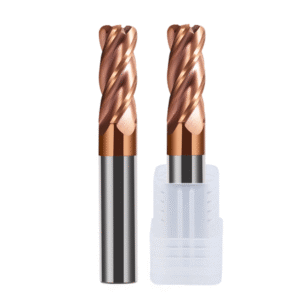
Tool performance and machining stability directly impact production efficiency and part quality. High-quality carbide tools require precise manufacturing processes to maintain consistent edge sharpness, dimensional accuracy, and coating uniformity. Choosing an experienced carbide end mill cutter manufacturer ensures optimal performance in high-hardness steel machining while reducing the risk of chipping, abnormal wear, and chatter.
Manufacturers with expertise can provide customized solutions for different machining conditions, including flute count, helix angle, tip structure, and coating selection. These solutions improve tool life, enhance cutting stability, and enable high-efficiency machining across roughing, semi-finishing, and finishing stages, ensuring stable production and better economic returns.
The Impact of Manufacturing Processes on Tool Consistency and Reliability
Tool consistency depends heavily on manufacturing precision. Advanced powder metallurgy, isostatic pressing, and precision grinding produce solid carbide end mills with homogeneous structures and stable edges. Tools made under strict process control provide predictable cutting performance, wear resistance, and chipping resistance, maintaining high precision and surface quality.
Additionally, advanced coatings and edge-strengthening treatments enhance thermal stability and wear resistance. Precision manufacturing ensures high rigidity in deep holes, complex cavities, and intermittent cutting, reducing vibrations and tool wear while supporting efficient long-term production.
Differences in Quality Control Among Carbide End Mill Cutter Manufacturers
Quality control varies across manufacturers, affecting tool performance stability. Leading manufacturers implement rigorous testing in material selection, sintering, edge processing, and coating application to ensure geometric accuracy, uniform coatings, and chipping resistance.
Conversely, manufacturers with weak quality control may produce tools with edge deviations, uneven coatings, or microcracks, increasing the risk of unstable machining and tool failure. Selecting tools from manufacturers with certified quality systems improves reliability, machining consistency, and reduces production downtime.
Practical Advantages of Manufacturers Experienced in Hardened Steel Machining
Experienced manufacturers can provide optimized solutions based on steel hardness, machining stage, and part structure. For instance, in HRC 45–50 semi-finishing and HRC 50–55 finishing, they can recommend optimal flute count, helix angle, tip structure, and coatings to ensure stable performance.
They also provide technical guidance and cutting parameter recommendations, helping users maximize tool performance under different machines and conditions. Combined with high-performance solid carbide end mills, this ensures high efficiency, precision, and low production costs in complex part machining and mass production.
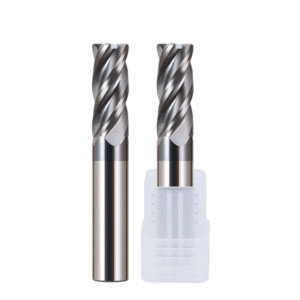
Choosing the Right Carbide End Mill Cutter Tools to Improve Overall Machining Efficiency
Proper tool selection is essential for high efficiency, precision, and cost-effective production in hardened steel machining. Different stages and steel hardness levels require tailored tool rigidity, wear resistance, edge design, and cutting parameters. Leveraging high-performance solid carbide tools and technical support from reliable manufacturers maximizes tool performance, extends tool life, and ensures consistent machining quality.
Proper tool selection also optimizes the match between machine tool rigidity and tool properties, reducing vibration, chipping, and abnormal wear. Combining optimal design, machining strategy, and parameter control ensures reduced downtime, lower maintenance costs, and reliable production for hardened steel parts, improving overall efficiency.
Matching Tool Performance with Machine Tool Rigidity
High-rigidity tools cannot fully perform on low-rigidity machines, leading to vibration, accelerated wear, and reduced accuracy. Tool selection should consider machine rigidity, tool diameter, flute count, cutting depth, and radial cutting depth to achieve optimal matching.
Optimized selection combined with proper cutting parameters and path planning ensures high-efficiency cutting, long tool life, and stable production. Complex cavities, deep holes, and intermittent cutting can all benefit from high-rigidity solid carbide end mills, resulting in reduced scrap rates and lower costs.
Reducing Unit Processing Costs Through Proper Tool Selection
Tool choice directly affects unit processing costs. While high-performance carbide tools may have higher initial costs, their wear resistance and rigidity reduce replacement frequency, minimize downtime, and increase efficiency, lowering unit costs.
Optimized tool selection for different steel grades and machining stages reduces chipping and wear, improves machining consistency, and decreases raw material waste. This enables stable production planning and higher process reliability for mold and precision parts.
The Importance of Stable Tool Supply for Mold and Precision Parts Machining
Even with proper tool selection, an unstable tool supply can cause delays, inconsistent replacement, and fluctuating quality. Partnering with experienced carbide end mill cutter manufacturers ensures consistent, timely supply, supporting high-hardness steel machining.
Stable supply, combined with optimized strategies and cutting parameters, allows continuous long-term machining. High-quality solid carbide tools, supported by technical guidance from the manufacturer, ensure consistent tool performance, part quality, and overall production efficiency.