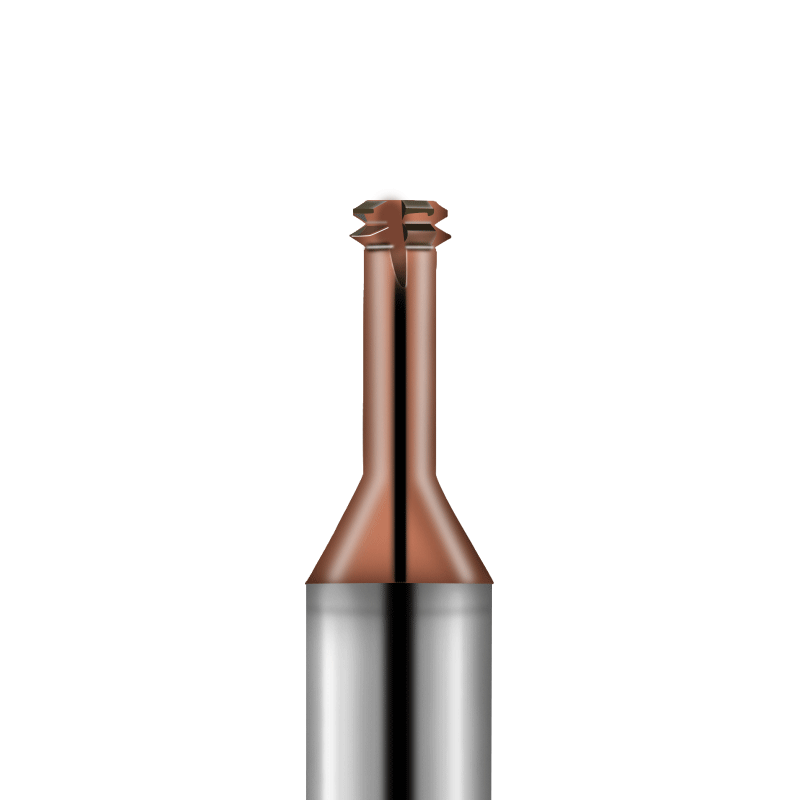
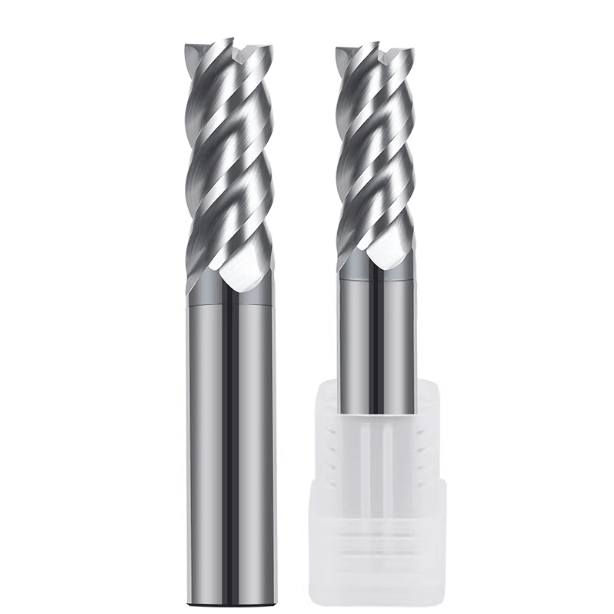
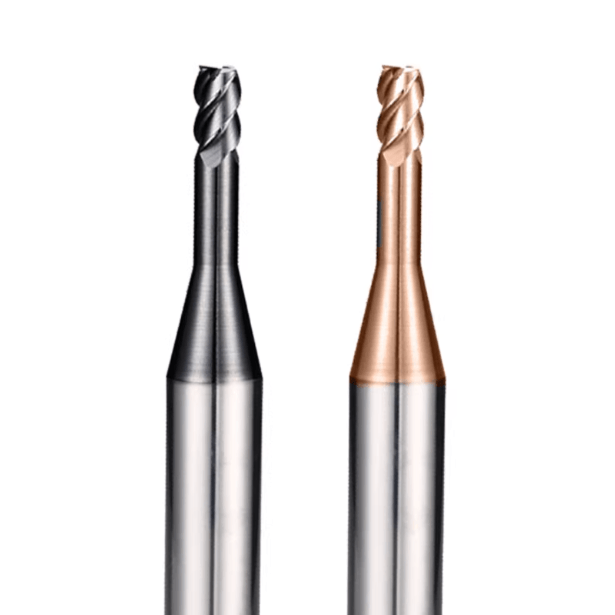
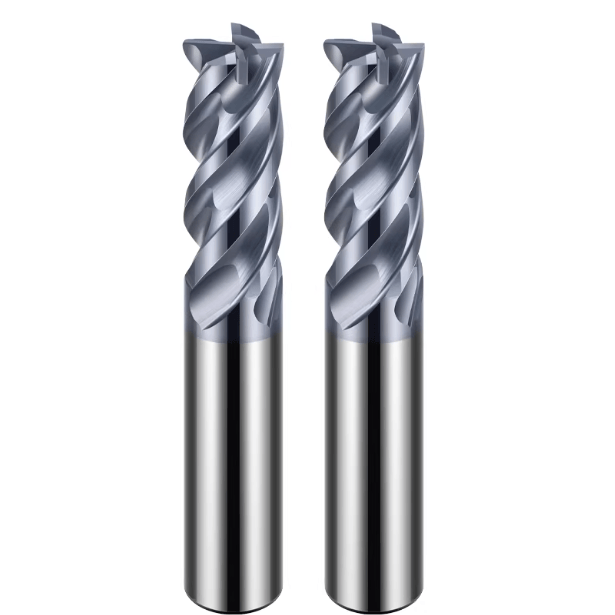
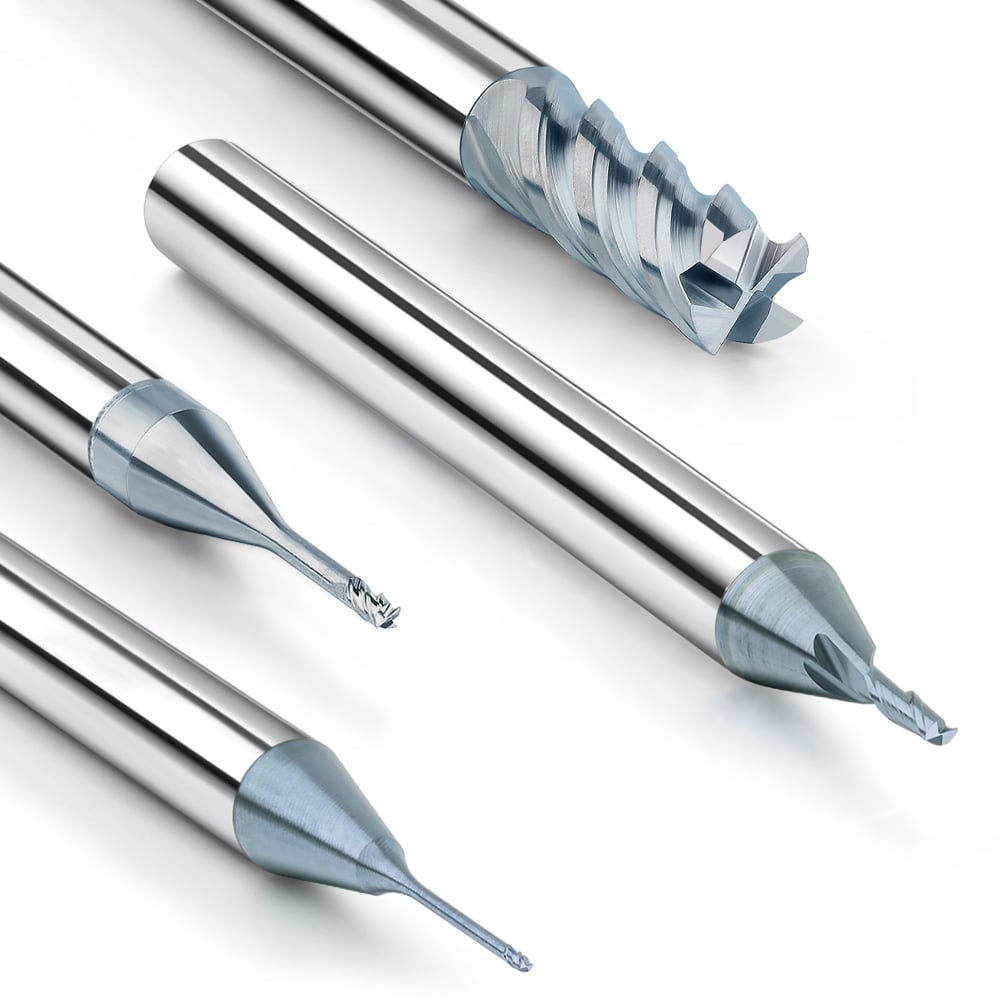
Diamond end mill cutting tools are high-performance tools designed specifically for machining graphite and composite materials. They offer significant advantages in wear resistance, cutting stability, and machining accuracy. Compared to traditional carbide end mill cutting tools, diamond-coated tools maintain sharper cutting edges for longer periods, reduce tool wear, and improve part yield. Whether performing complex surface machining or high-precision hole cutting, diamond end mills ensure consistent results, preserving both surface quality and dimensional accuracy.
In graphite applications, these tools effectively handle the material’s brittle and dusty characteristics, minimizing the risk of chipping and extending tool life. For composite materials, the tool’s chip evacuation design and edge geometry are critical for stable cutting, reducing delamination and burrs while increasing machining efficiency. Ball nose end mill cutting tools, with their spherical structure, enable smooth contour machining and precise finishing, making them ideal for molds and complex geometries.
Furthermore, customized end mill cutting tools can be tailored to material characteristics and specific machining requirements. High-quality carbide end mill cutting tools factories employ precise manufacturing and strict quality control, ensuring each tool meets high industry standards in wear resistance, concentricity, and cutting stability. This guarantees reliable machining performance for diamond end mills while enhancing repeatability and overall process reliability.

Core Cutting Challenges in Machining Graphite and Composite Materials
Graphite and composite materials exhibit unique characteristics during machining, such as high brittleness, layered structures, and uneven hardness. These properties place extreme demands on tool performance. Machining high-precision parts or complex surfaces requires tools that maintain accuracy while handling chip accumulation and localized heat that can accelerate wear. In high-speed cutting environments, effective chip evacuation and wear resistance directly impact machining efficiency and part surface quality. Using end mills with high hardness and wear-resistant coatings significantly reduces machining risks and improves overall yield.
Graphite and composite parts often require both dimensional precision and excellent surface finish, necessitating optimized tool geometry, sharp cutting edges, and precise cutting parameters. The tool material, edge design, and coating type influence cutting force distribution and thermal management, affecting chipping risk and tool life. By optimizing tool structure, feed rate, and cutting speed, manufacturers can achieve stable, efficient machining while maintaining part quality and reducing downtime due to tool wear.
Common Tool Wear and Chipping Problems in Graphite Machining
Graphite machining is prone to localized edge wear and chipping due to the material’s brittleness, particularly under high-speed or deep cutting conditions. Diamond-coated end mills and high-performance carbide end mills provide excellent wear resistance, extending tool life and maintaining accuracy. Proper edge geometry and chip flute design reduce cutting resistance, prevent chip clogging, and minimize tip chipping, improving overall machining efficiency.
Additionally, graphite dust contributes to extra wear on the tool surface and machine components, further challenging tool life and machining stability. Ball nose end mill cutting tools, with a ball-end structure or multi-flute design, distribute cutting forces effectively during complex contour machining. Adjusting feed rate and cutting depth scientifically allows uniform tool wear, extending tool life while maintaining surface quality.
Special Requirements for Cutting Tool End Mills in Composite Materials
Composite materials have varying hardness across fiber and resin layers, which can cause delamination and burrs during cutting. High-hardness, wear-resistant diamond end mills provide stable cutting forces, preventing fiber pulling and surface peeling. Customized end mills allow edge shape and flute number adjustments to optimize the cutting path and surface finish, ensuring high-precision part machining.
Fluctuating cutting forces and localized heat accumulation are the main causes of rapid tool wear in composites. Using precision tools from carbide end mill cutting tools factories, combined with optimized cutting parameters, reduces heat buildup and vibration, maintaining machining accuracy and surface finish. Ball-nose ball end mills effectively smooth contours, minimize burrs, and improve assembly accuracy and part longevity.
The Impact of Dust, Delamination, and Surface Quality on Tool Structure
Dust, delamination, and surface quality requirements directly affect tool stress and wear. Tool material and coating influence wear resistance and thermal stability, while geometry affects chip removal efficiency and cutting force distribution. Diamond end mill cutting tools with high-hardness edges and optimized chip flutes can control chipping and localized wear, extending tool life and maintaining machining consistency.
For high-quality surface requirements, refined cutting strategies are essential. Proper feed rate, cutting depth, and tool selection reduce delamination, burrs, and surface roughness. Customized end mills optimize blade shape and cutting parameters for specific workpiece characteristics, ensuring stable, repeatable machining and improving part assembly performance and reliability.

Practical Advantages of Diamond End Mill Cutting Tools in Graphite and Composite Materials
High hardness and wear resistance are critical in machining graphite and composite materials to ensure efficiency and part precision. Diamond-coated end mills maintain sharp edges under high-speed, high-load conditions, reducing chipping and tool wear. Compared to carbide end mills, diamond-coated tools provide stable cutting forces during extended machining, reducing replacement frequency and increasing overall efficiency.
Diamond-coated tools also enhance surface quality control. Optimized edge geometry reduces tearing, delamination, and burrs while improving temperature distribution during cutting, resulting in smooth surfaces. Combining customized end mills with precise cutting parameters enables high-precision machining and high yield rates, providing reliable performance for complex surfaces and precision parts.
Performance of Diamond End Mill Cutting Tools in Wear Resistance
Diamond coatings offer far greater hardness than conventional carbide, providing exceptional wear resistance when cutting graphite, carbon fiber, and composites. They withstand high-speed friction and elevated temperatures, reducing edge wear and extending tool life. Optimized chip flutes prevent localized chipping caused by debris accumulation, ensuring stable cutting and minimizing downtime.
Wear resistance affects not only tool life but also surface quality. Diamond end mills distribute cutting forces evenly on brittle materials, minimizing scratches and material peeling. Combined with ball nose end mills, cutting forces are further distributed in complex contours, improving accuracy and surface finish.
Comparison of Service Life Differences with Carbide End Mill Cutting Tools
Compared to carbide end mills, diamond-coated tools offer significantly longer life in high-hardness material machining. Carbide tools are more prone to edge wear, chipping, or thermal fatigue during continuous machining, whereas diamond-coated end mills maintain sharpness and stability, allowing longer machining cycles.
Diamond-coated tools also provide consistent cutting forces, reducing machining errors and frequent tool adjustments. Extending tool life reduces downtime and processing costs, making diamond-coated end mills a preferred choice for complex parts and high-end mold manufacturing.
Impact of Diamond Coating on Cutting Stability
The diamond coating enhances heat conduction and reduces friction, improving cutting stability. In graphite and composite machining, it maintains uniform cutting forces, reducing vibration and localized overheating, thus preventing delamination or surface scratches. Appropriate cutting depth and feed rate allow continuous, stable machining, improving part dimensional accuracy and surface finish.
Diamond-coated tools perform reliably under high-efficiency conditions. Whether standard or customized, they maintain consistent cutting performance, reduce machine adjustments, and minimize production interruptions, providing strong process assurance for high-precision parts.

Application Boundaries of Carbide End Mill Cutting Tools in Relevant Material Processing
Carbide end mill cutting tools provide high cost-effectiveness and stability for machining graphite and composite materials, particularly for roughing and medium-precision applications. Their excellent bending strength and toughness allow them to withstand high cutting forces while maintaining dimensional accuracy and processing consistency. By selecting the appropriate flute number, helix angle, and coating type, carbide end mills deliver reliable performance across a variety of materials, making them an important choice for machining high volumes of parts.
However, carbide tools may not match the wear resistance or surface finish quality of diamond-coated tools when machining high-precision or high-hardness components. For parts requiring excellent surface finish or complex curved surfaces, balancing machining quality and efficiency can be achieved by optimizing tool geometry or combining carbide end mills with diamond end mills. Understanding these application boundaries reduces tool wear, minimizes downtime, and improves overall production efficiency.
Applicable Scenarios of Carbide End Mill Cutting Tools in Graphite Rough Machining
Carbide end mill cutting tools perform well in graphite rough machining, maintaining stable cutting under deep cuts and high-speed operations. Optimized chip flute design and edge geometry reduce dust accumulation, prevent cutting force fluctuations, and enhance material removal rates. For standard graphite blocks or electrode machining, carbide tools provide an economical, efficient processing solution.
Moreover, using carbide end mills minimizes tool replacement and maintenance downtime, which is especially beneficial in high-volume production. Adjusting cutting parameters appropriately ensures a balance between tool life and machining accuracy, enabling efficient rough machining and laying the foundation for subsequent finishing or diamond tool operations.
Common Problems of Carbide Tools in Composite Material Machining
In composite materials, the layered structure and variable hardness can cause localized tool wear, burrs, and cutting force fluctuations, particularly at high feed rates or deep cuts. Friction between the tool edge and the fiber-resin interface may reduce surface quality and dimensional accuracy. Optimizing tool geometry, coating, and thermal stability helps mitigate these issues and extend tool life.
Additionally, maintaining surface quality may require frequent tool changes or parameter adjustments. Customized cutting tools end mills can be designed with optimized flute count, helix angle, and diameter to improve stability and efficiency. Planning tool sequence and cutting strategies carefully reduces burrs, delamination, and chatter, improving finished part yield.
Rational Matching Strategy of Diamond and Carbide Cutting Tool End Mills
A rational combination of diamond-coated tools and carbide end mills maximizes efficiency, wear resistance, and cost-effectiveness. Typically, carbide end mills handle roughing and material removal, followed by diamond end mills for finishing and high-precision surface treatment. This approach maintains machining quality while extending diamond tool life.
For complex surfaces or hard materials, ball-nose structures of ball nose end mill cutting tools optimize cutting force distribution and surface finish. Scientifically combining tool types and cutting parameters leverages the strengths of both carbide and diamond tools, achieving high-precision, efficient machining with reduced overall tool wear and production costs.

The Role of Ball Nose End Mill Cutting Tools in Complex Surface Machining
Ball nose end mills, with their rounded tips, enable smooth 3D contour machining, reducing stress at the tool tip and minimizing chatter and material chipping. In graphite parts or composite molds, they distribute cutting forces evenly, improving surface finish and consistency.
These tools also provide excellent chip evacuation and stability during high-speed machining, extending tool life. When combined with customized cutting tools end mills, parameters such as diameter, flute count, and helix angle can be adjusted to material and surface geometry, allowing high-precision machining of complex parts. Ball nose end mills are essential for high-end molds, precision components, and 3D surface work.
Application of Ball Nose End Mill Cutting Tools in Graphite Electrode Forming
Ball nose end mills reduce tip chipping and surface scratches in graphite electrode machining. Their rounded design evenly distributes cutting forces, mitigating brittleness-induced chipping, and enhancing surface finish. This makes them ideal for forming complex contours and grooves, especially in large electrodes or intricate parts.
Their wear resistance and chip evacuation capabilities handle graphite dust and debris effectively. Using ball nose end mills in combination with carbide end mills for roughing and finishing improves efficiency, reduces tool wear, and increases part yield while lowering overall processing costs.
Cutting Stability Performance in Composite Material Surface Machining
Composite materials are prone to delamination, burrs, and chatter due to layered structures and uneven hardness. Ball nose end mills maintain uniform cutting forces, reducing stress concentration and enhancing stability. Optimizing diameter, flute count, helix angle, feed rate, and depth enables continuous, smooth machining.
For high-precision composite parts, customized end mills can be tailored with specific edge shapes and lengths according to material and geometry. This approach increases efficiency and reduces defects from delamination or chatter, ensuring reliable machining of molds, aerospace components, and electronic parts.
Actual Impact of Ball Nose Structure on Surface Quality
The ball nose geometry enables smooth 3D transitions, reducing tip pressure and localized scratches, improving surface quality. In graphite and composites, ball nose end mills control roughness, reduce burrs, and prevent delamination, allowing parts to meet precision assembly standards without additional finishing.
Their spherical tips also distribute cutting forces on curved surfaces, reducing vibration and improving flatness and machining consistency. Combined with high-quality carbide end mills from specialized factories, they ensure geometric accuracy and wear resistance, providing long-term stable results for complex curved surfaces, molds, and precision parts.

Impact of Key Structural Parameters of End Mill Cutting Tools on Machining Results
End mill structural parameters—flute count, chip flute design, tip strength, and overall geometry—directly affect efficiency, part accuracy, and tool life. Optimizing these features according to material characteristics maximizes stability while minimizing chipping and wear. For graphite and composites, proper control of tool parameters is fundamental for high-precision machining and surface quality.
Tool balance and dynamic stability are also critical. Imbalance or geometric deviation at high speeds causes vibration, surface waviness, and dimensional errors. Selecting high-precision carbide end mills and combining them with customized designs ensures a stable, controllable process, extended tool life, and improved part yield.
Impact of Flute Number and Chip Flute Design on Graphite Machining
Flute count and chip flute design are crucial in graphite machining. More flutes reduce cutting force per flute, lowering chipping and wear. Proper chip flute geometry ensures quick debris removal, reducing localized stress and vibration, enhancing stability and surface finish.
Ball nose end mill flute design further distributes forces in grooves or curved surfaces, reducing wear and dust accumulation. Adjusting flute count, helix angle, and flute width ensures efficient, uniform material removal, maintaining dimensional accuracy and part quality.
Tool Tip Strength and Chipping Risk Control
Tip strength influences tool stability and life under high load. Diamond-coated and high-performance carbide end mills are engineered for toughness, resisting impact and vibration, which reduces chipping risk. Correct tip geometry distributes forces, lowering localized stress and improving part quality.
Poor tip strength or worn edges can lead to scratches, chipping, and dimensional errors. Using high-quality tools from carbide end mill cutting tools factories, combined with customized designs, optimizes force distribution and heat control for stable, precise machining.
The Importance of Tool Dynamic Balancing in High-Speed Machining
Dynamic balancing is vital for stability and accuracy in high-speed machining. Well-balanced tools reduce vibration, runout, and surface waviness, ensuring even cutting forces while reducing machine load and tool wear. For brittle or layered materials, stability directly affects surface finish and dimensional consistency.
Optimized dynamic balancing allows ball nose end mills to maintain performance during continuous machining, reducing downtime and adjustments. Coupled with high-precision factory-manufactured and customized tools, this ensures reliable results for complex surfaces and high-precision parts, enhancing production efficiency and quality.
The Value of Customized Cutting Tools End Mills in Special Working Conditions
In special working conditions, standard cutting tools often cannot meet the requirements of machining complex parts or non-standard materials. Customized end mills optimize tool structure based on material characteristics, part geometry, and machining requirements, improving cutting stability and surface accuracy. Adjusting flute number, helix angle, tip geometry, and coating allows customized cutting tools end mills to balance wear resistance, chip evacuation efficiency, and machining precision, satisfying the demands of high-precision graphite and composite materials.
Moreover, customized tools effectively reduce processing risks and improve part yield. For high-complexity surfaces or materials with special thicknesses, proper tool design balances cutting forces, minimizes vibration and chipping, and extends tool life. When combined with high-precision manufacturing and quality control from a professional carbide end mill cutting tools factory, these tools meet strict industry standards, supporting high-end molds, precision parts, and special material processing.
The Demand for Customized Cutting Tools End Mills in Non-Standard Graphite Machining
Non-standard graphite parts often have complex shapes or unique hole patterns, making stable machining difficult with standard tools. Customized cutting tools end mills allow optimization of cutting edge geometry, flute count, and chip evacuation grooves to handle graphite’s brittle and dusty nature. This reduces chipping risks while maintaining dimensional accuracy.
Additionally, customizing tool length, diameter, and coating overcomes limitations of standard tools in deep cavities or curved surfaces. When paired with ball nose end mill cutting tools, surface smoothness and finishing quality improve, achieving precise graphite part forming and reducing secondary processing and material waste.
Optimized Customized Tool Structure for Composite Materials
Composite materials vary in hardness between fibers and resin, often causing delamination and burrs. Customized cutting tools end mills can optimize cutting edge angles, helix angles, and flute count to evenly distribute cutting forces, reduce vibration, and minimize material delamination. Selecting ball-end or flat-bottom geometries based on surface shape further improves stability and surface quality.
For high-precision parts, combining diamond end mill cutting tools with customized end mills integrates roughing and finishing processes seamlessly. This approach enhances machining efficiency, lowers tool wear, and ensures dimensional consistency, providing reliable solutions for aerospace, electronics, and high-end mold industries.
How Customized Cutting Tool End Mills Reduce Overall Processing Costs
Customized cutting tools reduce overall production costs by improving tool life and cutting efficiency, minimizing tool changes, and reducing downtime. Optimized tool structures and cutting parameters also decrease material waste and secondary operations, improving first-pass yield and lowering scrap rates.
Combined with high-precision carbide end mill cutting tools factories, customized tools deliver cost-effective machining solutions while maintaining surface quality and dimensional accuracy. Scientific tool combinations and optimized processing strategies maximize efficiency and reduce total production costs.

The Impact of Processing Parameters on Diamond End Mill Cutting Tools Performance
Tool performance depends not only on material and geometry but also on processing parameters. Proper matching of spindle speed, feed rate, and cutting depth affects cutting force distribution, tool wear, and surface quality. In graphite and composite material machining, precise parameter control reduces chipping, vibration, and dimensional errors. Diamond end mill cutting tools’ high hardness and wear-resistant coatings enable stable, efficient machining.
Optimizing these parameters also extends tool life and enhances production efficiency. Combining carbide end mill cutting tools and customized tools with proper spindle speed, feed, and depth maximizes machining performance for challenging parts, ensuring stable output and high-quality surfaces.
Matching Principles of Spindle Speed and Feed Rate in Graphite Machining
Spindle speed and feed rate must be properly balanced to avoid tool overheating and chipping. Excessive speed or feed increases cutting forces and heat, accelerating wear, while too low reduces efficiency. Proper matching of diameter, flute count, and helix angle ensures balanced cutting forces and stable machining.
Material properties also affect matching. Graphite’s brittleness and dust require even force distribution to reduce vibration and localized chipping. When using ball nose end mill cutting tools, adjusting feed according to curvature and cutting path achieves stable, continuous cutting, improving tool life and yield.
Influence of Cutting Depth on Tool Life and Surface Quality
Cutting depth directly affects tool forces and heat distribution. Excessive depth accelerates wear and chipping, causing scratches or delamination; too shallow reduces efficiency and increases machining time. Combining carbide end mills or customized tools allows selecting optimal depth based on material and process, balancing tool life and surface quality.
For ball-nose tools, cutting depth should match the curvature radius to distribute forces evenly, reduce vibration, and prevent localized wear. Properly adjusted depth ensures efficient material removal while maintaining surface finish and part accuracy.
Common Parameter Misconceptions in Actual Machining
Misconceptions include mismatched spindle speed/feed, excessive or insufficient cutting depth, and poor tool path planning. These lead to rapid tool wear, vibration, and substandard surface finish. Using diamond end mill cutting tools and following material-specific recommendations avoids such issues, improving stability and tool utilization.
Neglecting tool geometry effects on parameters is another common error. Tools with varying flute counts, helix angles, or tip shapes generate different forces and heat distributions. Coupling this with high-precision carbide end mill cutting tools factories ensures parameter optimization for maximum tool life and stable machining quality.

The Role of Carbide End Mill Cutting Tools Factory in Tool Quality
Tool quality determines machining performance. Factory manufacturing capabilities and processes directly affect consistency and stability. Professional carbide end mill cutting tools factories use high-precision CNC machining and strict inspections to ensure dimensional accuracy, edge sharpness, and coating uniformity. High-quality tools improve efficiency, reduce chipping, wear, and material loss, and provide reliable performance for graphite and composite materials.
Factories also support customized tool production for non-standard applications. Using advanced equipment, precision testing, and process control ensures stable performance under high-speed and high-load conditions, enhancing yield, extending tool life, and ensuring repeatable machining results.
Manufacturing Process of a Professional Carbide End Mill Cutting Tools Factory
A robust manufacturing process guarantees tool performance. Steps include raw material selection, powder metallurgy, sintering, rough machining, precision grinding, coating, and quality inspection. Precision equipment ensures hardness, edge geometry, and coating meet design standards. Multiple quality checks, including dimensional accuracy, edge sharpness, and dynamic balance testing, maintain consistent performance.
Combined with customized cutting tools end mills, the factory can optimize tools for material characteristics and part structures, providing stable and efficient solutions for graphite, composites, and precision components.
The Impact of Tool Consistency on Diamond and Carbide End Mills
Tool consistency is critical for machining stability. Deviations in geometry, edge sharpness, or coating thickness cause uneven cutting forces, vibration, and surface defects. High-precision carbide end mill cutting tools factories ensure each tool performs consistently, delivering stable cutting and precise surfaces.
Consistency affects not only part quality but also production efficiency and tool cost. Stable wear reduces tool changes and machine adjustments, improving workflow. For combined machining with carbide and diamond end mills, consistency ensures smooth roughing-to-finishing transitions and high-quality surfaces.
Factory Technical Capabilities Supporting Customized Cutting Tools End Mills
Advanced factory capabilities enable production of high-precision customized tools. Using design software, CNC grinding, and coating processes, factories adjust flute count, helix angle, tip geometry, and coating type to meet machining requirements for graphite, composites, and curved parts.
Technical capabilities also include rapid sample validation and mass production. Collaboration with customers allows optimization based on part feedback, ensuring tools perform stably under high-speed and high-load conditions. High-precision manufacturing combined with customization enhances efficiency, tool life, and reduces production costs, providing reliable machining assurance.

Common Tooling Problems and Solutions in Graphite and Composite Material Machining
Even high-performance diamond end mill cutting tools face challenges when machining graphite and composite materials. Tool wear, chipping, vibration, and unstable surface quality are common issues. Material brittleness, layered structure, and complex curved surfaces increase tool load, making it difficult to balance cutting forces, heat generation, and chip evacuation. These factors can reduce tool life and lower part yield. By optimizing tool geometry, using customized designs, and adjusting machining parameters, processing stability can be significantly improved, enabling efficient production of high-precision parts.
A systematic approach is key. This includes careful tool selection, precise machining parameter optimization, and support from high-quality carbide end mill cutting tools factories. Combining roughing and finishing tools, ball-end and flat-end designs, and customized structures ensures uniform wear, reduces vibration, and improves surface quality, forming a reliable and repeatable machining solution.
Analysis of Abnormal Wear in Diamond End Mill Cutting Tools
Abnormal wear in diamond-coated end mills usually results from uneven cutting forces, improper machining parameters, or poor chip evacuation. High spindle speeds or excessive cutting depth generate localized heat at the tool tip, accelerating edge wear. Inappropriate flute count or helix angle can create fluctuating cutting forces, increasing the risk of chipping. Brittleness of graphite and layered composite structures further amplifies the sensitivity of the tool to friction and vibration.
To address these issues, tool geometry, material properties, and machining parameters must be carefully considered. Optimized customized cutting tools end mills improve edge sharpness, enhance chip evacuation, and increase wear resistance. This reduces localized stress and temperature, allowing the tool to maintain long-term, stable performance in high-precision machining applications.
Practical Solutions to Cutting Tool End Mill Vibration Problems
Vibration is common in graphite and composite material machining. It often arises from poor tool dynamic balance, incorrect machining parameters, or uneven cutting force distribution. Vibration negatively impacts surface finish, accelerates tool wear, and can lead to dimensional errors. Ball-nose end mill cutting tools, with precise geometry, help distribute cutting forces evenly, reducing vibration and enhancing machining stability.
In practice, optimizing spindle speed, feed rate, and cutting depth minimizes chatter. Selecting tools from high-precision carbide end mill cutting tools factories ensures consistent performance. Customized designs tailored to surface shape and material characteristics further improve smoothness, enabling continuous and stable machining operations.
How to Reduce Tool Wear Through Proper Selection
Proper tool selection is crucial to extend tool life and control costs. For different machining stages, using carbide end mills for roughing and diamond-coated end mills for finishing balances efficiency and surface quality. Customized cutting tools end mills allow optimization of flute count, helix angle, tip geometry, and coating for complex shapes or special materials, ensuring even cutting force distribution.
In addition, setting machining parameters scientifically—especially cutting depth and feed rate—significantly reduces tool wear and chipping. High-precision carbide end mill cutting tools factories ensure consistent tool quality, maintaining stable performance under high-speed machining. Systematic tool selection and parameter optimization maximize tool utilization, improve yield, and lower overall production costs while ensuring safe, efficient, and precise machining of graphite and composite materials.