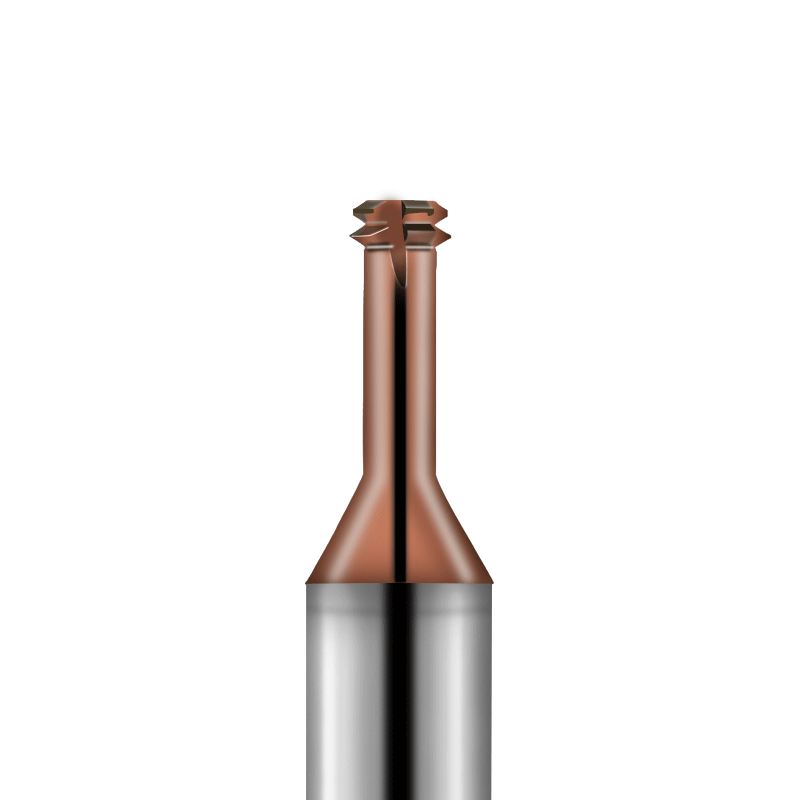
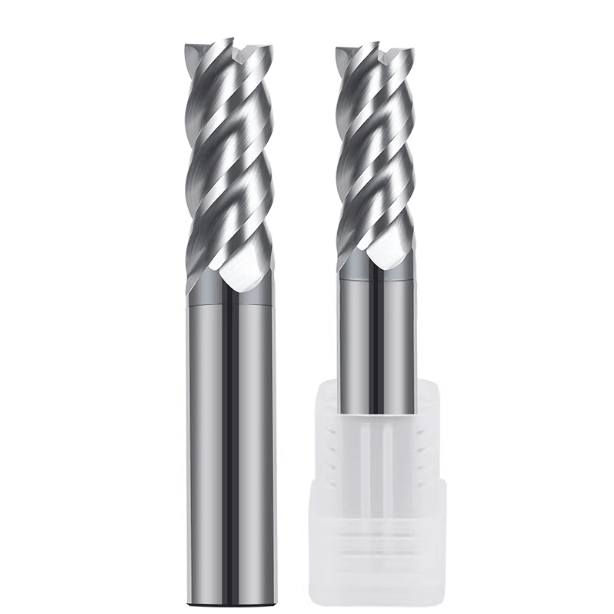
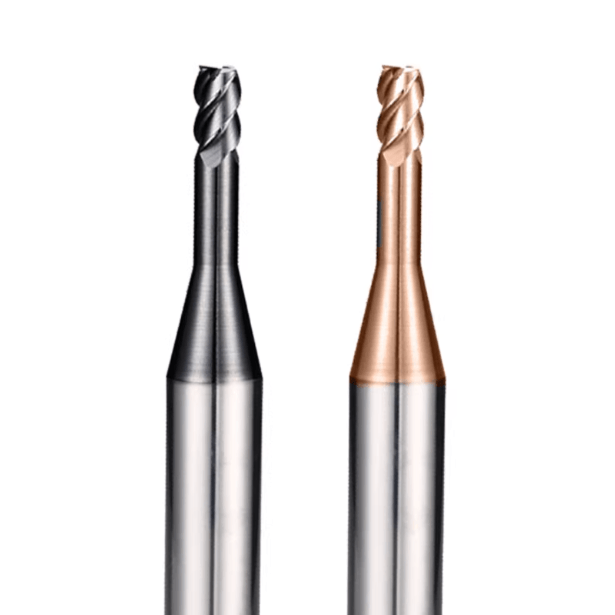
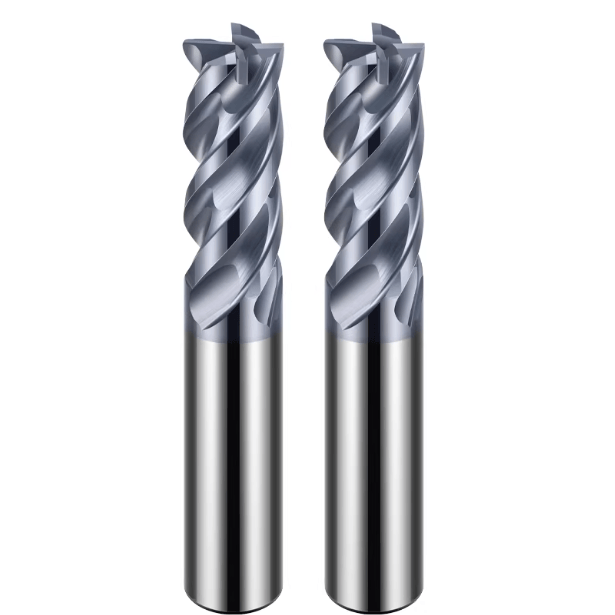
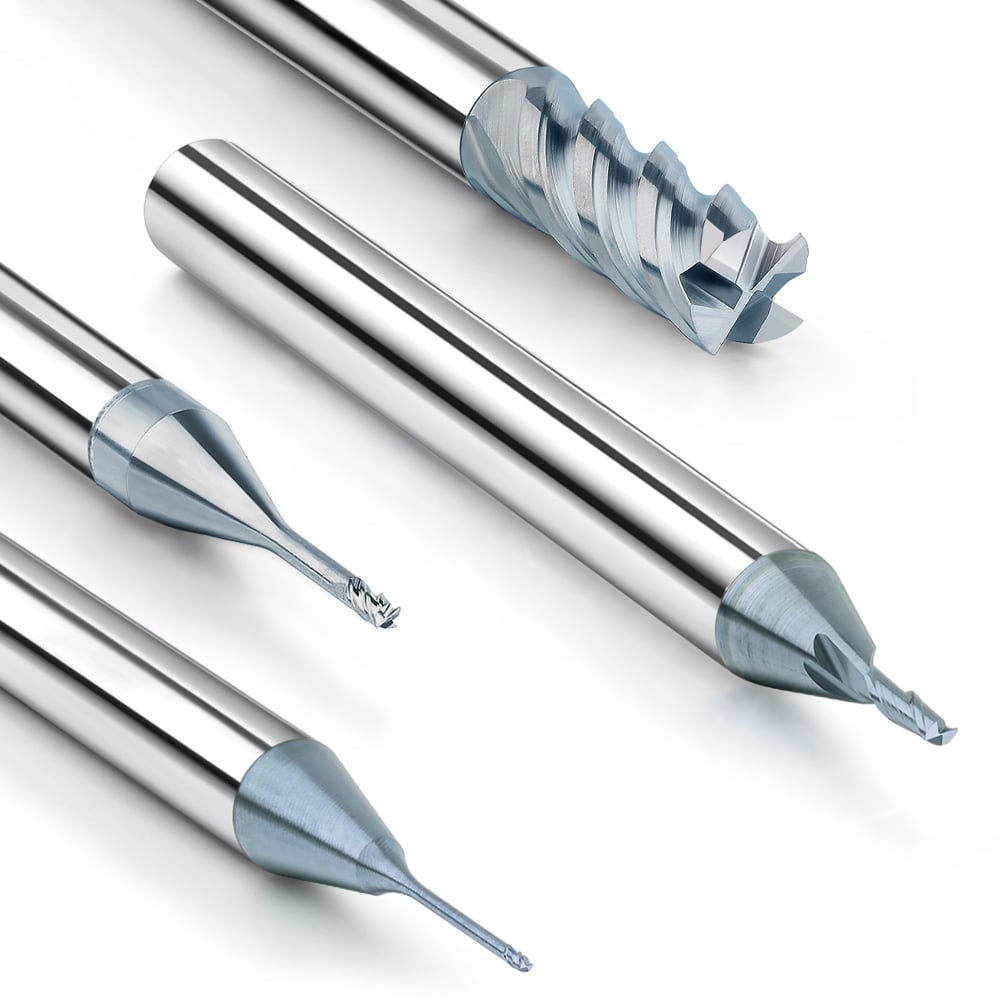
Steel milling is highly sensitive to tool selection, and the choice of cutter diameter directly affects cutting efficiency, surface finish, and tool life. Selecting the right end mill for steel requires considering material type and evaluating factors such as machine rigidity, depth of cut, spindle speed, and feed rate. For engineers working on mold manufacturing, precision parts, or high-hardness steel, matching the correct cutter diameter reduces cutting loads, minimizes vibration, and prevents tool chipping.
In practice, cutter diameter selection is influenced by tool material, flute design, and structural geometry. For instance, when comparing HSS vs carbide end mills for steel, carbide cutters offer higher rigidity and wear resistance for high-speed, high-hardness steel machining. HSS cutters, however, still provide cost-effective options for medium- and low-speed cutting. Flute design also matters: two-flute cutters are better for roughing and deep cavities, while four-flute cutters excel in finishing and high-hardness material applications.
Manufacturers looking for cost-effective, customized solutions can benefit from experienced China end mill for steel suppliers. These suppliers provide diameter recommendations and optimization designs that meet specific process requirements. Additionally, OEM end mill for steel services enable optimal tool diameter matching for mass production, balancing efficiency, tool life, and cost.
Rational cutter diameter selection is essential for improving process stability and optimizing overall production costs. The following sections explore key factors influencing cutter diameter choices, from tool material and flute design to OEM customization, providing practical guidance to find the optimal solution for steel machining.
Key Factors Influencing Milling Cutter Diameter Selection in Steel Machining
Cutter diameter affects cutting load, process stability, tool life, and surface quality. Engineers must consider multiple variables, including material hardness, cutting depth, and machine performance. A cutter that is too large may overload the spindle and increase vibration. Conversely, a diameter that is too small reduces rigidity, impacting surface finish and dimensional accuracy. The ideal diameter balances cutting efficiency, tool rigidity, and chip evacuation.
Variables are often interrelated. For example, a carbide end mill for steel can maintain sufficient strength with a smaller diameter in high-hardness applications, while an HSS cutter may need a larger diameter for stability. Adjustments should consider spindle power, clamping methods, and cutting conditions, which are critical for CNC machining optimization.
Matching Material Hardness with Cutting Load
Steel ranges from mild steel to high-hardness tool steel, each requiring different cutter diameters. Low-carbon steel is suitable for high-speed cutting with medium-diameter tools to maximize material removal. High-hardness mold steels, such as H13 or D2, require small-diameter, high-rigidity carbide end mills to reduce cutting loads and prevent chipping.
Coatings such as TiAlN or AlCrN enhance carbide cutter performance at high temperatures, making them ideal for high-speed milling of small diameters in hard steels. For softer steels, HSS end mills maintain stable cutting even at larger diameters and lower speeds. Matching hardness with tool diameter improves stability and extends tool life.
Optimizing the Ratio of Cutting Depth, Width, and Diameter
The ratio of cutter diameter, cutting depth, and width determines machining force balance. Cutting depth should generally not exceed 1.5 times the tool diameter to prevent vibration and deformation. Two-flute end mills allow wider cuts in roughing, while four-flute cutters require narrower cuts in finishing to maintain surface quality.
For deep cavities or complex shapes, long-neck or extended-shank cutters may be used, but the tool length-to-diameter (L/D) ratio should remain reasonable. Larger diameters provide rigidity for shallow cuts, while smaller diameters handle detailed or confined areas. Proper parameter adjustment improves efficiency while reducing vibration and tool chipping.
Machine Spindle Power and Clamping Effects
Machine tool capabilities are crucial in diameter selection. High-power, rigid machines can support large-diameter carbide end mills for heavy or high-speed cutting. Low-power machines are better suited for small to medium-diameter tools to avoid overload.
Clamping systems (shrink-fit, power holders, or ER collets) affect tool rigidity and runout. Precise clamping improves small-diameter tool stability, surface finish, and dimensional accuracy. Partnering with a reliable China end mill for steel supplier can help match cutter diameter to machine capabilities, optimizing efficiency and tool life.
Differences in Diameter Selection for Different Tool Materials in Steel Machining
In steel milling, the choice of tool material is closely linked to cutter diameter selection. Whether using traditional high-speed steel (HSS) end mills or high-performance carbide end mills, diameters, cutting parameters, and applications vary significantly. Selecting the appropriate tool material impacts tool life, cutting efficiency, machining costs, and surface quality.
For various steel types—mild steel, alloy steel, mold steel, or pre-hardened steel—these differences are amplified during machining. HSS tools are known for toughness and cost-effectiveness, making them ideal for medium- and low-speed cutting or intermittent operations. Carbide tools, with high hardness and wear resistance, excel in high-hardness steel and precision mold machining. Understanding HSS vs. carbide end mills for steel is essential for selecting the correct diameter and optimizing cutting strategies.
Economical and Sizing Strategies for HSS Tools
HSS end mills still play a vital role in steel machining, especially for medium- and low-speed operations or small-batch production. They offer excellent toughness and chipping resistance, allowing them to withstand interrupted cuts or heavy impact.
When choosing diameters, HSS tools often use slightly larger sizes to compensate for lower hot hardness and wear resistance. Larger diameters improve tool rigidity, reduce vibration, and stabilize cutting. For example, when machining mild or medium-carbon steel, 12–20 mm HSS end mills for steel provide sufficient cutting depth while maintaining tool life.
HSS cutters are advantageous when machine power is limited or cooling conditions are poor. Their lower cost and ease of resharpening make them suitable for small- and medium-sized mold shops, repair shops, and small-batch production. Overall, HSS tools offer a flexible and cost-effective diameter solution.
Optimal Diameter Range for Carbide Tools in High-Hardness Steel Machining
Carbide end mills are the mainstream choice for modern CNC machining of high-hardness steel. Their high hardness, heat resistance, and wear resistance make them ideal for demanding applications, such as mold steel, hardened steel, and tool steel with HRC 45–65.
The effective diameter range typically spans 3–16 mm. Small diameters (3–6 mm) are suitable for detailed machining and deep cavities, while medium diameters (8–16 mm) are better for finishing and large-area cutting. Selecting the correct diameter reduces cutting resistance, spindle load, and tool vibration, which is critical in high-speed steel milling or mold finishing.
Modern coatings, including TiAlN, AlCrN, or DLC, further extend carbide tool performance, allowing excellent tool life even under dry cutting or minimum quantity lubrication (MQL) conditions. Manufacturers seeking high efficiency, precision, and consistent surface quality must prioritize choosing the correct carbide end mill diameter.
Balancing Cost and Efficiency Between Tools for Different Materials
Balancing HSS and carbide tool selection requires clarifying production goals—unit cost versus overall efficiency. Comparing HSS vs. carbide end mills for steel highlights differences in material performance, machining strategy, and economic impact.
HSS tools offer low initial investment, ideal for small batches and diverse machining tasks, but cutting speeds are limited, and frequent resharpening adds maintenance time. Carbide tools are costlier upfront but provide higher speeds, longer lifespan, and improved productivity in mass production.
A flexible tooling strategy may involve using large-diameter HSS tools for roughing to reduce costs, then switching to small- or medium-diameter carbide end mills for finishing to enhance accuracy and surface quality. Collaborating with a professional China end mill for steel supplier or utilizing OEM end mill for steel services provides optimized diameter recommendations and mixed tool configurations, achieving the ideal balance of cost and efficiency.

Matching Flute Count Design with Milling Cutter Diameter
In steel machining, matching flute count with end mill diameter is a key factor influencing cutting efficiency and surface quality. Flute count directly affects chip evacuation, cutting load distribution, and heat management, which in turn determines the optimal diameter for milling cutters.
Typically, 2 flute end mills for steel are more suitable for roughing operations that require larger chip clearance, while 4 flute end mills for steel provide better surface stability and dimensional control for finishing and high-hardness steel machining. Engineers should consider tool diameter-to-length ratio, feed rate, spindle speed, and material hardness to achieve a balance between cutting efficiency and tool life.
Selecting the appropriate flute geometry and diameter combination for different steel types—medium carbon steel, die steel, or stainless steel—not only reduces tool wear but also optimizes cutting path and surface finish.
Advantages of 2-Flute Milling Cutters in Steel Roughing and Key Diameter Control
Compared with 4-flute cutters, 2-flute milling cutters for steel excel in roughing operations due to their larger chip space. This reduces the risk of chip clogging, tool overheating, and chipping. When machining low- and medium-carbon steels, a slightly larger diameter further improves material removal rates.
Maintaining the proper diameter is crucial. Increasing diameter enhances rigidity, but overly large diameters can impair chip evacuation and cause vibration. During roughing, prioritize machining stability by selecting the right tool diameter, cutting speed, and applying coolant appropriately to extend tool life.
Diameter Optimization Strategy for 4-Flute Milling Cutters in Finishing and High-Hard Steel
For finishing hardened steel or molds requiring a high-quality surface finish, 4-flute milling cutters are preferred due to higher edge density and smoother cutting action. Diameter selection should prioritize surface finish and chatter reduction.
Smaller diameters combined with high spindle speed improve cutting fluidity and finish. When machining high-hardness steel (HRC 55+), coated carbide end mills are recommended to prevent overheating and chipping. Proper feed rate and cutting depth control help achieve a mirror-like finish without tool marks.
How to Adjust Cutting Parameters and Tool Diameter Ratio Based on Flute Count
Flute count affects cutting load distribution and feed strategy. Two-flute cutters require higher feed per tooth for smooth chip evacuation, while four-flute cutters need reduced feed to avoid chip jamming.
Consider the L/D ratio when adjusting parameters; excessively high ratios can cause vibration and dimensional deviations. For deep cavities or tall walls, use a short, rigid tool and optimize spindle speed and feed rate to maintain efficiency and surface integrity.

How to Select the Appropriate Milling Cutter Diameter for Different Machining Scenarios
Milling cutter diameter affects machining efficiency, rigidity, and vibration control. Diameter requirements vary with machining scenarios, including mold steel, structural steel, and stainless steel.
In deep cavities, narrow grooves, or complex 3D surfaces, overly large diameters can cause interference and high cutting loads, while overly small diameters reduce rigidity and increase deflection. Engineers must consider workpiece geometry, tool overhang, depth of cut, and feed rate to balance tool life and machining accuracy.
Diameter matching should be adjusted according to machining strategy—high-speed machining, heavy cutting, or finishing. Proper selection reduces cutting forces, optimizes heat dissipation, and improves surface quality.
Diameter and Tool Length Balancing Principles in Mold Steel Machining
Mold steel’s high hardness and strength require careful balance between tool rigidity and chip evacuation. Deep cavities, narrow slots, and curved surfaces demand optimized diameter and tool length. Excessive length can cause deflection, while too small a diameter concentrates cutting loads and heat.
High-rigidity solid carbide end mills are recommended, keeping L/D ratio < 5. For long-reach cavities, consider anti-vibration holders or step-down milling. For cavity floors or curved surfaces, a tool diameter slightly larger than the slot width improves surface finish and dimensional accuracy.
Diameter Differences in High-Speed and Heavy-Duty Cutting Conditions
High-speed machining favors smaller to medium-diameter cutters to reduce centrifugal forces and chatter, enabling higher spindle speeds and thermal stability. Heavy-duty or high-strength steel cutting requires larger diameters to improve rigidity and heat dissipation, distributing cutting loads and reducing edge wear.
Optimizing depth of cut and feed per tooth allows engineers to balance tool diameter with cutting forces, achieving efficient, low-vibration, and stable machining.
How to Determine the Optimal Tool Diameter Based on Workpiece Structure
Different workpiece structures require tailored diameters. In pockets, select slightly smaller diameters for chip evacuation; for bottom surfaces, larger flat-end mills improve flatness; for sidewalls, match diameter to wall height and thickness.
Using CAD/CAM tool path simulations helps determine the ideal diameter, reducing tool load and wear while ensuring machining quality. Choosing the right end mill diameter is critical for tool life, economic efficiency, and consistent steel machining performance.

How Chinese Milling Cutter Suppliers Can Help Optimize Tool Diameter Solutions for Steel Machining
Selecting the right milling cutter diameter is critical in steel machining, affecting efficiency, surface quality, tool life, and production costs. Partnering with an experienced Chinese end mill for steel supplier can provide a comprehensive solution—from tool selection to machining parameter optimization. Leveraging mature production processes, material resources, and customization capabilities, Chinese manufacturers offer high-performance end mills with standard diameters as well as customized tools tailored to specific process requirements. These tools optimize cutting loads, chip evacuation, and machining stability, enabling efficient steel machining.
Technical guidance from suppliers allows engineers to consider key factors like tool rigidity, cutting force distribution, and tool life when selecting diameters. Whether in mold manufacturing, precision parts, or high-hardness steel machining, supplier expertise can reduce tool wear and machining risks while improving overall production efficiency.
Advantages of Chinese Tool Manufacturers in Steel Machining
Chinese milling cutter manufacturers have several advantages:
-
Cost-effective production – Competitive pricing while maintaining high performance compared to imported tools.
-
Reliable delivery – Standard-sized and bulk tools are delivered on schedule to meet production plans.
-
Technical support – Including diameter recommendations, machining guidance, coating and material selection advice, and process optimization for various steel types.
These advantages allow companies to achieve the optimal tool diameter configuration for different steel machining scenarios.
Diameter Optimization Solutions from Standard Tools to Customized Tools
Modern steel machining often involves deep cavities, high-hardness steel, and complex geometries, requiring precise tool diameters. Chinese suppliers offer both standard and custom end mills. By adjusting tool diameter, flute count, length, and coating type, suppliers optimize cutting load and chip evacuation for specific scenarios, enhancing machining stability and surface finish.
Engineering consultation services help customers select optimal diameters and machining parameters. For deep-cavity mold machining, customized tools reduce interference, minimize deflection, and improve accuracy while lowering tool change frequency and overall costs.
How to Evaluate the Quality and Delivery Capabilities of Chinese Milling Cutter Suppliers
When selecting a supplier, consider:
-
Material traceability – High-quality carbide or HSS impacts tool life and wear resistance.
-
Quality inspection – Dimensional checks, edge geometry, and coating inspections ensure tool tolerance and stability.
-
Production capacity & delivery – Reliable cycles prevent production delays.
-
Technical service – Diameter selection, cutting parameter optimization, and machining plan guidance.
Evaluating these factors ensures tool quality, delivery reliability, and access to supplier expertise for optimal diameter solutions.

OEM Custom Milling Cutters for Optimizing Steel Machining Efficiency
In steel machining, tool diameter, flute count, coating, and geometry directly impact cutting stability, machining accuracy, and productivity. By partnering with a professional OEM end mill for steel supplier, companies can obtain tailored tool solutions that optimize tool diameter, improve chip evacuation, and balance cutting loads. OEM customization not only meets specific workpiece requirements but also integrates customer equipment capabilities and machining strategies, providing a comprehensive solution for high-precision steel machining. This approach improves tool utilization, reduces machining risks, and boosts productivity.
Compared to standard tools, OEM-customized end mills offer greater flexibility in diameter, flute length, coating type, and shank design. These tools can be optimized for specialized structures in mold manufacturing, automotive components, and aerospace parts machining. By precisely matching machine power, spindle speed, and depth of cut, OEM tools can significantly reduce vibration and improve surface finish, ensuring stability and consistency in mass production.
Technical Support and Flexibility in OEM Tool Diameter Design
OEM custom milling cutters can be designed with a unique diameter tailored to the customer’s machine type, clamping method, workpiece material, and machining strategy. For instance:
-
In deep-cavity mold machining, a customized tool diameter reduces interference and deflection.
-
In automotive part finishing, adjusting the tool diameter and L/D ratio improves cutting rigidity and surface finish.
Additionally, OEM suppliers provide comprehensive technical consultation, including diameter optimization, feed and speed recommendations, cutting parameter settings, and guidance on coating and material selection. These services enable companies to maximize tool performance and lifespan while maintaining machining accuracy.
Reduce Tool Inventory and Unit Cost Through OEM Partnerships
Long-term collaboration with OEM suppliers allows companies to:
-
Adjust tool diameter and inventory based on production plans and batch sizes.
-
Reduce unnecessary inventory of standard-size tools, lowering management costs.
-
Extend tool life while maintaining cutting efficiency, reducing tool changes and downtime.
For B2B manufacturers, these optimizations translate to higher production efficiency and lower unit machining costs.
Success Story – Achieving Efficient Steel Machining Through OEM Customization
In the mold manufacturing industry, a specialized mold maker collaborated with an OEM supplier to design a custom carbide end mill with 6mm diameter and 2-flute configuration for complex cavities. Results:
-
20% increase in productivity
-
Reduced vibration and tool chipping
-
Improved surface finish
Similarly, in automotive parts machining, adjusting diameter and flute length of OEM carbide end mills enabled high-speed finishing of high-hardness steel (HRC 55+), increasing tool life by 30% and enhancing cutting stability.
These cases demonstrate that OEM end mills for steel provide precise diameter design and significantly improve machining efficiency and cost-effectiveness through customized solutions.

Correctly Selecting Milling Cutter Diameter Ensures Efficient and Stable Steel Machining
Proper selection of milling cutter diameter is essential for efficient and stable steel machining. This article examined multiple factors, including material properties, tool type, flute design, machining scenarios, and supplier support, providing practical guidance for engineers.
-
Material and cutting load: Tool diameter must match steel type (low-carbon, medium-carbon, alloy, or mold steel) and cutting depth, ensuring tool rigidity and chip evacuation.
-
Flute count: 2-flute cutters excel in roughing, providing effective chip removal and stability; 4-flute cutters perform best in finishing, high-hardness steel, and high surface finish applications.
-
Tool material: HSS tools are cost-effective for low-/medium-speed machining, while carbide excels in high-hardness steel, high-speed, and precision mold applications.
-
Supplier support: Chinese tool manufacturers and OEMs provide standard and customized solutions, technical guidance, and inventory optimization, improving efficiency and reducing costs.
Comprehensive optimization of these factors ensures efficient, stable, and economical steel machining, maximizing tool performance and delivering quantifiable production benefits.