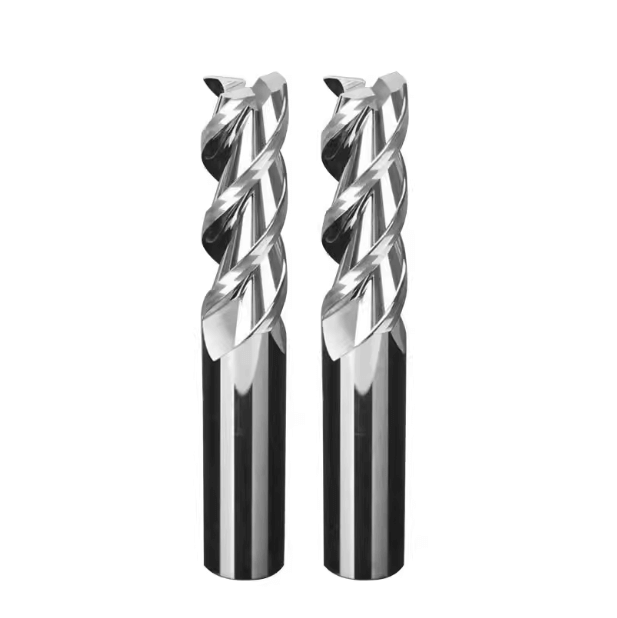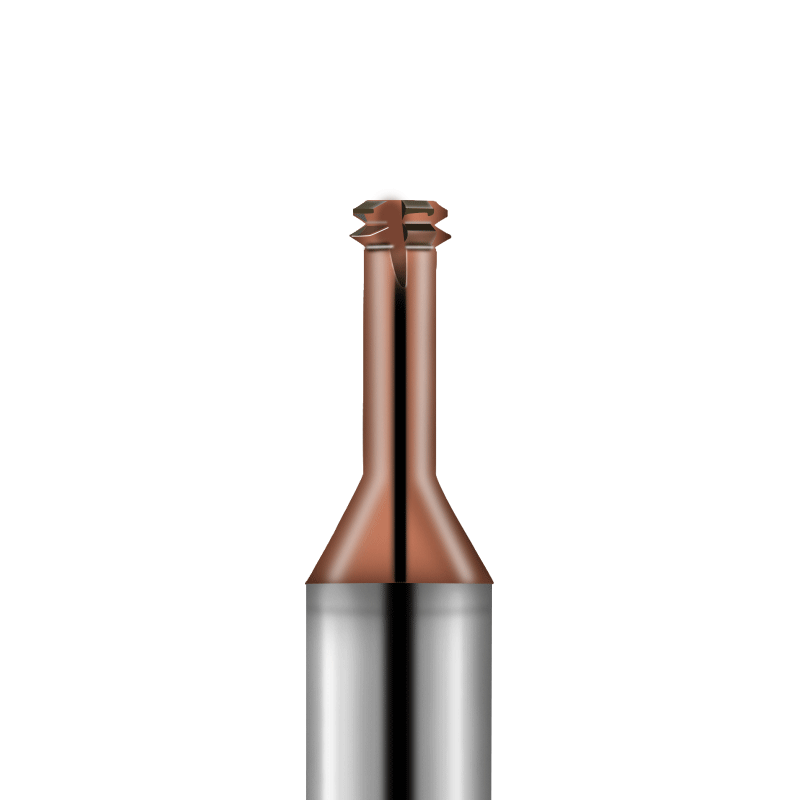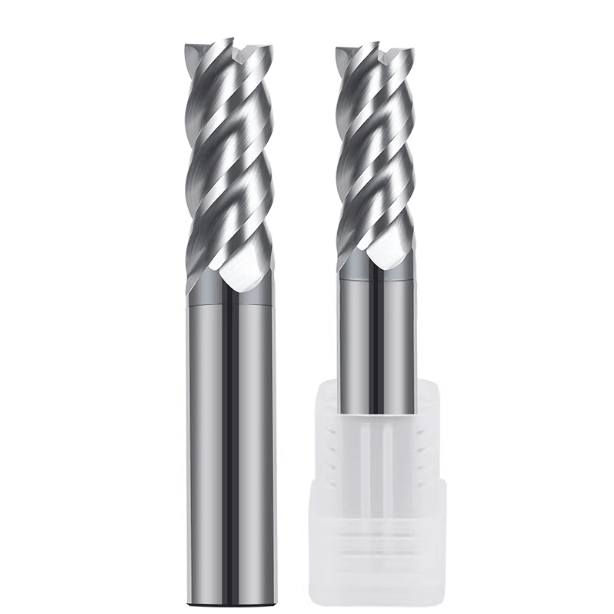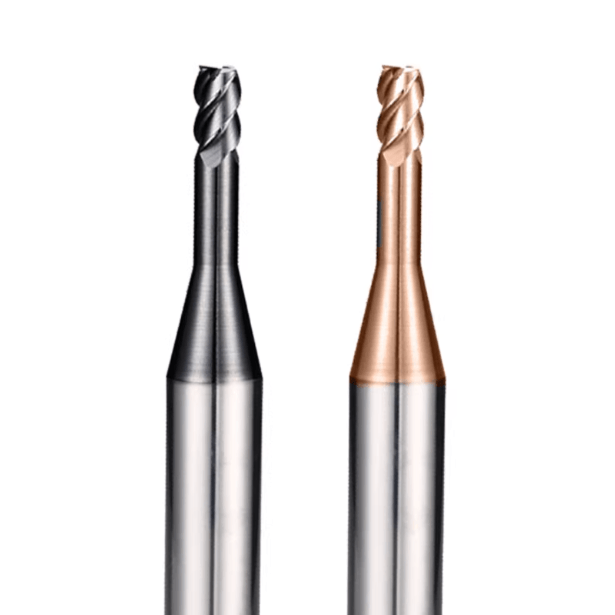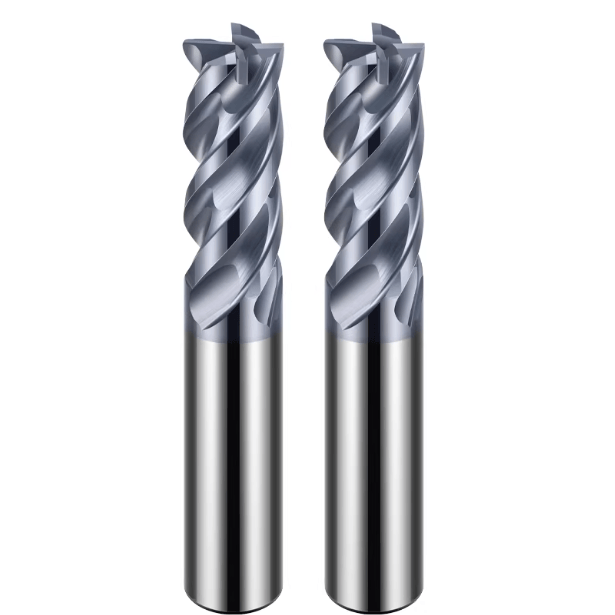
After 15 years split between carbide tool manufacturing and customer machining floors, one question haunts our technical support line more than any other: “Why does your carbide square end mill stay rock-solid on HRC65 hardened steel while other ‘rated’ tools chip out in minutes?”
Last week, a long-standing U.S. client specializing in precision molds sent us a video. They were rushing to meet a deadline on a batch of SKD11 cold-work die steel (heat-treated to HRC62-65). To save time, the operator attempted a heavy roughing pass with a large-diameter square end mill. The result? The coating peeled instantly, the tool snapped, and the workpiece surface was scorched beyond repair due to violent vibration.
This isn’t just a “bad luck” story; it’s a classic case of ignoring the physics of high-hardness machining. As a wholesale square end mill manufacturer, we know that HRC65 isn’t just a number—it’s a barrier. Success depends on more than just “hard” carbide. It requires a perfect synergy of heat management, specialized geometry, and coating toughness. If your long neck square end mill design is off by even a few microns, failure isn’t just a possibility—it’s a certainty.
We’ve distilled years of “shop floor trauma” into a set of unwritten rules. This isn’t a textbook definition of a milling cutter. This is a real-world guide for the guys on the front lines.
If you’re tired of staring at a pile of broken square end mill bits or fighting infuriating tool deflection in deep cavities, keep reading. And ask yourself: Do you really think cranking up the RPM is the answer to hardened steel?
Why Do Standard Carbide Square End Mills Fail Instantly on HRC65?
In our logs, the most frustrating sound in a shop is that sharp “click” of a tool breaking before the first cycle is even half-finished. Most operators blame the feed rate or machine rigidity. However, a decade of lab analysis shows the culprit is usually the tool’s internal architecture.
At HRC65, steel loses its plasticity. The cutting process becomes a “hard-on-hard” micro-crushing action. If your tool can’t handle high-frequency impact loads, it will chip in milliseconds. Most “off-the-shelf” carbide square end mills are design compromises. They lack the fracture resistance needed to hold an edge under the extreme heat and pressure of quenched steel. It’s like using a glass hammer to break granite—it’s hard enough, but it lacks the structural integrity to survive the impact.
Substrate Compressive Strength: Why We Insist on Ultra-Fine-Grain Carbide
When we manufacture a HRC65 square end mill, we are obsessive about the substrate. Standard carbide uses a grain size of 0.8μm to 1.0μm. In hardened steel, those large “gaps” between grains are breeding grounds for cracks.
We use ultra-fine micro-grain carbide (0.2μm to 0.4μm). Here’s why it matters:
-
Uniform Cobalt Distribution: Smaller grains mean the cobalt binder is spread thinner and more evenly.
-
Higher Compressive Strength: It withstands vertical cutting forces that would crush standard tools.
-
Edge Integrity: It prevents the “macroscopic” chipping that happens when cutting resistance spikes.
While this substrate costs more, the stability it provides in a B2B mass-production environment is priceless. No one wants to scrap a $20,000 mold cavity during an unmanned night shift because of a cheap substrate.
Coatings Are More Than Color: PVD Performance for Hardened Steel
We often get asked: “Why aren’t your HRC65 square mill bits more colorful?” Let’s be clear: a coating is a thermal barrier, not a fashion statement.
At HRC65, cutting zone temperatures easily top 800°C. We skip the “pretty” coatings in favor of nano-composite PVD coatings (AlTiN or TiSiN). These coatings form a dense layer of aluminum oxide (Al2O3) during the cut. This layer acts as a heat shield, preventing high temperatures from soaking into the carbide.
If your coating lacks “Red Hardness,” the heat will soften the substrate underneath, leading to “thermal softening” and total tool collapse. Our PVD technology allows us to hit surface hardness over 3500 HV while keeping the core tough. That is how you maintain dimensional accuracy during high-speed dry cutting.
Edge Reinforcement: Why We “Dull” the Edges of HRC65 Tools
This sounds counterintuitive: to make a tool last longer, we make it “duller.” But on HRC65 steel, a razor-sharp edge is a liability. It’s too thin to handle the shock and will micro-chip immediately.
As a manufacturer, we put every HRC65 square end mill through a precision honing (edge reinforcement) process. We remove microscopic burrs and create a minute “R-edge” (radius).
-
Increased Surface Area: It spreads the cutting load across a larger area.
-
Reduced Stress Concentration: It prevents the cracks that start at a sharp point.
In our field tests, a non-honed tool showed jagged wear in under 10 minutes. Our reinforced square end mill bits showed smooth, gradual wear over hours. If the tool doesn’t feel “sharp” to your thumb, don’t worry—that’s the defensive line we built to survive the impact.
Conquering Deep Cavity Challenges: Rigidity and Clearance for Long Neck Square End Mills
In a mold shop, it’s rarely the big roughing jobs that keep us up at night. It’s the bottomless narrow slots and tiny corner-cleans. When your depth-to-diameter ratio hits 5:1 or 10:1, a standard tool is useless. You need a long neck square end mill.
But let’s be honest: long-neck tools are a double-edged sword. They give you the reach, but they punish you for every ounce of lost rigidity. If your RPM or feed rate is off by a hair, that slender neck resonates like a guitar string. At best, you get ugly chatter marks; at worst, the tool snaps at the base.
After years of cleaning up deep-cavity disasters, we’ve learned one core principle: a clearance strategy isn’t just about not hitting the wall. It’s about finding that razor-thin window of stability. When you’re cutting HRC65 steel, the laws of physics are brutal. For every millimeter of extra overhang, your tool tip deflection grows exponentially.
The Tug-of-War: Selecting the Right Long Neck Extension
Our ironclad rule is simple: always use the thickest and shortest tool possible. It sounds obvious, but we see guys use a single long-reach tool for the whole job just to avoid a tool change. That is a cardinal sin in high-hardness machining.
When using carbide square end mills for deep cavities, the ratio of the neck diameter to the reach determines the tool’s natural frequency. We tell our clients to “stage” the job:
-
Use short-neck tools for the shallow layers.
-
Bring in the long-neck tools only for the final deep reaches.
This limits the time your high-risk tool is under stress. If you’re torn between a full-flute tool and a long-neck/short-edge design, choose the latter. A shorter cutting edge reduces the “lever arm” effect, significantly boosting tip stiffness. We’d rather perform three tool changes than scrap an HRC65 mold.
Eliminating Deflection: Real-World Feed Compensation
Most guys try to kill “chatter” by lowering the spindle speed. In our experience, that often makes it worse because you might drop right into the machine’s natural vibration frequency.
We prefer to fix deflection in the programming. When running Constant Z paths, we use “gradual entry” moves rather than slamming the tool into the material. This prevents that initial “spring” or deflection in the long-neck section.
For long neck square end mills, we recommend trochoidal milling or large-radius helical ramping. The goal is a constant radial depth of cut (Ae). If the machine starts “screaming” with a high-pitched shrill, your feed compensation has hit its physical limit. Don’t blindly trust your CAM software’s nominal paths. Always leave an extra finishing allowance to account for real-world deflection.
Air vs Mist: The Narrow Slot Cooling Debate
Should you go “wet” or “dry” in deep slots? In HRC65 steel, we almost never use flood coolant. Deep slots have zero room for chip evacuation. Thick coolant acts like glue, trapping tiny chips at the bottom. This leads to “re-cutting,” which is instant death for brittle HRC65 square end mill bits.
We advocate for high-pressure Air Blowing or MQL. We once solved a massive breakage issue for an automotive connector mold shop by switching them to air. The goal wasn’t cooling—it was “clearing the zone.” You need to blast those scorching-hot chips out immediately. At 600°C, the “thermal shock” from cold liquid does more damage to the coating than the heat itself.

Precision Clamping: Extending the Life of HRC65 Square End Mill Bits
Tool failure isn’t always about the tool—it’s often about the “fundamentals.” In HRC65 machining, your entire setup is like a taut string; any vibration is amplified. We see shops buy $80 carbide square end mills and stick them in worn-out, 10-year-old collets. That’s like putting budget tires on a Ferrari.
Effective clamping isn’t just about “tightness.” It’s about the alignment between the tool’s axis and the spindle center. If your setup has play, the impact load on entry will micro-chip your edges instantly. Stop analyzing tool life after the fact—fix your clamping standards in the tool room first.
Shrink-Fit vs. ER Collets: The Rigidity Reality
We get asked about holders all the time. While there’s no “one size fits all,” for HRC65 steel, we push our clients toward shrink-fit technology.
-
360-degree grip: Shrink-fit provides uniform pressure that kills centrifugal runout.
-
Extended Life: In our tests, the same tool lasts 30% longer in a shrink-fit holder than in a standard collet.
If you must use ER collets, buy “Ultra-Precision” (UP) grade and keep them surgically clean. A single speck of oil or a tiny chip inside a collet will seat the tool off-center. When that happens, one flute does all the work while the others “loaf.” That uneven load is why your carbide square end mills fail prematurely.
The 0.005mm “Red Line”: Don’t Cross It
In our shop, we have a “life-or-death” threshold for HRC65 work: 0.005mm radial run-out. You might think 0.01mm looks okay on a dial, but in high-hardness cutting, those extra microns are a disaster. HRC65 material has zero “give.” If the tool wobbles, the chip load on one tooth instantaneously doubles. The carbide can’t take that shock.
We frequently visit shops with our dial indicators. If the run-out is under 0.005mm, the spindle sounds like silk. Above 0.01mm, it sounds percussive and noisy. That noise is the sound of your HRC65 square end mill fatiguing. Take two minutes to check the tip run-out before you hit cycle start. It’s cheaper than writing an accident report.
Scientific Tool Management: The Warning Mechanism
Don’t wait for a “bang” to change your tool. We use preventive replacement based on actual run-time data. We track the stable cutting duration for every square end mill bit.
If a tool is safe for 60 minutes in HRC62 steel, we set a hard alarm at 50 minutes. You might “waste” 10 minutes of tool life, but you save the workpiece.
-
Monitor Spindle Load: Look for subtle spikes.
-
Surface Finish: Watch for the slightest degradation.
As a wholesale square end mill manufacturer, we provide more than tools—we provide wear-characteristics data. This digitized approach ensures that every mold you deliver meets micron-level precision.

Cutting Parameters for HRC65 Hardened Steel: Forget the Manuals, Look at the Chips
In our workshop, we have plenty of tool catalogs with theoretical formulas. But if you blindly apply those numbers to HRC65 hardened steel, you’re asking for a disaster. Real-world deformation resistance and frictional heat in quenched steel far exceed what any standard formula predicts.
After machining thousands of mold cavities, our data shows that success centers on “thermal equilibrium.” If your spindle speed and feed rate miss the material’s physical critical points, even a premium HRC65 square end mill will thermally soften and fail in seconds.
Don’t treat parameters as static figures. It’s a dynamic system. We teach our team to watch the “visual cues”—specifically the chip color. If your chips are deep blue or black, the heat isn’t leaving with the chip; it’s soaking into your tool edge. In these cases, cutting the feed rate often makes it worse by increasing friction. You must find the balance between your machine’s acceleration and the tool’s red hardness limit.
Master the Move: Trochoidal Milling with HRC65 Square End Mills
When you’re full-slotting or removing large volumes of high-hardness material, a traditional linear entry is “tool suicide.” We have shifted almost entirely to trochoidal milling. This circular entry-and-exit pattern gives your carbide square end mills vital “cooling intervals.”
By reducing the tool’s contact angle, the cutting edge is only under high stress for a fraction of a second during each rotation. Heat dissipates with the chips instead of building up in the zone.
-
Step-over Recommendation: Set your radial depth of cut to 5%–10% of the tool diameter.
-
The Result: You can substantially increase your cutting speed (Vc) and feed per tooth.
Even though the radial engagement is small, the higher Metal Removal Rate (MRR) and extended tool life make this the most profitable way to run square end mill bits.
High Speed, Light Cut: Defeating the “Silent Killer” of Work Hardening
Work hardening is the silent killer of square end mills. Many machinists set their feed rates too low, thinking they are being “safe.” Instead, the tool just rubs against the surface. This dry friction creates localized heat that makes the already-hard steel even harder.
Our standard countermeasure is “light radial cuts with rapid traverse.” By reducing the axial depth of cut (Ap), we can ramp up the spindle speed. This concentrates the heat in the chips, not the workpiece.
-
The “Glossy Surface” Warning: If your workpiece looks like a mirror but the next tool you use fails immediately, you’ve induced severe work hardening.
-
The Fix: Adjust your feed rate so the cutting edge actually “bites” into the material rather than gliding over it.
Side Milling vs. Slot Milling: Choosing Your Ae
Finish side milling and full-slot roughing require two completely different playbooks.
-
Side Milling: Keep your radial depth of cut (Ae) between 1% and 3% of the tool diameter. This “thin-chip” approach maximizes lateral rigidity, ensuring your walls are perpendicular and the finish is flawless.
-
Slot Milling: If you must slot-mill HRC65, reduce your axial depth (Ap) to 0.05x the tool diameter or less.
Slotting pushes the physical limits of carbide square end mills because there is nowhere for the heat or chips to go. We always recommend using 2-flute or 3-flute tools with larger flutes and a powerful air blast for these jobs. If possible, avoid slotting entirely and use trochoidal or plunge milling.
Why Partner with a Wholesale Square End Mill Manufacturer?
Buying cutting tools for B2B manufacturing isn’t like buying groceries. When you have a batch of high-value HRC65 parts on the table, you don’t just need a piece of sharpened carbide—you need a proven solution.
As a wholesale square end mill manufacturer, our day isn’t spent in a sales office; it’s spent analyzing broken tool remnants and fine-tuning run-out to the last 0.01mm. Our clients in North America and Europe come to us for “certainty.” They need to know their tools will perform during an unmanned 2:00 AM shift.
Are your current suppliers just selling you model numbers? Or are they recommending geometry based on your machine’s rigidity? Direct manufacturing expertise lets you skip the “costly trial phase” and move straight to production.
Beyond the Catalog: Custom Carbide Square End Mills
Standard specs often fall short. If you’re machining an 80mm deep rib in HRC62 steel, a standard tool will likely chip due to clearance issues. That’s where customization pays for itself.
We do more than “cut to length.” We perform micron-level redesigns of:
-
Neck Taper: Optimized for deep-reach rigidity.
-
Variable Flute Spacing: To kill harmonic vibration.
-
Variable Helix Angles: For smoother entry and exit.
If you’re struggling with a non-standard part or a difficult alloy, send us your machine model, spindle power, and workpiece status. We can adjust our grinding paths to create HRC65 square end mills with custom chamfers or coating formulas tailored to your specific pain points.
The Power of Batch Consistency
In high-hardness machining, the only thing worse than a bad tool is an inconsistent one. If tool #1 works but tool #100 shatters, your automation is useless. This “performance drop-off” usually comes from fluctuations in raw carbide batches or coating thickness.
To ensure consistency, we implement rigorous controls:
-
Source Control: We inspect every batch of ultra-fine-grain carbide for cobalt distribution.
-
Automated Inspection: Every square end mill bit is checked by high-precision optical systems.
-
The 0.005mm Standard: We strictly maintain run-out within this limit so you can push your parameters with total confidence.
Saving Your Hidden “Trial-and-Error” Costs
The true cost of a tool isn’t the price on the invoice—it’s the cost of the “trial and error.” Every long neck square end mill that snaps is a loss in machine time, scrapped material, and spindle precision.
By connecting directly with us, you eliminate the middleman communication gap. Our engineers can look at your drawings and tell you the exact entry angle or ramping radius you need. We bring our lab data directly to your floor.
If you have a new project and aren’t sure about the speeds and feeds—or if you want to boost your efficiency by 20%—let’s talk. Don’t waste time on generic formulas. Let’s look at your drawings and find a real-world solution together.