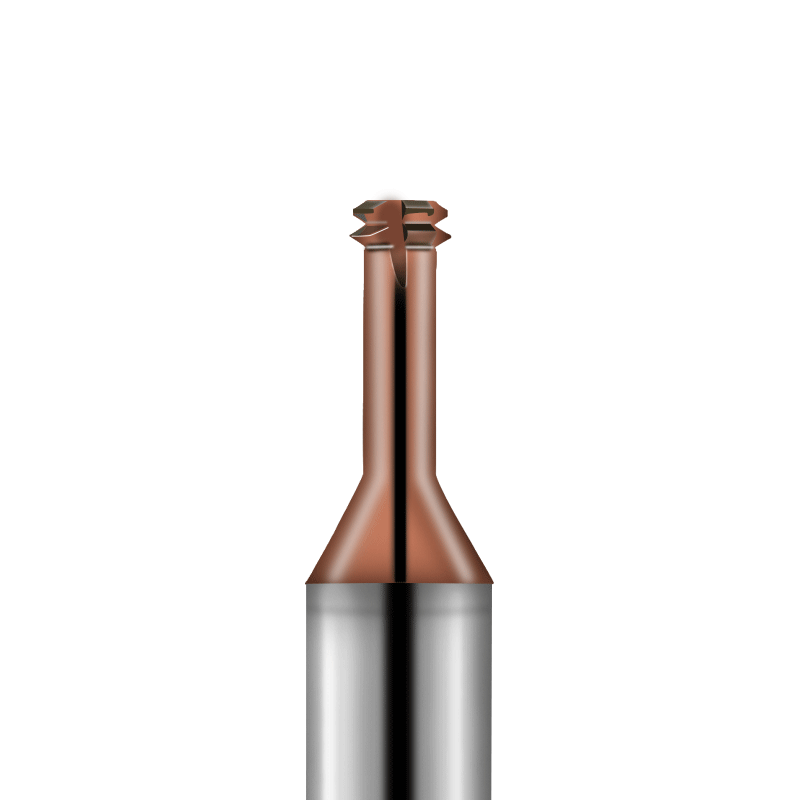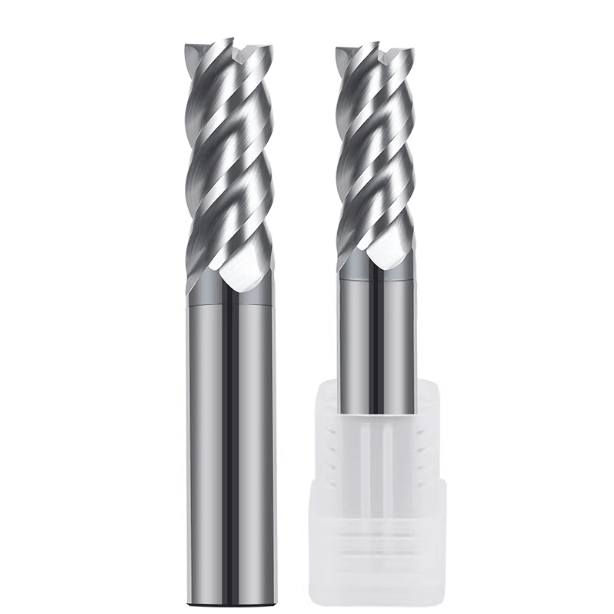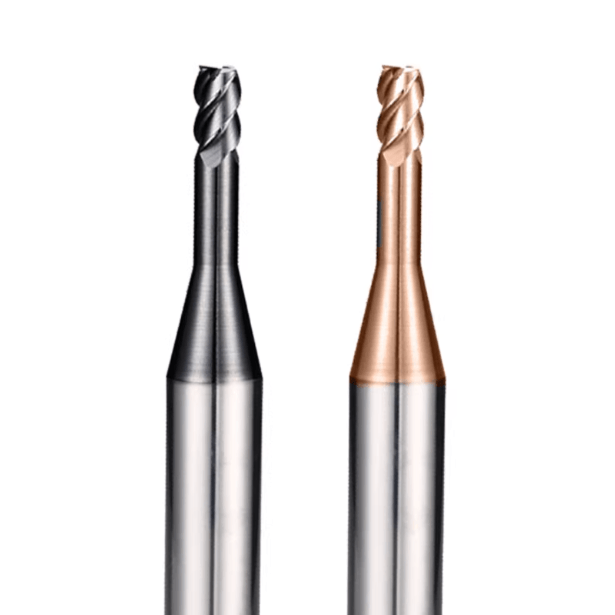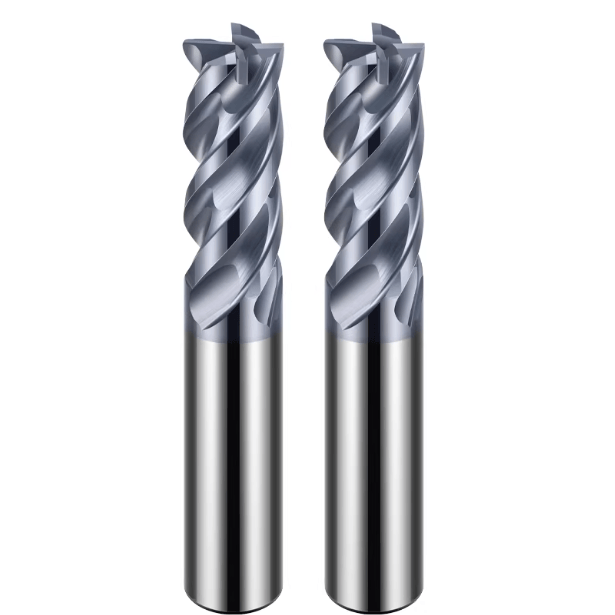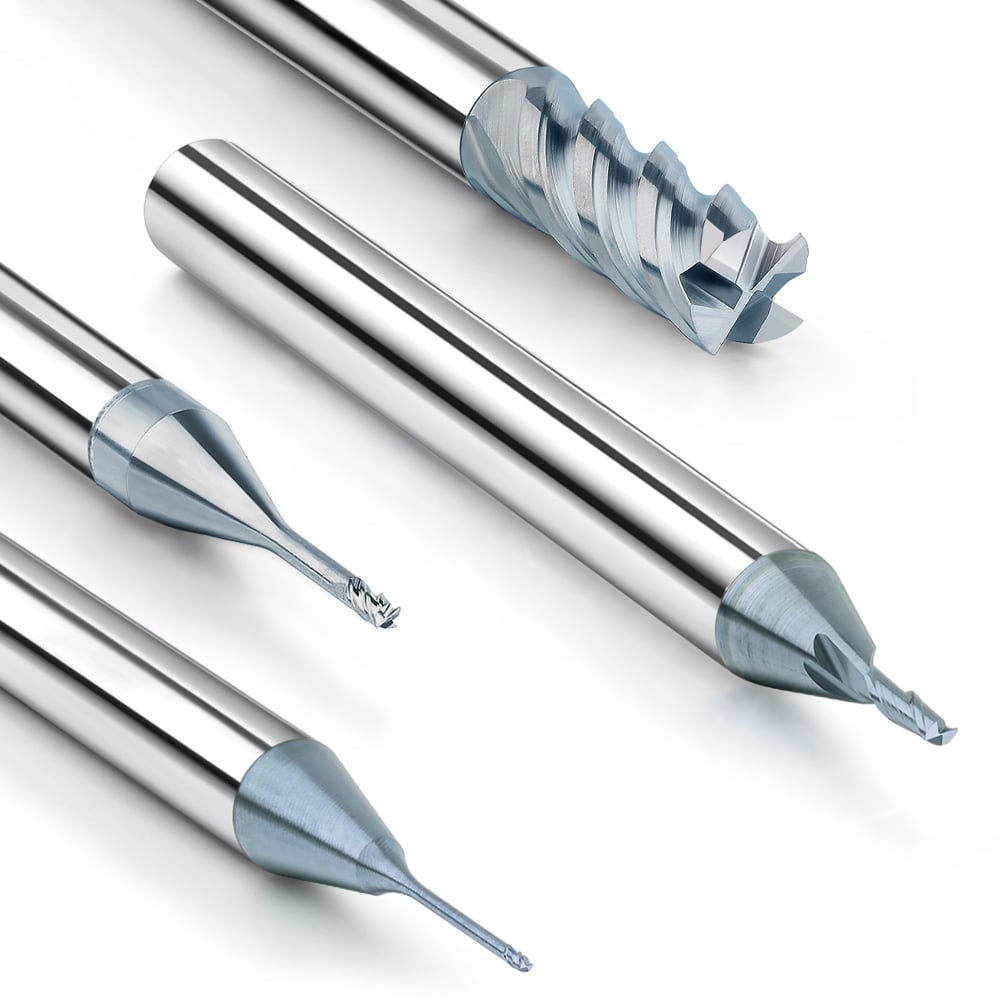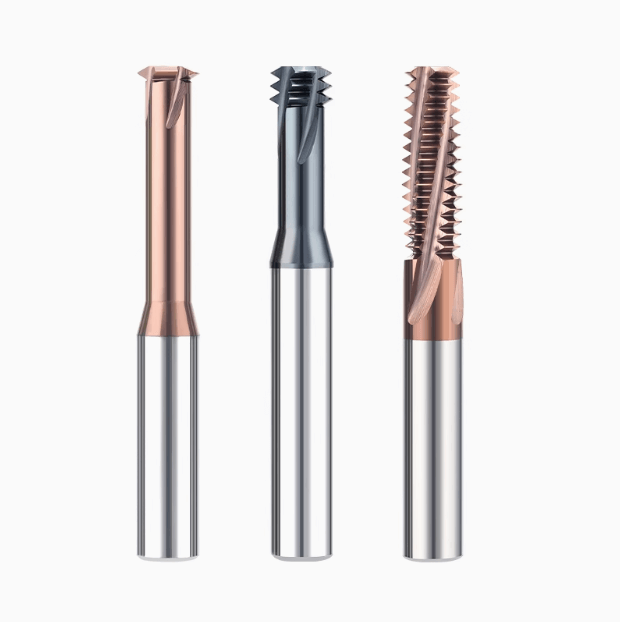
In actual thread machining processes, the structural form of a thread mill tool often directly determines machining efficiency, stability, and the consistency of the finished threads. Among these, single-form and multi-form structures are the most commonly discussed, and selecting the appropriate tool can be a source of disagreement in the planning stage. Choosing the right thread milling tool for different machining scenarios is crucial—not only for the quality of individual parts but also for the overall cycle time and cost of producing a batch of components.
From a cutting perspective, single-form thread milling end mills form threads gradually with a single tooth. This method offers excellent dimensional control, machining flexibility, and adaptability to machine load. Multi-form thread mill tools, in contrast, engage multiple teeth simultaneously to complete the entire thread profile more quickly, making them better suited for stable production environments that prioritize efficiency and consistency. These two structures differ fundamentally in cutting force distribution, tool wear patterns, and programming strategies.
In practice, thread specifications, material type, hole geometry, and machine performance all influence the choice of thread milling tool. The performance gap between single-tooth and multi-tooth cutters becomes particularly significant in small-batch, multi-variety production, deep or blind hole threading, and high-strength material processing. In these cases, whether to use a standard thread milling end mill or a custom thread mill tool to match the specific thread geometry often becomes a key factor in achieving machining stability.

Application Background of Thread Mill Tools in CNC Thread Machining
High-precision thread machining has become a critical measure of part quality and assembly accuracy in modern manufacturing. With increasing material diversity and structural complexity, traditional tapping is increasingly limited in terms of efficiency, tool life, and thread consistency. Thread milling, with its flexible cutting method and controllable tool path, effectively addresses the needs of internal and external threads of various diameters and pitches. It reduces machine load fluctuations and improves overall machining stability.
This approach is especially effective for deep hole threads, blind hole threads, and high-hardness alloy components. Optimizing cutting parameters, tool geometry, and feed strategy allows thread milling to achieve high precision for single pieces while also accommodating small-batch, multi-variety production. For non-standard threads or special materials, custom thread milling cutters can further enhance machining accuracy, balancing efficiency with part consistency.
Why Thread Milling is Gradually Replacing Traditional Tapping
Traditional taps are prone to breakage, thread size deviations, and vibration, especially when machining hard materials or deep holes. Thread milling, with its layered cutting and gradual forming, significantly reduces cutting load and extends tool life. It is particularly advantageous when machining difficult-to-cut materials such as high-strength steel, titanium alloys, and stainless steel, ensuring stable cutting and high-quality threads.
Adjustable cutting paths and pitch compensation make thread milling highly flexible for small-diameter or blind hole threads, reducing the need for secondary operations and improving overall production efficiency. Additionally, a single thread mill tool can often handle threads of different diameters and pitches, reducing tool inventory and replacement frequency. This versatility and low wear rate contribute to the gradual replacement of traditional tapping in precision and high-value manufacturing.
Advantages of Thread Milling Tools in Complex Working Conditions
Thread milling demonstrates reliability and flexibility across complex machining scenarios. In deep or blind holes, stepwise cutting prevents deformation or breakage caused by excessive tool forces. Under intermittent or discontinuous cutting conditions, multi-tooth or custom thread milling cutters maintain thread surface consistency, reducing burrs and improving surface finish.
For high-hardness or alloy materials, adjusting cutting speed, feed rate, and tool coating can extend tool life and maintain processing stability. When combined with five-axis or multi-axis machines in mass or multi-variety production, thread milling enables high-precision machining of complex thread profiles. It reduces the number of workpiece setups, minimizes machining errors, and improves overall efficiency, making it indispensable in modern high-precision manufacturing.

Machining Characteristics of Single-Form Thread Mill Tools
Single-tooth thread milling cutters machine threads one tooth at a time. This design focuses on precise cutting and flexible adaptation to different thread specifications. In small-diameter, deep-hole, or blind-hole threads, single-tooth tools reduce cutting load through layered cutting, minimizing vibration and machine impact, and ensuring stable thread profiles. They are also advantageous for high-precision parts, irregular thread forms, and high-strength materials.
By optimizing cutting speed, feed rate, and tool path, single-tooth cutters achieve high standards in precision and surface quality. When used with custom thread mill tools, they can further enhance machining results, ensuring consistent thread size and surface finish.
Impact of Single-Tooth Cutting Method on Thread Accuracy
Layered cutting with a single tooth reduces force fluctuations during machining, controlling pitch error and thread profile deviations. Each cutting pass removes material precisely, resulting in a consistent thread profile. In small-diameter or deep-hole threads, single-tooth cutters prevent dimensional deviations caused by vibration or impact, maintaining strict tolerance compliance.
Optimized tool geometry and helix angles allow single-tooth cutters to maintain stable cutting across different materials, improving thread surface finish and minimizing secondary operations.
Cutting Stability of Single-Form Thread Milling End Mills
Single-tooth cutters bear only partial cutting load at any given time, distributing forces evenly and reducing the risk of tool breakage and machine vibration. In difficult-to-machine materials like high-hardness steel, stainless steel, and titanium alloys, layer-by-layer cutting maintains stability, reduces heat accumulation, and extends tool life.
Single-tooth structures also allow precise adjustment of cutting parameters, ensuring consistent pitch and thread profiles. In porous or intermittent cutting conditions, single-form thread milling end mills demonstrate exceptional stability, reducing machining defects and improving first-pass yield.
Adaptability of Single-Tooth Structure in Different Materials
Single-tooth cutters adapt well to both soft materials like aluminum and copper alloys and hard-to-cut materials such as high-hardness steel and titanium alloys. Adjusting cutting depth and feed rate enables efficient machining across material types.
In soft materials, single-tooth tools minimize burrs and surface roughness. In hard materials, stepwise cutting reduces tool wear while maintaining thread accuracy. Custom thread mill tools further optimize cutting paths, reduce vibration and tool load fluctuations, and achieve high-precision, stable results for non-standard threads or special materials.

Machining Characteristics of Multi-Form Thread Mill Tools
Multi-tooth thread milling cutters engage multiple teeth simultaneously to machine the thread profile. Their design prioritizes efficiency and consistency, particularly in mass production. Multi-tooth cutters remove more material per cycle than single-tooth cutters, significantly shortening processing time. They are ideal for high-pitch threads, deep holes, or parts requiring high surface quality and thread accuracy.
Custom thread mill tools can extend these advantages to non-standard threads and special materials, balancing efficiency with precision. Proper matching of machine rigidity, cutting parameters, and tool coatings ensures stable cutting even in challenging materials or complex workpieces. Multi-form thread milling end mills reduce tool changes and machine downtime in standardized production, enhancing overall efficiency and product consistency.
Efficiency Improvement Brought by Multi-Tooth Synchronous Cutting
Multi-tooth cutters remove material with several teeth simultaneously, significantly improving processing speed. In high-volume or long-thread applications, multi-tooth cutters can reduce cycle times by 30–50% compared to single-tooth cutters.
Synchronous cutting distributes forces evenly, reducing tool wear and maintaining thread profile accuracy and surface finish. Even under intermittent cutting conditions, multi-tooth cutters maintain stability, reducing vibration and machine impact, supporting efficient continuous production. These characteristics make them widely used in aerospace, automotive, and high-precision mechanical part manufacturing.
Requirements of Multi-Form Thread Milling End Mills on Machine Rigidity
Multi-tooth cutters generate higher total cutting forces, requiring high machine rigidity. Insufficient rigidity can cause vibration or deflection, reducing thread accuracy and tool life. Proper machine selection and fixture setup, considering tool diameter, pitch, and depth, is essential.
Optimizing tool coatings, geometry, and cutting parameters reduces dependence on machine rigidity. Custom multi-form cutters further enhance stability for deep holes or challenging materials, ensuring consistent machining quality.
Advantages of Multi-Tooth Structure in Mass Production
Multi-tooth cutters provide significant economic and efficiency benefits for mass production. Synchronous cutting reduces tool changes and downtime, stabilizes production rhythm, and ensures thread dimension consistency. In high-volume, multi-specification production, multi-tooth cutters reduce operator intervention, lower human error, and adapt to non-standard threads with custom tools.
For hard or difficult-to-machine materials, multi-tooth cutters extend tool life and reduce costs through force distribution and optimized cutting paths. Combined with high-precision machines and proper cutting strategies, multi-form thread milling tools deliver stability and efficiency in continuous, blind hole, and deep hole threading, making mass production more reliable and cost-effective.

Core Differences Between Single-Form and Multi-Form Thread Mill Tools
In thread machining, single-tooth and multi-tooth thread milling cutters differ significantly in machining method, cutting force distribution, production efficiency, and accuracy. Single-tooth tools form threads one tooth at a time, making them ideal for high-precision, small-batch, deep-hole, or blind-hole threading. Multi-tooth tools, by cutting multiple teeth simultaneously, improve material removal efficiency, making them more suitable for mass production and high-pitch threads. Each type has advantages and trade-offs in terms of tool stress, machining cycle time, and thread consistency. Selecting the right tool balances efficiency, quality, tool wear, and processing costs.
In practice, cutting strategies and parameter settings for single-tooth and multi-tooth cutters vary depending on material, thread diameter, depth, and production volume. For hard or difficult-to-machine materials, customized thread mill tools can optimize tool geometry and cutting paths to achieve a stable cutting state and high-precision threading.
Comparison of Cutting Load and Tool Stress
Single-tooth thread milling concentrates the cutting force on one tooth at a time, keeping the per-cut load relatively low. This reduces machine vibration and force fluctuations, making it suitable for high-precision threads and low-load machining. Multi-tooth thread milling involves simultaneous cutting with multiple teeth, increasing overall cutting force and requiring higher machine rigidity and fixture stability. However, the force is distributed across multiple teeth, which helps maintain tool life and efficiency in high-volume production.
Proper selection of cutting parameters and tool geometry minimizes tool wear, reduces machining defects, and ensures thread accuracy. In deep-hole or hard material machining, multi-tooth tools can distribute cutting forces, reducing stress on individual teeth and maintaining machining stability.
Differences in Machining Cycle Time and Unit Cost
Multi-tooth thread milling significantly shortens cycle time through synchronous cutting, making it ideal for high-volume production and lowering per-part costs. Single-tooth thread milling has longer cycles but offers flexibility for small-batch, multi-specification, or special threads, reducing the need for frequent tool changes and parameter adjustments. This helps lower setup time and scrap rates.
Combining customized thread milling tools with optimized machining strategies allows manufacturers to balance cycle time, unit cost, and thread accuracy, achieving both high efficiency and cost-effectiveness.
Thread Consistency and Repeatability Comparison
Single-tooth cutters precisely control material removal in each pass, resulting in minimal pitch error and profile deviation, particularly in deep or blind-hole threads. Multi-tooth cutters rely more on machine rigidity and fixture stability, but they can maintain thread repeatability and dimensional consistency in mass production. With appropriate cutting parameters and tool design, multi-tooth cutters can also achieve high-quality thread surfaces.
Customized multi-tooth tools further enhance accuracy and repeatability for complex materials or special threads while supporting efficient, high-volume production and reducing secondary finishing.
Thread Mill Tool Selection Recommendations for Different Machining Scenarios
Different production scales, materials, and hole geometries require specific tool selections. For small-batch, multi-specification parts, high-volume standardized production, and deep or blind-hole threading, matching tool type and cutting parameters is critical for thread quality, efficiency, and cost control. Combining the features of single-tooth and multi-tooth cutters with machining strategies based on material, pitch, and hole depth ensures high-precision, stable, and efficient threading.
Customized thread milling tools are particularly useful for non-standard threads or special materials, balancing flexibility with consistency and providing practical solutions across various machining conditions.
Thread Milling Tool Selection for Small-Batch, Multi-Variety Workpieces
Small-batch, multi-variety workpieces often require frequent tool changes and process adjustments. Single-tooth cutters offer flexibility by cutting one tooth at a time, accommodating multiple diameters and pitches while reducing reliance on machine rigidity. Choosing single-tooth tools with good wear resistance and versatile geometry ensures thread accuracy, reduces setup time, and minimizes tool inventory pressure.
Using customized single-tooth tools, optimized cutting paths can be developed for non-standard threads, improving machining stability and first-pass success rates, thus enhancing efficiency in small-batch production.
Application Strategies for Thread Milling End Mills in High-Volume Stable Production
In mass production, multi-tooth thread milling cutters improve efficiency by forming threads with multiple teeth simultaneously, shortening cycle times and lowering unit costs. Ensuring repeatable thread accuracy requires careful attention to machine rigidity, tool coating, and parameter matching.
Multi-tooth tools are ideal for high-pitch threads, standardized parts, and continuous machining. Optimizing feed rates and cutting depth balances tool life and production efficiency. Using a combination of standardized and customized thread mill tools accommodates various thread specifications, improves production stability, and reduces tool changes and downtime.
Tool Matching Logic for Deep Hole and Blind Hole Machining
Deep or blind-hole threading demands high tool rigidity and efficient chip evacuation. Single-tooth cutters reduce cutting load and vibration through layered cutting, ensuring accurate thread profiles and surface finish. Multi-tooth cutters can maintain repeatable accuracy when used on high-rigidity machines, but require strict control of cutting parameters and fixture stability.
Customizing tooth profile, pitch, and cutting edge length further improves deep-hole stability, extends tool life, lowers scrap, and ensures a high first-pass success rate.
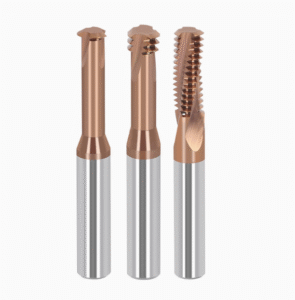
Influence of Material Factors on Thread Milling Tool Selection
The diverse physical properties and cutting characteristics of different materials impose varied requirements on thread machining. Material hardness, toughness, thermal conductivity, and chemical composition directly affect tool wear, cutting force distribution, and thread surface quality. Selecting the appropriate thread mill tool requires consideration of material characteristics and careful adjustment of tool structure, coating, and cutting parameters to achieve high precision, stability, and low wear.
In actual production, soft materials such as aluminum alloys and copper alloys behave very differently from hard materials like stainless steel, alloy steel, titanium alloys, or high-temperature alloys. Proper selection of tool type, tooth profile design, and feed rate not only extends tool life but also improves machining efficiency and part consistency. Custom thread mill tools are particularly valuable for non-standard threads or special materials, enabling optimized cutting paths and edge parameters for diverse working conditions.
Cutting Performance in Aluminum Alloys and Non-Ferrous Metals
Soft materials, including aluminum, copper, and magnesium alloys, are prone to chip adhesion and surface tearing during thread machining. Single-tooth thread milling cutters reduce cutting forces and tool vibration through layered cutting, ensuring accurate thread profiles. Multi-tooth tools are also suitable for high-volume production, but cutting parameters must be optimized to prevent chip accumulation or cutting-edge adhesion.
Optimizing tool coatings, tooth geometry, and cutting angles enhances chip evacuation and surface finish, reducing the need for secondary operations. Combined with custom thread mill tools, efficient machining can be achieved across varying thread pitches and hole depths, improving both consistency and production cycle times.
Differences in Tool Wear in Stainless Steel and Alloy Steel
Hard materials such as stainless steel and alloy steel generate high cutting forces and elevated temperatures, increasing the risk of cutting-edge chipping and thread size deviations. Single-tooth cutters distribute cutting forces gradually, reducing tool wear. Multi-tooth cutters can achieve high-efficiency machining under rigid machines and optimized cutting conditions but require higher machine stability.
Using high-performance coated tools or custom thread mill tools extends tool life and ensures machining stability. Adjusting cutting speed, feed rate, and tool geometry reduces tool changes while maintaining thread accuracy and enhancing mass-production efficiency.
Machining Stability Analysis of Titanium Alloys and High-Temperature Alloys
Titanium and high-temperature alloys have high strength, low thermal conductivity, and high wear resistance, making them susceptible to concentrated heat and rapid tool wear. Single-tooth thread milling cutters mitigate heat accumulation through layer-by-layer cutting, ensuring accurate threads and high-quality surfaces. Multi-tooth tools require strict control of cutting parameters on high-rigidity machines to prevent excessive forces, thread deformation, or tool damage.
Custom thread mill tools improve stability in deep-hole threading and high-strength material machining by optimizing tooth shape, cutting edge length, and coating material. A well-designed tool structure and cutting strategy extend tool life, reduce vibration and machining defects, and enhance consistency and efficiency in high-performance material parts.
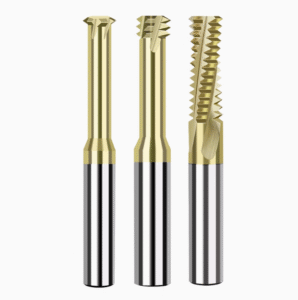
Comparative Analysis of Machining Accuracy and Surface Quality
Thread machining outcomes depend on tool structure, cutting method, material characteristics, and processing parameters. High-precision threading requires minimal pitch error, consistent tooth profiles, and excellent surface finish. Single-tooth and multi-tooth cutters perform differently in these aspects, necessitating careful selection based on workpiece requirements. Optimizing cutting path, feed rate, tool geometry, and coatings ensures high-precision, high-quality threading while improving part consistency and production efficiency.
For small-diameter threads, deep holes, or blind holes, single-tooth cutters are better for controlling pitch and profile accuracy. Multi-tooth cutters balance efficiency and surface finish in high-volume production. Custom thread mill tools further enhance accuracy and surface quality in non-standard threads or special materials, ensuring machining stability and part consistency.
Advantages of Single-Form Thread Mill Tools in High-Precision Threading
Single-tooth thread milling cutters allow precise control of material removal for each tooth, minimizing pitch error and thread profile deviation. In deep holes, blind holes, or high-hardness materials, single-tooth thread mill tools disperse cutting forces, reduce machine vibration and thermal deformation, and improve thread dimensional accuracy and surface finish.
Combined with optimized cutting parameters and tool geometry, single-form thread milling end mills offer strong stability, excellent repeatability, and low surface roughness. They are suitable for aerospace, precision machinery, and other high-demand machining scenarios.
Impact of Multi-Form Thread Milling Tools on Surface Roughness
Multi-tooth thread milling cutters increase efficiency through synchronous cutting in high-volume production, but cutting forces and tool vibration can affect surface quality. Optimizing tooth profile, cutting parameters, and machine rigidity allows multi-tooth cutters to maintain smooth surfaces.
In standardized production, multi-form thread milling end mills produce uniform thread profiles while maintaining machining cycles, reducing burrs and secondary operations. Custom tool designs further enhance surface quality in deep holes and high-hardness material machining.
Key Points for Controlling Pitch Error and Thread Profile Consistency
Pitch error and thread profile consistency are critical indicators of thread quality. Single-tooth cutters achieve precise removal through gradual cutting, suitable for workpieces with strict pitch and profile requirements. Multi-tooth cutters on high-rigidity machines maintain repeatability through even force distribution and optimized feed strategies.
Combining custom thread mill tools with optimized tooth profiles ensures high-precision threading in deep holes, blind holes, and hard materials, reducing scrap and improving mass-production yield.

Differences in Programming and Machining Strategies for Thread Milling End Mills
The programming and machining strategies for thread milling directly affect tool life, machining efficiency, and thread accuracy. Single-tooth and multi-tooth thread milling cutters differ significantly in tool path planning and feed strategies. They also have distinct program error tolerance characteristics.
Single-tooth tools are ideal for high-precision, complex threads or deep-hole threads. They distribute cutting forces through tooth-by-tooth cutting, offering flexible tool path planning, though machining cycles are longer. Multi-tooth tools are more efficient for mass production and standard threads, but require strict machine rigidity and careful parameter matching. Coordinating feed rate and spindle speed is essential to ensure thread consistency and surface finish.
By combining with custom thread mill tools, cutting paths and tool parameters can be optimized for different thread specifications, hole depths, and materials, balancing machining efficiency and thread accuracy for stable production.
Key Aspects of Tool Path Control in Single-Tooth Thread Milling
Single-tooth tools use a tooth-by-tooth cutting method. Tool path planning requires precise control of cutting depth, helix angle, and feed path for each layer. Proper tool path management distributes cutting forces, reduces tool vibration and machine load, and ensures thread profile accuracy and surface finish.
In small-diameter threads, deep holes, or blind holes, optimizing the cutting path is critical. Adjusting the number of cutting layers, entry angle, and compensation strategy ensures pitch consistency, tooth profile accuracy, and extended tool life.
Feed Rate and Spindle Speed Matching in Multi-Tooth Thread Milling
Multi-tooth thread milling cutters require precise feed rate and spindle speed coordination to maintain synchronous cutting stability. Excessive feed or mismatched spindle speed can lead to vibration, tool chipping, or thread deviations.
Optimizing cutting parameters, tool coatings, and geometry improves force distribution and chip evacuation, enhancing thread consistency and surface finish. Multi-tooth cutters reduce machining cycles and unit costs in standardized production.
Comparison of Program Error Tolerance and Debugging Difficulty
Single-tooth tools, due to layered cutting, have higher tolerance for programming or machine tool errors, making debugging relatively easier. They offer flexibility for non-standard threads or complex holes, ensuring high first-pass success rates.
Multi-tooth tools in mass production rely heavily on machine accuracy, fixture rigidity, and program settings. Low program error tolerance demands precise calculation of cutting parameters, helix angle, and feed rate. Combined with custom thread mill tools, programming strategies can be optimized, reducing debugging difficulty and improving machining stability and efficiency.

Application of Custom Thread Mill Tools in Single-Tooth and Multi-Tooth Structures
Standard thread mill tools cannot meet all non-standard threads or special workpiece requirements. Custom thread mill tools can be optimized for different pitches, diameters, thread profiles, and materials, achieving high precision, efficiency, and machining stability.
Custom tools in both single-tooth and multi-tooth configurations improve adaptability, extend tool life, reduce machining risks, and ensure consistency in mass production. Proper tooth profile, helix angle, and cutting path design maintain cutting stability in complex materials and deep/ blind holes. Selecting single-tooth or multi-tooth custom solutions according to batch size and workpiece specifications balances efficiency and accuracy.
Demand for Custom Thread Mill Tools for Non-Standard Threads
Non-standard threads, special profiles, or asymmetrical threads require customized tools for precise machining. Custom thread mill tools can be tailored by thread diameter, pitch, and depth to ensure accurate profiles and surface finish.
For complex hole shapes or small-batch, multi-spec production, single-tooth custom tools offer flexibility, while multi-tooth custom tools excel in mass production, balancing efficiency and thread consistency. Custom solutions improve machining stability and first-pass success rates for non-standard threads.
The Impact of Customized Tooth Profile on Machining Stability
Customized tooth profile design directly affects cutting force distribution and tool stress. Optimizing tooth angle, edge length, and helix design reduces vibration and improves stability in deep or blind hole machining.
Single-tooth custom tools disperse cutting forces for high-precision threading, ensuring pitch and profile consistency. Multi-tooth custom tools achieve efficient synchronous cutting while maintaining surface finish and thread accuracy. Tooth profile optimization ensures high stability across different materials and complex conditions.
Cost and Delivery Time Considerations for Single-Tooth and Multi-Tooth Custom Solutions
Single-tooth custom tools have lower design and manufacturing costs but slower processing, suitable for small batches, multiple specifications, or high-precision parts. Multi-tooth custom tools increase efficiency for high-volume production but have longer manufacturing cycles and higher costs.
Production planning should balance cost and delivery time with batch size, thread specs, and material type. Rational selection of single- or multi-tooth custom tools ensures machining accuracy, surface quality, and production efficiency.

Thread Mill Tool Selection Logic Based on Engineering Experience
Selecting single- or multi-tooth thread milling cutters depends on thread specifications, material, hole depth, machine performance, operator experience, and the trade-off between efficiency and yield. Single-tooth tools excel in flexibility and pitch control for high-precision, deep, or non-standard threads. Multi-tooth tools improve efficiency and repeatability in high-volume standardized production. Custom tools optimize performance further, balancing precision, stability, and productivity.
Selection should consider machine rigidity, material characteristics, tool structure, and process technology. Evaluating cutting force distribution, machining cycle, tool wear, surface quality, and pitch consistency provides feasible solutions for varied machining scenarios, reducing scrap, improving efficiency, and ensuring thread stability.
Machine Tool Performance as a Limiting Factor for Single-Tooth and Multi-Tooth Tools
Machine rigidity, spindle power, and fixture stability influence tool selection. Single-tooth tools, with smaller cutting loads, suit less rigid machines or deep/blind holes. Multi-tooth tools require high-rigidity machines and stable fixtures to maintain synchronous cutting accuracy and tool life.
Reasonable evaluation of machine performance and tool structure reduces vibration and wear, ensuring stable, consistent thread machining.
Influence of Operator Experience on Tool Structure Selection
Operator experience is critical for optimal thread milling. Skilled technicians select between single- and multi-tooth tools based on thread specs, material, and machine performance, adjusting cutting parameters and tool paths to maintain stability and surface finish.
For non-standard threads or complex workpieces, experience ensures proper use of custom thread mill tools, reducing wear, vibration, and defects, improving first-pass yield and production efficiency.
Decision-Making Approach Based on Yield, Efficiency, and Stability
Tool selection should consider machining yield, efficiency, and stability. Single-tooth tools suit small batches, multiple specs, or high-precision parts, ensuring pitch and profile consistency. Multi-tooth tools suit large-volume standardized production, reducing cycle time and unit cost.
Combining custom tools optimizes non-standard thread machining, balancing efficiency and quality. Rational matching of machine performance, tool structure, and cutting parameters, along with operator expertise, ensures thread stability, reduces scrap, and improves production efficiency.