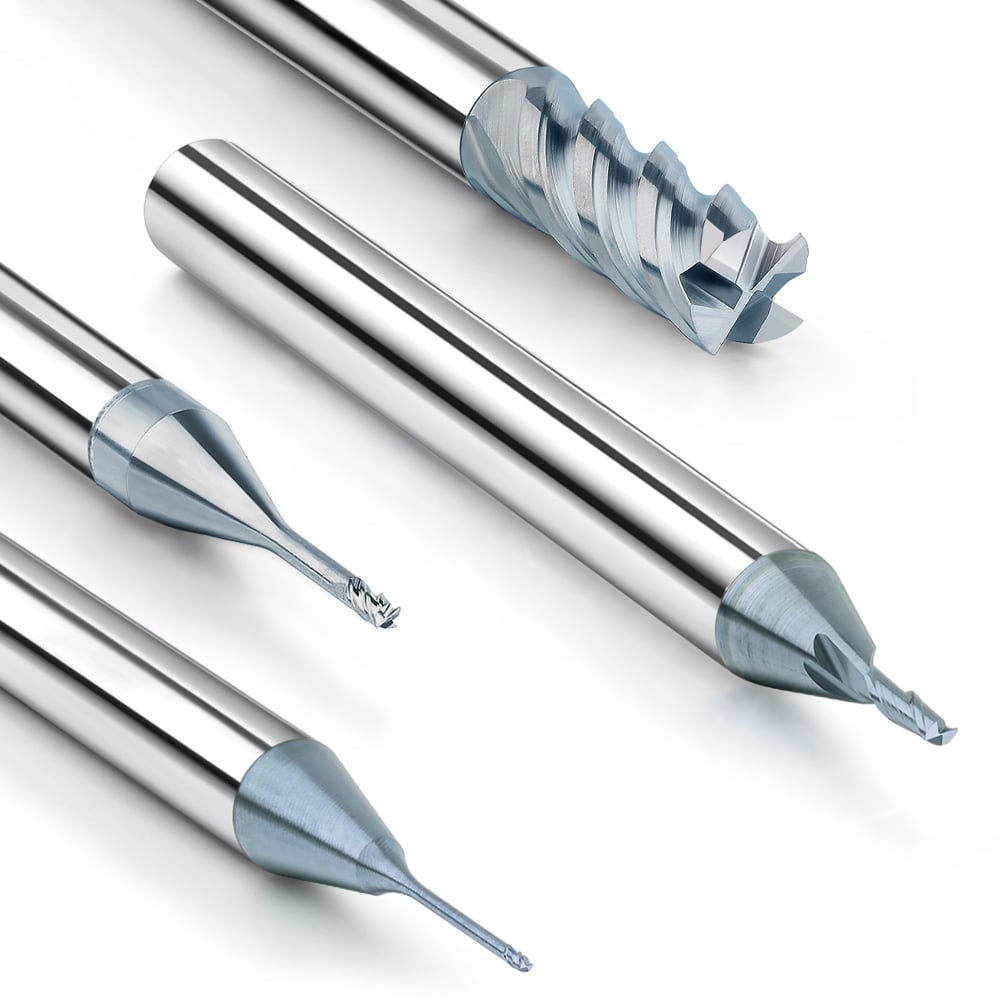
In modern manufacturing, precision metal cutting represents the ultimate pursuit of efficiency, stability, and quality. With the continuous advancement of automation and smart manufacturing, CNC milling machine tools have become essential for achieving high-accuracy machining. Whether producing aerospace structural components, precision molds, or high-volume runs of hardened steel and aluminum alloy parts, the performance of the cutting tools directly determines dimensional accuracy and surface finish.
High-performance tooling systems today combine the diverse geometries of milling machine cutters with advanced material technologies such as ultrafine-grain carbide, nano-composite coatings, and reinforced tool substrates. These innovations significantly increase cutting efficiency and tool longevity. At the same time, manufacturers are introducing new generations of CNC metal cutting tools that meet the growing demands of complex operations like five-axis machining, high-speed cutting, and intelligent tool monitoring.
When optimizing tooling solutions, manufacturers evaluate the overall performance of the best CNC milling machine tools for metal cutting—including wear resistance, thermal control, stability, and tool change frequency. Choosing the right tool system enhances productivity, reduces machine load, and minimizes material waste.
Increasingly, OEM CNC milling tool manufacturers are offering customized cutting tool services, developing application-specific designs that optimize cutting paths, tool geometries, and rake angles. These tailor-made solutions allow companies to maximize performance under specific materials and machining conditions.
Core Requirements for CNC Milling Tools in High-Precision Metal Machining
High-precision metal machining depends not only on advanced CNC machines but also on the integrated performance of CNC milling machine tools. For applications demanding mirror-like finishes, tight tolerances, and long-term cutting stability, the design, material selection, and rigidity of the tooling system are critical. Whether using milling machine cutters for fine milling of complex cavities or CNC metal cutting tools for heavy-duty cuts on hardened steel or titanium alloys, the tools must offer exceptional wear resistance, dimensional control, and thermal stability.
Consistent accuracy across variable spindle speeds and feed rates requires precise matching between the tool’s geometry, material, and clamping system. Proper tool selection minimizes vibration, thermal deformation, and wear—ensuring better consistency and higher precision.
Key Factors Affecting Machining Accuracy and Surface Quality
The main variables influencing CNC machining accuracy and surface finish include tool sharpness, balance, cutting parameters, and machine rigidity. The best CNC milling machine tools for metal cutting feature high concentricity, micro-edge preparation, and minimal runout, effectively reducing burrs and tool marks.
In high-speed milling, heat transfer between the tool and workpiece, coolant control, and toolpath programming directly affect surface quality. Maintaining consistent cutting forces and appropriate tool projection minimizes vibration, improving both dimensional accuracy and finish.
Uncontrolled tool wear can drastically reduce part quality. Therefore, implementing tool wear monitoring and timely replacement is essential for maintaining precision in high-value manufacturing.
Matching Strategies for Tool Materials, Geometry, and Coatings
Premium CNC milling machine tools are typically made from fine-grain carbide, ultrafine tungsten carbide, or ceramic-based composites to balance hardness and fracture resistance. The cutting geometry should match the material’s behavior: aluminum benefits from large helix angles for efficient chip evacuation, while stainless steel requires negative rake angles to strengthen the cutting edge.
Modern coatings such as TiAlN, AlCrN, and DLC significantly improve CNC metal cutting tool performance. These nano-coatings increase thermal resistance, reduce friction, and extend tool life. Under high-temperature or multi-axis cutting conditions, such coatings ensure dimensional stability and a superior surface finish.
The Importance of Tool Stability and Toolholder Systems
Cutting precision ultimately depends on system rigidity and dynamic balance. Even high-end cutting tools can produce dimensional errors if paired with unstable toolholders that cause runout or resonance.
In high-precision machining, HSK, BT, and shrink-fit toolholders are widely used to improve rigidity and positioning accuracy. These systems minimize tool deflection and maintain cutting stability, ensuring that even the best CNC milling machine tools for metal cutting can deliver consistent accuracy in long production runs.
Manufacturers focused on tight-tolerance assembly or mold production often collaborate with OEM CNC milling tool manufacturers to design tool–holder combinations with optimal mechanical compatibility. This integrated approach enhances cutting stability, extends tool life, and ensures superior surface quality.

Analysis of Mainstream CNC Milling Machine Tools Types and Applications
Different types of CNC milling machine tools serve unique functions throughout the machining process—from roughing to finishing, and from planar cutting to complex contouring. Each type offers distinct geometrical and performance advantages. Today’s manufacturing standards emphasize not only cutting ability but also comprehensive attributes such as tool life, accuracy, and stability.
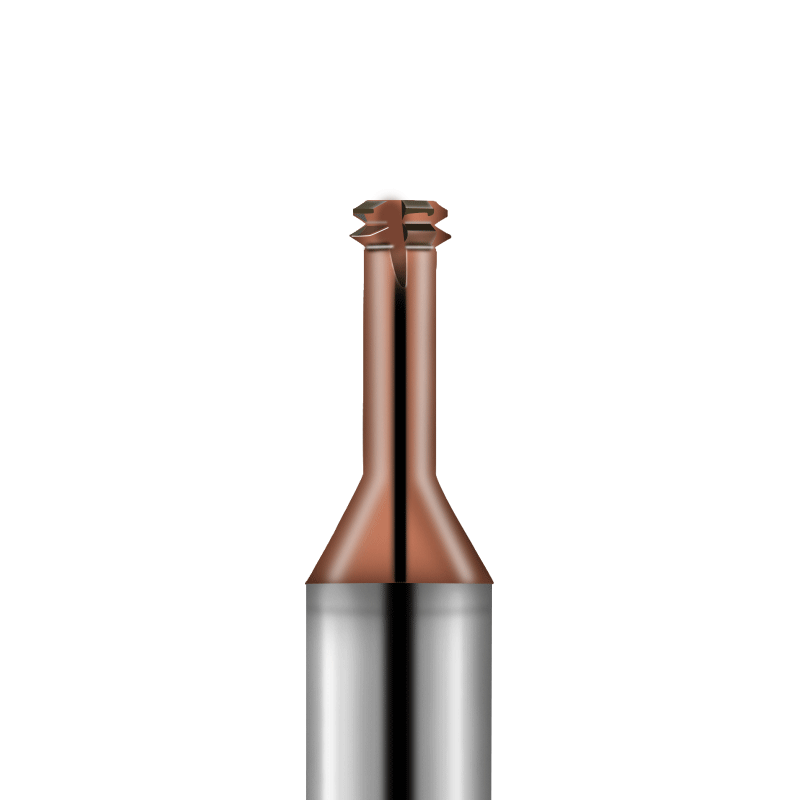
In practical applications, common milling machine cutters include end mills, face mills, ball-nose end mills, corner-radius end mills, and special-purpose tools. These are essential in industries such as mold making, automotive, aerospace, and precision engineering. Proper tool selection requires evaluating material type, machining path, surface requirements, and machine capability to ensure high efficiency and stability in CNC metal cutting operations.
Advantages of End Mills in Machining Complex Parts
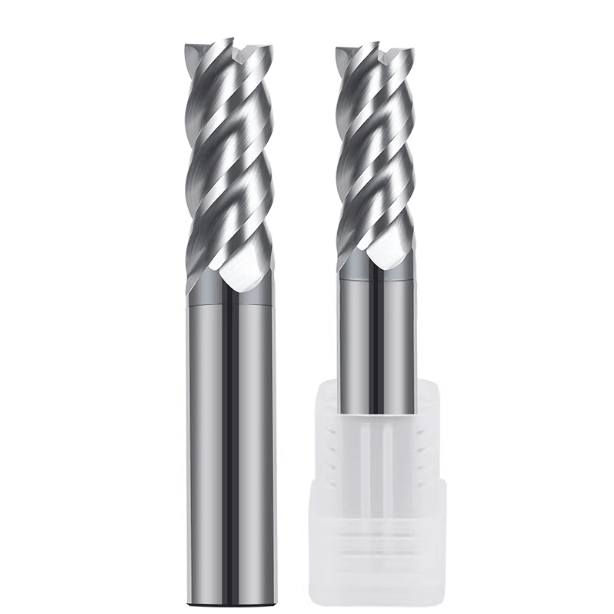
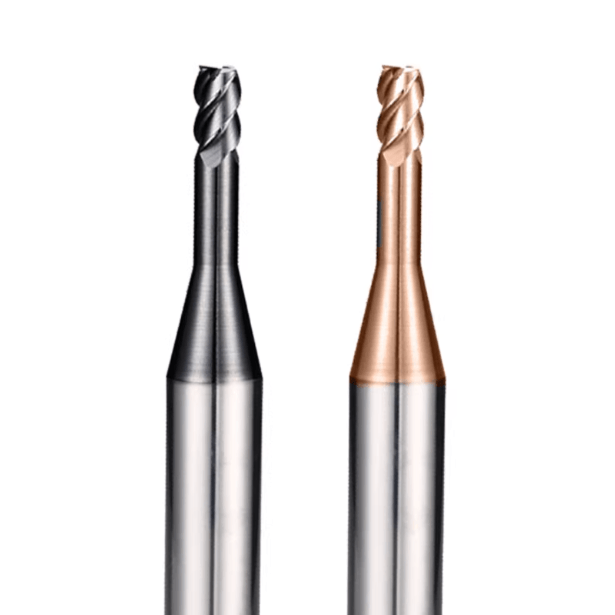
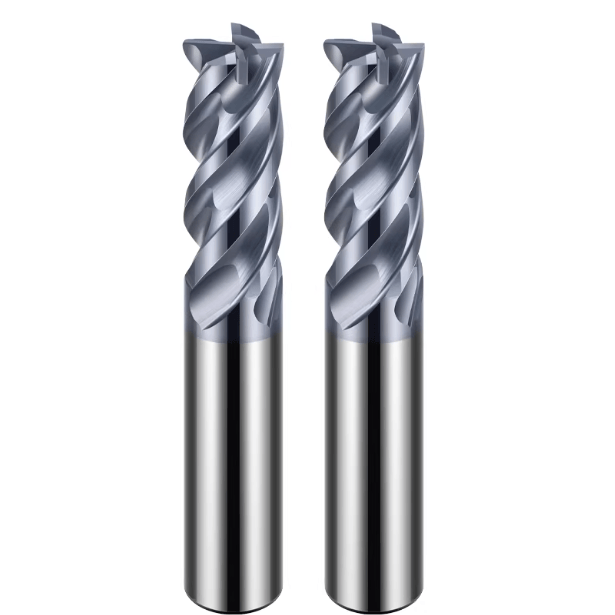
End mills are among the most versatile and widely used CNC milling machine tools, ideal for machining planes, grooves, and contours. High-performance end mills made of micro-grain carbide and coated with TiAlN or AlCrN maintain sharpness and wear resistance under high-speed and high-feed conditions.
In complex part machining, their multi-flute and helix designs reduce vibration, improve finish, and extend tool life. In industries such as aerospace and precision molds, the best CNC milling machine tools for metal cutting enable high-accuracy cavity finishing and precise surface contouring. Especially in five-axis CNC machining, end mills provide superior toolpath control and stability.
Leading OEM CNC milling tool manufacturers now offer specialized end mills optimized for difficult materials like titanium and nickel alloys. By customizing rake angles and flute geometries, these tools achieve higher metal removal rates and more consistent surface quality.
Comparison of Finishing with Face Mills, Ball End Mills, and Corner Radius End Mills
During finishing, the choice of tool type directly affects surface smoothness and dimensional consistency. Face mills are primarily used for large planar surfaces. Their multi-insert designs ensure high material removal rates and flatness—ideal for steels and cast iron.
Ball end mills excel in machining intricate 3D surfaces such as molds, impellers, and cavities. Their spherical geometry minimizes tool marks, producing excellent surface finishes.
Corner-radius end mills, combining features of both ball and flat end mills, reduce stress concentration at the cutting edge and improve tool durability. In high-hardness materials or high-feed conditions, they maintain edge strength and stable surface consistency. Selecting the right combination of tool diameter, corner radius, and cutting parameters ensures both productivity and precision.
Performance of Special-Purpose Tools in Machining High-Hardness Metals
Machining hardened steel (above HRC 60), tool steel, titanium alloys, and nickel-based alloys imposes extreme demands on tool performance. Standard cutters often suffer from chipping, rapid wear, or heat buildup. Specialized CNC milling machine tools designed for these conditions use ultrafine-grain carbide, CBN, or PCD, paired with high-temperature coatings like AlTiN or TiSiN.
Optimized tool geometry—such as negative rake angles and generous clearance—reduces cutting resistance, ensuring stability and accuracy even under heavy load.
Top OEM CNC milling tool manufacturers employ simulation and process data analysis to develop customized tooling solutions for hard materials—for instance, wear-resistant micro-edge cutters for mold cavities or low-friction, high-rigidity tools for titanium aerospace parts.
Such advanced milling machine cutters deliver higher productivity, improved tool economy, and better process reliability in high-hardness machining.
Performance Optimization of Milling Machine Cutters in Metal Cutting
The essence of metal cutting lies in the dynamic interaction between the cutting tool and the material. High-efficiency milling machine cutters must not only offer excellent sharpness and wear resistance but also maintain stable performance across various materials, cutting environments, and machine parameters. As manufacturing increasingly demands higher precision and productivity, tool performance optimization has become a key factor in CNC machining competitiveness.
In practice, CNC milling machine tool optimization involves three main aspects: selecting the appropriate tool structure and material, scientifically adjusting cutting parameters, and strategically planning tool combinations. Through these optimizations, manufacturers can significantly improve productivity, extend tool life, and reduce overall costs without sacrificing machining accuracy.
The following sections analyze three critical areas—tool selection for different materials, cutting parameter optimization, and tool combination strategies—to help manufacturers maximize the performance of CNC metal cutting tools in diverse machining applications.
Key Points for Tool Selection for Aluminum Alloys, Stainless Steel, and Titanium Alloys
Different metal properties require distinct approaches to tool design and cutting strategies.
Aluminum Alloys:
Characterized by high ductility and a low melting point, aluminum alloys are prone to built-up edges. High-helix end mills or mirror-polished CNC milling tools are ideal, often using uncoated or DLC-coated designs to reduce chip adhesion. Lightweight tool bodies and large chip flutes enable efficient chip evacuation and smooth high-speed cutting.
Stainless Steel:
With high hardness and poor thermal conductivity, stainless steel demands tools with strong heat resistance. TiAlN or AlCrN coatings help reduce heat buildup and prevent edge chipping. A smaller rake angle and moderate cutting speed improve tool stability and surface finish.
Titanium Alloys:
These alloys have high strength and low thermal conductivity, which can cause adhesion and wear. Fine-grained carbide or coated CBN tools, combined with sufficient coolant and optimized chip-breaking geometry, deliver the best performance.
Selecting the correct geometry and surface coating for each material type is crucial for improving cutting performance and extending tool life. Leading OEM CNC milling tool manufacturers often provide customized cutting solutions tailored to specific metal characteristics and machining conditions.
Cutting Parameter Adjustment and Tool Life Management Techniques
Proper cutting parameters are the foundation of tool performance optimization. Key variables—spindle speed, feed rate, depth of cut, and cooling strategy—must be coordinated according to the tool and workpiece materials.
-
Aluminum alloys: Increase spindle speed and reduce cutting depth to minimize chip adhesion.
-
Stainless steel and titanium alloys: Lower feed rate and ensure sufficient coolant flow to manage cutting heat.
Real-time tool condition monitoring helps detect wear patterns and enables timely parameter adjustments, preventing surface defects and dimensional deviations.
Effective tool life management also includes regrinding schedules and replacement cycles. Establishing a tool life database allows manufacturers to track tool performance across operating conditions, improving cost control and production planning.
How to Improve Production Efficiency Through Tool Combinations
In multi-stage or high-volume manufacturing, a single tool rarely meets all machining needs. A well-planned tool combination strategy can minimize tool changes and maximize productivity.
For complex part machining, using different tools for roughing, semi-finishing, and finishing reduces downtime and ensures consistent results. In five-axis or multitasking machining centers, modular tool systems and quick-change toolholders enhance efficiency and machining continuity.
Many advanced manufacturers collaborate with OEM CNC milling tool suppliers to develop customized toolsets for specific process routes. Examples include high-strength ball end and corner-radius end mill combinations for titanium parts, or lightweight, high-chip-flow face mills for aluminum structures.
Through systematic tool combination and process integration, manufacturers can achieve higher equipment utilization, better part quality, and greater cost efficiency.
Selection Criteria for the Best CNC Milling Machine Tools for Metal Cutting
Choosing the right CNC milling machine tools is essential for achieving both high-quality and cost-effective metal cutting. Different workpiece materials, machine configurations, and cutting conditions require specific tool designs, coatings, and heat resistance levels.
High-performance milling machine cutters should deliver three critical features: wear resistance, system stability, and precision control. These depend not only on tool material and geometry but also on external factors such as cooling strategy, toolholder rigidity, and machine tool dynamics.
When evaluating the best CNC milling tools, manufacturers should assess three main dimensions: high-speed cutting capability, adaptability to complex toolpaths, and cost-efficiency—ensuring optimal balance between performance and economics.
Tool Performance Evaluation in High-Speed Machining (HSM) Environments
HSM has become a dominant trend in precision manufacturing, requiring tools with superior thermal stability, vibration resistance, and chip evacuation efficiency. Under HSM conditions, tools must endure high temperatures, centrifugal forces, and friction—making material and coating selection critical.
For light metals such as aluminum, use large-helix, lightweight end mills that promote chip evacuation and reduce tool load. For harder materials like steel and titanium alloys, nano-coated tools provide superior heat resistance and longer tool life.
Dynamic balance and runout control are vital at high speeds. High-precision toolholders ensure stable tool rotation with minimal vibration. Certified balanced cutting tools are recommended for maintaining consistent quality and surface finish during HSM operations.
Higher Requirements for Tool Performance in Multi-Axis Machining Centers
Multi-axis machining—especially five-axis CNC—demands higher tool rigidity, geometry accuracy, and cutting flexibility than traditional three-axis setups.
Key requirements for tools in multi-axis machining include:
-
High-rigidity tool bodies to prevent runout and resonance.
-
Optimized cutting angles and tip radii for consistent cutting load across different tilt angles.
-
Heat-resistant coatings and smooth chip flutes to prevent chip accumulation and thermal fatigue.
For precision industries such as mold making, aerospace, and medical devices, OEM CNC milling tool manufacturers offer specialized tools with optimized cutting edge angles, cooling holes, and weight distribution for enhanced surface quality and shorter cycle times.
Balancing Tool Cost and Production Efficiency
Balancing tooling cost and production performance is critical in manufacturing management. Instead of focusing solely on tool price, decision-makers should evaluate total lifecycle costs, including tool life, productivity, tool change frequency, and maintenance.
Premium CNC metal cutting tools may cost more initially but often deliver lower per-part costs through longer service life and reduced downtime. Implementing predictive maintenance and tool monitoring systems enables early detection of wear, minimizing waste and ensuring consistent quality.
Using modular tool systems further reduces setup time and enhances flexibility. Partnering with experienced OEM CNC milling tool manufacturers allows companies to customize solutions that align tool investment with production goals.
The ultimate goal is to achieve synergy between precision, efficiency, and cost-effectiveness, ensuring stable and economical production across the entire manufacturing line.
Innovation and Technological Trends in CNC Metal Cutting Tools
As manufacturing shifts toward intelligent and sustainable production, CNC metal cutting tools are experiencing deep innovation. From advanced coatings and composite materials to intelligent monitoring and eco-friendly manufacturing, these tools are evolving into “data-driven intelligent systems.” These advancements not only boost machining efficiency and tool lifespan but also drive overall quality and cost optimization in precision manufacturing.
The current development of CNC milling machine tools focuses on three strategic directions: performance breakthroughs in nano-coatings and composite materials, sensing and analytics capabilities in intelligent tooling, and sustainable tool systems under green manufacturing. By integrating materials science, information technology, and ecological manufacturing principles, modern tools are becoming pivotal to productivity improvements and Industry 4.0 readiness.
Application of Nano-Coatings and New Composite Material Tools
Breakthroughs in nano-coating technologies have transformed the performance of milling machine cutters. Traditional coatings like TiN and TiAlN are increasingly replaced by multi-layer composite structures such as AlTiN, AlCrN, TiSiN, and DLC. These nano-coatings form dense thermal barrier layers at the micro-level, lowering friction, improving wear resistance, and delivering better thermal stability.
Meanwhile, new composite tool materials—ultrafine-grain cemented carbide, ceramic-matrix composites, CBN, and PCD—are emerging as key technologies for the best CNC milling machine tools for metal cutting.
-
CBN tools excel in high-speed finishing of hardened steel and super-alloys.
-
PCD tools deliver extraordinary wear resistance and surface finish when machining aluminum alloys, copper alloys, and carbon-fiber composites.
-
Ceramic tools offer clear advantages in high-temperature and dry-machining operations.
Leading OEM CNC milling tool manufacturers are combining nanostructured coatings and new tool-body composites to build lighter, higher-rigidity tools designed for demanding high-speed and multi-axis applications.
Intelligent Tools and Data-Driven Machining Monitoring Systems
In smart manufacturing, tools are no longer passive—they’ve become perceptive information nodes. Intelligent CNC metal cutting tools embed sensors that measure cutting force, temperature, vibration, and tool wear in real time. These data feed into machine control systems for process monitoring and predictive maintenance.
Leveraging IIoT (Industrial Internet of Things) and cloud analytics, these tools dynamically adjust cutting parameters—optimizing feed rates and spindle speeds to extend tool life and maintain part quality.
For example, in a five-axis machining center, CNC milling tools equipped with intelligent monitoring can detect load variations and correct toolpaths automatically to prevent chipping or overcutting.
This “data-driven machining” model is rapidly adopted by aerospace, medical device, and high-precision mold manufacturers. In the future, intelligent tools will integrate deeply with machine systems, becoming indispensable high-value components in automated production lines.
Green Manufacturing and Sustainable Tooling Technology Development
With global manufacturing emphasizing energy efficiency and environmental responsibility, green machining has become an essential trend in tooling. Maintaining performance while reducing resource use and environmental impact is a primary goal for modern CNC milling machine tools.
Green tooling strategies include:
-
Dry cutting and MQL: Reducing coolant dependency via optimized coatings and heat-dissipation designs.
-
Regrindable tool systems: Extending tool life, lowering waste, and cutting manufacturing costs.
-
Recyclable materials and low-carbon manufacturing: Using eco-friendly substrates and energy-efficient coating processes to reduce carbon footprint.
Some leading OEM tool manufacturers now apply “circular manufacturing” concepts—tool recycling, remanufacturing, and secondary coating—to close the material loop.
In the future, green tools will not just meet environmental standards but emerge as strategic assets for cost reduction and brand differentiation.
The Value of Cooperation and Customization for OEM CNC Milling Tool Manufacturers
In today’s precision and automated manufacturing environment, companies are demanding higher performance, stability, and reliable supply of CNC milling machine tools. Partnering with OEM CNC milling tool manufacturers has become a key strategy for optimizing production efficiency, controlling costs, and strengthening brand competitiveness.
OEM cooperation is more than tool supply—it’s a comprehensive technical service offering custom design, material optimization, tool-life management, and process support.
By collaborating with experienced partners, companies gain targeted solutions such as geometry-optimized high-precision milling machine cutters, custom coatings, special-alloy tools, and dedicated tooling for specific environments like high-speed cutting, hardened material machining, or dry processing.
This deep collaboration model is emerging as a core development trend for the best CNC milling machine tools for metal cutting.
How to Select a Reliable OEM Tool Manufacturer
Choosing the right partner is critical for ensuring quality and supply chain stability. High-quality OEM manufacturers not only have advanced production and quality-control systems, but also strong tool-design capabilities and process optimization experience.
When evaluating a potential partner, consider:
-
Manufacturing capabilities and technology reserves: Do they have complete production lines and an R&D team?
-
Materials and coating technologies: Are they proficient in coatings such as AlTiN, TiSiN, DLC and treatment of superhard alloy materials for high-performance CNC metal cutting tools?
-
Customization and responsiveness: Can they quickly develop tools tailored to different materials (stainless steel, titanium, aluminum) based on customer requirements?
-
Quality control and after-sales support: Do they offer dynamic-balancing testing, microstructure inspection, and reliable technical support?
Top OEM partners often act not only as suppliers but as long-term technical collaborators offering ongoing tool optimization and production improvement guidance.
Customized Tool Design Enables High-Precision Production
The true value of custom tooling lies in adapting to specific process demands rather than generic versatility. With the rise of complex parts, difficult-to-machine materials, and multi-axis machining, standard tools often no longer suffice.
OEM tool manufacturers use CAD/CAM modeling and simulation to develop optimal tool structures for specific part geometries, materials, and toolpaths. For example:
-
High-rigidity corner-radius end mills for titanium alloy machining reduce cutting forces and tool wear.
-
High-helix end mills for aluminum alloys enhance chip flow and surface finish.
-
Multi-layer nano-coated ball end mills for mold steel machining maintain high heat resistance and chipping resistance in high-speed operations.
Through custom design, companies can significantly improve tool life, stability, and product consistency—achieving true “tool-process-equipment” integrated optimization.
The Impact of OEM Cooperation on Brands and Supply Chains
OEM cooperation extends beyond production tools—it becomes part of a manufacturing brand’s competitive foundation.
In the CNC milling machine tools market, many leading brands achieve high-end differentiation through OEM partnerships, with unique tool series that elevate brand value.
Key benefits include:
-
Brand strengthening: Companies maintain their brand image while leveraging professional technical support and performance endorsement from OEM partners.
-
Supply-chain stability: Long-term OEM relationships help ensure consistent delivery cycles and tool quality, reducing inventory pressure and production downtime.
-
Cost control: The OEM model reduces R&D and equipment investment compared to in-house production while improving customization flexibility.
-
Technical collaboration: OEM partners often assist with tool testing and cutting-test data analysis to optimize overall machining processes and production line output.
In the global manufacturing landscape, selecting a reliable OEM CNC milling tool manufacturer has become a strategic move to enhance competitive advantage and build sustainable supply chains. OEM collaboration not only optimizes tool performance but also drives the industry toward specialization, intelligence, and efficiency.
Summary and Future Outlook
In the context of ongoing upgrades in precision manufacturing and the restructuring of global industrial chains, CNC milling machine tools have emerged as a core technological element driving high-end manufacturing systems. From innovations in tool materials and coatings to integration with intelligent monitoring and green manufacturing, and from customized OEM collaboration models to full tool-process-equipment integration, modern cutting tools are transforming from consumables into critical units of intelligent manufacturing.
Looking ahead, CNC metal cutting tools will not only meet higher demands for cutting efficiency and precision but will also play increasingly important roles in digitalization, sustainability, and flexible manufacturing. By working alongside data-monitoring systems, automated equipment, and AI-based process optimization platforms, tooling will become high-value information nodes in the intelligent manufacturing ecosystem—bringing firms greater production controllability and process adaptability.
To remain competitive, companies must re-strategize their tooling approach:
-
Embrace high-performance milling machine cutters and advanced coating technologies.
-
Deepen customized collaboration with professional OEM CNC milling tool manufacturers.
-
Establish data-driven tool-management and maintenance systems.
-
Promote continuous implementation of green manufacturing and energy-efficient production.
These measures will be essential for achieving the optimal balance of quality, cost, and efficiency in future high-end manufacturing.
The Strategic Position of CNC Milling Tools in Intelligent Manufacturing
In Industry 4.0 and smart manufacturing systems, tools are no longer just cutting components—they are critical nodes in the digital production chain. Modern CNC milling machine tools enable real-time monitoring and predictive maintenance via embedded sensing, data collection, and intelligent analytics. They can autonomously identify cutting conditions, adjust process parameters, and optimize tool lifecycles—delivering “self-sensing, self-adjusting, self-optimizing” functionality.
This evolution positions the tool as a “data bridge” between machine systems and process control. In industries such as aerospace, medical, and electric vehicles, intelligent tools dynamically correct toolpaths to maintain consistent precision on complex surfaces. From a strategic perspective, CNC milling tools have upgraded from traditional process accessories to strategic nodes in intelligent manufacturing—directly influencing efficiency, energy consumption, and product consistency.
The Driving Role of Technological Upgrading in the Global Metal-working Industry
Technological innovation is reshaping the global metal-cutting industry. New materials, coatings, and smart manufacturing methods have enabled a leap in the performance and lifespan of the best CNC milling machine tools for metal cutting.
The adoption of HSM, five-axis CNC, and automatic tool-change systems (ATC) has driven improvements in machining accuracy, productivity, and machine integration. Simultaneously, the rise of OEM tool manufacturers has enabled companies to obtain customizable, high-performance solutions while keeping costs under control—accelerating global collaboration and supply-chain optimization.
In the future, the metal-cutting industry will concentrate on three key dimensions:
-
Intelligentization: Deep interconnection between tools, machine tools, MES systems, and cloud platforms for full life-cycle data management.
-
Greening: Adoption of dry cutting, re-grindable tools, and low-carbon processes to meet sustainable manufacturing demands.
-
Customization: Tailored tool design through OEM collaboration to meet the needs of complex parts and high-hardness materials.
It is foreseeable that as these technologies evolve, CNC milling machine tools will continue to lead the transformation and upgrading of the global manufacturing industry. They are not only symbols of productivity—they are key drivers for companies advancing toward intelligent manufacturing and high-quality development.