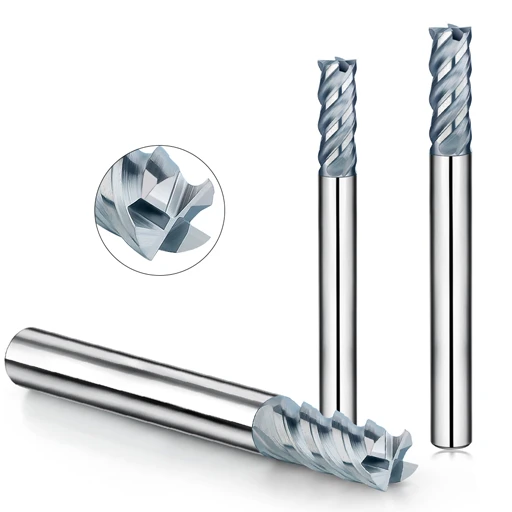
Q1: What are the recommended key machining parameters for an HRC55 4 flute long neck flat end mill?
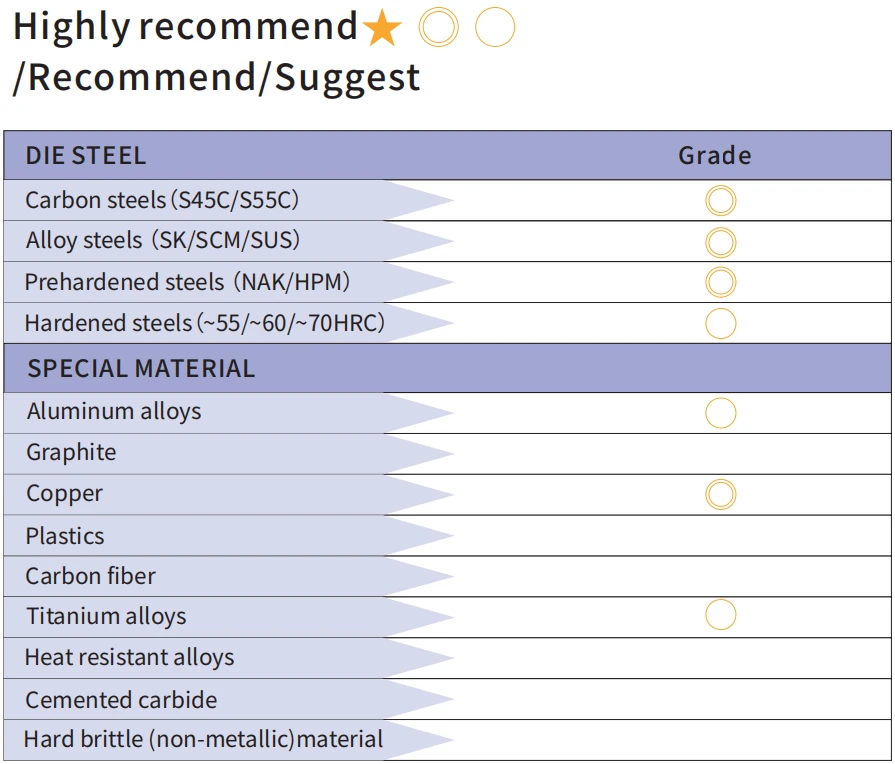
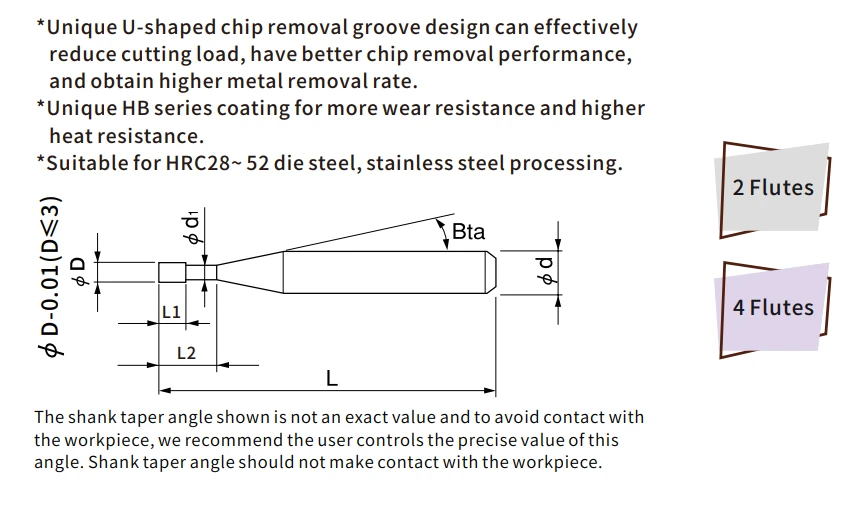
A: When using an HRC55 4 flute long neck square end mill for mold steel machining, a medium-to-high-speed cutting strategy is generally recommended for steels in the HRC30–50 range.
Key recommendations include:
- Use a small radial depth of cut (ae), typically 0.1–0.3D.
- Apply a layered machining strategy for axial depth of cut (ap).
- Prefer climb milling to reduce cutting impact and improve surface finish.
- Ensure stable cooling or use air blast for chip evacuation.
Actual cutting parameters should always be adjusted based on machine rigidity, tool overhang length, and workpiece geometry. In mold steel applications, stability is more important than maximum material removal rate.
Q2: What are the most common issues when using HRC55 long neck flat end mills, and how can they be prevented?
A: In real-world mold steel machining with long neck flat end mills, several common issues may occur:
- Chatter marks caused by reduced rigidity at extended tool length.
- Chip recutting in deep cavities due to poor evacuation.
- Micro-chipping at the cutting edge under unstable load conditions.
To reduce these problems:
- Minimize tool overhang as much as possible.
- Reduce axial and radial depth of cut (ap and ae).
- Improve chip evacuation using air blast or oil mist.
- Use step-down machining instead of full-depth cutting.
These practices significantly improve tool life and surface stability in deep cavity mold applications.
Q3: What advantages does a 4-flute design offer compared to a 2-flute tool in HRC55 mold steel machining?
A: A 4 flute HRC55 long neck flat end mill is generally preferred for finishing operations in mold steel machining.
Key advantages include:
- More cutting edges in contact with the material, resulting in improved surface finish.
- Lower load per flute, which increases stability during continuous cutting.
- Better performance in finishing toolpaths such as wall finishing and floor finishing.
However, chip evacuation is weaker compared to a 2-flute design.
For this reason, 4-flute tools are not recommended for deep-slot roughing or heavy stock removal in mold steel.
Q4: Why does chatter occur with long neck flat end mills, and how can it be optimized?
A: Chatter is a common issue when using a long neck flat end mill for mold steel, mainly due to reduced rigidity as tool overhang increases.
Typical symptoms include:
- Wavy sidewall surface finish
- Poor dimensional accuracy
- Visible vibration marks on machined surfaces
To improve stability:
- Keep tool overhang as short as possible (optimize L/D ratio).
- Reduce radial engagement to lower cutting force.
- Increase spindle speed to reduce cutting load per tooth.
- Use climb milling to stabilize cutting direction.
- Apply segmented or step machining strategies for deep cavities.
Proper setup is critical when machining deep mold cavities with long reach tools.
Q5: Is the HRC55 4-flute long neck flat end mill better for roughing or finishing?
A: The HRC55 4-flute long neck flat end mill for mold steel machining is primarily designed for finishing and semi-finishing operations.
Typical applications include:
- Finishing deep cavity sidewalls
- Precision floor finishing in mold cavities
- Achieving tight dimensional tolerances in pre-hardened steel
It is not recommended for heavy roughing operations.
The long neck structure reduces rigidity, which makes it unsuitable for high material removal rates.
For best results in mold steel machining, this tool should be used after roughing tools have removed the bulk material.





![HRC55 Flat End Mill [2 Flutes ϕ0.2-6]](https://samhotool.com/wp-content/uploads/2023/11/3-10.webp)