

A batch of S136 mold steel cavities—vacuum heat-treated to HRC63—was nearly scrapped over one final step: threading an M8 blind hole. This real-world crisis came from a German medical mold maker, and it reflects a recurring nightmare we see across sixteen years of cutting tool manufacturing. Even top-tier carbide taps can snap instantly from poor chip evacuation, leaving your shop with costly EDM removal and blown delivery schedules.
When machining quenched steel, many U.S. and European machinists switch to a single tooth thread mill to lower cutting resistance. However, single-point loading makes batch production painfully slow, and minor spindle runout quickly triggers micro-chipping at the cutting edge. Once the edge chips, the thread’s pitch diameter shrinks, causing finished parts to fail go/no-go gauge inspections.
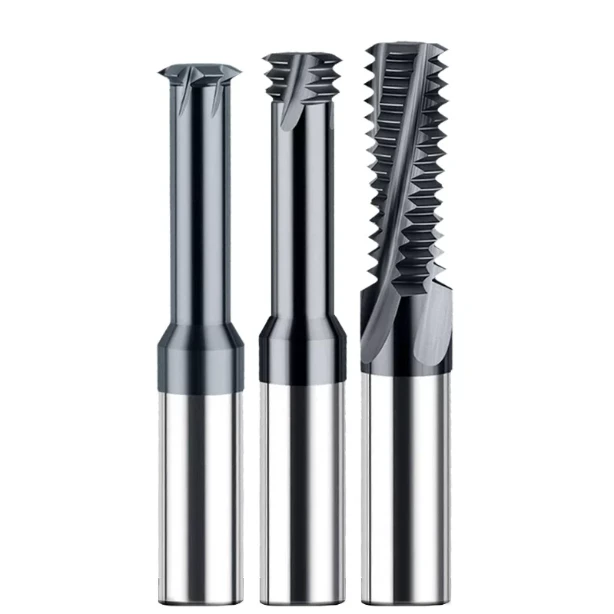
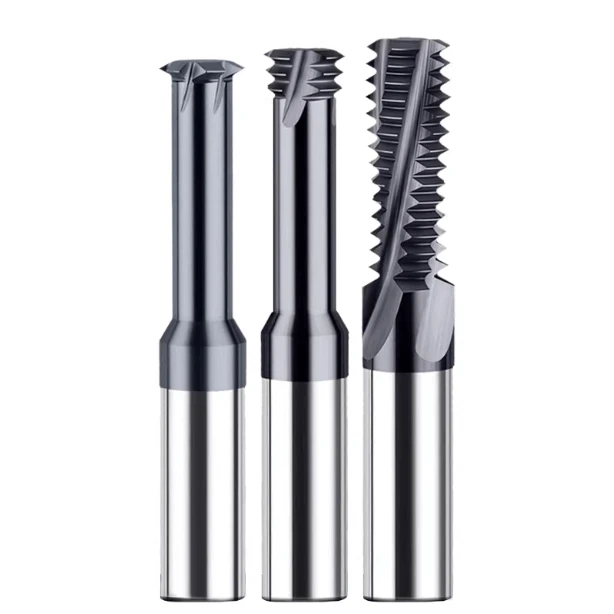
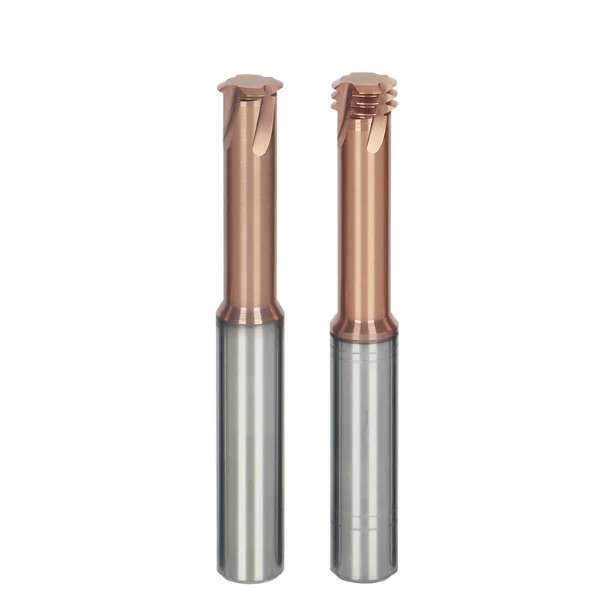
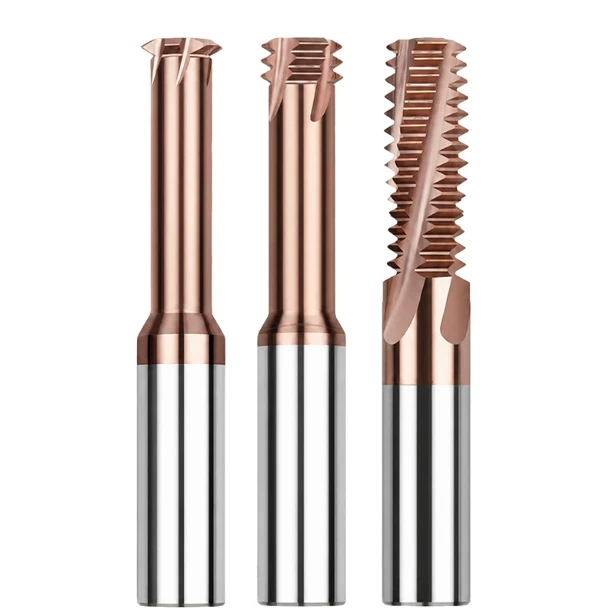
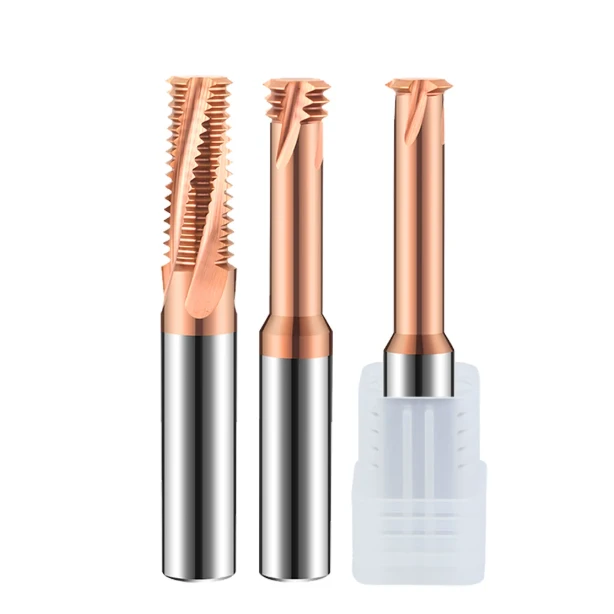
To solve this conflict between cycle time and process stability, we engineered our HRC65 3 tooth thread mill specifically for HRC60–HRC65 materials. By optimizing the solid carbide core rigidity and flute geometry, all three teeth share the radial cutting load without choking chip clearance. On-site trials proved it cuts cycle times in half, multiplies tool life, and holds strict 6H thread tolerances—so why keep risking broken taps or sluggish single-tooth cycle times in your shop?
Workshop Benchmarking: Why Switch from Single Tooth to Three Tooth Thread Mills for Hardened Steel?
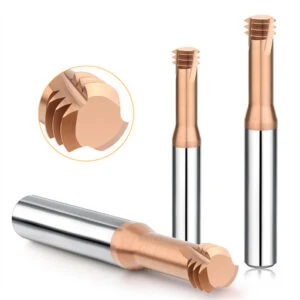
When helping precision mold shops thread HRC60+ components, engineers often ask us: “Isn’t a single-tooth tool safer because it generates the lowest cutting resistance?” On paper, yes, but batch production tells a different story. After extensive stress-testing in our lab and on customer machines, our verdict is clear: for high-volume or deep-hole hardened steel work, upgrading to a 3 tooth thread mill is the best way to protect both yield and cycle time.
We aren’t dismissing single-tooth cutters entirely, as tooling selection always comes down to smart engineering trade-offs. If you only thread one or two shallow, large-pitch holes occasionally, a single flute works fine. However, continuous production in hardened mold steel exposes its flaws immediately—here is what our shop-floor testing revealed.
The Limitations of Single-Tooth Thread Mills for HRC60+ Materials
Last year, while helping a German injection mold shop machine HRC63 inserts, the client initially insisted on using a standard single tooth thread mill for M6 blind holes. Because just one cutting edge handles the entire helical interpolation path, we had to choke back the feed per revolution to hold the required surface finish. As a result, cycle times dragged painfully, with thread finishing alone eating up over four hours per mold insert.
Deep-hole chip evacuation makes single-tooth cutters even riskier because all heat and impact concentrate on one isolated tip. At the bottom of a blind hole, fine hardened steel chips can get re-cut if high-pressure air doesn’t clear them instantly, causing microscopic edge chipping in milliseconds. You won’t hear this failure happen on the machine—you only find out when the go/no-go gauge binds halfway down the thread.
How a 3-Tooth Thread Mill Balances Cutting Resistance with Axial Feed Rigidity
To eliminate single-point failure, we recalculated the core-to-flute geometry when developing our latest solid carbide thread milling cutter. While some machinists worry that extra teeth crowd out chip space, grinding precise helix angles and flute depths on our 5-axis machines ensures smooth chip ejection. Even better, the reinforced core diameter dramatically boosts overall flexural rigidity.
On HRC64 test blocks at identical spindle speeds, three symmetrical flutes distribute radial cutting forces evenly around the tool’s circumference. This balanced load suppresses deflection and high-frequency chatter during long-overhang cuts, shifting the cutting sound from a sharp shriek to a steady, quiet hum. By keeping the chip load per tooth constant, we increased axial feed rates by nearly 2.5x while eliminating taper errors completely.

Real-World Case Study: Using an HRC65 3-Tooth Thread Mill for Thread Milling S136 Hardened Steel
After vacuum quenching and tempering to HRC62+, S136 mold steel (AISI 420ESR) delivers superior corrosion resistance and mirror-polishability, yet its high chromium content and martensitic structure make threading brutal. When helping shops with thread milling S136 hardened steel, we see most failures happen because machinists apply standard pre-hardened steel strategies (like P20 or 718H) to a fully hardened workpiece.
High-hardness S136 produces hard, granular chips that trigger severe abrasive wear and thermal shock on the cutting edge. Without specialized tool geometry and a radial multi-pass strategy, even top-tier machining centers lose pitch-diameter control. Below is a North American medical mold project where we cut the per-hole scrap rate to zero.
The Challenge: Tap Breakage and Thread Gauge Failures in Hardened S136 (HRC 62–64)
Last year, a California medical syringe mold maker hit a major bottleneck threading deep M6 and M8 blind holes in HRC 62–64 S136 cores. Because medical molds demand strict control over heat-treat distortion, every hole had to be threaded after hardening. Both imported carbide forming taps and standard coated thread mills failed completely in fewer than 15 holes.
Worse than constant tool changes was total dimensional drift. As standard coatings delaminated under extreme heat, rapid flank wear caused the thread pitch diameter to shrink by the 10th hole. Standard 6H Go gauges jammed one-third of the way down, and chasing threads with a tap risked snapping it inside a mold insert worth thousands of dollars.
Process Parameter Adjustments and Performance Data for a Long Tool Life Thread Mill
Rather than recommending a pricier cutter, we controlled cutting heat and radial loads using a long tool life thread mill built with an ultra-fine-grain carbide substrate and an AlTiSiN nano-coating. We switched from a single pass to a two-pass radial helical strategy (65% depth on pass one, 35% finish pass) at Vc = 48 m/min and fz = 0.022 mm/tooth. We also replaced flood coolant—which causes thermal micro-cracking—with high-pressure cold air and Minimum Quantity Lubrication (MQL).
On the client’s 5-axis machine, this setup delivered rock-solid stability across continuous HRC63 blind holes. The cutter needed zero offset adjustments for the first 150 holes, requiring just 0.012 mm of radial wear compensation at hole 165 before surpassing 180 holes per tool. If your pitch diameters shrink in hardened stainless molds, check if flood coolant is causing thermal fatigue and switch to radial multi-pass milling.

How to Make the Right Choice: HRC65 Thread Mill Selection Guide & Sizes
In our daily technical support, over 30% of premature tool breakages stem from selection errors rather than material hardness. Miscalculating the cutter-to-pilot-hole ratio or overestimating spindle rigidity under long overhang will shatter even the best HRC65 3 tooth thread mill within seconds if root interference or high-frequency chatter occurs.
To prevent these costly mistakes, we distilled over a decade of U.S. and European shop-floor data into this HRC65 thread mill selection guide. You do not need complex trigonometry to pick the right cutter—just follow the stock sizing logic and shop-floor thresholds below to maximize tool life safely.
Range of In-Stock Metric and US-Standard HRC65 Thread Mill Sizes
Our standard HRC65 thread mill sizes cover everything from miniature M2 medical threads up to M20 coarse and fine pitches, plus full UNC and UNF lines for North American shops. We engineer every cutting diameter (Dc) and neck diameter (Dn) around strict anti-interference ratios—for example, our M6×1.0 cutter (5.0 mm pilot hole) uses a 4.65 mm cutting diameter, 3.4 mm neck, and 15 mm effective depth (L2) for clean chip evacuation.
When reading any specification chart, focus on the clearance between the cutting diameter and pilot hole alongside effective neck length (L2). Picking an oversized cutter for large pitches (greater than 1.5 mm) increases the helical contact angle and traps chips at the thread root. Whenever possible, keep the cutter diameter between 75% and 85% of the pilot hole diameter to balance core strength with chip clearance.
| Target Thread | Pilot Hole (mm) | Cutting Dia. Dc (mm) | Neck Dia. Dn (mm) | Max Depth L2 (mm) | Pitch Range |
| M3 × 0.5 | 2.5 | 2.25 | 1.65 | 7.5 | 0.50 mm |
| M4 × 0.7 | 3.3 | 3.05 | 2.2 | 10 | 0.70 mm |
| M6 × 1.0 | 5 | 4.65 | 3.4 | 15 | 1.00 mm |
| M8 × 1.25 | 6.75 | 6.1 | 4.5 | 20 | 1.25 mm |
| M10 × 1.5 | 8.5 | 7.7 | 5.7 | 25 | 1.50 mm |
| M12 × 1.75 | 10.25 | 9.3 | 6.9 | 30 | 1.75 mm |
| 1/4″-20 UNC | 5.1 | 4.7 | 3.45 | 16 | 20 TPI |
| 3/8″-16 UNC | 7.95 | 7.2 | 5.3 | 24 | 16 TPI |
HRC65 Thread Mill Selection Guide: Factoring in Hole Depth, Overhang, and Machine Rigidity
Beyond dimension tables, smart tooling selection requires matching cutter geometry to hole depth and spindle rigidity. Whenever effective thread depth exceeds 2×D, skip full-flute cutters and choose a neck-relieved 3 tooth thread mill so rear teeth never rub finished threads. Once hole depth passes 3×D in HRC63+ steel, step down to a single- or two-flute long-reach cutter—trading feed speed for overhang safety.
Finally, never run catalog maximums blindly without adjusting for your machine’s spindle taper. Catalog feed rates assume high-rigidity HSK-A63 or BT40 spindles; if you run a compact BT30 drill-tap center, lower radial bearing stiffness demands caution. On BT30 machines, we always cut feed per tooth (fz) by 20% to 30% and expand two radial passes into three—spending three extra seconds per hole beats snapping a cutter in hardened steel.
Direct Access to the Source Manufacturer: Custom OEM Three Tooth Thread Milling Cutters and Bulk Procurement Solutions
By now, you see how 3-tooth geometry handles HRC60+ steel, how radial multi-pass parameters tame S136 blind holes, and how proper sizing prevents root interference. Still, sixteen years of shop-floor support have taught us one reality: standard catalogs cannot cover every extreme mold cavity or aerospace part. When off-the-shelf tools cause chatter, interference, or high per-hole costs, working directly with the grinding manufacturer beats endless trial and error with distributors.
We never recommend stocking up blindly without verifying your exact cutting conditions first. Whether you need custom neck clearance for a deep cavity or want to lower tooling spend through direct sourcing, we start with your part prints, material grades, and spindle taper. Every partnership begins with proven engineering rather than guesswork.
Non-Standard Thread Profiles and Custom Clearance Dimensions: OEM Three-Tooth Thread Milling Cutters
European and American mold and medical shops frequently hit roadblocks with stepped deep cavities, ACME trapezoidal forms, or ultra-fine pitches where standard cutters fail. At our R&D center, engineering custom OEM three tooth thread milling cutters is daily work. Send us your thread prints, pilot hole allowances, and interference limits, and our engineers will simulate grinding-wheel paths on our German Walter 5-axis CNC grinders to lock in the safest core-to-neck ratio.
Once you approve the geometry, we grind micro-grain carbide blanks, apply AlTiSiN nano-coatings, and add custom laser markings within 7 business days. If deep-cavity interference or non-standard profiles are stalling your machine right now, send over your part drawings and hardness specs. We will run a complimentary wheel-path and clearance check before you commit to a single tool.
Reducing Per-Hole Machining Costs: Wholesale Tungsten Carbide Thread Mill Procurement
For high-volume shops and regional distributors with proven processes, cutting out middleman markups through a direct wholesale tungsten carbide thread mill program typically lowers unit tooling costs by over 30%. To protect batch consistency, every cutter undergoes automated optical inspection on German ZOLLER measuring systems. This holds cutting-edge tolerances, helix angles, and coating thickness uniform—eliminating the classic headache where samples run great, but bulk orders fall short.
We structure flexible MOQ tiers to fit any shop size, supporting small trial runs alongside long-term stocking agreements. If you are reviewing your per-hole costs after our S136 case study or gearing up for a hardened production run, request our tiered price list or submit your specs to buy HRC65 3 tooth thread mill inventory directly. Share your material grade and machine parameters with us, and let’s dial in a rock-solid threading process together.