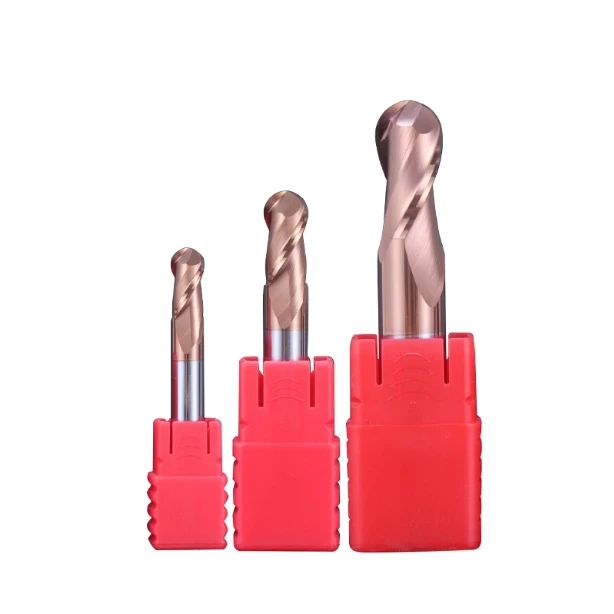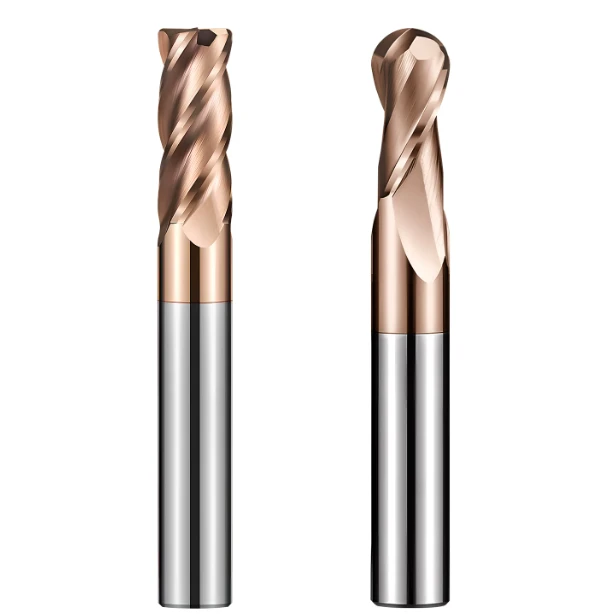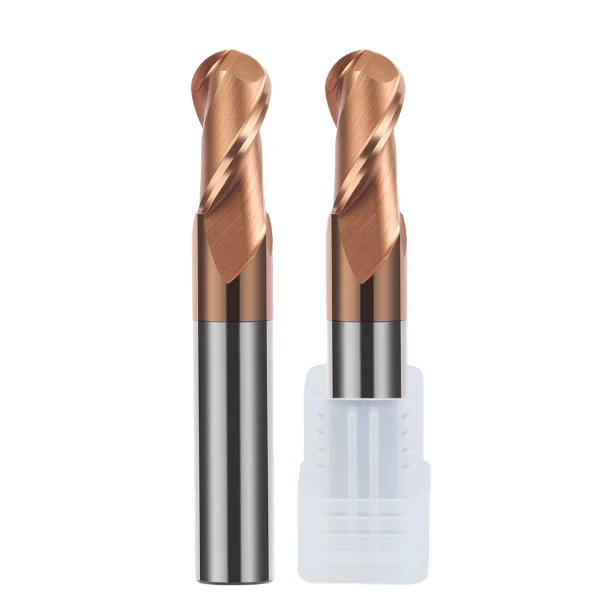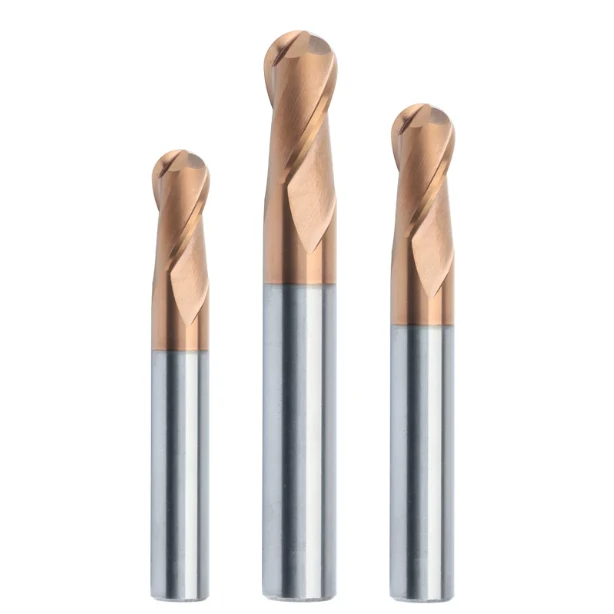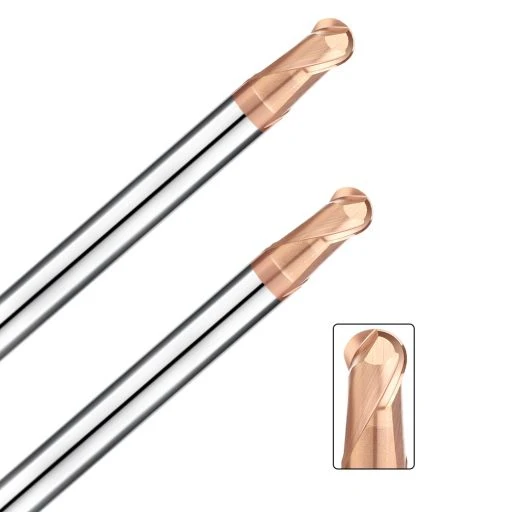

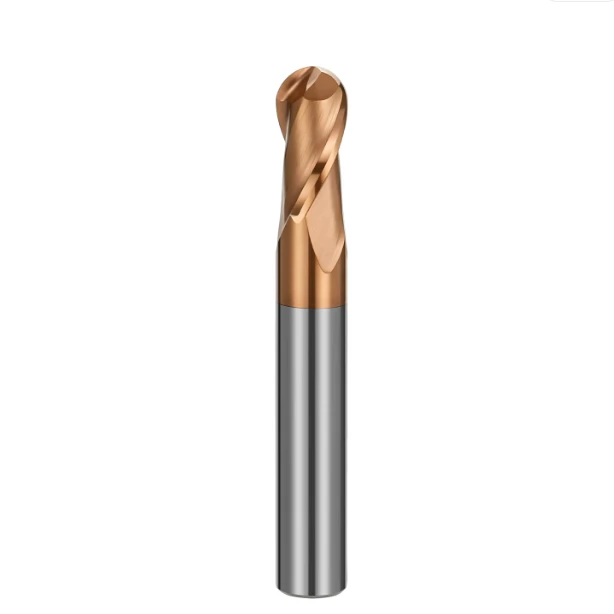
A process supervisor at a German automotive mold plant recently sent us several worn R3 ball nose end mills. While finish-machining H13 tool steel hardened to HRC 62, the tools suffered continuous micro-chipping in under 25 minutes. They tried two European coatings and cut feed rates by 30%, yet spindle loads still spiked and chatter covered the sidewalls.
Over 16 years of grinding carbide tools and troubleshooting US and European mold shops, we have seen this exact failure countless times. Operators often grab 40°–45° helix tools meant for softer alloys when machining hardened steel. However, even a slight shift in helix geometry completely alters the cutting force model on ultra-hard materials.
The helix angle controls far more than chip evacuation. It dictates edge wedge strength, core rigidity, and the balance between axial and radial forces. Above HRC 60, a steep helix weakens edge impact resistance and triggers harmonic resonance. Conversely, an overly low helix restricts flute space, causing chip recutting in deep cavities.
To help you avoid costly trial-and-error, we compiled real data from our 5-axis grinding lab and client test lines. Below, we break down force mechanics, hardness-based selection, and geometry tuning. Next time your ball nose end mill chips or chatters in hard steel, will you drop your feeds—or check your helix angle first?

Why End Mill Helix Angle Matters When Machining Hardened Steel
Our 5-axis grinding tests and high-speed trials show that a ball nose end mill behaves very differently from a flat end mill. From the dead-center tip—where surface speed is near zero—to the tangency point, the effective rake angle and chip thickness shift constantly. When machining hardened steel like H13, D2, or M2, this dynamic load magnifies any weak spot along the radius.
Based on our dynamometer force readings and SEM fracture inspections, choosing an end mill helix angle is a direct trade-off between axial pull and radial thrust. A higher helix enters the cut smoothly and reduces sidewall deflection. However, it thins out the edge wedge angle, allowing hard, brittle chips above HRC 60 to crush and flake the edge under extreme heat.
The Actual Loading and Chipping Mechanism in the Ball-Nose Transition Zone When Machining Hardened Steel
Most machinists assume the dead-center tip fails first because its linear cutting speed is zero. Yet after inspecting hundreds of worn tools returned by our clients, we found a completely different pattern. Over 70% of premature flaking during machining hardened steel actually starts at the tangency point, where the spherical radius meets the straight flute.
During 3D contouring, minor shifts in step-over and depth of cut concentrate cyclic stress right across this geometric junction. If the grinding wheel transition lacks a smooth blend, or if the helix angle triggers harmonic vibration, alternating shock loads rapidly fracture the coating and carbide substrate. Once a micron-level thermal crack forms there, chipping spreads up the flute regardless of how much you lower the feed rate.

Low-Helix vs High-Helix Ball Nose End Mills for Hardened Steel
When supporting mold shops across the U.S. and Europe, we often see a common misconception on the shop floor. Many machinists assume that high spindle speeds and heat-resistant coatings make high-helix cutters universal for all finishing work. Once you shift from pre-hardened steel to quenched tool steel above HRC 58, low-helix and high-helix geometries behave completely differently.
Through years of testing in our 5-axis grinding lab, we learned there is no single “best” helix angle for hard milling. Choosing the right cutter is always a trade-off between setup rigidity and workpiece hardness. A low helix sacrifices chip-evacuation speed for maximum edge strength, while a high helix trades impact resistance for smoother shearing.
Why We Prioritize a Low Helix Ball Nose End Mill for HRC 60+ Applications
When finishing cold-work mold steels or high-speed steels at HRC 60–65, we typically recommend a low helix ball nose end mill with a 25° to 30° helix angle. A shallower helix leaves a thicker carbide wedge behind the cutting edge. This extra backing absorbs the intense compressive shock of brittle chip formation and stops micro-chipping before it starts.
A smaller helix angle also requires shallower flute grinding, which preserves a larger core diameter for superior tool rigidity. During deep-cavity corner finishing with long overhangs (above 5xD), this stiff core drastically reduces radial deflection and holds micron-level tolerances. In deep enclosed slots, simply pair the cutter with a high-pressure air blast to clear chips smoothly.
When Does a High Helix Angle End Mill Fail in Hardened Steel Finishing?
We once helped a German connector mold maker and a U.S. die-casting shop troubleshoot severe high-frequency micro-chipping. Both teams were finishing HRC 61 steel using a 40°–45° high helix angle end mill. While steep-helix tools excel in aluminum, stainless steel, and soft alloys, their thin wedge angles turn brittle against hardened steel and flake under extreme heat.
Upward axial pull is another hidden culprit behind high-helix failure at high RPMs. On thin-walled cavities or marginal tool holders, constant axial tension pulls the cutter into the part and leaves rhythmic chatter marks on the sidewalls. We only suggest keeping a 38°–40° helix for semi-finishing shallow pockets in softer HRC 52–56 steels where chip room is tight.
Factory Trial Data: Low-Helix vs High-Helix Service Life in HRC 62 Steel
To eliminate material and coating variables, we ran a controlled side-by-side test in our temperature-regulated lab. Both 2-flute R3 cutters shared the exact same sub-micron carbide grade and AlTiSiN coating. We contour-finished an HRC 62 D2 tool steel block at 110 m/min surface speed and 0.045 mm feed per tooth.
The 42° high-helix cutter produced a slightly brighter finish during the first ten minutes, but heat quickly exposed its weak edge wedge. Within 38 minutes, severe micro-chipping ruined the cutting edge. Meanwhile, our 30° low helix ball nose end mill ran smoothly for 145 minutes with uniform flank wear, proving why low-helix geometry wins above HRC 60.
Selecting a Solid Carbide Ball Nose End Mill for Hardened Steel & HRC65-Rated Cutters
In real mold production, helix angle never works in isolation. When choosing a solid carbide ball nose end mill for hardened steel, you must match the helix lead with carbide cobalt content, rake geometry, and coating thermal limits. Simply lowering the helix angle while keeping a sharp positive rake will still cause edge failure within 30 minutes on quenched steel.
Process engineers often ask us if one cutter can cover everything from HRC 55 to HRC 64. Based on our shop-floor trials, a one-size-fits-all approach forces bad compromises at both ends. Below HRC 58, you need balanced chip flow and feed rates, but above HRC 60, edge toughness and core rigidity must take absolute priority.
Optimizing Helix Angle and Negative Rake for an HRC65 Carbide Ball Nose End Mill
While developing our hrc65 carbide ball nose end mill, we hit an early roadblock during 5-axis grinding trials. Combining a 25° helix with a standard zero-degree rake caused comb-like thermal cracks within ten minutes on HRC 64 powder-metallurgy steel. We solved this by grinding a -6° to -10° negative rake paired with a micron-level T-land edge hone.
This geometry replaces fragile sharp slicing with controlled compressive shearing. A negative rake shifts destructive tensile stress away from the tip and puts the tungsten carbide into compression, where it is strongest. Because cutting forces increase, we always recommend shrink-fit or high-precision hydraulic holders to prevent low-frequency chatter.
Matching a Solid Carbide Ball Nose End Mill for Hardened Steel by Hardness Range
To cut down shop-floor trial-and-error, we divide tooling selection into two clear hardness tiers. For HRC 52–58 pre-hardened or medium-hard hot-work steels, a solid carbide ball nose end mill for hardened steel with a 30°–35° helix balances chip evacuation and edge strength. Once workpiece hardness reaches HRC 60–65, lock into a 25°–30° low-helix design to maximize core bending resistance.
Once you lock in the geometry, your cooling strategy must match it to prevent premature coating failure. Whenever we see water-soluble flood coolant used above HRC 60, rapid heating and quenching almost always cause thermal-shock micro-cracking. Switching to high-pressure cold air or MQL keeps tool temperatures stable and routinely doubles service life.

Optimizing Ball Nose Milling Cutter Geometry Beyond the Helix Angle
When programming wheel paths on a 5-axis grinder, we never adjust the helix angle in isolation. Designing a helix angle ballnose end mill for hardened steel requires balancing helix lead with core taper, flute curvature, and relief land width. Lowering the helix angle without adjusting the rest of the ball nose milling cutter geometry simply shifts cutting stress to weaker areas.
Dropping the helix angle to 28° protects the cutting edge in hard alloys, but it slows chip evacuation and slightly raises radial force. In our shop, we compensate for every degree of helix reduction by refining flute polish or core thickness. The exact balance depends on whether your job demands deep-cavity rigidity or high-stepover chip flow.
Suppressing Deep-Cavity Resonance with a Variable Helix Angle Ballnose End Mill
During high-speed spindle trials at 24,000 to 40,000 RPM, long overhangs often trigger chatter even with a low helix angle. Using an unequal helix angle ballnose end mill—such as a 28°/31° combination—breaks up regular tooth-passing frequencies. This prevents vibration from locking into the holder’s natural frequency and eliminates “fish-scale” marks on hardened sidewalls.
Variable helix geometry does introduce one minor trade-off on the shop floor. Because adjacent flutes have slightly different wedge angles, one edge wears marginally faster during heavy, prolonged cuts. For that reason, we recommend variable-helix cutters strictly for semi-finishing and finishing rather than high-stock roughing.
How Core Taper and Flute Geometry Impact Ball Nose End Mill Cutter Chip Evacuation
Machinists often worry that low-helix tools will pack chips inside deep, narrow pockets. To optimize ball nose milling cutter geometry for smooth evacuation, we micro-polish the flutes after grinding and refine the hook angle at the ball-to-flute transition. This helps brittle, needle-like chips curl tightly and clear out fast under high-pressure air.
We also grind a progressive core taper—keeping flutes deep near the tip for chip room while thickening the core toward the shank. This stops bending and chip recutting when a ball nose end mill cutter clears narrow ribs. For open, shallow contours where chips clear easily, a standard straight core remains more cost-effective and lets air reach the tip directly.

When Standard Off-the-Shelf Tools Fail: Designing a Custom Ball Nose End Mill
When you align transition-zone strength, 25°–30° low-helix rigidity, negative rake hones, and cold-air cooling, catalog tools handle roughly 70% of hard-milling jobs. Through years of supporting US and European mold shops, we see the remaining 30% bottleneck on ultra-deep pockets, tiny corner radii, or thin walls.
When standard flute lengths and core tapers conflict under extreme reach, slowing down feeds is no longer a viable fix. Building a custom ball nose end mill reallocates limited geometric space—trimming excess flute length for neck clearance while dialing in exact helix and rake angles for your steel’s measured hardness.
Real-World Case Studies: Custom Ball Nose End Mill Solutions for Mold & Medical Shops
Last year, a North American die-casting mold shop struggled with tool breakage when clearing deep corners in HRC 60 H13 steel. Their standard 35° long-flute cutter snapped every 45 minutes and left heavy chatter. We engineered a custom ball nose end mill with a short flute, long relief neck, 28° helix, and tapered core—boosting life to 210 minutes and eliminating manual polishing.
Similarly, a European medical mold maker faced severe “fish-scale” chatter milling HRC 63 stainless micro-cavities at a 6xD overhang. Even at 32,000 RPM, standard low-helix cutters vibrated. We ground a 26°/29° variable low-helix tool with a micron T-land hone and polished flutes, stabilizing the cut for unattended overnight runs.
Five Shop-Floor Data Points Needed for a Custom Ball Nose End Mill Assessment
If tweaking speeds and feeds no longer stops micro-chipping or deep-pocket deflection, it is time to evaluate tool geometry. Before we design a custom ball nose end mill, we ask you to share three baseline specs: exact steel grade with measured HRC hardness, maximum overhang with cavity draft angles, and your spindle RPM, holder type, and cooling method.
Alongside machine setup details, send us close-up photos of your worn edge plus your finishing stock allowance and target Ra. A clear macro photo reveals immediately whether failure stems from weak wedge angles, chip packing, or harmonic chatter. Share your prints or failed tool photos with our engineering team, and we will help dial in the exact geometry for your floor.