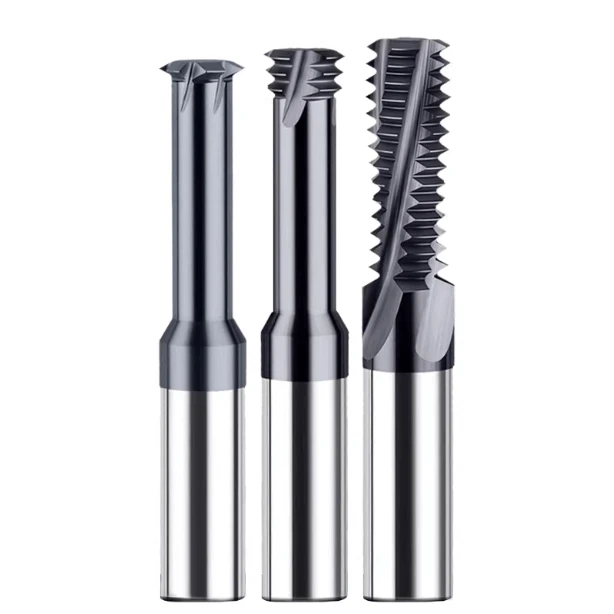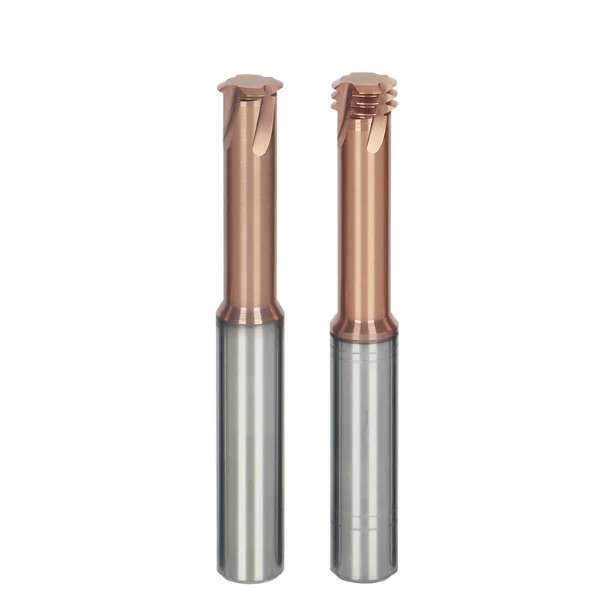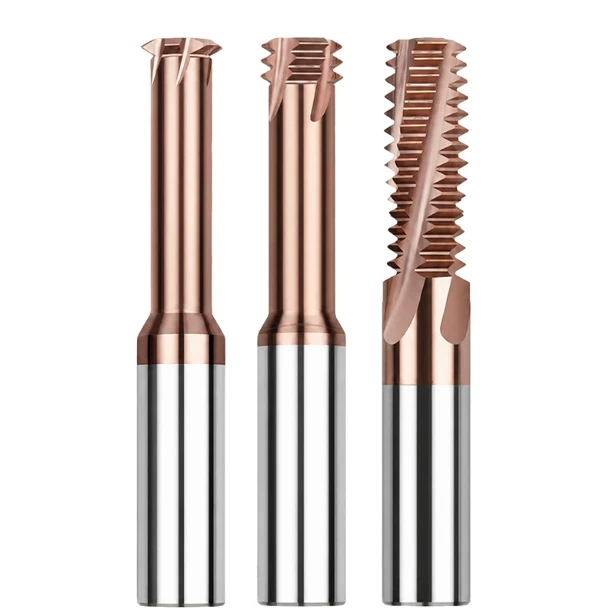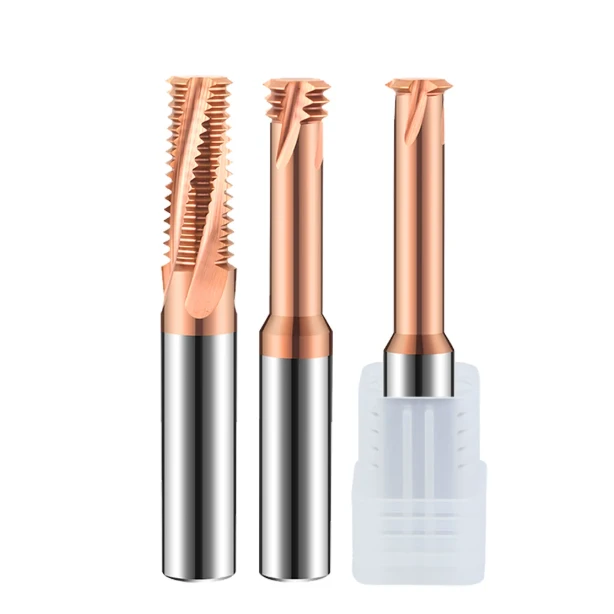

A production manager at a German die-casting shop sent us a photo: a 62 HRC mold core worth over €40,000 was completely ruined. An M10 tap snapped flush in a blind hole, and burning it out with EDM damaged the hole wall precision. Over 16 years of supporting machine shops across North America and Europe, we see this costly failure almost every month.
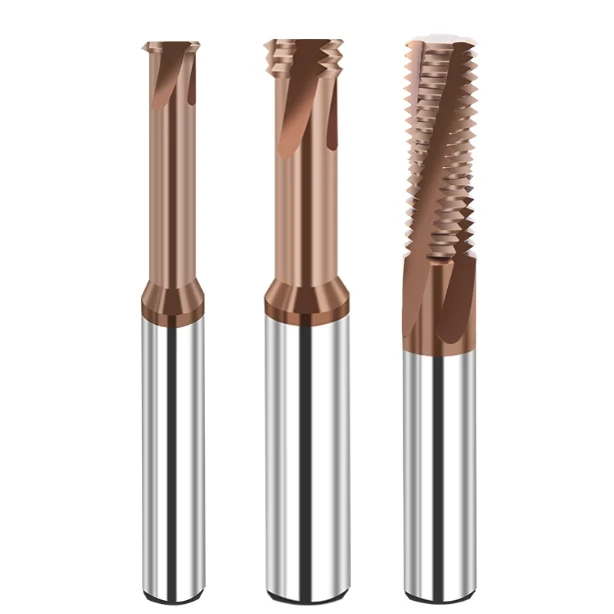
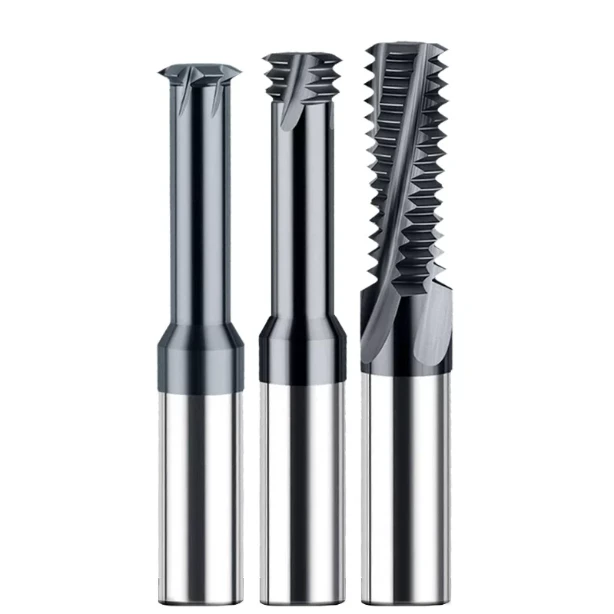
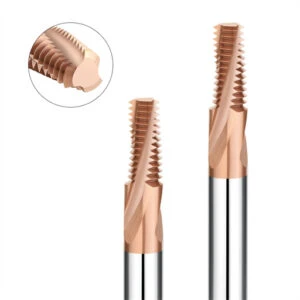
Once steel hardness exceeds 58 HRC, tapping torque spikes exponentially. With almost zero room for chip evacuation, tap breakage becomes a matter of “when,” not “if.” That is why, after extensive floor testing, we guide our clients to switch to an HRC65 full tooth thread mill for hardened steel.
Unlike tapping, a carbide thread milling cutter tool uses helical interpolation to take light, intermittent cuts. High-pressure air or through-coolant flushes out fine chips instantly, eliminating chip jamming. Plus, a multi-row full-tooth design finishes the entire thread in just 1.5 passes—holding tight Go/No-Go pitch diameters in H13, D2, or S7 without the rapid flank wear of single-point tools.
Still, having the right cutter is only half the battle. In our customer trials, one shop gets 350+ holes per tool, while another chips the tip in under 40 holes due to pilot hole tolerances, spindle runout, or radial step-over errors. If you are fighting scrap rates in hardened steel, have you ever had a tool tip chip unexpectedly—even when running the exact catalog speeds and feeds?
Why We Replaced Taps with Custom HRC65 Full Tooth Thread Mills for Hardened Mold Steels
Across European and North American mold shops, we see one recurring bottleneck: parts heat-treated to 55–65 HRC still need precision threads. Tapping at this hardness is pure gambling. When a carbide tap snaps at the bottom of a blind hole, EDM removal eats up hours of shop time and often ruins nearby cooling channels—scrapping the entire mold insert.
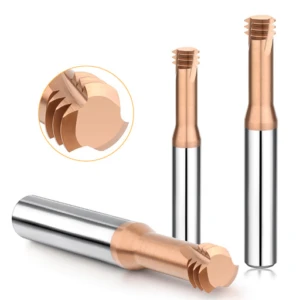
After rigorous testing on our own machines and client production lines, we phased out taps completely above 58 HRC. We switched to custom HRC65 full tooth thread mills instead. While a thread mill costs more upfront than a tap, eliminating just one scrapped mold block makes your cost-per-hole dramatically lower.
The Real Cost of Tap Breakage Above 60 HRC: Cutting Tests from Our Shop
To prove cycle times to a skeptical Swiss precision shop, we ran M8×1.25 blind-hole tests in hardened H13 (60 HRC) and D2 (62 HRC). Coated carbide taps spiked in spindle load by the fourth thread, packing brittle chips into the flutes until the tap shattered 12 mm deep. Using our thread mill for hardened tool steel, the smaller cutter diameter left plenty of room for through-coolant to clear fine chips, keeping spindle load under 18%.
Does thread milling slow down your cycle time? Single-profile cutters take multiple passes, which adds time. However, our full-profile cutter finishes the thread in 1.5 helical revolutions—taking about 9 seconds per hole, just two seconds slower than tapping. Even if the tool ever wears out or snaps, you simply pull the shank out with tweezers and save the part.
Carbide Thread Milling Cutter Tool Specs: How We Eliminate Micro-Chipping
Early on, micro-chipping at the tool tip was our biggest headache in hardened steel. Standard 0.4-micron carbide blanks developed jagged edge flaking after fewer than 25 holes in 64 HRC M2 tool steel. Working with our powder metallurgy supplier, we switched to a 0.2-micron sub-micron substrate with 10% cobalt, giving the cutting edge the transverse rupture strength needed to survive interrupted cuts.
A tough substrate alone cannot survive 900°C cutting-zone heat in 65 HRC steel. After grinding each carbide thread milling cutter tool, we apply a specialized micro-brushing edge prep to hone a uniform 0.008–0.012 mm edge radius. Paired with a high-silicon AlTiSiN nanocomposite coating, this geometry consistently delivers over 300 threaded holes per cutter in 62–65 HRC steel.
Full Tooth vs Single Profile Thread Mill: Practical Selection Based on Cycle Time and Profile Accuracy
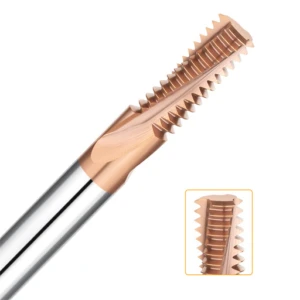
When handling technical support for shops across North America and Europe, one common debate is full tooth vs single profile thread mill selection. Many machinists stick to single-profile cutters for every pitch, or force full-tooth tools onto low-rigidity machines. The result is either blown cycle times or excessive radial cutting forces that taper the pitch diameter out of tolerance.
Neither geometry replaces the other—the right pick comes down to shop-floor trade-offs. When planning your process, simply look at batch volume, effective thread depth, and spindle taper rigidity to make the call.
When Is a Full Tooth Thread Mill Essential?
While optimizing cycle times for a North American hydraulic manifold and transmission manufacturer, we saw them running M12×1.5 threads in HRC60 alloy steel with a single-profile cutter. At 45 seconds per hole, it bottlenecked the entire cell. After checking their 15,000-piece monthly volume and HSK-A63 spindle rigidity, we switched them to a full tooth thread mill, cutting the full profile in 1.5 helical passes and dropping cycle time under 8 seconds.
Beyond raw speed, multi-row cutters deliver unmatched profile consistency in high-volume runs. Because a 5-axis tool grinder forms the entire pitch and root radius in one setup, you rarely need to chase tool offsets once your pilot hole is dialed in. Shops consistently hit over a 99.5% first-pass yield on Go/No-Go thread gauges.
Why Single-Profile Tools Win in Deep Holes, Coarse Pitches, and Low-Rigidity Setups
Still, we never push full-profile tools where physics works against them. Last month, a German mold shop needed M16×2.0 threads at a 3.5×D depth in a 62 HRC mold insert. Reviewing their print, we steered them away from a full-profile cutter and recommended a single-profile carbide thread milling cutter tool with a multi-pass radial step-over.
Full-tooth cutters engage the entire row of teeth at once, generating high radial cutting forces. Once overhang exceeds 3×D—or if you run a lighter BT30 spindle—that radial load causes tool deflection and chatter, leaving a tapered thread. A single-profile cutter engages just one tooth row at a time, trading a few extra seconds for tight tolerance control and the flexibility to cut multiple diameters of the same pitch.
High-Hardness Case Studies: Troubleshooting H13 Tool Steel and NPT Tapered Pipe Threads
Across our client failure analyses, over 70% of scrapped hardened threads come from two setups: tough quenched hot-work tool steels and 1:16 tapered sealing pipe threads. Programmers often apply default mild-steel feeds or ignore changing radial engagement along a taper, scrapping the very first part.
To help you nail your first-article runs, we distilled two proven shop-floor baselines from European die-casting shops and North American fluid-power plants. Use these parameters for quenched H13 and NPT full profile thread mill applications as a starting point, then fine-tune for your machine’s condition.
Thread Milling Tool for H13 Hardened Steel (58–62 HRC): Stopping Built-Up Edge and Thermal Cracks
Quenched and tempered to 58–62 HRC, H13 retains high red hardness and extreme metal adhesion, quickly welding chips into flutes or causing thermal fatigue cracks. Tuning a thread milling tool for H13 hardened steel at an Italian die-casting shop, we locked cutting speed (Vc) at 35–48 m/min and feed per tooth (fz) at 0.02–0.035 mm/z. Never drop feed too low out of caution—rubbing against work-hardened steel strips the coating fast.
Coolant choice also makes or breaks the run. Never use flood emulsion coolant on hardened H13, as rapid heating and quenching creates thermal shock micro-cracks across the carbide edges. Instead, run 20+ bar through-tool straight oil or cold air with MQL to blast red-hot chips out of blind holes while keeping cutting temperatures stable.
Eliminating Transition Marks and Taper Errors with an NPT Full Profile Thread Mill
Tapered pipe threads engage progressively deeper along a cone, creating heavy radial pressure that leaves visible witness marks and leak paths. Helping a North American valve-block shop fix leaking 1/2-14 NPT threads in HRC60 steel, we found single-pass milling deflected the cutter at the bottom, undersizing the L1 pitch diameter. Switching to a three-pass radial step-over (60% rough, 30% semi-finish, 10% finish) with our NPT full profile thread mill cut final-pass deflection to near zero.
Toolpath entry matters just as much in NPT helical interpolation. Many programmers plunge straight from the hole center into the tapered wall, creating an impact spike that chips carbide edges in hardened steel. Always program a tangential arc-in and arc-out with an entry radius at least 1.2× the cutter radius, and activate G41/G42 cutter compensation for a seamless blend.
On-Site Setup Checklist to Extend the Life of HRC65 Thread Milling Cutters by 40%
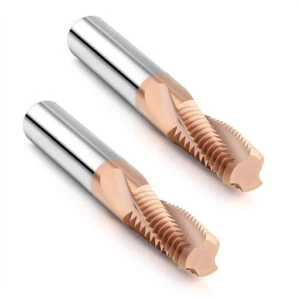
During on-site diagnostics for shops across North America and Europe, we often see a sharp contrast. The same batch of HRC65 thread milling cutters might produce over 400 blind holes in one mold shop, yet chip out in under 50 holes at another. Operators usually blame tool hardness, but our dial indicators and microscopes prove that over 90% of failures come from clamping runout, toolpath direction, or worn pilot drills.
Hardened steel leaves virtually zero margin for error—any clamping eccentricity or stock variation gets amplified right at the tool tip. Follow our field-tested setup checklist below to lock down these variables and boost your tool life by over 40%.
Four Hidden Killers of Thread Mill Tool Life: Runout, Climb Milling, and Pilot Holes
To protect thread mill tool life, start by measuring Total Indicator Reading (TIR) at the tool tip. Swap standard ER collets for shrink-fit or hydraulic holders to keep runout under 0.005 mm; anything over 0.01 mm forces one or two “high” teeth to absorb the entire impact load and chip early. Also, always program right-hand threads using bottom-up climb milling so the edge enters at maximum chip thickness instead of rubbing against work-hardened steel.
Never overlook the carbide drill cutting your pilot hole either. Many shops run a drill until it is nearly flat, shrinking the bore diameter by 0.05 mm. That tiny loss instantly doubles the radial load on your thread mill’s tooth roots and snaps the tip—so check pilot bores with a pin gauge every 50 parts.
Wear Limits and Regrinding: When to Pull a Tool Before It Chips
Never wait for a No-Go gauge to bind or a tool to snap before stopping the spindle. By then, internal fatigue cracks have already ruined the carbide substrate for regrinding. Teach your operators to watch chip color and listen to the cut: normal 60 HRC chips look silver-gray or light straw, while deep blue-violet chips paired with a sharp squeal mean the coating is gone and you must stop immediately.
If you have a portable digital microscope, set a hard replacement red line at a flank wear land width (VB) of 0.08–0.12 mm. Pulling the cutter before catastrophic chipping protects your workpiece threads and preserves the carbide core. Returned to our grinding shop, that cutter can be rake-reground and recoated to restore over 85% of its original performance.
Direct Factory Supply: Wholesale Carbide Thread Mill Factory QC and OEM Standards
After solving tap breakage, H13 built-up edge, NPT leaks, and runout failures on the shop floor, we found the final hurdle often sits in the supply chain. Many automated lines run great on trial cuts, only to see pitch diameter drift or early chipping on reorder batches. Tracing the issue usually reveals a trading broker subcontracting orders to different small shops with inconsistent carbide grades and grinding tolerances.
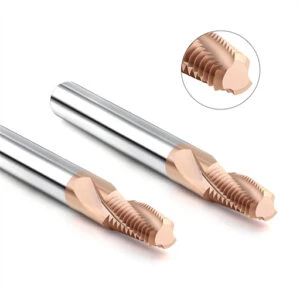
As a direct wholesale carbide thread mill factory with 16 years of grinding experience, we know continuous production demands strict batch consistency. Standard catalog cutters cover roughly 70% of daily jobs, while the remaining 30%—involving deep cavities, custom profiles, or extreme hardness—require direct engineering collaboration for a closed-loop fix.
From 5-Axis Grinding to Laser Inspection: Holding ±0.005 mm Profile Accuracy
In hardened steel, cumulative pitch or half-angle errors over 0.01 mm severely unbalance the cutting load across the first and last rows of teeth. On our Walter and ANCA 5-axis CNC tool grinders, we enforce a mandatory diamond wheel dressing cycle every 15 tools. This prevents subtle wheel wear from dulling the corner radius or shifting the pitch diameter mid-batch.
After AlTiSiN coating, every cutter moves to our climate-controlled lab for 100% inspection on non-contact laser profilometers and 100x optical projectors. Only tools holding ±0.005 mm across OD runout, cumulative pitch, and profile accuracy receive a traceable laser batch code—ensuring your reorders six months later run on the exact same machine offsets.
OEM Full Tooth Thread Milling Cutter Customization: 48-Hour Drawings and 7-Day Samples
Deep mold cavities often cause standard tool shanks to collide with part walls, while tough alloys require tailored helix or through-coolant exit angles. Our OEM full tooth thread milling cutter service connects you straight to our application engineers—send us your part print or 3D model, and we will return a 3D interference check and formal tool drawing within 48 hours, followed by trial samples in 7 business days.
Everything in hardened steel threading—from ditching taps and weighing L/D ratios to holding 0.005 mm runout and climb milling—comes down to matching tool geometry with machine rigidity. If you are machining 55–65 HRC steels or leaking NPT ports and struggling with erratic tool life, use our checklist to audit your spindle runout and coolant first, or send over your part prints and cutting data so we can run a targeted process review together.