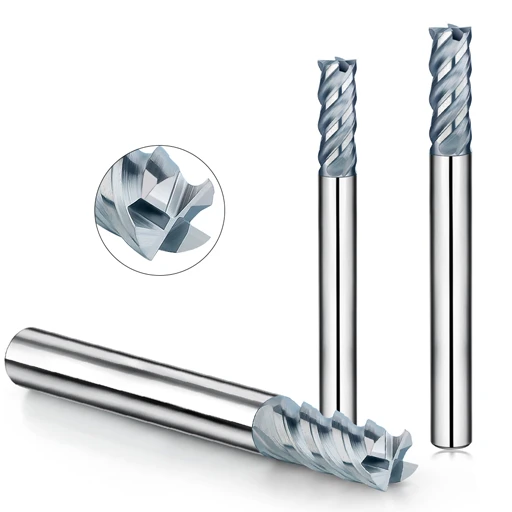
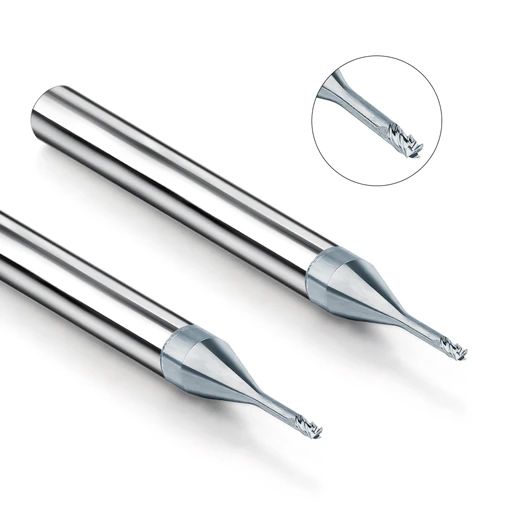
Q1: What are the main advantages of a long neck corner radius end mill when machining HRC65 materials?
A: The primary advantage of a long neck corner radius end mill is improved accessibility during deep cavity milling. The extended neck allows the cutting edge to reach areas that standard end mills cannot access while minimizing interference between the tool holder and the workpiece.
Typical benefits include:
- Better access to deep pockets and narrow mold cavities
- Reduced risk of tool holder collisions
- Increased Z-axis machining depth
- Improved machining flexibility for complex mold geometries and tall sidewalls
From our experience machining HRC60–65 mold steels, long neck tools are ideal for finishing deep cavities. However, because the extended neck reduces overall rigidity, they should always be used with conservative radial engagement and stable cutting conditions.
Q2: Why is a 4-flute long neck end mill better than a 2-flute end mill for HRC65 finishing?
A: A 4-flute long neck carbide end mill provides greater rigidity than a 2-flute tool, making it the preferred choice for finishing hardened steels.
Key advantages include:
- Higher tool rigidity with less deflection
- Better dimensional accuracy on mold surfaces
- Improved surface finish during finishing operations
- More even cutting force distribution, which helps extend tool life
- Higher productivity when using light radial cuts
The trade-off is reduced chip space. For this reason, 4-flute tools are recommended for semi-finishing and finishing rather than heavy roughing or full-slot milling.
Q3: Why choose a corner radius end mill instead of a square end mill or ball nose end mill?
A: A corner radius endmill combines the strength of a square end mill with improved edge durability. The small corner radius distributes cutting forces more evenly, reducing stress concentration at the cutting edge.
Compared with other tool geometries, it offers several advantages:
- Lower risk of edge chipping when machining HRC65 hardened steel
- Longer tool life under continuous finishing operations
- Better corner strength than a square end mill
- Higher machining efficiency on sidewalls than a ball nose end mill
- Smoother surface transitions with reduced vibration
In mold manufacturing, long neck corner radius end mills are commonly used for sidewall finishing, deep pocket machining, and precision contour machining after semi-finishing.
Q4: How can I prevent tool chipping when using a 4-flute long neck corner radius end mill?
A: Preventing edge chipping depends more on machining strategy than spindle speed alone.
Based on our machining experience with HRC60–65 mold steels, the following practices produce the most stable results:
- Keep radial depth of cut (ae) between 0.05D and 0.20D during finishing
- Use multiple light finishing passes instead of one heavy cut
- Maintain a constant feed rate and avoid sudden load changes
- Use a high-rigidity tool holder with runout controlled within 0.005 mm
- Apply smooth toolpaths such as constant-Z or constant-stepover finishing
- Minimize tool overhang whenever possible
For hardened steel machining, maintaining cutting stability is generally more important than maximizing material removal rates.
Q5: What cutting strategy is recommended for machining HRC65 hardened steel with a long neck end mill?
A: For HRC65 hardened steel machining, the most reliable approach is a high-speed, light-load finishing strategy.
Recommended machining practices include:
- Use shallow axial and radial depths of cut
- Apply multiple finishing passes with a small stepover
- Prefer climb milling whenever possible
- Maintain continuous tool engagement to reduce impact loads
- Avoid interrupted cutting and sudden changes in tool direction
- Select cutting parameters that prioritize stability over aggressive material removal
In practical mold manufacturing, this strategy significantly reduces vibration, improves surface quality, and extends the service life of long neck carbide end mills, especially during deep cavity finishing and high-precision mold machining.






![HRC55 Flat End Mill [2 Flutes ϕ0.2-6]](https://samhotool.com/wp-content/uploads/2023/11/3-10.webp)