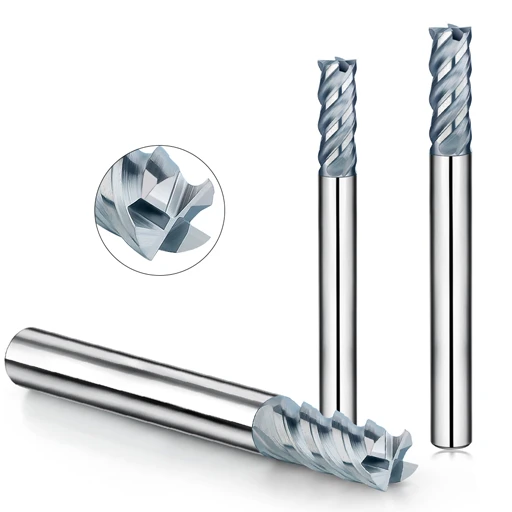
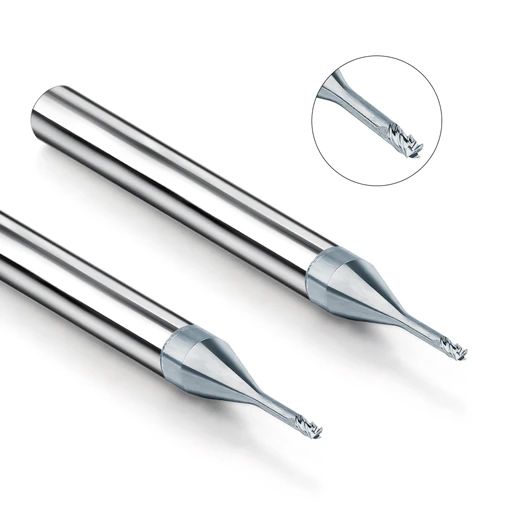
Q1: How can tool breakage or chipping be avoided when using a 4-flute long neck end mill?
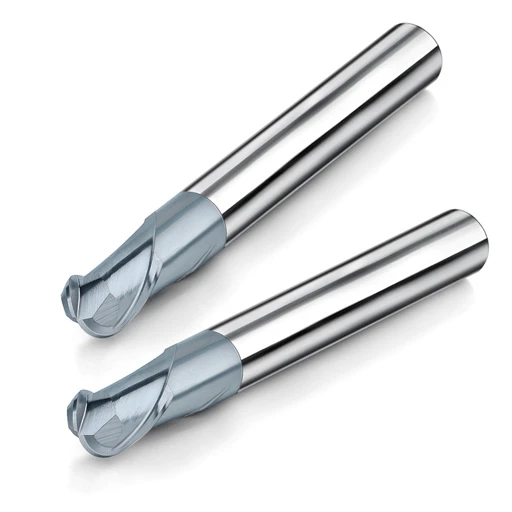
A: In hardened steel machining, tool breakage is mainly caused by vibration, excessive cutting load, and heat concentration at the cutting edge. When using a 4-flute long neck flat end mill for hardened steel, process stability is critical.
To reduce the risk of chipping or breakage, we recommend the following machining practices:
- Keep radial depth of cut (ae) between 10%–30% of tool diameter
- Use a step-down cutting strategy to distribute cutting load
- Maintain a stable and consistent feed rate to avoid shock loading
- Avoid interrupted cuts, which increase edge stress
- Use a high-rigidity tool holder such as a shrink-fit holder or high-precision collet chuck
- Ensure efficient chip evacuation to prevent chip re-cutting and heat buildup
In real machining practice, stable engagement is more important than aggressive cutting parameters when using a long neck carbide end mill for hardened steel.
Q2: What are the advantages of a 4-flute design over a 2-flute end mill for hardened steel machining?
A: When machining hardened tool steel (HRC 50+), a 4-flute end mill provides improved rigidity and cutting stability compared to a 2-flute design.
Key advantages include:
- Higher tool body rigidity, reducing deflection in deep cavity machining
- More stable tool path control during finishing and contour milling
- Improved surface finish quality with lower Ra values
- Better performance in semi-finishing and finishing operations of mold steel
However, due to reduced chip space, a 4-flute carbide end mill is not ideal for heavy roughing or deep slotting. It performs best in precision machining, mold finishing, and surface refinement applications.
Q3: Is a 4-flute long neck flat end mill suitable for high-hardness steel (HRC 50+)?
A: Yes, but only under controlled machining conditions.
A 4-flute long neck flat end mill for hardened steel machining performs well in the following range:
- Optimal material range: HRC 45–55 mold steel
- For HRC 55–58: reduce feed rate and axial depth of cut
- For HRC 60+: performance depends on machine rigidity and tool coating
- For HRC 60–65 and above: a dedicated HRC65 end mill series is recommended
To ensure tool life and prevent edge chipping, a rigid setup and short tool overhang are essential, especially in deep cavity milling applications.
Q4: How does a 4-flute long neck flat end mill perform in mold steel finishing applications?
A: In real-world mold machining, a 4-flute long neck flat end mill performs consistently in semi-finishing and finishing of hardened mold steels such as H13, SKD61, and P20.
Its key performance advantages include:
- Stable cutting with reduced vibration marks in deep cavity milling
- Excellent surface finish quality for mold wall and bottom surfaces
- Longer tool life when cutting parameters are properly optimized
- Reliable dimensional accuracy in precision mold finishing
However, for steels above HRC 60, it is generally recommended to switch to specialized high hardness end mills (HRC65 or coated carbide series) designed for extreme wear resistance and thermal stability.
Q5: How should cutting parameters be selected to prevent chatter and tool failure?
A: Proper parameter selection is essential when using a long neck carbide end mill for hardened steel machining, especially in deep cavity applications where tool deflection is more likely.
Recommended guidelines include:
- Keep tool overhang as short as possible (ideally within 3×D)
- Use light side milling with radial engagement (ae) at 10%–30% of diameter
- Balance spindle speed and feed rate to avoid excessive impact load
- Prefer climb milling for better stability and surface quality
- Use appropriate coolant strategy based on material (air blast, mist, or cutting fluid for steel)
- Maintain rigid fixturing to minimize vibration in deep pocket machining
In production environments, controlling tool stability and engagement consistency is more important than increasing cutting speed.