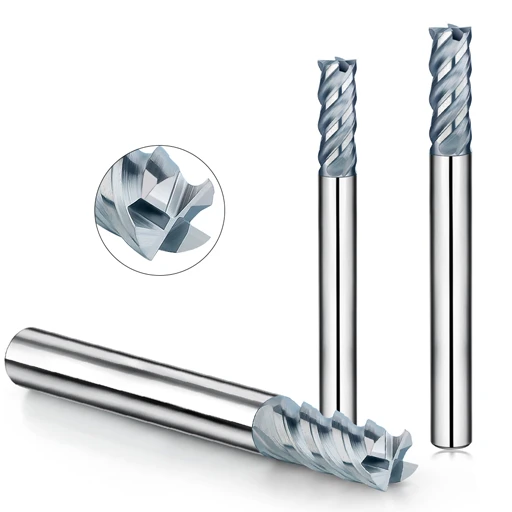
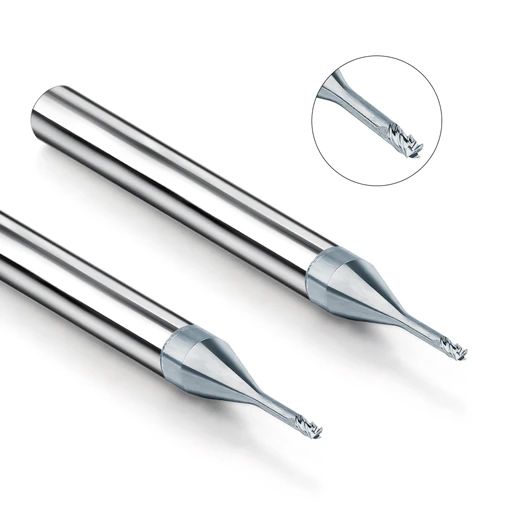
FAQ 1: How do HRC55 2-flute long-neck ball nose end mills improve accuracy in curved surface machining?
A: Achieving high accuracy in 3D surface machining depends on the combination of tool quality, machine rigidity, cutting parameters, and CAM toolpaths.
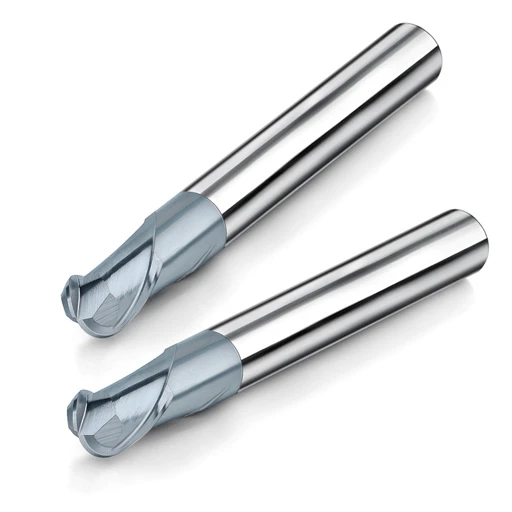
A high-quality HRC55 2 flute long neck ball nose end mill is manufactured with precise ball geometry, low radial runout, and consistent cutting edge accuracy. These features help reduce tool marks, improve contour accuracy, and produce smoother surface finishes when machining mold steel.
In practical mold machining, the best results are usually achieved by combining the tool with:
- Small step-over values
- High-speed machining strategies
- Optimized CAM toolpaths, such as Constant-Z or Waterline machining
- High-precision tool holders with minimal runout
- Proper spindle dynamic balancing
When these factors work together, a carbide ball nose end mill for steel can consistently deliver the dimensional accuracy and surface quality required for precision mold manufacturing.
FAQ 2: Why are long-neck ball nose end mills better for deep-cavity mold machining?
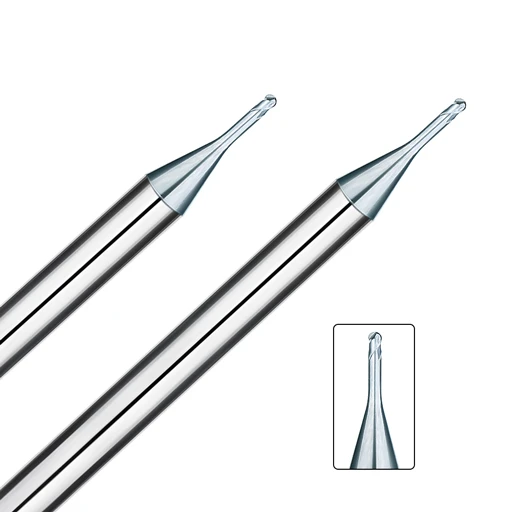
A: Long-neck ball nose end mills are specifically designed for machining areas that standard tools cannot easily reach. The extended neck provides greater clearance between the tool holder and the workpiece, reducing interference during deep-cavity machining.
Compared with standard ball nose end mills, a long neck ball nose end mill for steel offers several advantages:
- Better access to deep cavities and tall sidewalls
- Lower risk of tool holder collisions
- Improved reach for complex 3D surfaces
- Fewer tool changes during machining
- Higher efficiency in precision mold finishing
These tools are widely used for injection molds, automotive molds, die-casting molds, and other complex mold components.
Because the longer neck reduces overall rigidity, cutting parameters should be optimized to minimize vibration and maintain machining stability.
FAQ 3: What machining operations are HRC55 2-flute long neck ball nose end mills designed for?
A: An HRC55 2flute long-neck ballnose end mill is primarily designed for semi-finishing and finishing mold steels with hardness up to HRC55. It is especially suitable for high-precision 3-axis and 5-axis CNC machining.
Typical applications include:
- 3D mold cavity machining
- Deep cavity finishing
- Corner radius machining
- Smooth arc transitions
- Graphite and copper electrode machining
- Precision contour machining for mold components
Compared with flat end mills, a ball nose end mill for mold steel produces smoother toolpath transitions on curved surfaces. This helps improve surface finish and reduces polishing time after machining.
FAQ 4: What is the typical tool life of an HRC55 2-flute long-neck ball nose end mill?
A: Tool life varies depending on the workpiece material, machining parameters, machine rigidity, cutting conditions, and cooling method. Because every machining environment is different, there is no fixed number of parts or machining hours that applies to every application.
In practical steel machining, stable tool life can usually be achieved by following these guidelines:
- Select appropriate cutting speeds and feed rates
- Keep radial depth of cut (ae) relatively small
- Avoid unnecessary tool overhang
- Maintain secure tool clamping with low runout
- Use air blast or MQL to improve chip evacuation
Instead of replacing a carbide ball nose end mill after a fixed amount of machining time, most mold manufacturers monitor flank wear, cutting edge condition, and surface finish to determine the optimal replacement interval.
FAQ 5: How can I prevent chatter and tool breakage when using a long-neck ball nose end mill for steel?
A: Long-neck tools naturally have lower rigidity than standard-length end mills. As a result, machining stability depends on proper tool setup and cutting strategy.
To reduce chatter and extend tool life, it is recommended to:
- Keep tool overhang as short as possible
- Use light radial and axial depths of cut
- Apply high-speed, low-load cutting strategies
- Use climb milling whenever possible
- Minimize tool holder runout
- Ensure sufficient spindle rigidity and dynamic balance
- Remove chips efficiently to prevent recutting
For deep-cavity mold machining, optimized CAM toolpaths with smooth transitions can significantly reduce cutting force fluctuations. This helps improve machining stability, extend tool life, and achieve a better surface finish when using a steel ball nose end mill .



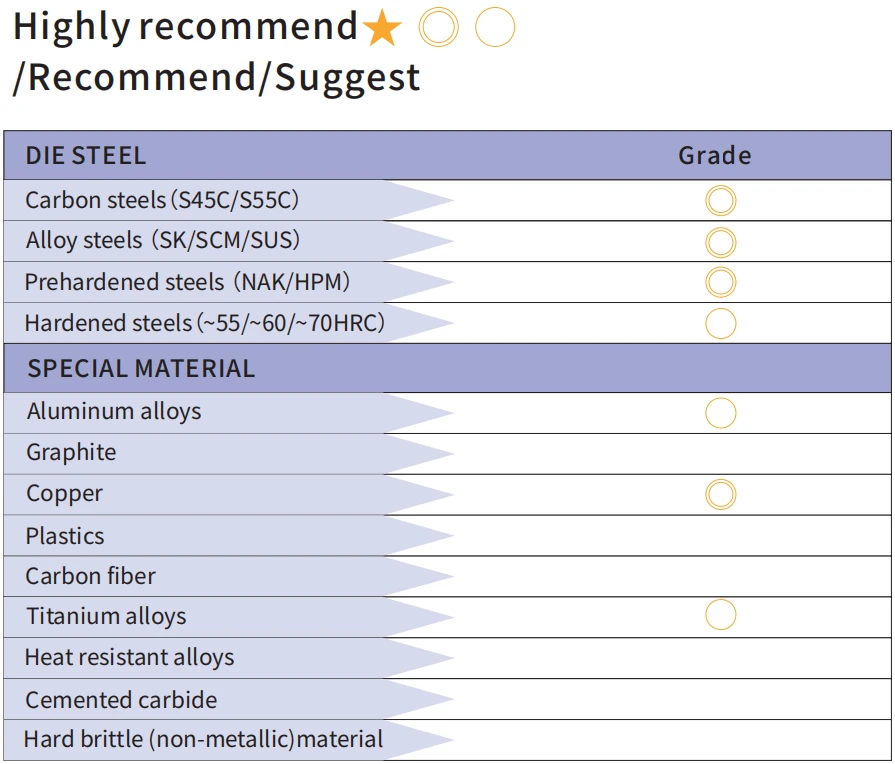
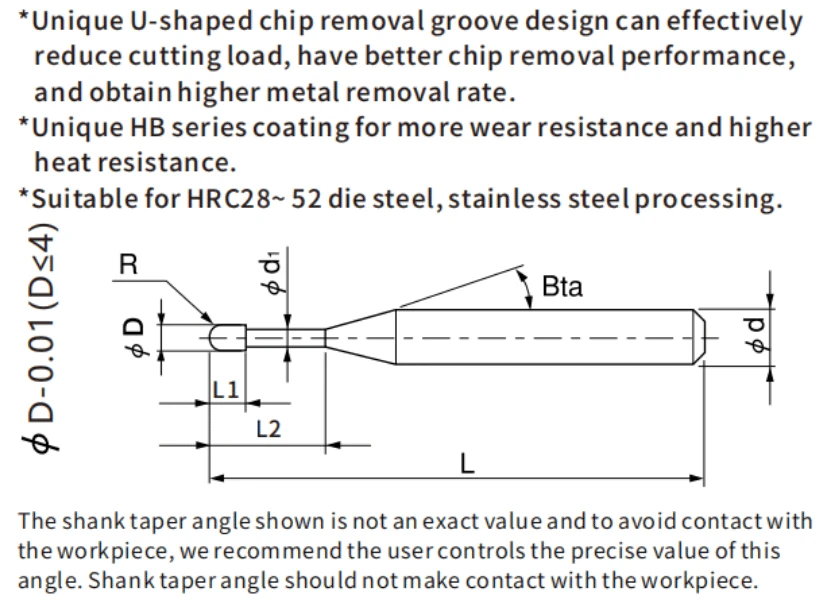



![HRC55 Flat End Mill [2 Flutes ϕ0.2-6]](https://samhotool.com/wp-content/uploads/2023/11/3-10.webp)