
Not long ago, we received an urgent email from a long-standing German client just as we were discussing the increasingly stringent demands mold shops face regarding machining efficiency for high-hardness components. The client was machining a precision mold cavity from HRC62 D2 hardened steel. They had hoped to use a 6-flute tool to handle both roughing and finishing in a single pass; however, less than three minutes into the cut, the tool suffered catastrophic edge failure due to chip clogging.
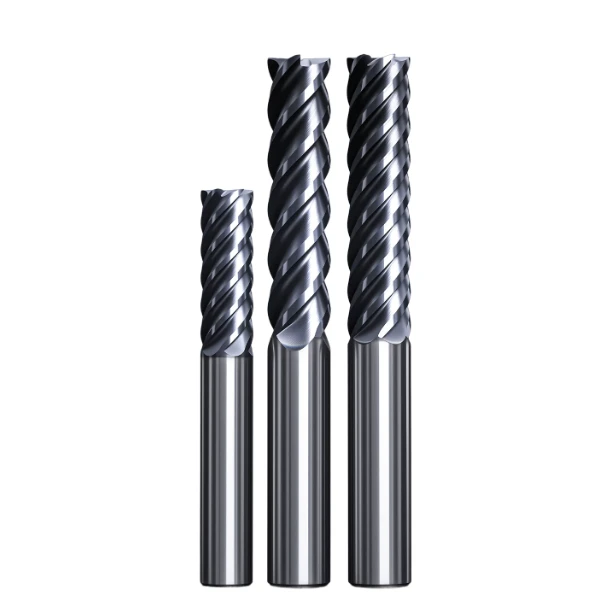
The dilemma of choosing between 4-flute and 6-flute carbide end mill for hardened steel is a challenge we encounter daily over the past decade—both on the factory floor and through technical support. Many shop supervisors and programming engineers fall into common traps: assuming that more flutes automatically equate to higher rigidity and efficiency, or defaulting to standard 4-flute tools for every task. Yet, when facing the rigorous demands of hrc65 carbide end mills, selecting the wrong flute count doesn’t just shorten tool life; it halts production and inflates costs.
To help you avoid these pitfalls, we synthesized our expertise—ranging from raw material composition and edge preparation in manufacturing to years of real-world field data. Here, we break down the fundamental differences between 4-flute and 6-flute tools regarding depth of cut (Ae/Ap), heat control, chip evacuation space (flute valley), and machine rigidity requirements.
Whether you are a supply chain manager planning a bulk purchase of wholesale carbide end mill for hardened steel or a process engineer struggling to fine-tune parameters on the shop floor, these hard-earned insights will give you confidence. On your shop floor, when faced with depth-of-cut limits or excessive overhang, have you selected the right end mills for cutting hardened steel?
Why Does the Choice of Flute Count Directly Determine Tool Life When Machining Hardened Steel?
While optimizing processes at North American mold facilities, we often see engineers indiscriminately add flutes to end mills for hardened steel to improve surface finish. Instead of gaining efficiency, they face rapid tool wear or sudden breakage. When machining steel above HRC50, the tool does not simply slice through metal; it compresses material under intense pressure and heat, altering heat dissipation with every added cutting edge.
Our R&D and field tests show that flute count dictates the ratio between core diameter and chip gullet volume. Programmers often focus on high feed rates while ignoring how fast heat accumulates in micro-chips. On materials with poor thermal conductivity, choosing the right flute count is a careful engineering trade-off between core rigidity and heat evacuation space.
Core Selection Logic for Hardened Steel End Mills Based on Real-World Challenges Faced by Western Clients
A client in Ohio reported severe tool life inconsistency while machining a batch of HRC58 Cr12MoV mold inserts. Tool life fluctuated wildly: some tools finished two cycles, while others chipped within minutes. After reviewing their parameters, we found they attempted a shallow-cut, high-feed strategy using a standard 4-flute carbide end mill for hardened steel, creating uneven chip thickness and severe chatter.
Over a decade of handling customer feedback shows that Western shops have shifted focus from “can it cut?” to overall process stability and cost per part. When milling complex cavities, success depends on matching your machine rigidity, toolholder style, and toolpath to the force distribution of a specific flute count.
The Trade-off Between Rigidity and Flute Valley Space: Why Aluminum Machining Logic Fails on Hardened Steel
Machining aluminum relies on wide flute valleys and large rake angles to flush out sticky chips quickly. Applying this logic to hardened steel end mills leads to catastrophic tool failure. Carbide end mills for hardened steel must withstand massive radial loads, requiring the core diameter to expand to 65% or even 70% of the outer diameter, which significantly compresses chip space.
Increasing the flute count from four to six shrinks the flute valley even further, turning chips into fine dust or tiny flakes. If you attempt a large radial depth of cut ($A_e$) with a 6-flute tool, chips instantly pack the flutes, trapping heat and triggering thermal cracking. Machining hardened steel requires abandoning soft-material habits and balancing chip space against tool core strength based on your cut strategy.
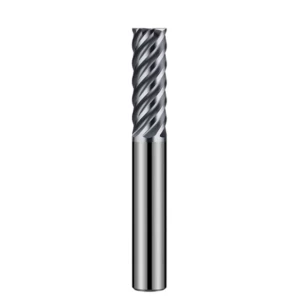
Real-World Performance and Applications of 4-Flute Solid Carbide End Mills in Hardened Steel Machining
On many shop floors, operators take the easy route of using a single 4-flute cutter from roughing all the way to finishing. While not the most aggressive approach, a 4-flute carbide end mill for hardened steel offers a highly forgiving balance between core rigidity and chip clearance under unpredictable machining conditions.
When dealing with fluctuating cutting forces, aging machinery, or inconsistent material hardness, 4-flute tools provide superior operational stability. During manufacturing, we optimize variable helix geometries to break up harmonic chatter. For deep cuts or frequent toolpath direction changes, 4-flute designs offer a crucial safety margin against sudden tool breakage.
Deep Slotting and High-Depth-of-Cut Roughing: How 4-Flute Tools Prevent Tool Failure via Chip Evacuation Space
During deep slotting or roughing with a large axial depth of cut (Ap), smooth chip evacuation determines process reliability. When using end mills for cutting hardened steel, hard chips accumulate rapidly in large volumes. The generous chip gullets of a 4-flute tool ensure chips are ejected cleanly rather than re-cut in the work zone.
Our lab tests confirm that most tool breakage comes from packed chips crushing the cutting edge rather than raw force snapping the shank. The deeper flute channels of 4-flute end mills allow high-pressure air blasts to reach the tool tip directly. This rapidly clears heat and debris, providing a level of process security that multi-flute cutters cannot match during heavy metal removal.
Vibration Mitigation for Limited Machine Rigidity: Performance of 4-Flute Hardened Steel End Mills on Older Equipment or Long Overhangs
Not every shop runs brand-new 5-axis machining centers; many clients rely on aging 3-axis mills or setups requiring long tool overhangs. In low-rigidity environments or holders with minor runout, forcing a multi-flute tool spikes cutting forces and triggers chatter. In contrast, 4-flute hardened steel end mills feature larger tooth engagement angles that adapt better to dynamic rigidity loss.
When assisting clients with setups where length-to-diameter ratios exceed 4:1 or 5:1, we prioritize 4-flute cutters. Their wider lands and optimized rake angles provide structural support to counteract radial runout. If your spindle bearings show wear or fixture clamping is limited, a 4-flute tool dampens vibration effectively to prevent unsightly chatter marks.
Real-World Case Study: Why 4-Flute Tools Offer Lower Per-Part Costs in HRC55 Mold Steel Roughing
A European automotive mold maker faced unsustainable tooling costs while roughing HRC55 S136 plastic mold steel. They had pushed 6-flute cutters for full-profile roughing, but trapped heat caused severe thermal cracking, requiring a new tool every two parts. We analyzed their machining logs and recommended switching to a 4-flute end mill tool with a slightly increased feed per tooth.
While the theoretical table feed dropped by 15%, actual tool life more than doubled due to improved chip clearance and edge impact resistance. Even with ten extra seconds of cycle time per part, drastically reduced tool consumption and downtime lowered their total processing cost per part by 28%.
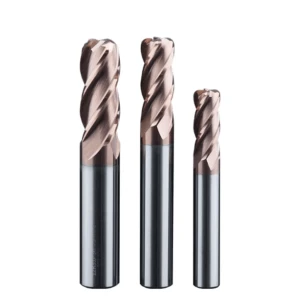
The Ultimate Tool for Cutting Ultra-Hard Materials (HRC65): 6-Flute HRC65 Carbide End Mills
When workpiece hardness reaches HRC60 or higher, conventional roughing strategies fail. Attempting a brute-force approach with fewer flutes results in severe impact damage and immediate edge chipping. When developing our 6-flute HRC65 carbide end mills, our core strategy was maximizing core diameter ratio for extreme rigidity while distributing cutting loads across more teeth to keep chip thickness micro-thin.
A higher flute count enables faster table feed rates at high spindle speeds without overloading individual teeth. Factory tests show that when tool rigidity resists radial deflection, dynamic spindle runout and high-frequency vibrations drop dramatically. For direct hard milling of mold cavities without EDM, 6-flute tools are essential for achieving high-efficiency, high-quality results.
Shallow-Depth, High-Feed (HSM/Trochoidal) Strategies: How 6-Flute Tools Achieve Remarkable Metal Removal Rates
Achieving high Metal Removal Rates (MRR) in hardened steel relies on modern CAM strategies like trochoidal milling or High-Speed Machining (HSM) with shallow depths of cut. When planning toolpaths for customers using HRC65 carbide end mills, we limit radial depth of cut (Ae) to 5%–10% of tool diameter. This small engagement angle ensures cutting heat escapes with the tiny chips, preventing dangerous thermal buildup in the cut zone.
Small radial engagement avoids chip-evacuation bottlenecks, eliminating the flute-space disadvantage of 6-flute cutters while maximizing high-feed benefits. Six cutting edges quickly shave the workpiece surface at high frequencies, yielding impressive metal removal rates despite thin per-tooth chip loads. This light-cut, high-speed approach is why modern hard milling outperforms traditional machining methods.
Mirror-like Finishing: The Physics of Achieving Low Roughness When Hard Milling with End Mills
In finishing operations, surface roughness and geometric tolerances become top priorities. When using an end mill cutting hardened steel on sidewalls, surface finish is dictated by theoretical scallop height and minute tool deflection. Thanks to tighter tooth spacing, 6-flute cutters reduce the distance between feed mark peaks at given feed rates, directly lowering $R_a$ values.
Additionally, the thick core of a 6-flute cutter provides exceptional resistance to bending forces. Under finishing loads, the tool body experiences minimal elastic deformation, ensuring excellent sidewall verticality and dimensional control. Pairing a 6-flute cutter with a precision shrink-fit holder yields a mirror-like finish comparable to grinding, eliminating labor-intensive manual polishing.
Real-World Case Study: How a 6-Flute Tool Boosted Machining Efficiency by 40% in Finishing HRC62 Hardened Parts
We assisted a North American medical device supplier struggling with high-precision sidewall milling on HRC62 440C stainless steel parts. Using standard 4-flute tools, any feed rate increase caused tool deflection, creating a mid-wall bulge that pushed cycle times to 45 minutes per part.
We replaced their tooling with our custom 6-flute solid carbide end mills and boosted the feed rate by 50% at the same surface speed. The increased rigidity held sidewall perpendicularity within 0.005 mm and reduced surface roughness (Ra) below 0.2 microns. Cycle time dropped from 45 to 27 minutes—a 40% efficiency gain—while extending tool life by nearly 30%.
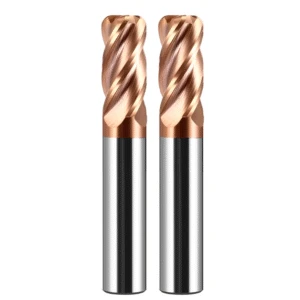
Engineer’s Decision Tree: How to Choose the Best End Mills for Cutting Hardened Steel Based on Operating Conditions?
We avoid giving rigid formulas when clients ask whether to use 4-flute or 6-flute cutters. Instead, we evaluate workpiece conditions, machining strategies, and available hardware. Selecting end mills for cutting hardened steel requires looking beyond catalog specs to ensure tool compatibility with your entire machining system.
Deciding on tool geometry requires balancing cutting forces, chip evacuation, and heat dissipation. Overlooking material hardness, CAM toolpaths, or workholding limits during selection prevents optimal performance on the shop floor, even with premium grade carbide. Effective decision-making relies on taking a systems-engineering perspective.
Considering Material Hardness and Condition: Matching Principles for HRC45–55 vs. HRC65 Carbide End Mills
The first step in tool selection is evaluating actual workpiece hardness and heat-treatment status. Materials in the HRC45–55 range retain ductility, producing longer chips that adhere to cutting edges; under these conditions, we recommend 4-flute tools for their superior chip clearance. For high-hardness steels like D2 or SKD11 above HRC60, specialized HRC65 carbide end mills are essential to withstand massive cutting resistance.
A common pitfall is using multi-flute tools designed for hard milling on softer, tougher materials. Shallower chip gullets on multi-flute tools cause ductile chips to pack tightly, leading to sudden edge failure. Conversely, forcing 4-flute tools into HRC65 steel causes micro-chipping from excessive pressure per unit area, making hardness-based tool selection critical.
Analyzing Cutting Paths and Cut Depth: The Impact of Radial Depth of Cut (Ae) on Heat Dissipation for 4-Flute vs. 6-Flute Tools
Evaluating radial depth of cut (Ae) is crucial because heat is the primary enemy in hard milling. Large radial cuts (Ae > 30% D) keep cutting edges in contact with material longer, generating intense heat. Here, you must rely on a 4-flute carbide end mill for hardened steel combined with strong air blasts to clear heat and chips from the work zone.
Conversely, high-efficiency trochoidal strategies keeping Ae under 10% D allow cutting edges to cool during the air-rotation phase. Small engagement angles mitigate heat accumulation, rendering smaller chip gullets irrelevant while fully unlocking the feed-rate advantages of 6-flute tools. Your programmed Ae value directly determines which flute count belongs in the spindle.
Considering Workholding and Toolholders: How Shrink-Fit and Hydraulic Holders Amplify High-Rigidity 6-Flute Tools
Tool clamping systems are frequently overlooked during tool setup. Even premium 6-flute end mill cutters lose their rigidity advantage if mounted in low-quality collet chucks with 0.01 mm runout, causing uneven tooth loads and premature failure. Pairing these tools with high-precision shrink-fit or hydraulic holders keeps radial runout under 3 microns, unlocking the true potential of hardened steel end mills.
Shrink-fit holders apply uniform 360-degree clamping forces to suppress high-frequency vibration at elevated RPMs, maximizing 6-flute tool stiffness. We strongly recommend 6-flute cutters for hard milling when high-precision holders are available. However, if setups are limited to standard collets or long overhangs, flexible 4-flute cutters help avoid severe chatter.
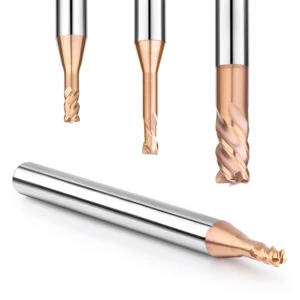
Avoiding Common Shop-Floor Pitfalls: 3 Mistakes Western Customers Often Make When Using Carbide End Mills for Hardened Steel
Over a decade of working with overseas facilities shows that shop-floor errors cause most premature tool failures. When edge chipping or sudden wear occurs, customers often blame tool substrate quality or coating adhesion. However, analyzing returned tools reveals that improper shop-floor practices are usually the real culprit. Properly applying a carbide end mill for hardened steel is just as crucial as its manufacturing quality.
While Western technicians follow standardized procedures, many carry over habits formed on soft steels or aluminum alloys to high-hardness milling. Minor programming oversights or bad habits amplify rapidly in extreme high-pressure, high-temperature cutting zones. Understanding these common pitfalls will help you avoid unnecessary tool wear and improve process reliability in daily production.
Mistake 1: Chip Accumulation and Edge Chipping Caused by Forcing a 6-Flute Tool into Full-Slot Milling
A frequent shop-floor mistake occurs when operators force a 6-flute tool into full-slot milling (100% tool diameter engagement). In steels above HRC50, full-slotting creates a maximum 180-degree wrap angle that spikes cutting resistance. Multi-flute tools have narrow flute valleys, causing micro-chips to pack tightly inside the channels.
Microscopic inspection of damaged end mills for cutting hardened steel reveals molten chips welded to flute gullets, causing immediate, explosive edge chipping. For full-slotting or high-engagement roughing, always revert to a 4-flute design with ample chip clearance. If you must use multi-flute tools for slotting, adopt a trochoidal path to ensure a clear physical exit for chips.
Mistake 2: Excessively Conservative Feed Rates (Insufficient Fz) Causing Severe Frictional Wear
Programmers facing HRC60+ hardened steel often reduce feed per tooth (Fz) to extremely low levels, believing “slow grinding” is safer. However, this conservative approach backfires when milling hardened steel. To prevent chipping, cutting edges undergo precise micro-honing during manufacturing, creating a microscopic radius along the edge.
If feed thickness falls below this honing radius, the cutting edge rubs against the material instead of shearing it cleanly. This intense friction generates localized heat, creating a work-hardened surface layer and accelerating thermal wear on the tool’s rake and flank faces. Increasing the feed rate allows the carbide end mill for hardened steel to bite into the material properly, letting chips carry away heat.
Mistake 3: Mistakes in Cooling Strategy (Dry Air Blow vs Coolant) Leading to Thermal Cracking
Improper cooling is another hidden culprit behind premature tool failure in hard milling. On many shop floors, workers spray liquid coolant directly onto high-speed rotating tool heads. In high-hardness cutting, instantaneous temperatures exceed 800°C. Rapid heating upon entering the cut followed by sudden liquid cooling upon exiting induces severe thermal shock.
This extreme thermal differential creates dense networks of intersecting heat cracks across the coating and substrate, causing the cutting edge to flake off. When machining steels above HRC55 with an end mill cutting hardened steel, avoid conventional flood coolant entirely. Use a cold air blast to clear chips and stabilize cutting zone temperatures without thermal stress.
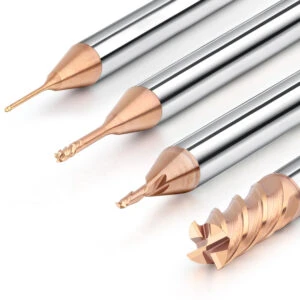
How to Source High-Quality Chinese End Mills for Hardened Steel Directly from the Factory?
When sourcing overseas suppliers, procurement managers often worry about batch-to-batch quality inconsistency rather than single sample performance. Sourcing a dependable China end mill for hardened steel requires evaluating a manufacturer’s quality assurance system—from raw material inspection and precision grinding to PVD coating application. Minor flaws at any stage multiply quickly when milling materials over HRC60.
Matching tool geometry to your cut strategy is only effective when tools feature consistent physical properties. If you are evaluating overseas suppliers or trying to reduce tooling costs, scrutinizing manufacturing metrics—such as carbide rod grain size, edge preparation, and coating hot-hardness—is essential to building a reliable supply chain.
Avoiding Pitfalls in Wholesale Procurement: Key Metrics for Evaluating Carbide End Mills for Hardened Steel
When purchasing in bulk, buyers often focus on surface finish while overlooking substrate quality and coating adhesion. When evaluating wholesale carbide end mill for hardened steel options, focus closely on the carbide rod grain size. Tools designed for HRC65 steel must use ultra-fine (0.2μm–0.4μm) or nano-grade tungsten carbide rods to balance extreme hardness with fracture toughness.
Coating adhesion is another critical metric that dictates tool survival during hard milling. Premature coating delamination exposes the carbide substrate, leading to rapid thermal annealing and catastrophic wear. Always request scratch test data to ensure the coating forms a dense, protective oxide layer capable of preserving substrate hardness at temperatures exceeding 800°C.
Ensuring Batch Consistency and Edge Preparation Standards in Our Production of Carbide End Mills for Hardened Steel
The greatest challenge in mass production is ensuring every cutter in a 500-piece batch delivers identical performance. In our manufacturing process for a China end mill for hardened steel, we utilize 5-axis grinding centers and advanced optical inspection to hold radial runout strictly within 3 microns. This micron-level tolerance ensures every tooth bears an equal load, eliminating tool breakage caused by single-tooth overloading.
Microscopic edge preparation is our final core quality control step for hard milling tools. Sharp cutting edges are too fragile for hardened steel, so we apply precise drag finishing to create uniform micro-hones or K-land chamfers. If you face interrupted cuts or deep cavity slotting, share your parameters, material grades, and CAM paths with us so we can engineer the optimal tool solution for your shop.