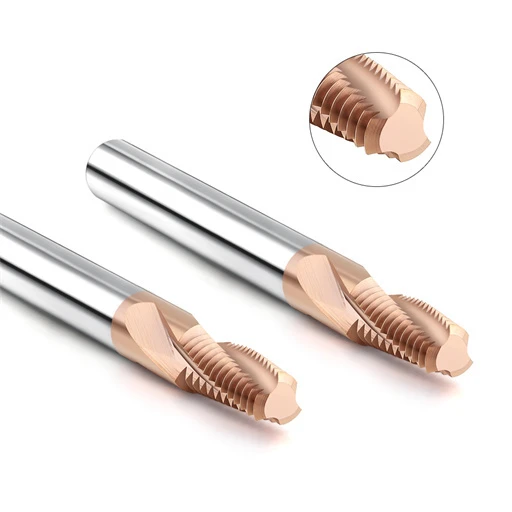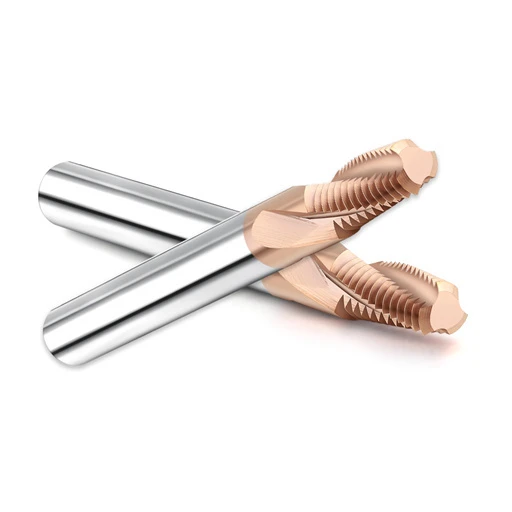

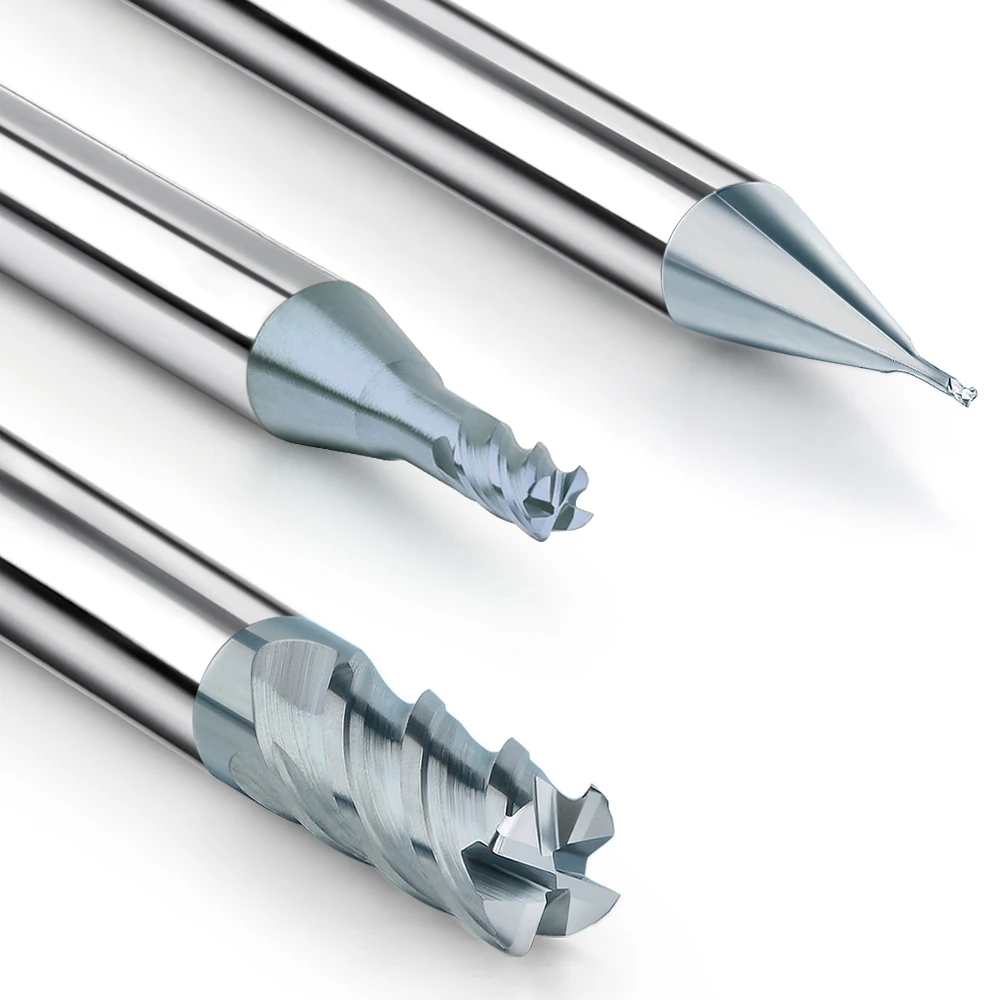
As engineers who spend our days on the shop floor—surrounded by hardened steel and the constant hum of CNC machines—we know the dilemma. When customers open our catalog, the most common question isn’t about price; it’s: “For this specific mold block, do I need HRC45, HRC55, or should I jump straight to HRC65?”
Just last month, a long-term German client shared some frustrating feedback. They were machining pre-hardened steel at roughly HRC48. In an effort to maximize tool life, they opted for our top-tier CNC HRC65 milling cutter tools. The result? Efficiency plummeted because the tools kept chipping. This highlights a massive misconception we’ve seen over the last 15 years: higher hardness does not automatically mean better stability.
As a specialized China milling cutter tools supplier, we know that real-world tool selection goes beyond a Rockwell hardness tester. You have to weigh the carbide milling cutter tools’ substrate grain size, the coating’s oxidation temperature, and—most importantly—the “sweet spot” between toughness and hardness.
Whether you are running high-feed roughing or using a ball mill cutter tool for a mirror-finish pass, the wrong grade will kill your cycle time. In this breakdown, we’ll use lab data and thousands of shop-floor cases to help you avoid the common “hardness traps” that ruin workpieces and profits.
Ultimately, what do you want: the hardest tool on the shelf, or a tool that reliably runs through the night without triggering a 3 a.m. broken-tool alarm?
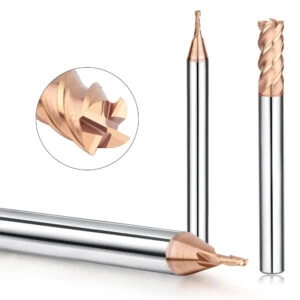
Stop Idolizing Hardness: Why Blindly Upgrading Your Carbide Milling Cutter Tools Could Cost You Profits
We often see North American clients buying the most expensive, high-hardness tools to “speed things up,” only to find the edges chipped within minutes. It’s a common mental trap: the belief that a higher HRC rating equals smoother machining. However, chasing extreme hardness without context is a fast way to lose money. If the tool’s physical properties don’t match your machine’s rigidity or the workpiece material, you aren’t just burning through tools—you’re wasting expensive machine time.
Tool selection is the art of balance. Increasing hardness usually means sacrificing Transverse Rupture Strength (TRS). If your Vertical Machining Center (VMC) isn’t perfectly rigid, or if your workholding has even a tiny bit of flex, a brittle HRC65 tool will snap. The best carbide milling cutter tools for your specific job will always save you more money than the most expensive ones.
The Tug-of-War Between Toughness and Hardness: A North American Case Study on “Chipping”
Last year, we supported a mold shop in Chicago machining standard mold bases at HRC30. To reduce tool changes, they switched to CNC HRC65 milling cutter tools. Less than 30 minutes in, the side edges showed significant micro-chipping. It was a classic case of “using a cannon to kill a mosquito.” An HRC65 tool has an incredibly fine grain structure; while its wear resistance is elite, it is far too brittle for soft materials. At HRC30, the chip evacuation pressure and minor harmonic chatter are enough to shatter a brittle, high-hardness edge.
In that scenario, we moved them back to an HRC45 grade. The reason is simple: HRC45 carbide blanks use a higher proportion of Cobalt (Co) binder. This gives the tool a better elastic modulus and superior impact resistance. This “toughness” allows the tool to absorb the shocks of non-homogeneous materials, preventing cracks from spreading. The result? Even though HRC45 is “softer,” the lack of chipping extended the effective cutting time by over 40%.
Practical Selection Logic: Why HRC55 is the “Universal Safety Net”
As a China milling cutter tools supplier, we don’t believe in a “one-size-fits-all” formula. However, for the majority of general CNC applications that don’t require ultra-precision hard milling, we recommend the HRC55 series as the standard inventory. It isn’t just about the specs on paper; it’s about the margin of error. HRC55 strikes the perfect balance: it stays sharp long enough for hardened steel but is tough enough to survive unexpected vibrations.
We call this the “Universal Safety Net.” The secret lies in the substrate’s microstructure. When you’re jumping between carbon steel and alloy steels (HRC35 to HRC50), carbide milling cutter tools in the HRC55 range handle high-temperature oxidation beautifully during dry cutting. They are also robust enough to survive sudden changes in tool path direction without snapping under instantaneous torque. Unless you are doing specialized hard milling, this logic eliminates 80% of unexpected downtime risks.
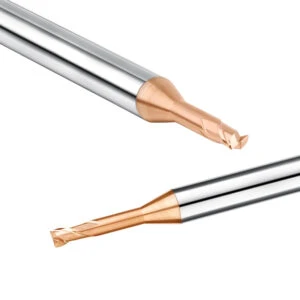
Practical Performance Analysis: Application Boundaries for HRC45, HRC55, and HRC65 Milling Cutters
In the workshop, we often see a telling contrast: a seasoned veteran uses one tool for three days, while a novice snaps the same tool in thirty minutes. The difference usually isn’t the machine—it’s the “temperament” of the tool’s hardness grade. We classify milling cutter tools into specific grades to handle the thermal deformation and chemical reactions that happen at the cutting edge. In real production, you must work backward: choose your tool based on whether your workpiece is annealed, tempered, or fully hardened.
There is no “universal” tool—only an “optimized” boundary. The jump from HRC45 to HRC65 is a trade-off: you gain hardness but lose toughness. The following cases show how we delineate these boundaries based on chip pressure and heat. This isn’t textbook theory; it’s practical logic forged over thousands of hours, paid for with scrapped steel and broken edges.
For Pre-hardened Steels: The High-Feed Advantage of HRC45 Carbide Milling Cutters
When roughing 45# steel or tempered 4140 alloy, your goal is the “metal removal rate” (MRR). At this stage, we prioritize toughness over sheer hardness. We use HRC45 carbide milling cutter tools because they offer exceptional fracture resistance. Roughing involves immense, alternating stresses as the tool repeatedly enters and exits the cut. If the tool is too hard, the microscopic grains will spall or flake off under the constant impact.
Our empirical testing shows that with these medium-hardness cutters, you can aggressively increase the feed per tooth. Even with unstable depths of cut (Ap) or scaly castings, these tools act like springs, absorbing vibration. This “flex-to-survive” strategy can shorten machining cycles by over 30%. For a high-throughput shop, this efficiency boost is far more valuable than a high hardness rating on a broken tool.
The Mold Shop Workhorse: Parameter Optimization for CNC HRC55 Milling Cutters
In mold making, materials like P20, 718H, and S136 are the standard. For these steels (HRC35 to HRC48), we recommend CNC HRC55 milling cutter tools. This is our most balanced formulation. If you see rapid wear here, the problem usually isn’t the tool; it’s the balance between cutting speed (Vc) and feed rate (Fz).
When machining “gummy” stainless steels like S136, chasing high RPMs is a mistake. Heat builds up too fast, causing the coating to peel. The winning strategy is “moderate speed, high pressure.” Combine a reasonable Vc with a high feed rate so the chips carry the heat away. This maximizes the coating stability of the HRC55 cutter, preserving cavity dimensions and eliminating the “witness marks” caused by frequent tool changes.
Hardened Steel Challenges: HRC65 Milling Cutters Under Extreme Heat
When a workpiece exceeds HRC60—like quenched guide rails or stamping dies—standard tools melt like wax. In these cases, CNC HRC65 milling cutter tools are your only lifeline. Their advantage isn’t impact resistance; it’s “Red Hardness.” Even in the high heat of dry cutting, the substrate retains its shape and resists “thermal softening.”
However, you must overhaul your strategy for ultra-hard tools. Switch to High-Speed Machining (HSM): high frequency and shallow cuts. Because HRC65 tools have very low cobalt, they are brittle and sensitive. Using the wrong coolant can cause thermal shock cracks. We strongly recommend air-blast cooling only. Let the oxidation-resistant coating do its job at high RPMs to achieve that breathtaking, mirror-like finish.
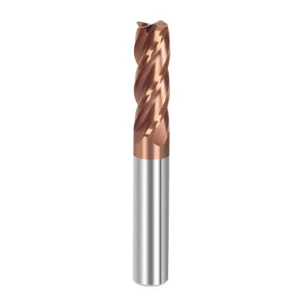
3D Surface Machining: How Hardness Affects Ball Mill Surface Quality
Precision contoured parts bring up the most common question: “How do I get a better finish?” A ball mill cutter tool is unique because the cutting speed drops to zero at the very center of the tip. This means the center of the ball is “extruding” or rubbing the material rather than cutting it. Choosing the right hardness is about finding the equilibrium between edge sharpness and wear resistance to stop irregularities at 3D transition points.
For a finish of Ra 0.4 or finer, micron-level wear on the ball apex will ruin the job. This wear shows up as “dull” patches or visible “step-over lines.” As an experienced China milling cutter tools supplier, we suggest selecting your tool grade based on the workpiece’s hardness after its final heat treatment. This keeps cutting resistance constant, which is the secret to a flawless contoured surface.
Mirror Finishing: Damping Strategies for Ball Mills in Hard Materials
For medical or optical molds, hardness alone isn’t enough. When using a ball mill on materials over HRC50, the brittleness of the tool can cause microscopic “serrations” on the edge. To get a mirror finish, we use multiple passes with minimal stock removal. We leverage the rigidity of a high-hardness substrate combined with ultra-thin nano-coatings (like TiAlN) to kill friction.
The secret to hiding “step marks” is controlling radial run-out. Even with the best carbide milling cutter tools, using a grade that is too hard (like HRC65) on a low-precision spindle causes microscopic chatter. For finishing hard materials, slightly reduce the axial depth of cut (Ap) and use high spindle speeds for micro-cutting. This counteracts the brittle vibrations and leaves a surface as smooth as glass.
Long-Reach Solutions: Using HRC55 to Solve Deep Cavity Chatter
Deep cavities are a nightmare, especially when using long-neck ball mills. That piercing “screech” of chatter is a warning that your tool is about to snap. We once saw a client insist on HRC65 tools for a 120mm deep cavity, thinking the rigidity would help. Instead, the brittleness caused the tool to snap instantly upon contact due to resonance.
We solved it by “downgrading” to a custom CNC HRC55 milling cutter tool. The HRC55 material has better internal damping—it acts like a shock absorber for the long tool overhang. Combined with an unequal helix design, the machine went silent. The lesson: in deep cavities, stability beats hardness. Proper relief design and the right material toughness allow you to maintain a stable feed even with extreme overhang.
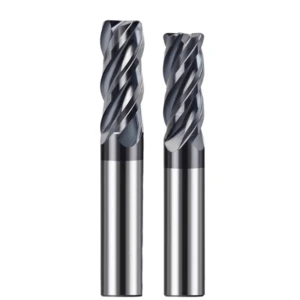
Inside Look at Quality Control: Why Our “China-Made” Milling Cutters Are More Durable
In the global market, the variety of “Made in China” milling cutters is massive, and the price gaps can be baffling. Clients often ask us: “The spec sheets both say HRC55—so why does one cutter fail after 200 holes while yours lasts an entire shift?” As a manufacturer with over 15 years in the game, I’ll be blunt: the gap isn’t about branding. It’s in the production details you can’t see with the naked eye. In CNC machining, stability is everything. Any “corner-cutting” during production inevitably shows up as a doubled cost in your final unit price.
We believe a great carbide milling cutter tool is the perfect synergy of materials science and geometry. From the moment raw carbide rods enter our facility, we implement a rigorous—bordering on obsessive—internal audit. Durability isn’t a slogan; it’s the result of controlling tungsten carbide grain uniformity, optimizing coating adhesion, and reinforcing the cutting edge. We don’t just sell tools; we sell “machining predictability”—the peace of mind that lets you run a lights-out shift without worrying about a 2:00 AM tool breakage.
The Difference Starts at the Source: Microscopic Precision in Raw Materials
If you stepped into our lab, you’d see us using metallographic microscopes to screen every batch of raw carbide. To cut costs, many “budget” China milling cutter tools suppliers use recycled carbide or cheap rods with coarse grain structures. On paper, their Rockwell hardness might pass, but under a microscope, the internal structure is uneven. We insist on ultra-fine-grain tungsten carbide (0.4μm or finer). This density is the bedrock that prevents a tool from developing micro-cracks under high-load operations.
In our testing, inferior rods—often with “inflated” hardness ratings—show internal voids and carbide segregation. During high-speed machining, these minute defects become fracture points. We supply high-end clients in the U.S. and Europe because we control grain consistency at the source. While this commitment to “matrix purity” increases our upfront cost, it guarantees that every carbide milling cutter tool we ship maintains exceptional fatigue resistance, regardless of the material batch you’re cutting.
Edge Preparation and Coating: The Final Performance Boost
Many engineers assume a tool is “finished” once it’s ground and coated. That’s a mistake. The most critical final stage at our facility is “Edge Preparation” (honing). If we sent a freshly ground tool straight to the coating chamber, the microscopic serrations along the edge would chip instantly under load, taking the expensive coating with them. We use a precise passivation process to refine the edge into a uniform radius. This “strengthened edge” is the secret to how our HRC55 tools outlast competitors in the same class.
For coatings, we don’t believe in a “universal” fix. We use PVD to apply composite elements like AlTiSiN in nanoscale layers tailored to specific environments. This acts as “body armor” for our CNC HRC55 milling cutter tools, withstanding heat over 1,000°C and creating a self-lubricating film. This level of meticulous control—from the rod to the final polish—is what makes us a reliable partner for your shop.
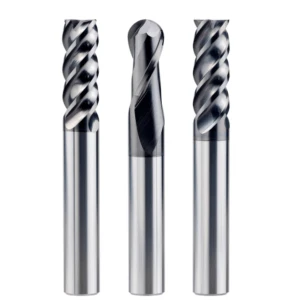
Engineer’s Advice: A Three-Step Method to Pick the Right Milling Cutter
We’ve talked a lot about the science, but as fellow professionals, we know you need rules you can apply at the machine. Tool selection isn’t an academic exercise; it’s about finding a solution that fits your equipment’s rigidity, your material, and your deadline. Based on a decade of on-site debugging, here is our “Results-First” framework to help you eliminate the wrong options and maximize your spindle efficiency.
Match the Tool to Material Hardness (HRC)
-
For annealed steels or 300-series stainless (Hardness < HRC35): Go with HRC45 carbide milling cutter tools. You need chip evacuation space and impact toughness here. Using high-hardness tools is a waste and actually increases the risk of “built-up edge” (BUE) where the material sticks to the tool.
-
For pre-hardened mold steels like P20, 718H, or S136 (HRC35 – HRC48): HRC55 is your “Goldilocks” zone. We recommend leaving a small allowance for finishing; use a moderate surface speed and a constant feed per tooth for the most predictable tool life.
-
For hardened steels after heat treat (HRC50 – HRC65): You must step up to HRC65 tools. Switch your strategy to High-Speed Machining (HSM)—light cuts at high frequencies—to let the tool’s “hot hardness” handle the resistance.
Evaluate the Machining Geometry
-
For large 3D surface finishing: Use a high-hardness ball mill cutter tool and keep the overhang as short as possible. Even on softer workpieces, a high-hardness ball-nose maintains its edge geometry longer during “surface-sweeping,” which minimizes those frustrating blend lines and tool path marks.
-
For deep cavities, narrow slots, or thin-walled parts: Try stepping down one hardness level (e.g., from HRC60 to HRC55). The HRC55 substrate has better “internal damping,” which helps suppress high-frequency resonance. Sometimes a bit of physical elasticity is the only cure for that “screeching” chatter in deep pockets.
Assess Machine Rigidity and Setup
-
For high-speed, high-precision centers: You can confidently use our ultra-fine-grain, high-hardness series. Harness the centrifugal force of high spindle speeds and the lubricity of our PVD coatings for highly efficient dry machining.
-
For older machines or low-rigidity setups: Increase your coolant concentration and stick with tougher tools like HRC45 or HRC55. In these setups, protecting the edge against vibration-induced chipping is much more important than chasing high-temperature resistance.
Every blueprint has its own “temperament,” and every shop is different. We’ve seen countless cases where a tiny tweak in a parameter or a simple switch in tool grade saved a part from the scrap heap.
Are you struggling with a material that eats through tools? Or a surface finish that just won’t clear inspection? Let’s talk. We’re happy to review your specific and paths to help you find the perfect tool-and-process combination.