
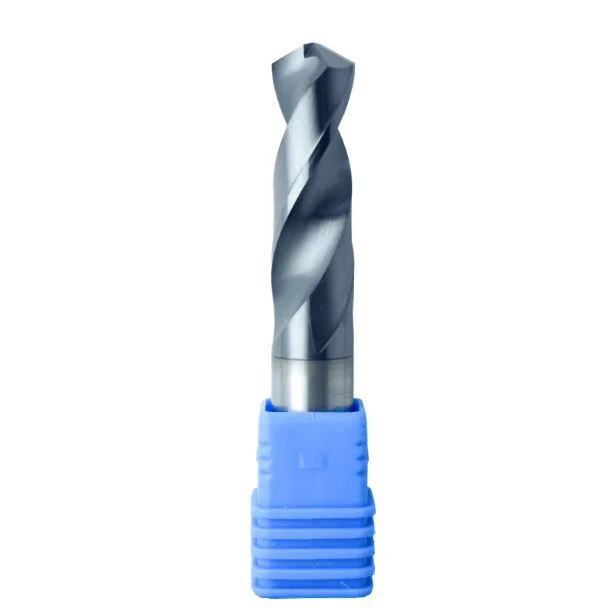
A few months ago, a machine shop supervisor in Ohio reached out to us with an urgent problem. Their CNC workshop was running a large batch of 316L stainless steel valve bodies. A job expected to take one day was completely stalled because their expensive solid carbide drill bit kept chipping and snapping inside the holes after fewer than 20 cycles.
To save the tool, the operator lowered the feed rate. This proved disastrous; the drill merely rubbed against the bottom of the hole until it smoked. It instantly hardened the workpiece surface to a point where even brand-new carbide couldn’t cut into it. This is a classic case of work hardening, an issue we have resolved repeatedly for US and European shops over the past 15 years.
Many machinists mistakenly apply carbon steel techniques to stainless steel, thinking a “gentle” low-feed approach protects the tool. In reality, austenitic stainless steel is highly prone to deformation. If your stainless steel drill bit rubs or dwells, friction spikes temperatures instantly. This transforms the base metal from a soft 180 HB into a brutal 45 HRC hardened crust, making tool breakage inevitable.
As a dedicated china drill bits manufacturers team with extensive shop-floor experience, we know that conquering “gummy” yet tough metals requires specialized tool geometries and rigid parameters over textbook theory. We resolved the Ohio shop’s crisis by deploying customized drill bits for stainless steel and overhaul-optimized cutting programs. Here is exactly how we break the work-hardening curse using high-performance china drill bit strategies.

Why do your stainless steel drill bits trigger work hardening during hole drilling?
In the technical support cases we handle for Western machine shops, over 70% of stainless steel drilling failures trace back to work hardening. When tools snap, engineers usually blame the substrate or coating quality and immediately back off on speeds and feeds. This defensive adjustment, while correct for carbon steel, is an absolute disaster for stainless steel.
In actual CNC operations, mechanical compression and localized heat cause severe crystal lattice distortion in austenitic alloys. We tell our clients that stainless steel is a temperamental beast; you must slice through it decisively. Any hesitant rubbing causes the metal to friction-harden instantly, creating a surface shell tougher than the tool itself. Through analyzing countless scrapped parts, we isolated three main culprits.
Culprit #1: Excessive cutting speed (Vc) and secondary friction during pecking
Driven by aggressive cycle times, many programming supervisors run high cutting speeds. However, our wear tests show that when linear speed exceeds a critical threshold, stainless steel’s low thermal conductivity traps heat at the cutting zone. This intense heat alters the metal’s grain structure, creating an impenetrable, hardened barrier at the bottom of the hole.
Compounding this is the traditional peck drilling cycle (like a G83 command). Every time the stainless steel drill bit retracts and re-enters, the tip strikes residual micro-chips and the previously cold-worked hole bottom. This constant mechanical jarring and intermittent dry friction guarantees a hardened crust that will chip your cutting edges on the very next pass.
Culprit #2: Excessively low feed rate (Fn) causes the cutting edge to “scrape” rather than “cut” the material
This is the single most common programming error we diagnose for our B2B customers. Novice programmers lower the feed per revolution out of caution, trying to ease the tool through. However, if your feed rate is lower than the drill’s edge honing radius, the cutting edge cannot bite into the parent metal; it simply rubs and compresses the surface.
This inefficient cutting state generates massive shear stress, compressing and hardening the ductile alloy much like an industrial metal rolling process. If your feed per revolution fails to break past the deformation layer left by the previous rotation, the hole becomes unmachinable. Even a premium solid carbide drill bit cannot survive drilling into an artificially hardened steel plate.
Culprit #3: Incorrect Drill Bit Geometry: Standard Point and Clearance Angles Fail to Effectively Shear Stainless Steel Fibers
Many procurement departments buy standard, general-purpose drill bits to save money, which yields catastrophic results on tough alloys. Stainless steel demands high axial force and razor-sharp shearing geometry. Standard bits feature a chisel edge that is far too wide, which causes extensive metal smearing and rubbing at the hole entrance rather than immediate self-centering.
Furthermore, improper clearance and helix angles restrict chip evacuation, packing highly elastic stainless chips inside the flutes. This creates severe friction against the hole walls and leads to built-up edge (BUE) formation. Without a dedicated flute geometry engineered by an expert china drill bit supplier, standard tools will choke and fail in high-tensile materials.
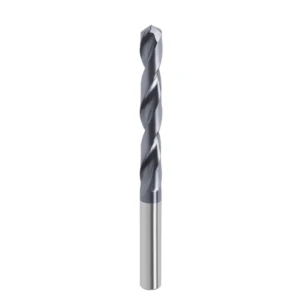
Fine-Tuning Solid Carbide Drill Bit Parameters to Overcome Work Hardening in the CNC Workshop
Tackling mass production for challenging austenitic stainless steels turns parameter adjustment into a test of nerve and technical expertise. When faced with tool breakage from work hardening, many machinists instinctively ride the feed override knob, ready to dial it back. However, our years of tool manufacturing and on-site machine setup prove that blindly backing off is counterproductive.
In practical CNC programming, our strategy relies on two core principles: forcing the cutting edge through the previous pass’s work-hardened layer, and evacuating cutting zone heat along with the chips. This requires precisely balancing spindle speed, feed rate, and coolant pressure. The practical techniques outlined below represent the signature solutions we use to extend the service life of our solid carbide drill bit lines for Western clients.
Forcing Entry into the Hardened Layer: Calculating and Setting Feed per Revolution for Stainless Steel
When consulting with programming supervisors in US workshops, our first non-negotiable recommendation is to increase the feed per revolution (fn). In actual machining, the feed rate must never fall below the critical threshold defined by the cutting edge’s hone radius. For 304 stainless steel, we recommend a baseline feed rate of 0.08–0.18 mm/rev, adjusted slightly based on the hole diameter.
Only when the cutting thickness per revolution exceeds the depth of the work-hardened layer can the tool slice cleanly through the softer base material. If the feed rate is too low, the tool merely rubs or burnishes the workpiece, generating exponential thermal shear stress that cracks the carbide. Maintaining a high feed rate is the safest programming strategy when running a high-performance stainless steel drill bit.
Controlling Temperature to Prevent Work Hardening: Practical Tips for Using Through-Coolant Solid Carbide Drill Bits to Suppress Heat in the Cutting Zone
Stainless steel has extremely low thermal conductivity, meaning nearly 70% of cutting friction heat remains trapped inside the hole. Conventional external coolant sprays cannot penetrate the centrifugal barrier created by high-speed rotation. Consequently, when designing high-volume production lines, we mandate the use of a through-coolant solid carbide drill bit for continuous machining.
Our testing indicates that the coolant system requires a pump pressure of at least 20–70 bar (2.0–7.0 MPa). This high-pressure flow provides targeted cooling to the cutting edge and utilizes hydraulic force to flush highly adhesive chips out of the flutes. If coolant pressure is insufficient, chips undergo secondary grinding at the bottom of the hole, instantly ruining even premium tools.
Say No to Intermittent Cutting: Why We Avoid Traditional Peck Drilling for Deep-Hole Machining in Stainless Steel
When machining deep holes exceeding 5xD, many operators habitually use the G83 peck drilling cycle for chip evacuation. However, when machining stainless steel, this practice is highly counterproductive. Each time the drill retracts, residual heat rapidly forms a thin, extremely hard metal crust on the hole bottom. When the tool returns via rapid traverse, the tip clashes “hard-on-hard” against this high-tensile layer.
We guide customers toward using the G73 high-speed chip-breaking cycle or optimizing flute geometry to achieve continuous, single-pass drilling. If pecking is unavoidable, we recommend a variable-speed strategy: briefly reducing spindle speed and increasing the feed rate at the exact moment of re-entry to forcibly crush the hardened layer. This approach helps shops break the cycle of frequent tool breakage common with a low-end china drill bit.

Tackling Challenging Stainless Steel Machining: How to Select Truly Suitable Drill Bits Based on Structural Design?
In our manufacturing workshop, we often joke that stainless steel behaves like a high-toughness spring; if you don’t use the right structural design to tame it, it will strike back. Many buyers focus solely on carbide grain size or overall transverse rupture strength. However, the substrate is merely the foundation; the true determinants of tool life are cutting edge geometry and flute parameters.
A standard tool designed for general steel often fails when cutting stainless steel due to structural incompatibility. After drilling just two or three holes, excessive cutting forces frequently trigger severe work hardening. The following three key geometric and coating parameters represent the fundamental design code we use as a premium china drill bits manufacturers team.
The Decisive Role of the 135° Split Point and Edge Honing in Suppressing Work Hardening
The drill bits for stainless steel that we engineer invariably feature a 135° split point design. Compared to a standard 118° point, the 135° design significantly reduces the chisel edge length, drastically lowering axial cutting resistance. During the critical first second of drilling, if the bit fails to penetrate immediately, it skids and rubs; this initial slippage is the primary trigger for work hardening at the hole entrance.
Beyond the point angle, microscopic edge honing is a top priority in our process control. Many less experienced peers believe that sharper edges are always better for ductile metals, but razor-sharp edges easily micro-chip against high-tensile alloys. We use precision polishing equipment to create a uniform, micron-scale radius (R0.02–0.04 mm) on the cutting edge, promoting a stable shearing flow that prevents localized overheating.
Why Solid Carbide Drill Bits with Unique Helix Angles and Large Chip Flutes Are Essential for Stainless Steel Machining
In deep-hole applications, the speed and smoothness of chip evacuation directly determine whether secondary work hardening occurs within the hole. Stainless steel chips are wide, gummy, and highly elastic. If the flute space or surface finish is inadequate, severe chip packing occurs, causing subsequent chips to be kneaded and compressed at the bottom of the hole, instantly raising wall hardness.
To address this, we design each solid carbide drill bit with a specialized helix angle between 28° and 33°, combined with large, mirror-polished chip flutes. This design forces gummy stainless steel chips to curl, break, and eject rapidly even at high feed rates. CNC machining center tests show that this unique flute geometry reduces frictional heat by approximately 30%, eliminating chip-induced hardening.
Coating Showdown: Identifying the PVD Coating That Best Prevents BUE on Stainless Steel Drill Bits
BUE acts as a catalyst for work hardening and tool breakage during stainless steel hole machining. As chips slide across the rake face under high temperature and pressure, molecular adhesion causes them to bond tenaciously to the tool tip. This renders the drill’s intended geometry useless, transforming a shearing process into a high-pressure grinding action that triggers severe cold work hardening.
Our factory laboratory testing shows that new PVD coatings based on nanocomposite AlCrN or AlTiN structures offer superior surface hardness and oxidation resistance. Crucially, a specialized post-treatment process reduces surface burrs, allowing chips to glide rapidly across the tool face much like ice skating. This advanced coating technology is a core reason why sourcing from elite china drill bits manufacturers significantly extends your continuous tool life.

Real Feedback from Western Buyers: Reducing Cost-per-Hole by Partnering with High-Quality Chinese Drill Bit Manufacturers
Purchasing managers and technical directors at Western machinery plants face a constant supply chain dilemma. While traditional top-tier Western tool brands offer consistent quality, their high unit prices and long lead times squeeze profit margins. This is particularly true when dealing with the work-hardening of stainless steel, where rapid tool wear causes companies to lose their competitive edge on project bids.
To survive in a cutthroat market, precision CNC workshops in the US and Europe are calculating the “Cost-per-Hole” over a tool’s entire lifecycle rather than focusing solely on the purchase price. When seasoned buyers look past geographical biases and connect with elite china drill bits manufacturers, they discover that technical upgrades yield massive supply chain benefits. The right partnership easily outperforms hunting for minor discounts on local warehouse items.
A Real-World Case Study: Western Workshops Shift from Blindly Relying on Top-Tier Western Brands to Adopting High-Precision Chinese Drill Bits
We recently worked with a UK-based client machining stainless steel flanges for a major European new-energy vehicle brand. Early on, terrified of work-hardening issues, they relied exclusively on products from established European tooling giants. Consequently, tooling depreciation for the drilling process alone consumed a staggering 35% of the total cost per part, leading to razor-thin margins.
After contacting us through our website, they received straightforward technical consultation rather than unrealistic marketing fluff. We requested workpiece samples to conduct a direct process benchmark, subsequently adjusting coating formulas and micro-geometries to tailor an optimized solution. On-site tool life tests showed our tool life reached 92% of the European OEM, but at half the unit procurement cost, prompting an immediate shop-wide change to our china drill bit lines.
As a high-end Chinese drill bit manufacturer, how we use 5-axis grinding technology to solve carbide drill bit runout issues
In CNC stainless steel drilling, radial runout is the ultimate catalyst for asymmetrical work hardening. If the cutting edges experience uneven forces during rotation—even by a mere 3 microns—one edge suffers from excessive engagement, leading to intense localized friction. This causes a temperature spike and metal hardening on one side of the hole wall, causing the entire solid carbide drill bit to chip prematurely.
As a high-end china drill bits manufacturers team benchmarking against world-class quality standards, we recognize that core hardware is irreplaceable. Our production floor is fully equipped with 5-axis precision CNC tool grinders from Walter and ANCA, paired with precision tool holders from Schneeberger. By controlling edge coaxiality and symmetry to within 2 microns in a temperature-controlled environment, we ensure our tools exhibit exceptional dynamic stability.
Technical indicators for evaluating whether a Chinese drill bit supplier has the R&D capability for custom stainless steel tooling
If you are selecting a long-term overseas tooling partner, do not simply rely on attractive factory photos displayed on websites. The complexity of stainless steel means that standard tools often fall short; you frequently require custom geometries tailored to specific material grades, machine rigidity, and coolant pressure. Therefore, the key is evaluating whether their technical team can immediately grasp your specific pain points.
We recommend that Western buyers screen any potential china drill bit supplier based on specific criteria. First, verify whether they possess independent laser equipment for inspecting cutting-edge passivation, such as German Zoller systems, to ensure consistent micro-geometry. Second, test whether their technical team proactively offers solutions—like helix angle adjustments and specialized coating selection—to address work-hardening directly rather than just quoting from a catalog.
Field Diagnosis Checklist: Solving Abnormal Wear on Stainless Steel Drill Bits for European and American Clients
In daily CNC workshop operations, stainless steel hole machining acts like a mirror, instantly revealing even the slightest flaws in your setup. Often, when you observe abnormal wear, burn marks, or breakage on a stainless steel drill bit, the root cause lies not within the tool itself, but in the combined effects of machine rigidity, fixture stability, programming parameters, and cutting fluid delivery.
To help you quickly mitigate losses when facing sudden tool breakage or a drastic reduction in tool life, we compiled this troubleshooting checklist based on years of providing technical support. If you are currently struggling with issues like strange screeching, premature edge chipping, or abnormal chip formation during stainless steel machining, take a moment to review your machining conditions against the following three common symptoms.
Diagnosis 1: A piercing screech the moment the drill engages? Check workpiece clamping rigidity and spot drill depth.
If you hear a piercing metallic screech from the cutting zone the instant the spindle-driven drill contacts the workpiece surface after spot drilling, you must immediately hit “Feed Hold.” This screeching is usually caused by high-frequency vibration. Because stainless steel possesses extremely high tensile strength, if your workpiece fixture lacks rigidity, cutting forces transform into thrust that causes minute displacements and rubs a work-hardened layer onto the surface before actual cutting begins.
Additionally, if your process includes a spotting operation, be sure to check the point angle of the spotting drill. If your spotting drill has a 90° or 120° point angle while the subsequent stainless steel drill bit has a 135° angle, the drill’s outer cutting edges will contact the material before the central chisel edge does. This subjects the cutting tip to immense, asymmetrical lateral forces, instantly triggering severe vibration and localized work hardening.
Diagnosis 2: Sudden carbide drill chipping? Determining if the cause is a work-hardened layer or spindle runout
Chipping is the most common failure mode for carbide tools when machining tough, ductile metals. If you notice tiny nicks along the drill’s main cutting edge or the complete fracture of the central cross-edge while clearing chips, you need to conduct a rigorous qualitative analysis. If improper peck-drilling retraction in the previous hole left a cold-worked layer at the bottom, chipping will typically occur at the outer edge where it contacts that hardened rim.
Conversely, if you have ruled out work hardening but the drill still exhibits irregular chipping during the initial machining step, you should use a dial indicator to measure the radial runout of the spindle and tool holder. When runout exceeds 0.005 mm, uneven forces cause periodic mechanical shocks that are fatal for a brittle solid carbide drill bit. Upgrading from standard ER collet chucks to high-rigidity shrink-fit or hydraulic chucks often yields immediate improvements.
Diagnosis 3: Chip color shifting from silver to dark blue? Fine-tuning cutting speeds for stainless steel drill bits based on chip morphology
Experienced shop-floor engineers can instantly interpret conditions in the cutting zone simply by observing the color and shape of the chips. If the chips exiting the flutes are bright silver-white or pale yellow, and form tight “C” shapes or short curls, your cutting parameters are in the “sweet spot.” This indicates that the vast majority of cutting heat is being efficiently carried away by the chips.
However, if the chips turn dark brown, purple, or dark blue, the temperature in the cutting zone is approaching or exceeding the critical point for plastic deformation (typically above 700°C). At this stage, high heat drastically accelerates the material’s tendency toward work hardening at the hole wall. If you encounter these dark blue chips, try gradually reducing the spindle speed by 10%–15% without lowering the feed rate, while ensuring your drill bits for stainless steel receive maximum internal coolant flow.
In actual CNC hole-making operations, factors such as microscopic material variations, the machine tool’s true rigidity, and each factory’s unique process habits can cause work-hardening issues to manifest in vastly different ways. Relying solely on generic parameter charts often fails to perfectly match your specific operating conditions. If you are struggling with the machining of specific stainless steel components—such as complex, non-standard stepped holes or ultra-deep holes—or are dealing with challenging part blueprints and special material grades, please feel free to consult our technical team. We would be delighted to collaborate with you to determine the most suitable tool geometry and process optimization strategies, tailored to your specific workshop conditions.