
Last month, an aerospace and heavy machinery job shop in the US Midwest pinged our tech support with an urgent issue. They were batch-processing 4140 quenched and tempered steel, but their premium solid carbide drill bits—rated for 200 holes—were micro-chipping at the tip by the 40th hole. This wear triggered a piercing screech, followed immediately by catastrophic drill burnout.
We see this specific failure mode all the time. Over our 15 years of supporting global machine shops, this identical bottleneck has plagued countless programmers: no matter how premium your carbide drill bits are, high-intensity metal cutting can instantly trigger abnormal tool wear.
When drill life plummets, many operators reflexively blame tool quality or blindly chase generic textbook feed charts. But as industrial drill bit manufacturers, we know the real fix isn’t on a standard data sheet. It requires understanding the exact thermodynamic stress the cutting edge faces inside the hole.
From rapid flank wear caused by workpiece surface hardening to uneven edge loading from tool holder runout, minor errors quietly sap your metal drill bit life. This risk skyrockets when tackling hardened materials near the hrc55 drill bits application limit. Sticking to old carbon steel habits here will let high cost-per-hole eat your margins alive.
To help you eliminate this production bottleneck, we are sharing our internal laboratory data and hard-won field experience from troubleshooting client shops. Let’s skip the textbook theories and focus on practical edge geometry adjustments, coating oxidation limits, and high-pressure coolant tuning to lock down premature wear on your drill bit for metal.
At the end of the day, those of us running high-volume CNC lines know the bottom line: the shop that extends tool life by 30% is the one that wins the next major contract, right?
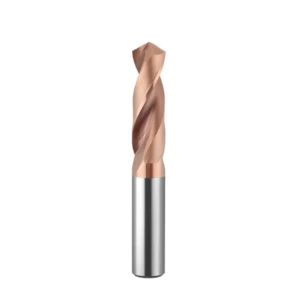
Why Standard Guidelines Fail: The Reality of Metal Drill Bit Wear in High-Volume Production
When optimizing lines for large American machine shops, we constantly see engineers program CNCs strictly by tool catalog speeds and feeds. Yet, once that program runs on a high-volume line, the metal drill bit rarely hits its scheduled tool life. Standard data derived from rigid, climate-controlled testing labs cannot predict real-world shop floor variables like spindle thermal growth or fixture fatigue.
In continuous production runs of thousands of parts, tool failure is almost always a combined result of thermal stress and mechanical friction. You must look past generic manuals and adjust parameters dynamically based on actual flank wear and chip morphology. Blindly trusting static parameters without watching chip evacuation or listening to spindle pitch is why single-hole costs stay stubbornly high.
The Thermal Shock Myth: What We Learned from a German Automotive Client’s Flute Chipping
When solving sudden edge chipping, many machinists make the mistake of immediately dropping the cutting speed (Vc). Last year, a tier-one automotive supplier encountered severe micro-chipping along the flute edges while drilling high-strength forgings. The supervisor assumed excessive spindle speed was causing friction-induced galling, so he lowered the RPM three times, which caused dozens of carbide drill bits to snap clean in half.
Our team inspected the fractured edges under a high-power microscope and immediately halted the speed reductions. This wasn’t standard abrasive wear; it was classic thermal shock caused by external flood cooling. The external emulsion couldn’t penetrate the deep hole against the rushing chips, causing the edge to cycle violently between 800℃ cutting zones and cold fluid contact, creating micro-cracks in the carbide substrate. We restored the correct cutting speed and switched to a 20-bar internal through-coolant system, which instantly stabilized edge temperatures and cleared the chipping issue.
Work Hardening: How Incorrect Feeds Kill a Drill Bit for Metal on the First Pass
Another critical failure we resolve on-site is work hardening caused by conservative feed rates. This issue is notorious when drilling ductile, high-alloy materials like austenitic stainless steel. Fearing a sudden snap, operators often set the feed per revolution (IPR) extremely low, believing a gentle cut protects the tool. In reality, a low feed rate forces the cutting edge to rub and burnish the metal rather than shear it.
This heavy friction causes localized deformation hardening on the workpiece surface within seconds, creating a dense, cold-worked glaze. When the drill bit for metal makes its next rotation, it hits a surface far harder than the original base metal, causing cutting forces to spike and flattening the flank face instantly. Provided your machine setup is rigid, the only way to bypass this hardening layer is to increase your feed rate, forcing the cutting edge to bite directly into unhardened material.

Mastering Speeds and Feeds: Our Formula for Extending Carbide Drill Bits Lifespan
When troubleshooting tool failure for machine shops, we find almost everyone is hunting for a “perfect” set of cutting parameters. When hitting an efficiency wall or seeing tool life halved, operators usually turn to standard reference manuals. However, our production testing proves that the real formula for extending carbide drill bits lifespan isn’t a fixed chart value; it requires adaptive tuning based on workpiece material condition, spindle rigidity, and coolant concentration.
Optimizing parameters is a dynamic balancing act between cutting efficiency and mechanical friction. During high-load machining cycles, we closely monitor the spindle load current and chip morphology. If your chips shift from bright, silvery curls to charred, elongated ribbons, the cutting zone heat is breaching the substrate’s thermal limit. Rather than reflexively slowing down, you must re-evaluate your speed-to-feed ratio and optimize the shear angle to eliminate this wear-inducing friction.
Why We Advise Against Textbook Vc Standards for Premium Carbide Drill Bits
When training clients to hit peak productivity, we always advise them to step away from generic engineering textbooks. Standard cutting speeds (Vc standards) listed in manuals are ideal figures derived in sterile labs using homogenous steel blocks and brand-new machine tools. On a real shop floor, raw material segregation, heavy forging skins, and minor hydraulic pressure drops in your fixtures will quickly turn those textbook speeds into a death sentence for your premium carbide drill bits.
When machining pre-heat-treated alloy steels, blindly running maximum catalog speeds spikes edge temperatures beyond the coating’s oxidation limit. We prefer a progressive testing strategy: start at 80% of the recommended speed, then carefully grade the hole wall roughness and chip flow. High-quality tools have massive untapped potential, but you must unlock it by aligning with your spindle’s actual torque output curve rather than a generic formula.
Micro-Chipping at the Outer Corner? Adjusting the IPR (Inches Per Revolution) to Save Your Metal Drill Bit
If you notice your drill wear isn’t concentrated at the center point but is causing micro-chipping at the outer corner, you need to act immediately. The outer corner is the high-risk zone where cutting speeds peak and heat dissipation is poorest. We recently diagnosed this for a shop running a metal drill bit through hydraulic valve blocks; the tool developed tiny, step-like chips at the outer edge whenever it hit cross-holes or interrupted cuts, causing the final hole diameters to fall out of tolerance.
Most machinists blame high spindle speeds for outer-corner chipping, but our experience pinpoints a mismatch in your feed rate (IPR). When your feed rate is too low, the edge merely rubs and scrapes the metal, generating high-frequency harmonic vibration that destroys the corner. Conversely, an excessive feed rate overloads the edge during entry, exceeding the carbide’s flexural strength. The fix is increasing the feed to form a stable, structural “C” chip, while pulling back the $IPR$ by 30% only during the initial entry phase.
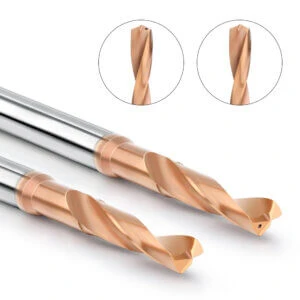
Processing Hardened Steel: Severe Wear Troubleshooting with HRC55 Drill Bits
Machining hardened steel is a brutal beast in mold making and high-strength automotive manufacturing. When workpiece hardness nears the limits of conventional tooling, standard abrasive wear instantly escalates into catastrophic thermal cracking. Through years of manufacturing and optimizing specialized hrc55 drill bits, we’ve learned that this hard-metal territory leaves zero room for error; if cutting zone temperatures cross the critical threshold, your tool edge will burn out in seconds.
To conquer wear under these extreme conditions, your primary focus must shift to substrate red hardness and cutting force resistance. We tell our field engineers that drilling high-hardness metal is a direct war between setup rigidity and thermal softening. If your machine tool lacks static rigidity, or if the tool’s rake and clearance angles haven’t undergone specialized edge honing, intense compressive forces will spike, causing immediate tool fracture.
Hardness Over 45 HRC: Why Coating Adhesion Determines the Life of HRC55 Drill Bits
When your workpieces exceed 45 HRC, the microscopic PVD coating on your tool becomes your primary line of defense. While many buyers focus only on the nominal hardness of the coating material, our application data shows that the actual service life of hrc55 drill bits depends entirely on coating adhesion strength. If this bond is weak, the extreme normal stresses of cutting hard metal will cause localized micro-flaking on the very first pass, exposing the bare carbide substrate to rapid thermal failure.
To lock down flank wear here, we utilize specialized nano-layered AlTiN or nanocomposite coatings that provide superior oxidation resistance under high heat. Never judge a coating’s effectiveness by its pristine color straight out of the box; inspect the cutting edge after running 20 holes to check for stepped flaking. If microscopic inspection shows a bleached tool tip with metal adhesion, your coating has failed prematurely, and you need to audit your supplier’s substrate pre-treatment process.
The Dangerous Mistake of Peck Drilling When Operating HRC55 Drill Bits
In deep-hole processing, peck drilling is a deeply ingrained habit for machinists accustomed to working with soft or gummy materials. However, when using an hrc55 drill bits setup on hardened steel, relying on frequent retraction cycles is a dangerous, tool-killing error. While solid carbide offers incredible compressive strength and wear resistance, its core weakness is low fracture toughness and extreme sensitivity to cyclic mechanical impacts.
Every time your drill retracts and rams back into the bottom of the hole, the cutting edge sustains a massive shock load. Worse yet, in hardened steel, if microscopic chip fragments settle at the bottom during retraction, the re-entering drill will crush against these hardened particles, causing instant edge shattering. For any hole depth within three times the diameter (3*D), we strongly recommend a continuous solid-pass strategy paired with a precise, consistent feed rate to keep chip evacuation smooth and continuous.
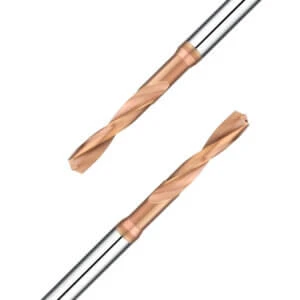
The Toolholder and Rigidity Factor: Issues Most Drill Bit Manufacturers Won’t Tell You
When troubleshooting hole-making issues for global job shops, we notice a bad habit of focusing exclusively on the drill bit. If a tool wears out prematurely, operators reflexively switch brands or complain to their drill bit manufacturers about batch quality. However, as shop-floor veterans, we must share a hard truth: if your machine spindle and toolholder setup lack rigidity, even the most expensive, state-of-the-art edge geometry is completely useless.
During high-speed, heavy-load metal cutting, a drill faces massive axial forces and torque the moment it hits the workpiece. Your toolholder does far more than clamp the round shank; it acts as the primary dampening barrier against severe harmonics. If your holding system permits even a few microns of deflection during continuous production, it triggers violent alternating stresses across the cutting edges, leading to uneven loading and catastrophic chipping.
How 0.0002″ Runout Prematurely Destroys Solid Carbide Drill Bits
In precision manufacturing, many machinists dismiss a mere 0.0002 inches (5 microns) of total indicated runout (TIR) as negligible. While a tough high-speed steel ($HSS$) drill can flex to absorb this alignment error, the situation changes drastically when running high-end solid carbide drill bits. At spindle speeds spinning at several thousand $RPM$, those 5 microns of runout mean instant tool death because solid carbide offers zero elastic tolerance for eccentric loading.
When your workholding exhibits runout past 0.0002 inches, one cutting edge carries significantly more chip load per revolution than the other. This unbalanced, cyclical hammering causes rapid mechanical fatigue, out-of-tolerance holes, and severe bell-mouthing. When clients ask why their tool flank wears flat on one side or snaps inside a blind hole after a few parts, we check the toolholder runout first—nine times out of ten, that is your silent tool killer.
Hydraulic Chucks vs. ER Collets: Real-World Wear Data from Our Machining Lab
To measure how workholding styles affect tool wear, our testing lab conducted a hundred-hour drilling benchmark on tough alloy steels. We pitted standard ER collet chucks against high-precision hydraulic holders under identical feed rates and spindle speeds. The data proved that the group using hydraulic chucks extended the lifespan of our carbide drill bits by 35% to 45%, while maintaining an incredibly smooth, uniform wear land.
ER collets are highly cost-effective for general setup work, but their metal-on-metal clamping mechanism fails to absorb high-frequency harmonics. In contrast, hydraulic holders feature an internal fluid chamber that acts as a localized shock absorber during aggressive drilling cycles. For long-run precision contracts, don’t skimp on your initial toolholder budget; upgrading to hydraulic or shrink-fit setups wipes out downtime and pays for itself in tool savings.
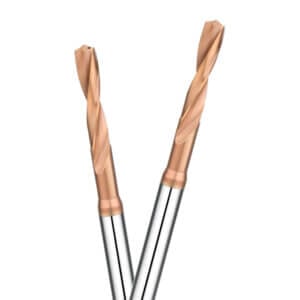
Coolant Delivery Secrets: Maximizing Drill Bit Efficiency for Metal Removal
In high-intensity, repetitive manufacturing, shops frequently treat coolant delivery as an optional, secondary afterthought. Most operators assume that as long as flood liquid is splashing around the workpiece, the tool is perfectly safe. However, our field engineering data proves that precision fluid management is the ultimate hidden card for unlocking the maximum material removal rate (MRR) of a premium metal drill bit.
When pushing machine spindles to their volumetric limits, cutting fluid must be treated as a structural component of the tool setup. Without precise lubrication directly at the shear zone, localized friction generates intense heat that destroys the cutting edge matrix, regardless of your PVD coating’s thermal rating. In deep-hole applications, minor drops in fluid concentration or pressure lead directly to rapid flank wear, poor chip evacuation, and severe surface tearing.
Internal Through-Coolant vs Flood Cooling: Eradicating Built-Up Edge (BUE) in Stainless Steel
When drilling austenitic stainless steels like 304 or 316, BUE formation is a constant production nightmare. We recently audited a marine valve plant where the tool flanks were completely glazed with cold-welded workpiece material, spiking cutting resistance and blowing out hole tolerances. They ran heavy external flood lines, but the rapidly spinning flutes and outward chip flow created an aerodynamic barrier that blocked the fluid from hitting the drill tip.
This “dry-core” environment causes ductile stainless steel to weld itself to the cutting margins under extreme localized pressures. The definitive fix is replacing standard tooling with internal through-coolant carbide drill bits. Delivering emulsified fluid directly through the spindle center at pressures over 20 bar forces the liquid to gush right from the tool tip, creating a high-pressure lubricating film that halts thermal adhesion and blasts hot chips straight out of the hole.
Micro-Hole Drilling: Pressure Requirements for Small-Diameter Carbide Drill Bits
When drilling micro-holes under 2 mm in diameter, the physics of chip evacuation change entirely. In these ultra-confined spaces, capillary action and fluid surface tension make micro-chips highly prone to packing tightly inside the narrow flutes. Engineers running a small-diameter metal drill bit often see it drill three perfect holes and then instantly snap on the fourth; this is almost always caused by chip packing, which triggers secondary cutting and immediate structural overload.
For micro-drilling, high flow volume is useless without extreme pressure to break the air barrier. Our precision laboratory testing indicates that for deep micro-holes under 1.5 mm, low-pressure coolant systems fail completely. You must boost your internal pump pressure to 40 bar—or ideally 70 bar—to generate a fluid jet powerful enough to pierce the high-$RPM$ vortex, cool the miniature cutting margins, and evacuate micro-chips before resonance shatters the tool.
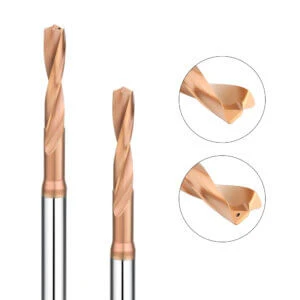
Why Sourcing Consistency Matters: The Advantage of Partnering with a Specialized Drill Bit Manufacturer
After optimizing your speeds, feeds, toolholder runout, and high-pressure coolant, you must address the foundation of your supply chain: tool manufacturing consistency. Every shop floor has faced the nightmare where one batch of tools drills 500 clean holes, but the next shipment chips out before hitting 200 parts under identical CNC programs. This costly variance stems from poor batch control at the grinding source, which is why sourcing directly from dedicated drill bit manufacturers is vital for high-volume automated lines.
When a tier-one manufacturing facility controls the entire ecosystem—from proprietary tungsten carbide powder formulation and low-pressure sintering to dynamic wheel compensation on multi-axis CNC grinders—you receive rock-solid tool life predictability. Batch consistency allows you to schedule reliable, unattended tool changes during night shifts. Locking down this raw material variable ensures that your shop-floor parameters and cycle time calculations actually hold true during lights-out manufacturing.
Substrate Grading: How Top Drill Bit Manufacturers Control Edge Chipping Through Micro-Grain Sintering
To resolve the classic industrial conflict between carbide hardness and fracture toughness, we must control the microstructural matrix of the tool substrate. Premature macroscopic edge chipping rarely stems from your spindle speed; it is usually caused by irregular cobalt distribution or uneven grain boundaries inside the carbide rod. This is where partnering with premier drill bit manufacturers changes your scrap rate, as they utilize advanced micro-grain or nano-grain low-pressure vacuum sintering.
If your lines are drilling tough automotive forgings or aerospace superalloys and facing constant micro-chipping at the drill point, audit your raw material substrate grade immediately. Cheap, generic tools rely on coarse-grained recycled carbide to cut costs, which cracks rapidly under heavy thermal cycling or work-hardening loads. Premium micro-grain substrates act like a dense, bulletproof barrier, evenly distributing cyclical impact forces across the cutting edge to keep the tool digging smoothly into tough metals.
Customized Edge Preparation (Honing): The Thin Line Between Tool Longevity and Sudden Failure
Finally, let’s address edge preparation (honing)—a micron-level manufacturing step that dictates whether your tool survives or shatters. Freshly ground solid carbide features an razor-sharp but highly unstable, micro-serrated edge that will immediately fracture under initial compressive loads. As an engineering-focused team, we use precise nylon-brush brushing or drag finishing to hone these edges, establishing the perfect, delicate balance between geometric sharpness and structural edge strength.
If you are running high-volume jobs on tough mold steels or cold-rolled plate, you need a customized edge profile to survive. Hardened metals above 45 HRC require a heavy K-land or a 20-to-30-micron radius hone to reinforce the cutting margin against chipping. If you are hitting a wall with tool wear, or tackling an exotic material grade for the first time, drop us a line with your specific machine constraints, component blueprints, and material specs—our engineering group will model the cutting forces to grind the exact edge preparation your job demands.