
-白底主图3.webp)
To be honest, when a German automotive driveshaft manufacturer messaged me on WhatsApp last month, his tone was pure frustration. They had hit a wall on a mass-production run of 4140 alloy steel pre-hardened to HRC35. Their target was 500 deep-hole parts daily, but using traditional twist drill bits with external lines became a nightmare. Once the depth passed 3xD, chip evacuation choked, causing sudden tool breakage, constant machine alarms, and costly downtime.
We have seen this scenario countless times over the past 16 years serving machine shops across the US and Europe. When selecting drill bits for steel, many engineers focus entirely on cobalt content, premium coatings, or custom geometries from carbide drill bit manufacturers. Yet, they frequently overlook the one critical factor that actually dictates success or failure: the method of coolant delivery.
In high-volume steel drill bits applications, choosing between an external spray and internal flushing is not just an operational preference. It directly dictates whether you can push your cutting speeds (Vc) and feed rates (Fn), and whether your tool life is measured in minutes or days. Making the wrong choice can instantly ruin a tool costing hundreds of dollars.
Let’s ask ourselves honestly: Is your shop currently running deafening external coolant lines while simultaneously fighting frequent tool chipping and poor hole finishes?
Why does external coolant often cause trouble in deep-hole drilling of steel?
In our daily work with shop supervisors, we often see a common misconception: aiming an external nozzle at the hole entrance and maxing out the flow guarantees sufficient cooling. However, close observation of a CNC machine in real-time proves that this visible cooling is entirely superficial. When cutting tough, gummy steels or high-hardness alloys, this outside-in delivery fails against the intense outward stream of hot chips, losing all its potency before reaching the cutting zone.
We frequently observe that once a hole depth exceeds three times the diameter (3xD), externally sprayed fluid simply cannot fight the current of evacuating chips. This leaves the drill tip running completely dry, causing torque spikes and localized heat buildup. This explains why many shops buy premium steel drill bits but still suffer from constant tool failure. External lines might work for shallow holes, but deep-hole setups often turn them into a costly lesson.
A major pain point reported by Western clients: Coolant flow interruption in the flutes of twist drill bits
A UK-based hydraulic component manufacturer recently came to us regarding highly inconsistent tool life. They were using high-helix twist drill bits for deep holes in valve bodies, and our failure analysis showed the root cause was fluid interruption inside the flutes. As the tool rotates and advances, compressed chips pack the helical flutes, forming a tight, moving “wall of steel.” External fluid simply hits this barrier and deflects, failing to penetrate the bottom of the hole.
The resulting chain reaction is catastrophic. Lacking lubrication at the drill point, chips undergo severe secondary friction against the flutes, generating heat that welds them directly to the tool body. In our experience, once the evacuation path clogs and fluid flow is cut off, the drill tip suffers a catastrophic torsional fracture within seconds. This is not a tool quality defect; it is a physical limitation of external cooling.
How Thermal Shock Can Instantly Destroy a High-End Carbide Drill Bit
We often hear that sudden, sharp “snap” from inside a CNC enclosure, only to pull out a premium tool broken right down the middle. This is a classic brittle fracture caused by thermal shock on a high-end carbide drill bit. While carbide offers incredible red hardness and wear resistance, it is highly sensitive to drastic temperature swings. With external lines, the tip gets blazing hot from dry friction, but intermittent chip shifts cause the cold fluid to suddenly splash the incandescent edge.
This extreme hot-to-cold cycling creates massive internal thermal stress. Under high-magnification microscopy in our R&D lab, we regularly see microscopic, web-like thermal cracks covering these fractured cutting edges. Once these cracks propagate under heavy mechanical cutting forces, the entire carbide structure shatters instantly like glass. That is why we tell our peers: for rigid but brittle tools, unstable external cooling is far more dangerous than running completely dry.
Shop-Floor Data: Cost-per-Hole Comparison (External Cooling) for Low-Carbon vs. Alloy Steel
To prove the financial reality to B2B procurement managers, we ran a controlled test on a Mazak horizontal machining center using 42CrMo4 alloy steel. Using external emulsion, we had to cap our cutting speed at 60 m/min to prevent burning, stopping every 20 holes to inspect the tool. Factoring in downtime for tool changes, operator labor for regrinding, and scrapped parts, the net cost per hole was exceptionally high.
We then ran a comparative test using optimized internal processing on the same material. The data was undeniable: while initial tooling investments differed, the excessive wear and choked productivity of external setups made their total cost per hole 1.8 times higher. This is why we advise production-focused shops never to look at the purchase price of drill bits for steel in isolation; your total shop-floor consumption is what determines your true profit.
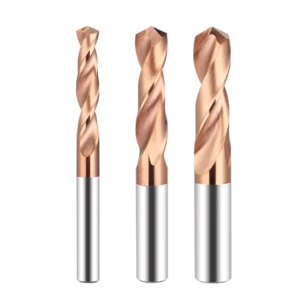
The Game-Changing Impact of Upgrading to Internal Coolant for Steel Drilling
Switching from external flood lines to through-spindle coolant (TSC) yields immediate, noticeable results on the shop floor. You will instantly hear the cutting noise drop, and the spindle load meter on your CNC controller stabilizes significantly. This transformation stems entirely from internal fluid dynamics. When high-pressure fluid shoots through axial channels inside the tool body directly to the cutting tip, it creates a pressurized fluid cycle that shields the critical cutting zone.
In terms of production efficiency, this internal pressure delivery gives programmers the confidence to aggressively optimize process parameters. With old-fashioned external lines, you have to tread cautiously with feed rates, fearing that a heavy cut will bind and snap the tool. Internal delivery encapsulates and flushes heat the moment it is generated. This allows you to boldly increase cutting speeds and feed-per-revolution, making it the essential path to maximizing productivity while minimizing wear on your drill bits for steel.
High-Pressure Internal Coolant (TSC) for Forced Chip Evacuation: Eliminating Sudden Edge Failure Caused by Chip Recutting
When monitoring automated production lines in the US and Europe, the failure we dread most is sudden, brittle chipping of the cutting edge. Often, upon pulling the tool, you find large chunks missing from the margin. This damage is rarely caused by material hardness; instead, it happens because nested chips pack the bottom of the hole and get ruthlessly recut. This creates an instantaneous spike in localized mechanical stress that even the highest-quality steel drill bits cannot survive.
Through-spindle coolant acts like a high-pressure hydraulic pusher right at the drill point. Symmetrically arranged internal oil holes shoot fluid directly at the C-shaped or needle chips the moment they are sheared, forcing them straight up the helical flutes. When drilling gummy, high-toughness materials like low-carbon steel, where chip breaking is a nightmare, this continuous upward thrust keeps the cutting zone completely clear. By eliminating residual debris, you drastically reduce sudden edge chipping.
Coolant Delivered Directly to the Cutting Edge: Doubling Tool Life in High-Hardness Machining
When machining challenging materials like high-alloy steels or pre-hardened mold steels, frictional temperatures at the cutting zone can easily soar to 700–800°C. At these extreme temperatures, the carbide substrate undergoes irreversible thermal degradation, softening the cutting edge. As specialized carbide drill bit manufacturers, our greatest engineering challenge is maintaining edge sharpness under intense heat. External coolant simply cannot penetrate the micrometer-sized interface where the tool meets the workpiece.
By channeling fluid straight through the tool body, you achieve precision-targeted lubrication that instantly dissipates frictional heat at the shear zone. In our long-term customer testing, directing high-pressure fluid straight to the cutting edge slowed flank wear by nearly 50% on identical alloy workpieces. This stable thermal control allows advanced coatings and underlying substrates to perform at their peak. For your shop floor, this translates directly to a multi-fold increase in tool life.
Why internal cooling is the only way to achieve high cutting speeds in deep-hole machining (depth-to-diameter ratio >3xD)
Anyone experienced with deep-hole ratios of 5xD, 8xD, or deeper knows that the deeper the tool goes, the more the hole resembles a black box. Heat cannot escape, and chips cannot get out. If you stick with external lines, your only option to protect the tool is to drop your spindle speeds or program slow “peck drilling” cycles. Retracting the tool every few millimeters to clear chips clears the hole, but it drags out cycle times and destroys shop throughput.
During our R&D testing of long-flute tools, the data showed that internal cooling is the only choice for continuous, single-shot deep-hole cutting. Because a steady stream of high-pressure fluid flushes outward from the very bottom of the cavity, the cutting edges remain optimally cooled at maximum depth. You no longer have to artificially throttle your parameters. You can maintain full-load operation at high spindle speeds, making it an irreplaceable method for boosting high-speed efficiency with a long-flute carbide drill bit.
-白底主图2-300x300.webp)
A practical showdown between internal and external cooling for machining ultra-hard materials
When workpiece hardness hits HRC65, conventional cutting stops and a process bordering on high-force extrusion and grinding begins. Under such intense shear resistance, standard tooling is worn flat almost instantly. To cut these alloys, you must employ specialized tools like an ultra-hard hrc65 carbide drill bit. However, extreme hardness means a proportional increase in material brittleness, leaving virtually zero tolerance for thermal fluctuations or shocks on the cutting edge.
In our testing facilities, the showdown between external and internal cooling on ultra-hard steels yields dramatic results. With external lines, you hear a piercing metal screech, see intermittent sparks, and risk cracking the part. Switch to through-spindle cooling, and while the machine’s load meter stays high, the cut takes on a smooth, continuous stability. Here, the fluid delivery method is no longer just about machining efficiency; it is the critical factor determining the life or death of a high-value tool.
Why is external cooling a “death warrant” when machining HRC65 hardened mold steel?
When drilling HRC65 hardened molds or SKD11 ultra-hard steel, we repeatedly warn operators: never gamble with external flood lines. In these high-hardness, brittle cutting scenarios, localized instantaneous temperatures at the tool tip easily blast past 800°C. If you use external lines, high-speed rotational centrifugal forces and packed metal chips completely block the fluid from reaching the tip. Instead, it creates a violent, intermittent splashing effect that ruins the tool.
This rapid hot-to-cold cycling triggers severe thermal shock, acting as an invisible death warrant inside the material structure. We frequently handle after-sales cases where an expensive carbide drill bit looks perfectly fine to the naked eye, yet the cutting edge is riddled with microscopic thermal cracks. The moment cutting forces fluctuate, these micro-fractures instantly merge and propagate. This causes the entire drill tip to shatter catastrophically, frequently destroying the expensive, hardened workpiece along with it.
Insights from Our R&D as Carbide Drill Bit Manufacturers: The Critical Role of Internal Coolant Channel Design in Machining HRC65 Materials
As global carbide drill bit manufacturers, our R&D team prioritizes the engineering of internal helical coolant channels specifically for HRC65 applications. While standard tools use basic straight fluid holes, our ultra-hard tooling line utilizes specialized cross-sectional geometries and optimized helical configurations. This engineering goes far beyond simply ensuring high flow rates and injection pressures; it is crucial for balancing internal stress distribution within the tool body during heavy-load cutting.
Our lab data indicates that when high-pressure fluid exits these precisely positioned internal channels, it establishes a micro-level pressure field with a highly constant temperature around the cutting edge. This stable thermodynamic state significantly delays grain softening in the carbide matrix and effectively relieves the mechanical stresses generated by intense friction. In-house comparative testing proves that tools featuring these optimized internal configurations exhibit far superior stability and toughness against extreme material hardness.
白底-主图2-300x300.webp)
From External Coolant Lines to High-Pressure Internal Coolant: Real-World Cases of Machine Tool Upgrades and Process Optimization for European and American Clients
Tool selection never happens in a vacuum; it must be deeply integrated with your machine hardware, power systems, and real-world shop conditions. When helping Western shops troubleshoot jobs, we often see a frustrating mismatch: a shop buys premium drill bits for steel, but their coolant pump is stuck at a weak 3 to 5 bar. Running an old-school line that dangles limply beside the spindle head is like putting a truck engine in a sports car—you completely throttle your efficiency.
True process optimization always starts by re-evaluating your existing pressure configurations and piping systems. If you are facing stagnant throughput, poor tool life, or unexplained breakage, pause the machine and check your actual pump output. Upgrading your hardware and restructuring your tool paths can transform a problematic job into a highly stable, high-yield operation.
Real Feedback from a Long-Standing German Client: A 300% Boost in Efficiency After Switching from External-Coolant Twist Drills to Internal-Coolant Carbide Drills
Last year, an automotive parts manufacturer in Stuttgart, Germany, hit a wall while machining 42CrMo shafts pre-hardened to HRC32. They were running standard high-speed steel twist drill bits with external flood lines. Because the hole depth reached 5xD, the operator had to use a slow peck-drilling cycle—retracting every two millimeters to clear out packed chips. This dragged the cycle time to 45 seconds per hole and caused severe flank wear, wasting an hour of production daily on tool changes.
We evaluated their machine setup and recommended swapping the old tooling for a solid carbide drill bit engineered with internal oil holes. Delivering high-pressure fluid through the spindle center directly to the cutting zone allowed us to eliminate the peck cycle entirely for a single, continuous pass. Cutting speeds doubled, secondary chip grinding disappeared, and cycle times plummeted from 45 seconds to just 12 seconds. This real-world shop data proves that tool substrates can only perform when fluid delivery is precise.
Recommendations on Internal Coolant System Configuration for Buyers and Shop Managers
As experienced carbide drill bit manufacturers who have spent years on the shop floor, we offer a few practical configuration rules for B2B buyers and shop managers drilling steel. If you want to implement through-spindle technology or optimize your current equipment, score your hardware against these metrics. For depths up to 5xD, your pump pressure must hit at least 20 bar (290 psi). For deep holes at 8xD or greater, aim for 40 to 70 bar to successfully flush hot chips out of the cavity.
Second, never overlook filtration precision, which is a critical detail that frequently ruins expensive steel drill bits. Your filtration system must reliably remove any particulate larger than 20 microns; otherwise, micro-debris will clog the tool’s internal spiral channels, leading to instant failure. There is no one-size-fits-all fix for complex machining challenges. If you are struggling with a tough print, tight tolerances, or a hard-to-machine alloy, let’s talk peer-to-peer. Send us your machine specs, part prints, and material grades, and we will help you fine-tune your process for the perfect setup.