
Last month, a US medical device client sent us an urgent email. They were machining Ti-6Al-4V (Grade 5 titanium) bone screws using 1.2mm micro-drills, and the bits snapped after only 5 to 7 holes. Their scrap rate skyrocketed, halting the production line. The client asked, “Is there a defect in the coating on this batch of drills?”
This scenario is all too familiar to us. Over 15 years of supporting precision machine shops across North America, we have witnessed countless identical micro-drilling failures. Machinists with extensive experience running steel or aluminum often find that conventional drilling methods fail completely on titanium alloys.
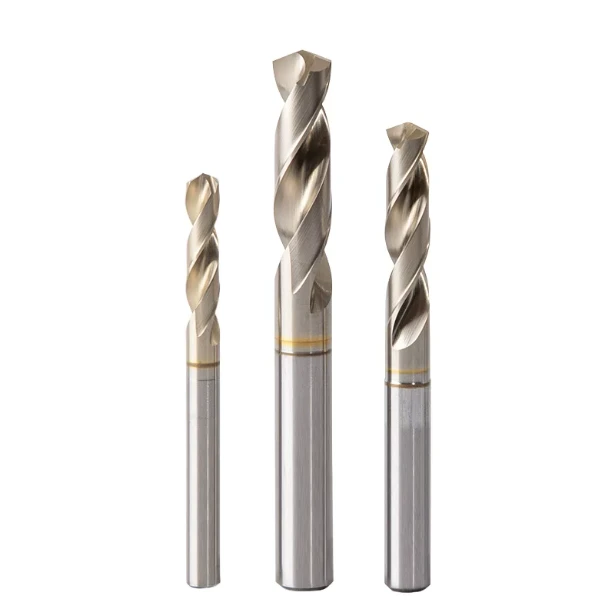
A common initial reaction is to search the market for budget-friendly titanium drill bits. However, seasoned professionals know that ordinary drill bits titanium—specifically HSS bits with standard TiN coatings—fail here. Titanium’s low elastic modulus and poor thermal conductivity mean standard tools accelerate work hardening and trigger severe built-up edge (BUE) issues.
At micro-diameters, micron-level deviations in edge preparation or substrate strength are drastically magnified. Our customized solutions for these extreme conditions rely strictly on solid titanium twist drill bits. They are the only option capable of withstanding the combined onslaught of intense cutting heat and high mechanical stress.
By optimizing web thickness and utilizing polished flutes on our sub-micron grain substrate, we increased tool life to over 120 stable holes. Micro-drilling titanium is a battle of rigidity, heat dissipation, and chip evacuation. If your shop faces frequent tool breakage, ask yourself: was your machining strategy misled by amateurish marketing rhetoric?
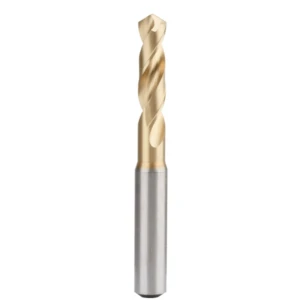
16 Years of Shop-Floor Experience: Why Standard Titanium Drill Bits Are a Waste of Time for Micro-Drilling Titanium
On the shop floor, we often see experienced machinists instinctively reach for standard tooling when drilling small titanium holes under 2mm. They look at titanium drill bits with pale-yellow TiN coatings and assume that because the name includes “titanium,” it should handle the material. However, on high-speed spindles, the cutting edge undergoes rapid thermoplastic deformation due to intense frictional heat before chips can even evacuate.
Data we have gathered on the CNC production line over the past decade shows that this “cost-effective” choice is a genuine technical trap. When hole diameters shrink to the micron scale, titanium’s low thermal conductivity concentrates all cutting heat onto the narrow cutting edge, softening standard HSS tools instantly. For high-viscosity titanium alloys, we always configure tooling based on the substrate’s fundamental physical properties rather than surface coatings.
H3: The Nightmare of “Work Hardening” in Micro-hole Machining: Why Conventional Titanium-Coated Drill Bits Must Be Abandoned
When machining Grade 5 titanium, the material’s work-hardening characteristic is a massive headache for any CNC shop. Any momentary hesitation in the feed rate or a half-second pause at the hole bottom causes the material hardness in the cutting zone to spike instantly. Conventional drill bits titanium options lack sufficient rigidity, causing the cutting edge to elastically deflect, rub against the hole bottom, and cold-work harden the workpiece.
We once resolved a crisis for a Western aerospace client who was drilling 1.5mm diameter blind holes using standard bits. Insufficient tool rigidity led to discontinuous cutting, pushing the hard-layer past HRC 45 and snapping the subsequent tool immediately, which scrapped a high-value component. At the micro-machining scale, we must use ultra-rigid carbide drill bits for titanium to maintain a constant feed per tooth and cut cleanly beneath the unhardened base material.
H3: Rigidity vs. Deflection Resistance: The Core Advantages of Solid Carbide over HSS in Precision Machining
In micro-hole machining, the length-to-diameter (L/D) ratio frequently exceeds 5:1 or even 8:1, meaning the tool’s bending resistance determines the hole’s straightness. Standard HSS titanium twist drill bits possess an elastic modulus of only around 210 GPa, making them highly susceptible to radial runout and severe chatter during high-speed operations. In contrast, the sub-micron grain carbide we use features a modulus near 600 GPa—nearly three times that of HSS.
This fundamental difference in physical properties translates to superior machining stability and tighter dimensional control in practice. Higher rigidity minimizes radial deviation and suppresses high-frequency vibration caused by uneven cutting forces. While carbide has lower impact toughness than HSS, provided your machine setup and toolholders are stable, its exceptional bending resistance is the ultimate defense against micro-hole breakage.
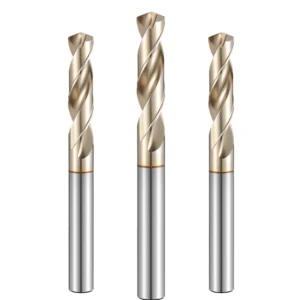
Optimizing Carbide Drill Bit Geometry for Titanium Under Extreme Tolerance Requirements
On the shop floor, extreme micro-machining tolerances mean holding dimensions within a few microns. Standard tool designs quickly fail to maintain hole consistency during extended production runs on tough, low-conductivity titanium alloys. To hit these strict limits without destroying tool life, we must optimize the tool’s micro-geometry at a sub-millimeter level. This process goes far beyond basic CAD drafting; it requires constant shop-floor testing to balance cutting mechanics with real-time chip evacuation.
In our manufacturing experience, optimizing carbide drill bits for titanium is a delicate balancing act. For instance, increasing the rake angle to reduce heat makes the cutting edge too fragile, leading to micro-chipping against work-hardened layers. Conversely, a wide land increases cutting forces exponentially. We use 5-axis grinders to fine-tune the radial relief and chisel edge, ensuring immediate centering. This technical precision is why Western clients trust our custom aerospace and medical solutions.
Point Angle and Chisel Edge Modification for Titanium Twist Drill Bits (0.5mm–2mm Micro-holes)
In the 0.5mm to 2mm range, a standard chisel edge becomes a major liability. In conventional drilling, the center chisel edge merely pushes and extrudes material because its cutting speed is virtually zero. In micro-drilling, this creates massive axial resistance, causing slender titanium twist drill bits to bend or snap instantly. That is why our engineering team always starts by modifying and thinning the chisel edge for our B2B clients.
We implement an S-type split-point grind to transform that extruding center into two micro-shearing edges. This modification reduces centering resistance by over 30% during initial contact. The tool tip bites into the base material instantly, suppressing radial runout on high-speed spindles. For high-precision jobs demanding perfect roundness, this microscopic center correction is the critical first step to success.
135° and 140° Double Point Angle Designs: Empirical Data on Solving Exit Burrs
Exit burrs on thin-walled titanium components are a nightmare for process engineers. Because titanium alloy is highly ductile, the material at the bottom of the hole gets pushed out rather than cleanly cut during breakthrough. This creates a stubborn, flared burr that is difficult to remove. We tested multiple geometries and found that standard 118° points fail completely, whereas a carbide drill bit for titanium with a 135° or 140° double point angle solves the issue.
Our laboratory data shows that a 140° double point angle with a shoulder chamfer alters cutting force distribution at breakthrough. The wider angle thins the chip layer, converting axial punch into outward radial forces. In our 1.5mm drilling tests, this 140° design reduced exit burr height by nearly 65% compared to standard drills. For our American clients, this eliminates costly manual deburring and keeps automated lines running smoothly.
Polished Flutes—A Practical Grinding Technique to Prevent Chip Adhesion and Overheating When Machining Titanium Alloys
Titanium chips in micro-holes are incredibly tough and quickly bond to raw carbide surfaces, causing severe built-up edge (BUE). Once chips jam inside narrow helical flutes, subsequent material cannot escape, driving hole temperatures past 1400°F instantly. Under these extreme thermal conditions, even a premium carbide drill bit for titanium will twist and snap in milliseconds.
To fix this, we added a secondary mirror-polishing step after grinding the primary cutting edges. Specialized ultra-fine wheels polish the flutes along the chip flow direction, dropping surface roughness (Ra) below 0.1 microns. This eliminates grind marks and lowers friction significantly. Chips glide out smoothly like ice skaters under minimal coolant pressure, preventing catastrophic heat buildup.
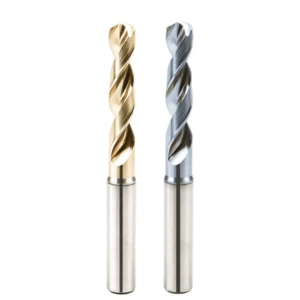
Practical Guidelines for Micro-Hole Machining: Cutting Parameters and Cooling Strategies for Carbide Drill Bits for Titanium
Mounting a perfectly ground tool into a precision holder is only half the battle. We frequently see US engineers buy top-tier carbide drill bits for titanium, only to burn them out within minutes. This happens because they apply speed and feed data intended for standard stainless steel or nickel alloys. Titanium leaves zero margin for error; a single wrong parameter choice shows up immediately on your scrap report.
Achieving reliable tool life requires a tight dynamic balance between spindle runout, machine response, and fluid delivery. This demands an intuitive grasp of the thermodynamic behavior inside a microscopic cutting zone. Below, we share our verified parameters developed through years of troubleshooting extreme applications. These guidelines will help your workshop protect high-value parts and stop breaking drills.
Avoid “Rubbing”: Feed per Tooth and Spindle Speed Verified on High-Precision CNCs
Setting the feed rate too low out of fear of tool breakage is a disastrous mistake in titanium machining. If your feed per tooth is smaller than the tool’s cutting-edge honed radius, the edge cannot penetrate the metal. Instead, it slides and rubs against the surface, generating friction that work-hardens the material instantly. We have seen standard titanium drill bits completely melt inside micro-holes due to these ultra-conservative feeds.
Through extensive trials on 5-axis machining centers, we found the sweet spot for 1.0mm holes. We recommend a cutting speed (Vc) of 25 to 40 m/min, meaning a spindle speed of roughly 8,000 to 12,000 RPM. More importantly, keep your feed per revolution (f) strictly between 0.01 and 0.025 mm. This ensures the edge shears unhardened base material. If your spindle runout is under 2 microns, you can safely run at the higher end of this feed range.
The Pitfalls of Peck Drilling: Preventing Tool Breakage by Optimizing Micro-hole Step Depth
Standard G83 peck drilling cycles can become a dangerous trap when drilling deep titanium micro-holes. Every time a slender drill bits titanium retracts completely from a hole, tiny loose chips at the bottom can shift out of place. When the drill re-enters the hole at rapid speed, it slams into these loose fragments. This sudden axial shock instantly shatters the delicate carbide tip.
We recommend a “decreasing step” peck strategy instead of a full retract. Program your macro to take an initial depth of 1.5D to 2D, then reduce subsequent steps (Q-values) to 1.0D, 0.5D, and finally 0.3D. This maximizes efficiency near the top where chip space is open. Near the deep bottom, it uses short, frequent movements to break chips without ever pulling the drill completely out of its guiding hole. This method reduced tool breakage by 70% for our aerospace partners.
High-Pressure Internal Coolant vs. Mist Cooling: Ensuring Coolant Reaches the Cutting Edge in Micro-Hole Machining
Dissipating heat from a cutting zone spanning only a few square micrometers is critical for tool survival. Standard external flood nozzles cannot penetrate micro-holes because the high-speed rotating tool creates an air vortex barrier. The coolant deflects, leading to brutal dry cutting and immediate thermal cracking. Under these conditions, even specialized titanium twist drill bits split apart from thermal shock.
Our testing proves that a through-coolant system operating at 70 bar (1000 PSI) or higher is the absolute best choice. Internal channels blast coolant right at the cutting zone, lowering temperatures and using hydraulic force to flush chips out. If your machine lacks internal lines, use Minimum Quantity Lubrication (MQL) to blast atomized oil at the tool base. Keeping the cutting zone lubricated is often more important than the speed and feed parameters themselves.
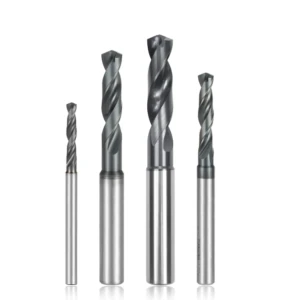
Evaluating Overseas Supply Chains: How Western Factories Should Select High-Precision Carbide Drill Bit Suppliers
Overseas procurement requires looking beyond the unit price of a tool to its overall performance on the production line. In demanding operations like drilling titanium, any instability in the supply chain translates directly into workshop downtime and higher scrap rates. When helping shops optimize their supply chains, we often find procurement managers are easily swayed by polished samples and glossy brochures. Actual production requires a deep audit of a supplier’s fundamental manufacturing standards and quality control processes.
If you are facing unreliable delivery schedules or need to recalibrate parameters with every new batch of tools, it is time to re-evaluate your tooling partners. A qualified industrial carbide drill bit suppliers must consistently deliver products with highly uniform performance without compromising precision. Below, we outline the strict selection criteria we use to audit raw material control, processing equipment, and custom engineering capabilities.
Checking the Sub-micron Substrate: Essential Raw Material Inspection Standards for Carbide Drill Bit Suppliers
In micro-hole cutting, the grain size and cobalt content of the tungsten carbide substrate determine the tool’s flexural strength. For micro-drills used on titanium alloys, a coarse substrate makes the cutting edge highly susceptible to micro-chipping under alternating cutting stresses. When evaluating carbide drill bit suppliers, our primary hard criterion is their capability to perform metallographic microscope inspections on every batch of carbide rods.
If you are machining aerospace-grade titanium or medical bone screws, you should request inspection reports detailing density and magnetic saturation. Controlling raw material purity at the source to eliminate porosity is the only way to prevent brittle tool fractures under high axial loads. If a supplier is evasive regarding fundamental material data, their performance in precision micro-hole sector is unlikely to inspire confidence.
Batch Consistency: Why 5-Axis Tool Grinders and Zoller Inspection Are Key Criteria for B2B Procurement
For automated CNC production lines, inconsistent performance across batches is far worse than predictable wear. If the first batch of drills produces 100 holes while the second breaks after just 30, the resulting uncertainty paralyzes process engineers. In our manufacturing experience, locking in micro-hole tolerances requires high-precision 5-axis tool grinders from builders like Walter or ANCA. Furthermore, geometric verification must be performed using non-contact systems like Zoller.
If you are facing a technical bottleneck where identical parameters fail when switching tool batches, you need to audit your supplier’s production line. A competent carbide drill bit suppliers integrates their Zoller inspection equipment directly into the automated first-article and in-process workflows. Controlling cutting-edge radii within a $\pm$1-micron range is the only way to ensure every delivered tool offers identical real-world performance.
Unlock Over 30% Cost Savings: Deep Collaboration with Carbide Drill Bit Suppliers for Custom Micro-Hole Tooling
Extreme conditions like deep-hole titanium drilling often force a compromise between feed rates and tool life when using off-the-shelf components. Genuine cost optimization lies in custom-engineered tool geometries tailored to specific operating conditions. When tool helix angles, point angles, and flute profiles are precisely matched to your material’s work-hardening rate, the total cost per hole can drop by more than 30%.
If your current standard drill bits fail to meet required length-to-diameter ratios or drive up costs, consider partnering with agile carbide drill bit suppliers. Instead of relying on blind trial-and-error with different standard brands, simply provide us with details regarding your specific operating conditions, part blueprints, and material grades. We welcome the opportunity to collaborate directly with your engineering team to develop the optimal custom tool geometry solution.