
Last week, our team received an urgent email from a client in Ohio. Their machine shop was rushing a batch of heat-treated H13 tool steel parts with a hardness reaching HRC54. The client was blunt: “We tried three ‘ultra-hard’ drill bits on the market. They either chipped during centering or melted before reaching a depth of 2mm, spiking our spindle load. What exactly is the best type of drill bit for hard metal?”
In our 16 years of tool manufacturing and on-site technical support, we have received hundreds of similar SOS messages from workshops worldwide. Once a workpiece crosses the HRC50 threshold, standard machining logic simply fails. Many shops fall into the trap of buying the most expensive retail tools available. Unfortunately, this often results in exorbitant tooling costs and broken carbide fragments stuck inside the holes.
When drilling metals exceeding HRC50, the real challenge isn’t just grinding out a hole. It is about maintaining cutting edge integrity and ensuring smooth chip evacuation under extreme heat and axial resistance. If you have ever struggled with work-hardened stainless steel, quenched steel, or high-nickel alloys, you know the stakes. Choosing the wrong tool sky-rockets your scrap rates and destroys your expensive CNC spindle.
As drill bit manufacturers specializing in tungsten carbide R&D, our mission is to help you avoid these pitfalls. To solve machining challenges at this hardness level, we must look at the fundamentals: micro-grain carbide structures, coating thermal limits, and rigid edge geometries. When facing these severe applications, how do you choose between HRC55 and HRC65 tools to ensure your investment translates into stable production capacity?
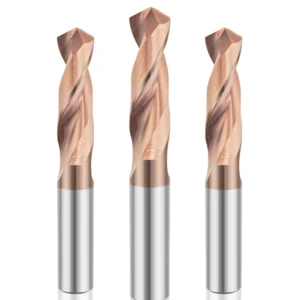
Why Traditional High-Speed Steel Fails in Hard Metal Drill Bit Applications
During shop-floor visits to our American and European clients, we often witness a costly mistake. To save a few dollars, technicians habitually reach for a cobalt high-speed steel (HSS) bit to machine D2 tool steel heat-treated to HRC52. The result is always the same: a piercing shriek, followed by the drill tip turning charred black in seconds. Veteran machinists are often baffled as to why M42 or cobalt bits—which excel on standard stainless steel—instantly become useless scrap here.
This happens because standard high-speed steel cannot exert “hardness dominance” over workpieces above HRC50. When the workpiece hardness matches or exceeds the tool, the cutting action shifts from shearing to brutal extrusion and friction. Under immense axial cutting resistance, the tool tip fails to engage the material, causing instant plastic deformation at the contact interface. If you rely on traditional HSS tools for high-hardness jobs, they certainly won’t be the best type of drill bit for hard metal production.
The Thermal Threshold: What Happens to Cobalt Bits at 600°C+
In our on-site cutting trials, infrared thermal imaging reveals a brutal reality. When a drill forces its way into a workpiece above HRC50, the contact temperature at the cutting edge skyrockets past 600°C within two seconds. This temperature hits the absolute limit of the red hardness capacity of cobalt-bearing high-speed steel. Once this critical thermal threshold is crossed, the steel’s matrix undergoes irreversible annealing and softening, causing the cutting edge to flatten like warm butter.
The immediate consequence of this high-temperature softening is severe flank wear and rapid edge deformation. As the cobalt-bearing drill loses its rigidity, friction intensifies, temperatures spike further, and a vicious failure cycle triggers. Tool breakdown from this thermodynamic breakdown represents a massive sunk cost that we eliminate for clients during process optimization. Without solving this thermal softening issue, standard iron-based alloys simply cannot handle high-intensity drilling as specialized drill bits for hard metal.
Work Hardening: How Inefficient Penetration Ruins Your Workpiece
Another silent killer that causes traditional tools to fail during high-hardness machining is the work-hardening effect. When a cobalt drill dulls and fails to cleanly shear metal fibers, it subjects the workpiece surface to high-pressure burnishing. With high-nickel alloys or die steels, this ineffective friction compresses the material’s grain structure. This compression spikes the local surface hardness by another 5 to 10 HRC points, turning the hole into unyielding glass.
Once this hardened layer forms at the bottom of the hole, subsequent machining becomes a total disaster. Unable to penetrate this ultra-hard shell, any cutting edge that engages next will suffer micro-chipping almost instantly. As a manufacturer specializing in advanced solid carbide hard metal drill bits, we always remind our industry peers: the cardinal sin of hard-metal machining is letting the tool slip or rub. Every instance of inefficient penetration actively destroys both your workpiece and your drill bit.
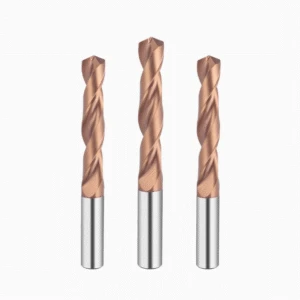
Hard Metal Drill Bit Showdown: HRC55 vs HRC65 for Extreme Hardness
In our technical support interactions with American and European shops, tool hardness selection remains a fierce debate. Many supervisors assume that if a workpiece is hard, they should simply buy the hardest tool available. However, we frequently observe at customer sites that tools chosen solely for extreme hardness fail the fastest. This happens because users overlook a critical CNC factor: the balance between machine tool rigidity and the overall system setup.
High hardness always implies high brittleness. In real-world cutting conditions, spindle runout, fixture clamping stability, and coolant delivery pressure determine tool life. We must make rational trade-offs between flexural strength and extreme wear resistance based on your specific equipment. Balancing these mechanical dynamics is the only way to get the most out of premium hard metal drill bits.
When to Deploy HRC55 Drill Bits: Best for Pre-Hardened Steels and Stable Setups
If your workshop is machining pre-hardened mold steels like NAK80, tempered alloy steels, or high-strength stainless steels, look no further. For these applications, we generally recommend prioritizing hrc55 drill bits. These tools feature a pragmatic balance of toughness, allowing them to withstand heavy cutting resistance while absorbing structural vibrations. Standard hydraulic chucks or shrink-fit holders on a stable CNC machining center are more than enough.
Shop floor tests prove that within the HRC38 to HRC48 range, these tools routinely outperform harder grades. Because the substrate retains an optimal ratio of cobalt binder, the cutting tip resists fracturing during interrupted cuts. Provided your cutting speeds and feed rates are balanced correctly, this grade delivers the ideal sweet spot for cost-effective machining.
Facing Hardness Up to HRC68? Why HRC65 Drill Bits Are Your Only Option
When dealing with extreme workpieces like high-frequency quenched bearing steels or high-vanadium tool steels, hardness can soar past HRC60. In these scenarios pushing the limits of carbide cutting capabilities, lower-grade tools will rapidly rub, burnish, and fail upon contact. For these unforgiving jobs, specialized hrc65 drill bits featuring high tungsten content and tailored grain compositions become your mandatory choice.
However, using such high-hardness tools to tackle these severe applications comes with a strict technical price. They are extremely brittle and demand near-perfect CNC machine rigidity. If your spindle has a tiny dynamic imbalance or the workpiece shifts by a few microns, the tip will shatter instantly. We advise running lower cutting speeds (Vc) paired with a high, continuous feed rate to force the edge through the hardened layer.
Carbide Grain Structure: Why Micro-Grain Matters for Cutting Edges
As experienced drill bit manufacturers, we know that microscopic base material structure determines tool success far more than surface coatings. Regardless of the target hardness range, we utilize sub-micron or ultra-fine grain tungsten carbide particles. Finer grains create a higher density of grain boundaries within the substrate, significantly enhancing structural hardness while maintaining excellent tensile strength.
This fine-grained matrix is crucial for drill bits for hard metal, which must maintain microscopic sharpness under intense friction. In contrast, traditional coarse-grained cemented carbides suffer from extensive grain pull-out under high heat and pressure, causing immediate dulling. Our ultra-fine matrix locks the microstructure in place under heavy shear forces, stopping thermal stress cracks before they destroy the tool.

Engineering the Edge: Anatomy of the Best Type of Drill Bit for Hard Metal
Every day, countless cemented carbide rods undergo precision grinding on our 5-axis CNC machines. As engineers on the shop floor, we know that when a workpiece exceeds HRC50, tiny geometric errors are drastically amplified under spindle loads. Many peers ask us why their tools—despite having the correct catalog specs—inexplicably fracture when machining hard metals. The deciding factor is almost always the geometric profile and structural design of the drill tip.
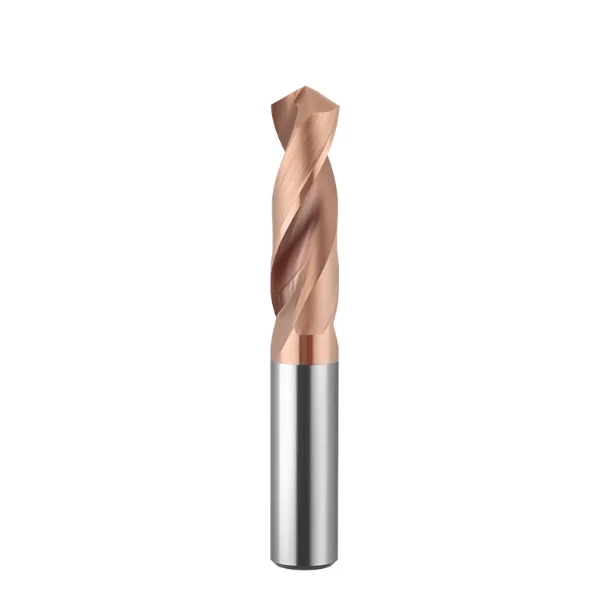
Designing specialized cutting tools for hardened steel goes way beyond merely increasing material hardness. Our primary goal is optimizing the distribution of cutting forces through precise geometric configurations. We must rebalance web thickness to prevent torsional deformation and carefully weigh chip evacuation capacity against flute rigidity. Only a product that perfectly integrates these engineering geometries qualifies as the best type of drill bit for hard metal.
135-Degree or 140-Degree Split Point: Eliminating Tool Wandering
When machining hard flat or curved surfaces, operator frustration usually stems from “wandering”—the tool deflecting upon initial contact. Attempting to machine hard materials using conventional 118° point angles causes the long chisel edge to skid violently across the surface. This high-pressure skidding instantly induces micro-chipping at the onset of the cut. To eliminate this issue, we engineered a 135° or 140° split-point geometry.
This combination of a wider point angle and a split-point grind drastically reduces the effective contact length of the chisel edge. The result is powerful, instantaneous self-centering the moment the tool engages. The wider angle also distributes axial cutting forces evenly across the face. By utilizing drill bits for hard metal with this specific geometry, you can completely eliminate center-drilling steps while improving hole roundness.
AlTiN vs. Nano-Silicon Coatings: Fighting Heat in Dry and Wet Cutting
In the critical friction zone where temperatures exceed 600°C, an exposed tungsten carbide substrate cannot survive alone. This is why we rely on PVD to equip our tools with an oxidation-resistant armor. For years, conventional AlTiN coatings were the workshop standard, performing reliably up to 800°C. However, when drilling super-hard metals exceeding HRC55, high-temperature coating flaking became a major bottleneck.
To address extreme heat accumulation, we introduced nano-silicon composite coatings into our high-end product lines. Under high-temperature friction, these coatings spontaneously form an ultra-dense silicon dioxide protective layer, raising the oxidation threshold to over 1100°C. If your operations favor high-speed dry cutting or Minimum Quantity Lubrication (MQL), this nano-coating offers a distinct advantage. For conventional wet emulsion setups, AlTiN remains highly competitive, making it vital to select your hard metal drill bits based on your cooling method.
Through-Coolant vs. External Flooding: The Crucial Role of Internal Cooling
In technical discussions with corporate production managers, we frequently emphasize one core rule: cutting fluid is for chip evacuation, not just lubrication. Many factories rely on external flooding nozzles, but when drilling depths exceed 2*D, high-speed swirling chips block external fluid from reaching the hole bottom. This creates a dangerous cooling blind spot where heat spikes rapidly.
This localized heat accumulation leads to secondary chip welding, clogging the flutes and causing catastrophic drill breakage from torsional overload. As professional drill bit manufacturers, we strongly recommend through-coolant systems for high-hardness CNC machining. High-pressure coolant delivered through two symmetrical internal channels instantly dissipates heat and hydraulically forces short, hard chips out of the hole, ensuring automated process stability.
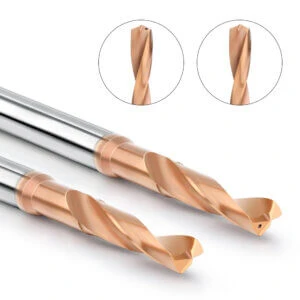
Sourcing Smart: How to Evaluate Drill Bit Manufacturers for Premium Carbide Quality
As engineers managing production lines, we understand the gap between B2B procurement and shop-floor reality. Purchasing managers often focus strictly on tool catalogs, density sheets, and price lists. However, actual testing reveals that cheap tools with attractive price tags rarely meet the basic service life of a quality hard metal drill bits setup. This isn’t just about commercial negotiations; it is about upstream quality control of the tungsten carbide base material.
For supply chain executives managing high-volume CNC projects, identifying vendors with true in-house manufacturing is critical. In a market flooded with low-price options, failing to evaluate core performance metrics leads to buying from traders who use cheap, outsourced rod stock. To safeguard your production yields and delivery schedules, you must establish a scientific supplier audit process right at the source.
Testing the Base Material: Demanding Virgin Tungsten Carbide Powder
When providing supply chain technical support, clients frequently ask why two identical-looking bits have a threefold difference in tool life. The answer lies within the microscopic crystal structure of the raw materials. To cut costs, low-end suppliers mix recycled scrap powder into the sintering process. This scrap introduces unpredictable microscopic voids and impurities that turn into catastrophic fractures when drill bits for hard metal face heavy cutting loads.
In our manufacturing facility, we subject every incoming batch of carbide rod stock to strict metallographic microscope inspections. This ensures our grain size distribution stays tightly within the sub-micron range. True virgin powder creates an exceptionally tight bond between the tungsten carbide grains and the cobalt binder phase. For high-precision drilling, always demand material composition reports from your suppliers and never compromise on raw base quality.
Consistency in Large Batches: What Separates Top Drill Bit Manufacturers from Low-Cost Shippers
Small-scale prototype tests can be deceiving, as samples from smaller tool shops often perform well. However, when scaling up to orders of thousands of units, quality fluctuations become an absolute nightmare for CNC technicians. One batch might hit 200 holes smoothly, while the next suffers edge failure after just ten. This lack of batch consistency is exactly what separates world-class drill bit manufacturers from ordinary workshops.
To meet the strict standards of Tier-1 automotive and aerospace clients, we maintain near-obsessive control over grinding wheel dressing and machine thermal stability. A dimensional drift of just a few microns will cause instant failure in hardened metals. Top-tier manufacturers back up their 5-axis CNC grinders with non-contact optical measuring systems and tight PVD coating process windows. Look beyond the initial samples and audit their in-line inspection capabilities.
Calculating the Cost Per Hole: Why Cheap Tools Cost Your Shop More
We see too many machine shops lose money because procurement departments fall into the trap of chasing the lowest unit purchase price. As engineers responsible for machine utilization and daily output, we calculate tool expenses very differently. Using poorly designed, cheap tools to cut hard materials forces you to drop cutting speeds (Vc), extends cycle times, and causes frequent downtime. Worst of all, a broken bit stuck in a hole can scrap a high-value workpiece.
We always encourage B2B buyers to implement a data-driven “Cost per Hole” analysis model. When drilling metals above HRC50, a premium tool featuring a high-quality substrate and optimized geometry might cost twice as much. However, if it delivers four times the service life and allows for a 50% increase in feed rates, your total cost per part drops significantly. Shifting your focus to overall production efficiency is the key to identifying the best type of drill bit for hard metal.
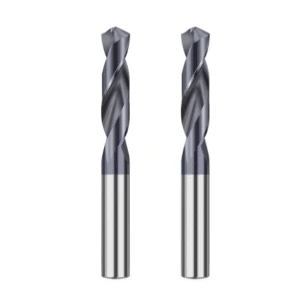
CNC Parameters and Troubleshooting: Stop Snapping Your Drill Bits for Hard Metal
Once your supply chain and tool geometries are optimized, success comes down to the specific data entered into your CNC control panel. We frequently troubleshoot broken carbide tools caused by operators running parameters meant for standard carbon steels. Setting cutting speeds (Vc) and feed rates (Fn) too high without adequate cooling is suicidal for your tooling. When tackling metals exceeding HRC50, your margin for error is virtually zero.
A parameter deviation of just 10% can instantly ruin an entire batch of premium drill bits for hard metal. Through years of shop-floor testing, we developed a simple rule for hard metals: low spindle speed, heavy feed, and continuous engagement. If you are struggling with tool breakage at the bottom of a hole or rapid cutting-edge burnout, it is time to re-evaluate your feed profiles. We encourage you to analyze your current machine rigidity against your programmed tool paths.
Peck Drilling Profiles: G83 vs G73 for High-Hardness Materials
When programming deep holes in hardened parts, many operators default to the G83 full-retract cycle. However, when machining materials above HRC50, a full retract poses a massive risk of micro-chipping. As the tool re-enters the hole, slight axial runout or hitting residual micro-chips will instantly fracture a carbide edge. If you are machining steels prone to work-hardening and your depth is within 3*D, switching to a G73 high-speed peck cycle is highly effective.
The G73 cycle uses tiny, high-frequency micro-retractions of just 0.2mm to 0.5mm to break chips. This keeps the tool tip constantly aligned with the axis of cutting resistance, avoiding repeated entrance shocks. If your hole depth exceeds 5*D, a through-coolant system paired with a carefully controlled G83 cycle becomes necessary for chip evacuation. Always balance your cycle choice against the specific depth-to-diameter ratio of your workpiece.
The Dangerous Turn: Why Micro-Chipping Happens During Tool Exit
The final 0.5mm zone where the drill breaks through the bottom of the workpiece—the tool exit—is a major troubleshooting blind spot. Most programming guides recommend a constant feed rate from start to finish. However, as the tool tip nears breakthrough, the material rigidity at the edge drops abruptly. Under intense axial pressure, the metal stops cutting cleanly and is instead pushed out, leading to heavy burrs and micro-chipping on your hard metal drill bits.
This sudden loss of resistance can also cause micro-movements in the CNC spindle, subjecting the brittle carbide to severe shear shock. If you notice chipping on the flank face or if your drills constantly snap right at breakthrough, you must alter your program. Using a macro or CAM software to drop the feed rate by 50% to 70% during the final breakthrough will dramatically increase tool life. If you are currently dealing with a challenging part geometry or an unpredictable alloy, feel free to share your prints, material specs, and current parameters with us so we can help you map out an exact solution.