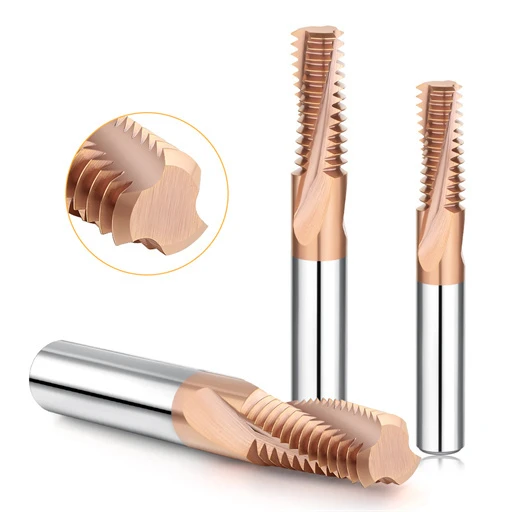

Last month, an Ohio machine shop asked us to fix a major issue with medical-grade PEEK components. They were drilling deep holes at a 5:1 depth-to-diameter ratio, but the process was a total nightmare. Once the drill penetrated past 3xD, the flutes clogged with melted plastic, causing hole bursting, severe shrinkage, and tools snapping during retraction.
In our 15 years of tool manufacturing, we have seen this exact scenario far too often. Many shops mistakenly use standard metal-working twist drills or generic parameters on polymers with disastrous results. In deep-hole operations, without the right peck drilling strategy, even the most premium drill bit for plastic cannot perform.
Plastics possess a very high coefficient of thermal expansion combined with extremely low thermal conductivity. During continuous cutting, frictional heat cannot dissipate through the chips like it does when machining steel or aluminum. If your flute design is too narrow, the helix angle is incorrect, or your G-code Q-value is too aggressive, chips will instantly melt.
Over the years, we have supplied engineered wholesale drill bits for high-load production to clients across the US and Europe. We learned that preventing stress cracking and exit burrs requires pairing high-performance carbide drill bit geometry with precise CNC control algorithms. It is a systems engineering challenge involving heat balance, feed rates, and residual stress.
As fellow machinists, you have likely battled hole-diameter spring-back or tool wandering in nylon, polycarbonate, or PTFE. How do we fine-tune those critical program parameters and the cutting-edge geometry of a plastic drill bit based on actual shop floor data?
Why a Standard Peck Drilling Cycle Can Ruin Your Plastic Drill Bit: Real-World Lessons from 16 Years on the Shop Floor
In our workshop, a harsh, unusual squeal from a VMC usually means one thing: a drill bit has hopelessly melted inside a plastic part. Many peers assume that applying a standard metal-working peck cycle to deep holes is the safest bet. However, our 16 years of troubleshooting experience proves that plastics are extremely heat-sensitive, and blindly relying on metal rules will ruin a high-quality plastic drill bit.
Standard peck cycles break metal chips perfectly but trigger a catastrophic spike in axial force when applied to polymers. Because plastics have a low modulus of elasticity, the material naturally springs back during continuous reciprocating peck movements. Without optimized retraction paths, the drill’s landing edges rub violently against the hole wall on re-entry, snapping the tool within a few hundred cycles.
G83 or G73? Recommendations for G-Code Selection When Machining Thin-Walled Plastic Parts
When machining thin-walled acrylic or polycarbonate enclosures, your G-code selection directly determines your scrap rate. We strictly advise against using a blanket G73 high-speed chip-breaking cycle for deep holes in flexible components. G73 only backs off a fraction of a millimeter without fully withdrawing from the hole, failing to clear the long, stringy strands produced by drill bits plastic in materials like nylon or POM.
Instead, we recommend the G83 deep-hole peck cycle to force a full retraction back to the reference plane after each pass. This movement physically pulls the chips out of the hole while allowing a brief blast of shop air or coolant to hit the cutting edges. If a thin-walled part lacks rigidity and vibrates under frequent retractions, we simply reduce the Q-value frequency rather than abandoning the full withdrawal.
Frictional Heat and Chip Stagnation: Why Standard Drill Bits Cause Melting at the Hole Bottom
To understand why standard drills suffer catastrophic failure deep in a hole, you must look at the microscopic friction within the flutes. Plastic thermal conductivity is only a fraction of a percent of metal’s, meaning over 80% of cutting heat stays trapped inside the cut. Once hole depth past 3xD, conventional metal-working flutes create too much friction, causing chip evacuation to lag behind chip generation.
Once chip stagnation occurs, the trapped polymer chips rapidly accumulate massive friction heat at the bottom of the hole. The plastic quickly reaches its melting point, shifting from a solid chip to a sticky, viscous mass that wraps around the carbide drill bit. This molten mass eliminates all cutting capability, expands instantly, and seizes the tool the second it cools.
Optimizing Peck Drilling Parameters: Ensuring Efficient Cutting Without Carbide Drill Bit Failure
Many CNC shops blindly ramp up spindle speeds to shorten cycle times, but they forget to match cutting parameters with the polymer’s mechanical properties. For a brittle carbide drill bit, unstable cutting impacts are the worst enemy. After fine-tuning countless deep-hole projects, we found that eliminating defects like entry blowouts and delamination requires redefining the feed logic within the peck cycle.
Unlike steel, plastics lack predictable ductility and accumulate high internal residual stresses under high-frequency peck impacts. Our multi-axis machining center tests show that optimizing the entry speed for each peck and adding a smooth retraction deceleration prevents instantaneous tearing. Parameter tuning is not about just slowing down; it is about balancing material shear strength with tool rigidity to sustain stable mass production.
The Golden Rule of the Q-Value (Peck Increment): Adjusting Carbide Drill Bit Feed Based on Material Hardness
You cannot use a “one-size-fits-all” fixed Q-value for deep holes in engineering plastics. When machining hard, stable polymers like PEEK or POM, we initially apply an aggressive peck increment of 1 to 1.5 times the tool diameter. These materials form chips cleanly, allowing for rapid material removal in the initial phase when using a rigid drill bit for plastic.
However, as the hole gets deeper, or when tackling soft, creeping materials like UHMW-PE, a decreasing dynamic Q-value strategy is vital. Chip evacuation resistance at the hole bottom rises exponentially with depth. For these deep sections, we gradually drop the Q-value to 0.2–0.3 mm to force out stringy chips before they cause a catastrophic tool seizure.
Matching Feed Rate and Spindle Speed On-Site: Technical Insights to Prevent Hole Shrinkage in High-Speed Machining
Hole shrinkage is a troublesome silent killer where a hole passes plug gauge inspection immediately after drilling but shrinks a few hours later. This issue is primarily caused by excessive spindle RPM combined with an insufficient feed per revolution. The tool ends up rubbing and scraping the hole walls instead of cutting, inducing severe elastoplastic deformation and thermal spring-back.
To overcome this on high-speed CNC lines, we prefer a “low RPM, high feed” setup strategy. Lowering the spindle speed directly minimizes friction heat at the source. Simultaneously, increasing the feed per revolution allows the plastic drill bit to penetrate deep into the material’s nominal shear layer, producing thick chips that carry the vast majority of heat away.

Specialized Drill Bit Geometry Optimized for Deep-Hole Peck Drilling in Plastic
Whenever B2B clients ask us about deep-hole plastic jobs, we ask about their material, hole depth, and machine rigidity instead of checking standard catalogs. Standard twist drills fail here because their narrow flute volume and honed, blunt edges act as liabilities against high thermal expansion. To achieve rapid cutting without stress concentration during frequent pecking, we must completely re-engineer the tool geometry.
Our structural optimization focuses on two main areas: flute volume and the secondary cutting edge’s clearance. Plastic machining requires a clean, surgical slicing action rather than the extrusive shearing used in metalworking. Our R&D testing proved that polishing and thinning the tool margin drastically reduces secondary friction against the hole wall, yielding superior temperature control for drill bits plastic.
Why We Recommend High-Helix Carbide Drill Bits for High-Speed Deep-Hole Machining
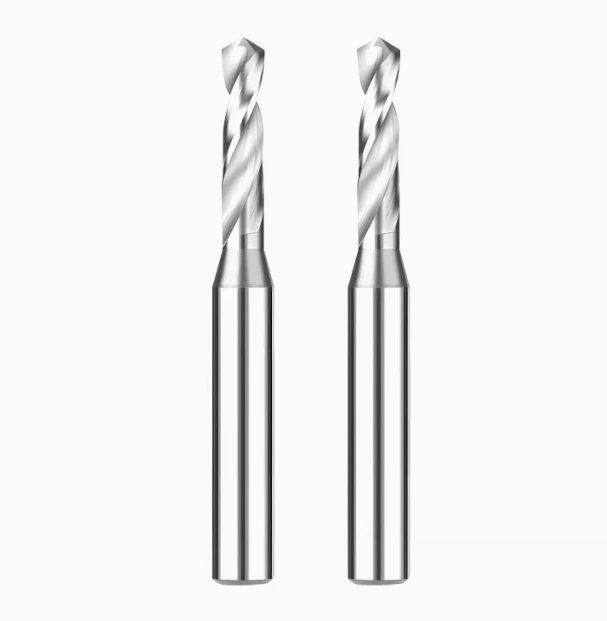
In high-speed jobs where spindle speeds soar to thousands of RPM, every millisecond counts as chips travel from the hole bottom to the exit. Some workshops use low-helix tools to maximize rigidity, but this triggers frequent tool burning because chip evacuation lags behind chip generation. For mass production, we consistently recommend custom carbide drill bit options with high helix angles between 35° and 45°.
The high-helix design significantly enhances the upward pumping effect during the single-feed stroke of a G83 cycle. Combined with carbide’s high torsional rigidity, the wide, polished flutes rapidly clear away clumping, continuous chips in materials prone to thermal expansion like HDPE. We simply advise technicians to fine-tune the feed-per-revolution based on material brittleness to prevent any micro-chipping at the tip.
118° vs. 90° Point Angles: Solutions to Minimize Bottom-Hole Burrs and Tearing During Exit
The breakthrough moment when the drill is about to exit the workpiece is the most critical stage of deep-hole drilling. Standard 118° or 135° metal-working drills exert too much axial thrust at breakthrough, pushing out the remaining thin polymer layer as a solid chunk and causing severe splitting. This results in heavy flanged burrs or torn material at the exit surface.
To solve this widespread shop floor issue, we use sharper 90° or 60° point angles when manufacturing a wholesale drill bits batch for plastics. Although a sharper point extends the total tool stroke and adds slightly to cycle times, it cleverly converts axial thrust into outward radial cutting force. This allows the main cutting edge to smoothly score and sever the outer rim first, ensuring a clean, burr-free exit.
Evaluating Mass Production in Western CNC Workshops: Tool Life and Cost Control for Wholesale Drill Bits
Controlling per-unit cost during high-volume, continuous production is the ultimate goal for workshop owners and purchasing managers. Across US and European CNC shops, deep-hole plastic machining often involves annual volumes reaching tens of thousands of units. Sourcing tools piecemeal from small retailers results in high premiums that quickly erode slim profit margins. Buying wholesale drill bits allows multinational workshops to secure profitability the moment procurement is finalized.
Controlling costs does not mean blindly chasing the lowest price; it means pursuing superior tool life predictability. High-frequency peck drilling causes continuous, microscopic wear on the secondary cutting edges. If bulk-purchased tools exhibit batch-to-batch inconsistencies in material purity or hardness, tool life becomes unstable. This forces frequent downtime for inspections, creating hidden costs that far exceed the price of the tools themselves.
Reducing Per-Hole Tool Amortization Costs with Wholesale Drill Bits for Large-Scale Deep-Hole Orders
Calculating the amortized tool cost per hole is an essential skill when bidding for massive deep-hole orders. If you are struggling with high tooling expenses for multi-hole polymer parts, you can shift your focus to bulk customization economies of scale. Direct sourcing via a wholesale drill bits channel eliminates middleman markups. More importantly, it allows batch-level edge adjustments, like thinning the chisel edge, tailored to your specific machine rigidity.
This targeted batch customization can extend the average service life of each drill bit by 25% to 40% on the shop floor. For example, an engineering plastic job requiring 50 drills for 10,000 holes might now require only 35. Combined with bulk discounts, the tool depreciation cost allocated to each deep hole often drops by half. This precise cost analysis is the technical ace that wins fierce commercial bidding.
Comparing Actual ROI: Carbide vs HSS in Long-Term Continuous Peck Drilling
Is it really necessary to use expensive solid carbide when machining soft materials like plastics? If you are evaluating a long-term project spanning months with daily spindle runtimes exceeding 16 hours, you can calculate the ROI numbers right from your machine logs. High-Speed Steel (HSS) has low initial costs, but its wear resistance degrades rapidly under high-friction peck drilling. This forces operators to frequently stop for tool changes, disrupting production.
In contrast, a well-designed carbide drill bit maintains edge sharpness and dimensional stability throughout high-load cycles. In our case studies, when drilling deep holes in Delrin, carbide tool life is often ten times longer than HSS with zero intermediate regrinding. Unless your setup has severe spindle runout or unstable clamping, carbide offers unmatched long-term economic benefits for automated lines.