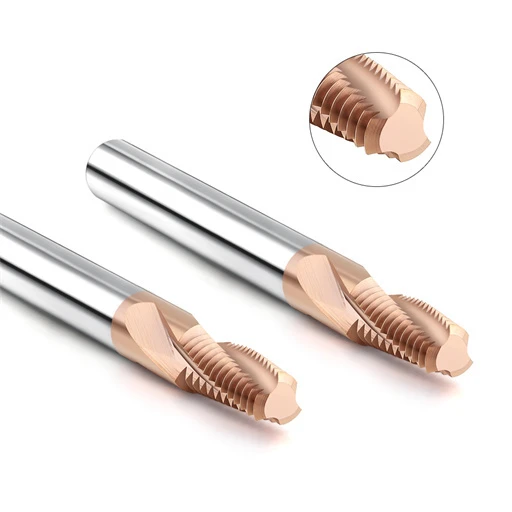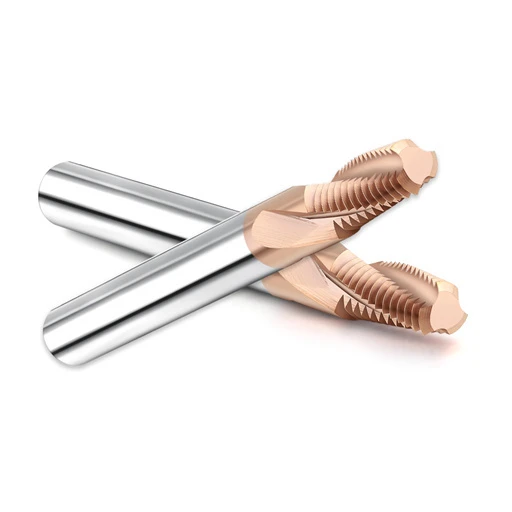

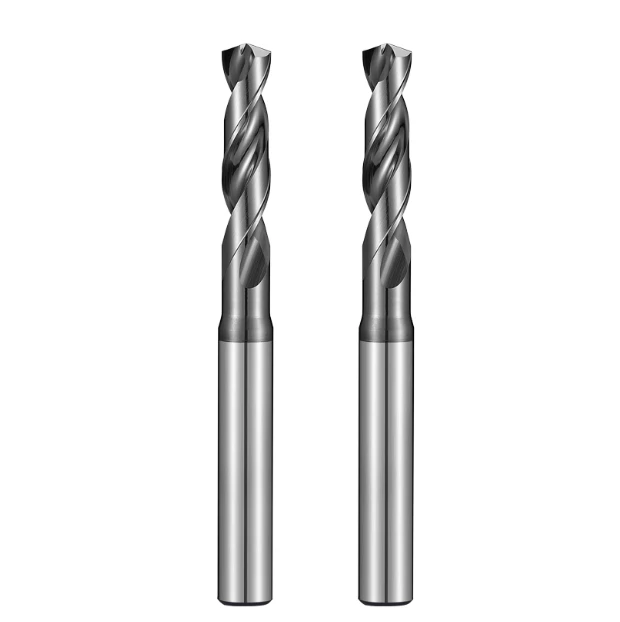
As tooling specialists who spend every day in the shop battling difficult materials, we know exactly what deep-hole drilling demands. Last month, a North American automotive client reached out in a panic while mass-producing 12D deep holes in quenched 42CrMo steel. Their standard types of drill bits for metal were screeching halfway through, chips choked the holes, and tools snapped constantly, sending scrap rates skyrocketing.
This “deep-hole nightmare” is a common issue we solve for global clients running high-intensity automated lines. Many shops assume buying any long metal twist drill bit works, ignoring flute space, cutting rigidity, and heat buildup. Opting for cheap, low-grade wholesale carbide drill bits without advanced coatings creates a financial black hole rather than boosting factory efficiency.
To solve this, we tailor solutions by material hardness. For standard steels around HRC 35–45, we recommend a custom carbide hrc55 drill bit with high-pressure internal cooling to force out tightly curled chips. For hardened mold steels up to 60 HRC, we deploy high-rigidity carbide hrc65 drill bit options and strictly control pilot hole alignment.
Maximizing the life of your twist drill bits for metal requires strict standards for centering, speeds, feeds, and coolant pressure. So, in your shop, which is your go-to card for breaking up long, tangled chips: high-pressure through-spindle coolant or a precise peck drilling cycle?
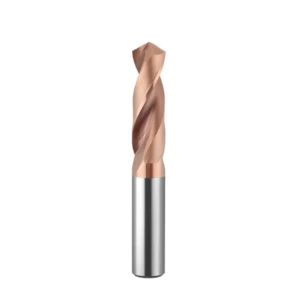
Insights from 16 Years of Deep-Hole Machining: Why Do Standard Metal Drill Bits Frequently Fail in Deep-Hole Applications?
At our facility, we analyze tool failure reports daily from machine shops worldwide. When first tackling deep-hole jobs (depths exceeding 5D), many machinists assume any tool capable of cutting can handle the depth. In reality, standard types of drill bits for metal suffer a drastic drop in structural integrity and chip evacuation once they dive deep. This failure rarely happens as gradual wear; instead, the cutting edge chips or snaps without warning, catching operators off guard.
Based on our sixteen years of shop-floor experience, the root cause is that deep drilling is a completely closed cutting process. Standard tools feature flute geometries and clearance angles designed only for shallow holes. As the tip penetrates deeper, cutting heat trapped at the hole bottom causes the drill tip hardness to plummet. Without fundamental structural optimization tailored to the material and depth, simply dropping your speeds and feeds won’t stop premature tool failure.
HSS vs Standard Carbide: How Deep-Hole Chip Evacuation Resistance Tests Tool Rigidity
Optimizing processes for overseas clients always involves tough trade-offs, especially regarding material rigidity. High-speed steel (HSS) offers great toughness but suffers from elastic deformation under high deep-hole temperatures and pressures. Conversely, while standard cemented carbide provides excellent hardness, it lacks an optimized micro-crystalline structure, making it prone to brittle fracture under heavy compressive chip loads. This exponential rise in chip resistance tests the limits of all types of drill bits for metal.
We once optimized a shaft-machining project where the hole depth reached 10D. To cut costs, the customer initially used basic carbide tools, but insufficient torsional rigidity caused the drill to shatter the moment chips packed the flutes. In our view, tool rigidity depends heavily on a progressive web thickness design and polished flutes. If a tool cannot balance torque spikes with smooth chip flow, frequent breakage and machine downtime will become your shop’s norm.
A Common Misconception in Western Workshops: Hole Deviation Caused by Blindly Drilling with Standard Long Metal Twist Drill Bits
In our discussions with manufacturing supervisors, we often spot a risky habit: operators taking a long metal twist drill bit and drilling straight to full depth without a pilot hole. Their logic is that modern CNC centers have such high positioning accuracy that they can just run a standard G81 or G83 cycle. However, they overlook basic physics; without external guidance, the long tool overhang causes the drill point to walk or wander the microsecond it hits the raw material surface.
The direct result of this blind drilling is severe hole deviation. Once verticality is lost in the first few millimeters, the long drill follows that crooked path deeper into the part, worsening the axial runout. We strongly recommend machining a precise pilot hole first using a short, stubby spotting drill or a short drill of identical diameter. Providing this rigid guide for your twist drill bits for metal is the only reliable way to ensure straightness and prevent scrap.
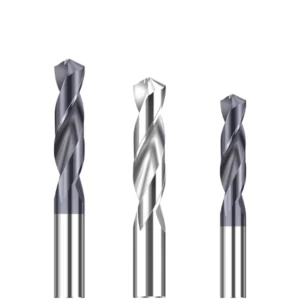
A Methodical Strategy for Deep-Hole Drilling: Correct Application of Carbide HRC55 and HRC65-Grade Drill Bits
On the shop floor, selecting the right cutting material dictates your project’s success. Many workshop supervisors opt for convenience, using a single carbide grade for all metal workpieces. In our experience, this shortcut causes frequent edge chipping on hard materials and wasted money on softer ones. Stable deep-hole drilling relies entirely on matching the tool—like a high-rigidity carbide hrc55 drill bit or an ultra-fine grain grade tool—to the workpiece’s actual Rockwell hardness (HRC).
Deep-hole machining is not a matter of brute force; it is a delicate balance of speed, feed, and material resistance. Different hardness levels generate vastly different cutting torques and heat, requiring a smart trade-off between toughness and hardness. By categorizing materials into precise hardness gradients and tailoring edge honing, we have helped countless overseas workshops eliminate costly trial-and-error and achieve an immediate leap in process stability.
Standard Steels and Quenched & Tempered Materials: Feed Control Using Carbide HRC55 Drill Bits with Peck Drilling Cycles
When machining materials like AISI 1045, 40Cr, and common alloy steels—which typically range from HRC 28 to HRC 40—we generally select a carbide hrc55 drill bit. These materials possess high toughness and easily produce long, continuous bird-nesting chips. Left unchecked, these long strands quickly tangle and clog the tool’s evacuation flutes. Consequently, we strongly recommend using a peck drilling cycle (like G83) during CNC programming to manage the chip load.
However, when controlling the peck increment (the Q-value), many practitioners go to extremes. Setting the Q-value too high causes chips to compact within the hole during tool retraction. Setting it too low increases friction between the tool tip and the workpiece, worsening work hardening. Our experience proves that progressively decreasing peck depths, paired with a robust initial feed-per-revolution, forces early chip breakage and maximizes tool service life.
Machining Hardened Mold Steel (>50 HRC): Speed Limits to Prevent Chipping with HRC 65 Carbide Drills in Deep-Hole Applications
When machining through-hardened mold steels like H13 or SKD61, the material hardness frequently exceeds 50 HRC. Under these extreme conditions, conventional tool substrates suffer rapid wear or catastrophic chipping upon initial contact. This environment necessitates upgrading to a highly specialized carbide hrc65 drill bit. While these ultra-hard tools offer exceptional wear resistance and hot hardness, their inherent brittleness makes them highly sensitive to cutting speeds and sudden impact forces.
When optimizing deep-hole processes for high-hardness materials, our first step is to dispel the myth that higher spindle speeds are always better. For ultra-hard tools, the primary adversary is the intense heat generated by heavy friction. Once your cutting speed (Vc) crosses a critical threshold, the cutting edge undergoes instantaneous thermal cracking. We advocate a “low speed, heavy feed” strategy, relying on machine spindle torque and tool rigidity to power through safely.
Ultra-Deep Holes (15D+): Practical Steps from Centering and Pilot Drilling to Relay Machining with Long Twist Drill Bits
When a hole depth reaches the extreme range of 15X diameter (15D) or greater, no single tool can handle the job alone. Some workshops attempt to save time by forcing a long twist drill bits for metal option to drill the hole in a single pass. This almost always results in severe axial deflection the moment the bit hits the raw material. We treat ultra-deep drilling like a precise relay race, always starting with a rigid centering drill.
Next, we use a short 3D or 5D drill to create a precise guide hole with tight tolerances, drilled to a depth of at least 2X diameter. When the long tool enters this pilot hole, it must slide in without rotation or at a very low RPM. Only after the tool tip is fully constrained by the guide hole do we activate high-pressure coolant and standard cutting parameters. This methodical approach keeps straightness errors within microns.
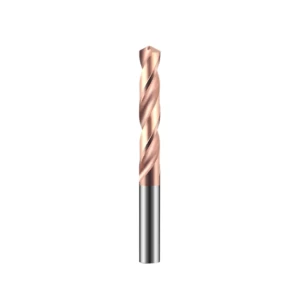
Solving the Three Major Pain Points of Deep-Hole Drilling: Optimizing Twist Drill Bit Service Life for European and American Clients
Through long-term collaboration with high-end manufacturing clients in the US and Europe, we know that overseas workshops enforce rigorous standards for efficiency. In deep-hole drilling, three critical issues—heat accumulation, severe chatter, and chip jamming—consistently plague process engineers. When clients complain that their newly purchased twist drill bits for metal options are underperforming, we never blame the tools right away. Instead, we audit the entire machining system.
Based on over a decade of on-site tuning, more than 90% of premature deep-hole failures stem from failing to manage these three pain points. Extending the service life of high-performance tools requires more than calculating desk parameters; it demands hands-on observation at the machine. You must monitor coolant spray patterns, listen to cutting frequencies, and analyze the shape of broken chips. Here is how we guide clients to overcome these challenges.
Coolant-thru vs External Cooling: How High-Pressure Cooling Revolutionizes Chip Evacuation in Deep-Hole Drilling
In deep-hole machining, your cooling method determines tool survival, especially when hole depths exceed 8X diameter. Many traditional workshops still rely on external coolant nozzles to direct fluid into the hole along the flutes. However, when a metal twist drill bit operates at high speeds, centrifugal force and back-flowing chips prevent external fluid from reaching the drill tip. This causes temperatures to spike within seconds, melting the cutting edge.
We strongly advocate upgrading to coolant-thru systems, which deliver high-pressure fluid directly to the cutting edge via internal channels. This method provides immediate lubrication and generates a powerful outward hydraulic thrust that forcibly ejects freshly cut chips. In our retrofit projects, simply increasing internal coolant pressure above 30 bar fundamentally transforms the evacuation environment, virtually eliminating sudden tool breakage from built-up edge (BUE) issues.
Eliminating Chatter and Hole Oversizing: Controlling Metal Twist Drill Bit Runout via Shrink-fit Holders and High-performance Chucks
On the automated production lines of our Western clients, we frequently encounter issues where hole diameters exceed tolerances or wall finishes appear rough. These phenomena are often accompanied by a low-frequency, metallic chattering sound. Measuring the spindle-side tool holding system with a dial indicator usually reveals the culprit: standard ER collets creating runout over 0.03mm. For a long-shank metal twist drill bit, this initial runout is geometrically amplified deep in the hole.
To limit runout to within a strict 0.005mm limit, we recommend abandoning traditional collet clamping for high-rigidity shrink-fit holders or hydraulic chucks. Exceptional tool concentricity balances the cutting forces on both cutting edges as they engage the metal, completely eliminating resonance. Although high-precision holders require a higher initial investment, the result is superior hole size stability and significantly extended tool life by eliminating micro-chipping.
Chip Control: Adjusting Feed per Revolution to Prevent Carbide HRC55 Drill Bits from Breaking Due to Chip Tangling
When drilling stainless steel or certain aerospace alloys, the chips exhibit high plasticity. Without proper control, they easily form long, continuous, noodle-like strands that wrap tightly around the body of a carbide hrc55 drill bit. As depth increases, they compress between the helical flutes and the hole wall, instantly clogging the remaining evacuation space. Once jammed, the immense axial feed force of a CNC machine shatters the carbide tool body within milliseconds.
When providing on-site guidance, our core technical strategy is to proactively manage chip breaking by fine-tuning the feed per revolution (fn). Many operators instinctively reduce the feed rate when they see long chips, but this backfires by making the chips thinner and harder to snap. We take the opposite approach: we moderately increase the feed to force thicker chips, leveraging the flute’s geometry to snap them into ideal “C-shaped” fragments for trouble-free, 24-hour automated production.
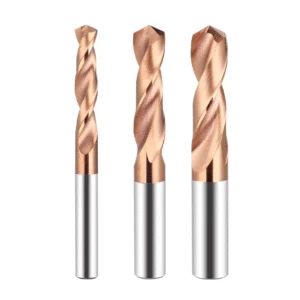
Reducing Cost-per-Hole in the Workshop: Key Technical Metrics for Evaluating Wholesale Carbide Drill Bits in High-Volume Production
Balancing procurement costs against machining efficiency is a critical art form in high-volume, automated production. As an industrial manufacturer supplying major shops in the US and Europe, we fully understand the pressure to cut tooling expenses. However, focusing solely on the upfront price quote usually leads to a trap: buying a cheap tool only to see overall machining costs skyrocket. Truly evaluating wholesale carbide drill bits requires looking beyond the price tag at actual tool life, downtime frequency, and amortized cost-per-hole.
The core of a high-quality bulk tool supply relies on the extreme consistency of technical specifications across thousands of parts. If you are concerned about high monthly tooling expenses, calculate the time and labor wasted every time a tool breaks on your automated lines. In this technical supply chain assessment, we will break down how to avoid the low-price trap during bulk procurement. By focusing on micro-level specifications, you can optimize your shop’s bottom line using a comprehensive Return on Investment (ROI) approach.
Avoiding the Low-Price Trap: Verifying Substrate Grain Size and Cutting Edge Polishing When Purchasing Wholesale Carbide Drill Bits
In the vast bulk tooling market, drills that look identical on the surface often perform completely differently on the machine. If you are cutting high-strength steel or difficult alloys, focus on verifying two microscopic metrics of your wholesale carbide drill bits: substrate grain size and flute polishing. To cut manufacturing costs, low-priced tools utilize coarse-grained substrates or recycled materials. These sub-par materials are highly prone to micro-chipping and catastrophic fracturing under deep-hole cutting pressures.
Premium carbide drill bits utilize micro-grain or nano-grain substrates to strike the ideal balance between exceptional hardness and impact toughness. Furthermore, mirror-polished helical flutes drastically reduce the friction coefficient of the chips inside the hole. If your bulk-purchased drills tend to pack or clog with chips, check the flute surfaces under high magnification. Rough flute walls cause a sharp increase in chip evacuation resistance, but we can help you optimize edge honing if you share your part drawings or specific material grades with us.
The Production Line Ledger for Western Buyers: Boosting ROI through the Regrinding of High-Quality Carbide Drill Bits
In mature American and European shop management practices, premium cutting tools are never treated as mere single-use consumables. If you manage a lean production line, you can dramatically lower expenses by analyzing the total regrind potential of high-quality wholesale carbide drill bits. Thanks to uniform substrate materials and superior coating adhesion, premium drills can be precisely resharpened on 5-axis tool grinders and re-coated up to 3 to 5 times, restoring over 90% of original performance.
This is why experienced industrial buyers prioritize the total lifecycle value of a cutting tool over the initial invoice. While low-cost drills are often scrapped after a single run due to micro-cracks, a high-specification drill drops the total cost-per-hole by over 30% across multiple regrinding cycles. If you are looking to reduce costs or upgrade a tough application, we invite you to analyze your material grades and actual hole-drilling data with us to calculate your exact operational savings.