
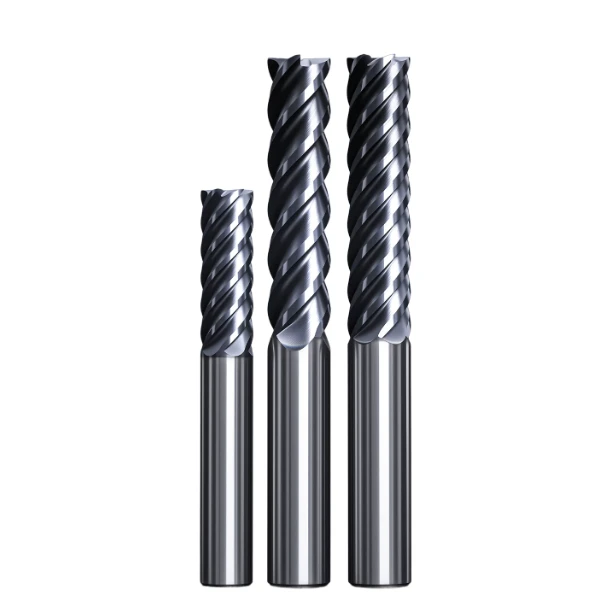
A few months ago, we helped a long-established German machine shop resolve a classic machining disaster. They were using 4-flute carbide square end mills to clear slots in 7075 aluminum alloy on a newly installed high-speed machining center. Within less than half an hour, chips jammed the slots, snapping the tool and triggering an emergency spindle stop. Their technical supervisor called us, utterly baffled: “We’ve always used 4-flute tools; why can’t we handle basic chip evacuation with this new equipment?“
In our 15-plus years of manufacturing and troubleshooting metal cutting end mills, we see downtime and scrapped parts caused by incorrect flute count selection almost weekly. Many operators and purchasing managers fall into a rut of habitual thinking—either assuming that “more flutes mean greater rigidity” or stocking a single end mill style for the entire facility.
However, in actual production—ranging from high-MRR aluminum roughing to high-speed finishing of hardened mold steels—selecting the number of flutes is a dynamic balancing act between chip pocket space and core rigidity. Make the right choice, and tool life doubles while surface finish quality eliminates the need for polishing. Make the wrong choice, and the result ranges from severe chatter to catastrophic tool breakage.
As a trusted china end mill for metal manufacturer working closely with workshops in Europe and North America, we know that while customers seek cost-effective tooling, what matters most is real-world cutting performance. So, when should you run 2 flutes for slotting, switch to 4 flutes for dynamic trochoidal milling, or step up to 6 flutes for high-hardness alloys?

Why Flute Count Choices Make or Break Your Metal End Mill Performance
Over a decade of technical support for European and American clients shows that shops often blame poor coatings for tool failure. However, analyzing failed cutters usually reveals a deeper issue: a mismatch between tool geometry and actual cutting conditions. Flute count directly determines dynamic load distribution and heat dissipation efficiency in a metal end mill.
Selecting flute count is a fundamental engineering trade-off. You cannot expect maximum core rigidity and massive chip clearance in a single tool. Ignoring how flute count affects cutting forces, friction, and heat accumulation will shorten tool life, increase cycle times, and raise production costs across your entire operation.
The Engineer’s Balance: Chip Clearance vs. Carbide Core Rigidity in End Mills for Metal
Cutting each chip flute inevitably reduces the core diameter when designing end mills for metal. Core diameter dictates resistance to bending and torsion, while flute volume controls how smoothly chips curl and evacuate. These two physical requirements directly oppose each other; increasing core diameter compresses chip space and raises evacuation resistance exponentially.
Selecting high flute counts for deep slots causes chips to pack tightly inside the flutes. This creates sudden force spikes, high-frequency vibration, and thermal stress, leading to chipped edges or tool breakage. Conversely, choosing an undersized core for hard steel causes tool deflection and dimensional errors. Engineers must balance depth of cut, width of cut, and material ductility to find the right tool core.
Real Shop Floor Cases: How Flute Selection Directly Impacts Tool Life and Cycle Time
A North American aerospace contractor faced severe issues finishing 17-4PH stainless steel sidewalls with a 4-flute tool. To achieve an Ra 0.8 surface finish, they ran an extremely low feed-per-tooth. This strategy stretched cycle times to 42 minutes per part and caused rapid flank wear, requiring a tool change every three parts.
We evaluated their spindle power curves and fixture setup, then recommended switching to a high-rigidity 6-flute tool with dynamic trochoidal milling. This change doubled the axial feed rate while maintaining thin chip thickness, cutting cycle time to 23 minutes. Spindle chatter dropped significantly, and tool life increased by 150%, proving that proper flute selection drives real productivity gains.
Our Testing Bench Data: Cutting Force Distribution Across Different Flute Counts
Using 3D dynamometers on our 3-axis and 5-axis test rigs, we measured cutting forces across various carbide square end mills. The data confirmed that adding flutes while holding radial cut width constant reduces peak impact forces on individual edges. Overall radial force and torque also stabilize because more edges engage the workpiece simultaneously.
Our test data also highlighted an often-overlooked factor: multi-flute tools create much smaller force fluctuations when entering and exiting cuts. This smooth loading slows fatigue propagation in the carbide substrate. However, if poor chip clearance causes chip recutting, force spikes occur immediately. These sudden shock loads act like hammers, destroying cutting edges regardless of tool quality.

2-Flute Metal Cutting End Mills: Maximizing Chip Evacuation in Aluminum and Soft Metals
Supervisors new to non-ferrous machining often ask why aluminum alloys cause built-up edge (BUE) and tool breakage even with premium metal cutting end mills. Soft metals undergo severe plastic deformation and rapid chip expansion at high speeds. High cutting temperatures also increase chemical affinity with the tool rake face, causing material to weld to the edge.
Reducing flute count is the most effective way to boost efficiency during heavy roughing in non-ferrous metals. Two-flute designs provide large gullets and open evacuation paths that minimize frictional heat. When machining sticky materials that produce long chips, sacrificing some core rigidity to ensure smooth chip flow is the best decision for stable mass production.
Why We Recommend 2 Flutes for Non-Ferrous Materials and Deep Slotting
When designing slotting processes in aluminum or copper, 2-flute end mills for metal are almost always our primary recommendation. In 100% full-slotting operations, chips cannot escape laterally and must travel forward or upward through the gullets. A 2-flute tool provides a 180° flute space, allowing chips to curl naturally without compression and reducing spindle torque spikes.
Machining highly ductile materials like pure copper causes material deformation rather than clean shearing. Two-flute geometries allow for larger rake angles and sharper edge radii, shearing material cleanly without restricting chip flow. Field tests show this approach drops cutting temperatures by over 30%, preventing trailing burrs on sidewalls and eliminating flank face adhesive wear.
Overcoming Chip Packing: Real Lessons from Our High-Speed Aluminum Machining Clients
A Mexican automotive contract shop was machining 6061-T6 aluminum heat sinks at 20,000 RPM. They originally used 3-flute tools to cut deep cavities for a better finish. However, high-speed chips could not evacuate fast enough, leading to chip packing at the cavity bottom. This caused severe chip welding, destroying four to five cutters per shift.
We replaced their tooling with 2-flute carbide square end mills featuring polished flutes. The mirror-smooth flute surfaces drastically reduced chip friction, while high-pressure air blasts cleared chips instantly upon formation. This change eliminated chip packing completely, allowed a 20% increase in axial depth of cut, and boosted overall machining efficiency by nearly 33%.
Feed and Speed Adjustments When Running 2-Flute Metal Cutting End Mills
Setting parameters for 2-flute tools requires a different approach than multi-flute cutters, especially when sourcing from a specialized end mill for metal supplier. Because 2-flute tools have smaller cores, pushing feed-per-tooth too high causes tool deflection. Instead, leverage the open flute space and run higher surface speeds (SFM) to make up for fewer cutting edges.
We recommend running high spindle speeds, moderate feed-per-tooth, and large axial depths of cut (Ap). Keep feed-per-tooth between 1% and 2% of tool diameter while applying directed coolant through the flutes. This strategy allows chips to carry away most of the cutting heat, maximizing tool life without overloading the cutter body beyond its yield point.
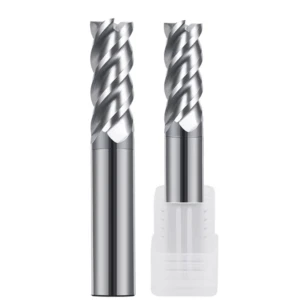
4-Flute Carbide Square End Mills: The Versatile Workhorse for Steel and Stainless
When asked for a single general-purpose tool capable of handling low-to-medium carbon steels, alloy steels, and stainless steels, we unhesitatingly recommend carbide square end mills. Unlike 2-flute designs that prioritize large chip channels, 4-flute tools strike a balance between chip clearance and core strength. This setup lets machine shops maintain high feed rates while achieving excellent sidewall finishes and strong tool rigidity.
The reason 4-flute cutters are a staple in CNC shops is their high process tolerance. Whether you perform side milling, step milling, or dynamic trochoidal paths, 4-flute geometry delivers stable cutting force distribution. Unless you are machining extremely hard steels or soft non-ferrous metals, 4-flute tools remain the most reliable choice for balancing productivity, tooling costs, and stability.
Structural Rigidity of 4-Flute Carbide Square End Mills in Heavy Steel Milling
Under heavy loads on carbon steel (like 45# or Q235) or alloy steel (like 4140 or 42CrMo), force demands on tool rigidity rise exponentially. Tests on our shop floor confirm that 4-flute carbide square end mills feature a core thickness 15% to 20% larger than 2-flute designs. This extra core strength prevents bending and deflection during deep cuts, eliminating dimensional errors and surface waviness.
Furthermore, a 4-flute tool ensures at least one or two flutes stay engaged with the workpiece during rotation. This continuous engagement reduces the shock impact experienced when a cutting edge hits raw metal. During heavy roughing, this structural stability protects the corner radius from premature chipping and lowers peak torque on your spindle, producing a deep, rhythmic sound that indicates a stable cut.
Trochoidal and Dynamic Milling Strategies: Why 4 Flutes Is Our Go-To Recommendation
Dynamic milling algorithms in modern CAM software have cemented the position of 4-flute tools in modern CNC machining. When supplying high-performance china end mill for metal solutions to overseas clients, a 4-flute dynamic setup is almost always our primary recommendation. Combining small radial cuts (Ae 5%–15%) with full-flute axial depths (Ap 2–3x diameter) transfers heat into the chips rather than the tool body.
With trochoidal paths, the small engagement angle eliminates chip packing risks, fully unleashing the speed of 4-flute designs. Compared to 2-flute cutters, 4-flute tools allow table feed rates (IPM) to increase by 33% to 50% at the same feed-per-tooth. Upgrading mold shops across Europe to 4-flute dynamic milling has cut machining times in half while multiplying tool life through uniform heat distribution.
How We Optimized Flute Geometry for European Shops Cutting Stainless 304 and 316
Machinists consider austenitic stainless steels (like 304 and 316) tough due to work hardening, low thermal conductivity, and heavy built-up edge. Supporting European valve manufacturers, we noticed standard 4-flute tools failed quickly on 316L. Dull rake angles and material friction caused extreme heat in the cut zone, leading to severe flank wear within minutes.
To fix this, we optimized the geometry of our metal cutting end mills. We introduced variable helix angles and an asymmetrical flute layout to break harmonic cutting resonance. Combined with micro-radius edge honing and a friction-reducing AlTiN/TiSiN coating, this custom 4-flute geometry shears stainless cleanly without triggering work hardening, delivering an unprecedented balance of tool life and surface finish.
6-Flute End Mills for Metal: High-Efficiency Finishing in Hardened Steels and Superalloys
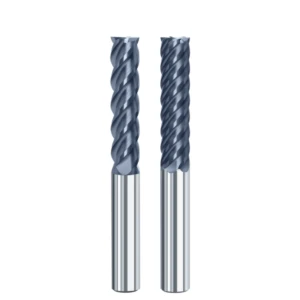
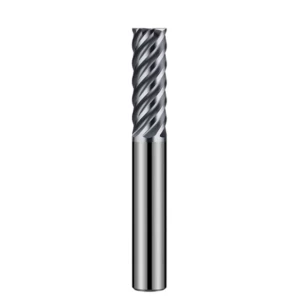
Finishing hard materials—such as mold steels over HRC 50, titanium alloys, or Inconel—requires tight dimensional tolerances and flawless surface finish. Relying on 4-flute cutters for sidewall finishing often forces you to run slow feeds to achieve a mirror finish. Introducing a 6-flute metal end mill allows shops to leverage high-density cutting points, particularly when taking light finishing passes.
The 6-flute design is a specialized finishing cutter rather than a roughing tool. When axial and radial depths of cut (Ap/Ae) are kept very shallow, generated chips are razor-thin. Huge chip pockets are no longer required; instead, high core rigidity and dense cutting frequencies dominate. Choosing 6 flutes trades a denser array of cutting teeth for micron-level surface finishes while distributing cutting forces across more edges.
Pushing Surface Finish Limits: When and Why We Deploy 6 Flutes in High-Hardness Alloys
Finishing sidewalls on hardened steels (like NAK80, SKD11, or DC53) often leaves tool marks due to uneven forces and cutter deflection. Deploying 6-flute end mills for metal provides 50% more cutting contacts per spindle revolution. This high-frequency micro-shearing action flattens scallop heights, allowing you to achieve Ra 0.4 or better surface finishes without extending machine cycle times.
In addition, machining high-hardness alloys subjects tool tips to extreme resistance. Because 6-flute tools have shallower flutes, their core thickness can reach 70% or more of the tool diameter for maximum bending strength. Provided your spindle runout is under 0.005mm, a 6-flute tool acts like a rigid micro-grinding wheel, producing mirror-smooth finishes that eliminate the need for manual bench polishing.
Managing Core Strength and Heat Dissipation During High-Speed Finishing Operations
In high-speed finishing (HSM) of hardened steels, cutting heat and high-frequency vibration destroy cutting edges. Thanks to incredible core rigidity, 6-flute carbide square end mills resist bending during high-RPM rotation, stopping edge micro-chipping caused by tool chatter. Because more flutes share the workload, individual edge contact time is brief, giving each edge time to cool as it rotates through the non-cutting zone.
However, a massive core restricts chip clearance, meaning engineers must strictly control radial engagement (recommended at 2%–5% of tool diameter). Using high-pressure air blasts clears tiny chips instantly to prevent recutting. Test data shows that as long as chips evacuate freely, 6-flute cutting zone temperatures remain lower than 4-flute setups, allowing heat-resistant nano-coatings to protect the flank face longer.
Real Customer Feedback: Reducing Bench Polishing Hours with 6-Flute End Mills for Metal
A European mold manufacturer producing automotive lighting molds struggled with extensive manual polishing needed on cavity sidewalls. Traditional 4-flute tools left microscopic step marks that required hours of hand work, risking mold dimensional accuracy. The plant manager asked us for a tooling solution to shorten their overall delivery schedule.
We evaluated their setup and introduced a custom 6-flute finishing tool with optimized CAM toolpaths. Running the 6-flute cutter at original feed rates improved sidewall roughness from Ra 0.8 to better than Ra 0.2. This tooling change cut manual bench-polishing hours by nearly 70% while improving flash control during injection molding, proving the value of deploying 6-flute cutters in proper finishing applications.
Sourcing Considerations: Partnering with a Reliable Chinese End Mill Supplier for Metalworking
Selecting a supply chain partner is essentially choosing an extension of your shop’s machining stability. Before a tool leaves the factory, minor process variations—from carbide rod grain size to 5-axis grinding tolerances—manifest as chipped edges on your CNC spindle. Understanding a manufacturer’s quality control systems and technical capabilities ensures that tool cost savings do not lead to expensive downtime.
Finding a reliable end mill for metal supplier involves far more than comparing catalog unit prices. When overseas shops build an international supply chain, they often worry about batch-to-batch quality variations and a lack of timely technical support. Partnering with an engineering-focused supplier guarantees predictable tool performance and reliable troubleshooting when complex machining challenges arise.
How We Guarantee Batch Consistency as a Quality Chinese End Mill Manufacturer
As a high-standard china end mill for metal manufacturer, we fully understand the strict demands European and American clients place on batch consistency. In automated mass production, if one batch lasts two hours while the next chips in thirty minutes, shops cannot risk unattended overnight machining. To solve this pain point, we strictly source high-quality micro-grain carbide rods for consistent hardness and flexural strength.
During grinding, we utilize Swiss and German 5-axis CNC tool grinders alongside Zoller optical inspection systems. We monitor radial runout, flute polish quality, and edge honing radii on every production lot. Controlling geometric tolerances within micron-range limits ensures that machinists achieve fully predictable tool life on their CNC machines without constantly adjusting tool offsets.
Evaluating an End Mill Supplier for Metalworking: What Overseas Shops Must Look For Before Ordering
When evaluating an end mill for metal supplier, look beyond website marketing images and inspect their actual technical capabilities. Verify whether they provide a complete inspection data chain, including substrate property data, coating thickness reports, and real cutting test data. A transparent supplier willingly shares verified lab data to prove their tool reliability.
Equally important is the supplier’s responsiveness when you face specialized materials or complex cutting conditions. A mature technical team should interpret your component drawings, assess spindle rigidity, and recommend customized flute geometries. If a supplier only sells off-the-shelf items without troubleshooting vibration or abnormal wear, they cannot support you during urgent engineering changes.
Our Engineering Support: Customizing Flute Geometries for Your Specific CNC Machine Capabilities
Even when cutting identical materials, machine capabilities, tool-holding systems, and coolant conditions vary greatly between machine shops. When standard 4-flute carbide square end mills do not match your exact setup, blindly pushing higher parameters causes premature tool failure. In these situations, customizing non-standard flute geometries to match your machine rigidity becomes essential for optimal performance.
For large machine tools with limited spindle speeds, we eliminate cutting resonance by adjusting helix angle combinations and variable flute spacing. For high-speed finishing centers, we optimize core thickness ratios and rake angles to achieve superior surface finishes. Our engineering-first philosophy optimizes tool geometry around your specific equipment to unlock your machine tools’ full potential.
Troubleshooting Flute-Related Failures on the CNC Shop Floor
Unexpected tool breakage during mass production is one of the most frustrating challenges on the shop floor. When a end mills for metal cutter fails prematurely, machinists often lower feed rates or blame the carbide grade. However, our shop floor troubleshooting experience shows that most failures stem from conflicts between flute count, workholding rigidity, tool overhang, and cutting allowance.
Resolving failures requires learning to interpret the wear patterns left on the tool body. The number of flutes determines chip channel volume as well as the frequency of dynamic impact forces. Evaluating tool geometry alongside your machine spindle system allows you to identify whether issues stem from chip packing, runout, or cutting resonance without sacrificing productivity.
Diagnosing Premature Chipping: Is It Wrong Flute Count or Bad Runout?
When encountering micro-chipping or broken tools, first determine if the root cause is chip crowding or single-flute overloading from runout. When using 4-flute carbide square end mills to cut deep slots, chips undergo secondary cutting inside the flutes. This creates sharp force spikes, resulting in tool chipping accompanied by visible chip welding inside the slot.
Conversely, if severe micro-chipping appears on only one or two flutes while others stay intact, radial runout is likely the culprit. Runout creates uneven feed-per-tooth, doubling the impact load on the outermost edge for every 0.01 mm of runout. Measure runout at the tool tip using a dial indicator; if chipping persists under 0.005 mm runout, reduce flute count or adjust depth of cut.
Solving Excessive Chatter and Harmonics by Matching Flute Count to Overhang Length
Chatter ruins surface finishes and severely shortens tool and spindle lifespan. When machining with long tool overhangs or processing thin-walled parts, cutting forces amplify tool deflection and vibration. Many workshops switch to tools with more flutes to suppress chatter through rigidity, but when overhang exceeds four times tool diameter, high-frequency impacts actually trigger system resonance.
To eliminate chatter, match your flute count to the rigidity of your tool overhang setup. Because long-overhang tools deflect easily, engaging too many flutes simultaneously causes cutting resistance to accumulate rapidly. We recommend reducing flute count to minimize engagement angles while applying a variable helix design to break fixed-frequency cutting resonance for stable, chatter-free cuts.
Our Checklist for Picking the Right Metal End Mill Flute Count on the First Try
Selecting the proper flute count for metal cutting end mills follows a clear engineering logic across different machining scenarios. Before starting your next cut, quickly evaluate your setup using these core criteria:
-
Material & Chips: Choose 2-flute or 3-flute tools for soft, gummy materials like aluminum where chips expand rapidly. Opt for 4 flutes or more when cutting steels, stainless, or hard alloys.
-
Toolpath & Engagement: Full-width slotting requires maximum chip space, making fewer flutes ideal. For modern CAM dynamic milling with minimal radial engagement, choose 4 or 5 flutes to boost feed rates.
-
Machining Stage: Use 4-flute cutters for general roughing to balance chip clearance and force distribution. Deploy 6-flute tools for high-frequency finishing passes on HRC 50+ hardened steel sidewalls.
-
Rigidity & Overhang: On flexible setups or long overhangs, adding flutes increases vibration; reducing flute count and controlling cutting engagement yields far more stable results.
If you are struggling to select the right tool for a difficult material or facing on-site issues like chatter and short tool life, share your operating parameters, workpiece drawings, and machine model with us. We can analyze the tool geometry together based on your actual cutting paths to find the ideal balance between machining efficiency and tooling costs.