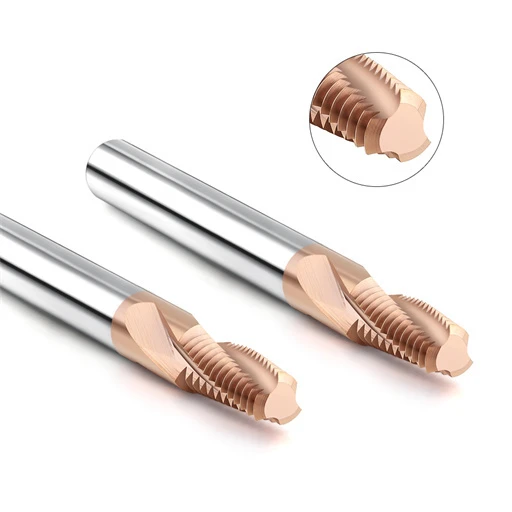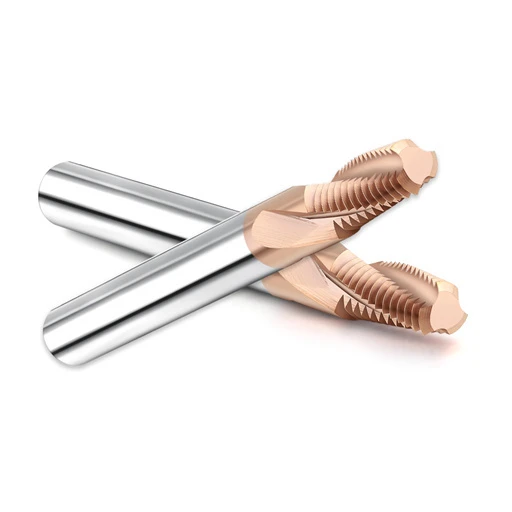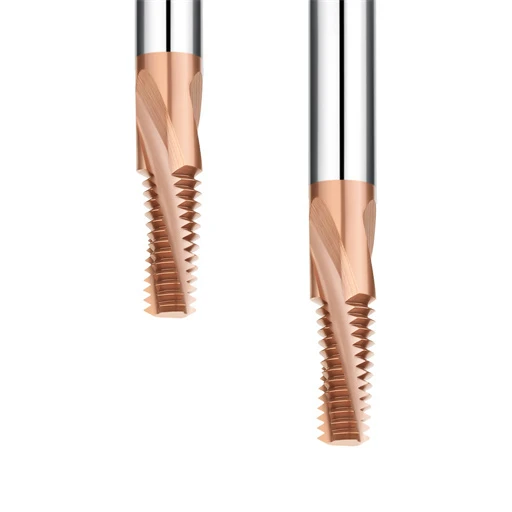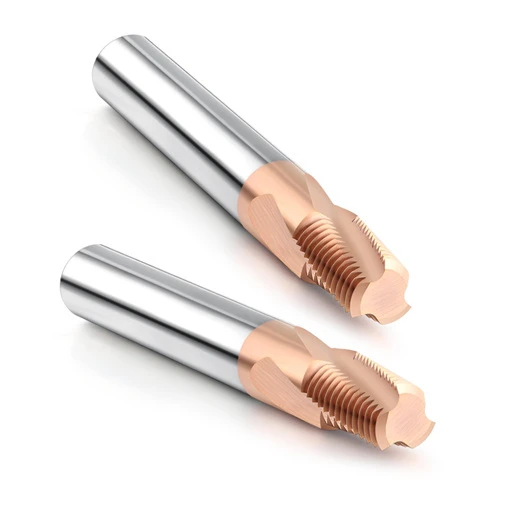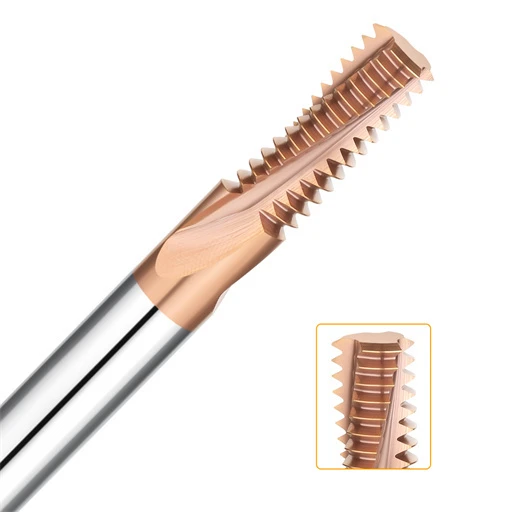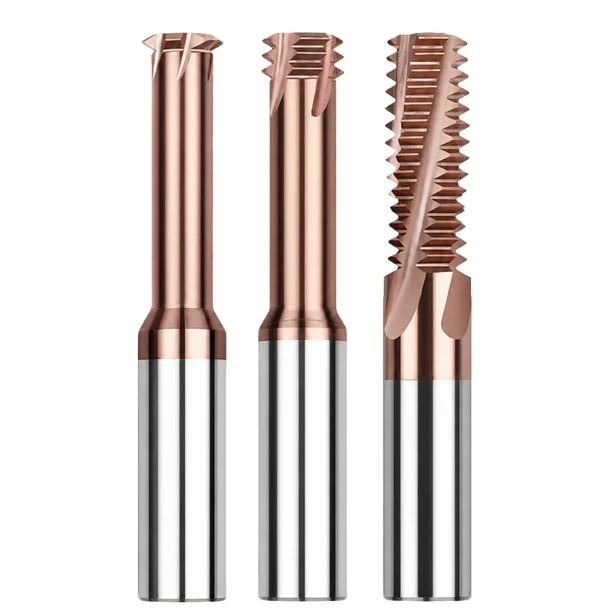

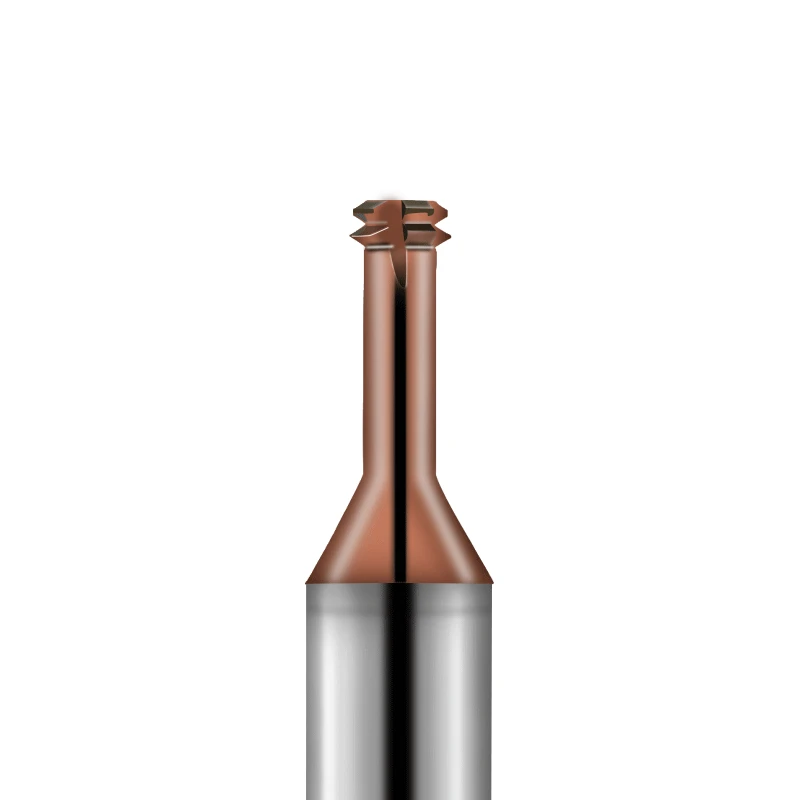
Last week, a long-standing US client emailed us about a crisis. Their shop was machining an expensive, aerospace-grade mold hardened to HRC63. Due to a flawed process plan, they used traditional carbide taps, and the tap snapped inside the final M8 blind hole. The entire workpiece was ruined, wasting thousands of dollars in prior machining labor.
With 15 years in CNC cutting tool R&D, we see this disaster far too often. Scraping a high-value, ultra-hard workpiece due to the wrong threading process is a painful reality for shops tackling materials above HRC60. Standard tools fail under extreme cutting temperatures, which is why we continuously optimize the substrate and coating technologies of our solid carbide thread mills.
In this guide, we focus strictly on practical shop-floor realities like tool longevity, resistance management, and precision control. We will explore how to select a specialized hrc70 thread mill and optimize helical interpolation programs to eliminate dimensional errors from tool deflection. Since conventional taps hit a dead end here, how can we use high-quality thread mills for hard metals to safely cut perfect threads into rock-hard workpieces?
Insights from 16 Years of Manufacturing: Why High-End European and American Workshops Are Abandoning Taps for Solid Carbide Thread Mills in Hard Metal Machining
In our Western clients’ workshops, process safety is paramount. Machinists used to tap parts before heat treatment, but quenching deformation caused severe thread precision issues and high rework costs. When shops transitioned to threading after heat treatment, traditional forming or cutting taps failed instantly against hardened steels, twisting or shattering under immense cutting resistance and rapid heat buildup. To avoid this high-risk, brute-force clash, high-end shops have phased out tapping in favor of solid carbide thread mills.
The reason these tools comprehensively replace taps lies in a fundamental shift in machining logic. They utilize 3-axis simultaneous interpolation on CNC machines with a tool diameter smaller than the thread’s minor diameter. This intermittent, interrupted cutting action creates vital physical space for chip evacuation and heat dissipation, preventing tool seizure. As a premier thread mill cutter supplier, we view this transition not just as a tool upgrade, but as a smarter philosophy that moves from forceful confrontation to flexible resolution.
A Painful Lesson for Western Clients: The “Catastrophic Loss” of Tap Breakage When Machining Hardened Steel
We frequently receive urgent, midnight calls from automotive mold clients sharing the same tale of woe. A mold steel workpiece valued at tens of thousands of dollars faces total scrapping during the final stage because a tap broke. Once a carbide tap jams inside a blind hole harder than HRC60, traditional EDM extraction methods often compromise the hole’s original dimensional tolerances and surface finish. This catastrophic scenario forces process managers to seek more reliable solutions.
During on-site technical support, we are always candid: relying on taps for high-hardness workpieces is a high-stakes gamble. In contrast, when using thread mills for hard metals, even if a brittle fracture occurs due to improper parameters, the tool never jams because its diameter is smaller than the hole. Machinists can easily extract the broken tool, leaving the workpiece completely intact. In mass production, this crucial margin for error is why clients willingly pay a premium for these tools.
How Solid Carbide Thread Mills Overcome Hard-Cutting Resistance Through Process Toughness
How do solid carbide thread mills bite a perfect thread profile into materials offering virtually no room for deformation? The answer lies in our meticulous design of the tungsten carbide substrate and the tool’s geometric profile. Laboratory analysis reveals that the moment the cutting edge contacts hard metal, it faces high-frequency impact loads. By combining a shallower radial depth of cut with multi-tooth force distribution, we effectively disperse concentrated stress evenly among the cutting edges.
Tool rigidity is another critical factor we optimize during the design phase. To counteract deflection, we maximize the ratio between the tool’s core diameter and its overhang length. A robust core provides exceptional flexural rigidity, ensuring that your metric thread mill profile angles remain stable and precise under extreme cutting forces. Rather than chasing extreme speeds in a single pass, we utilize micron-level feed control during helical interpolation, allowing the tool to cut through unforgiving metal with a smooth, resilient peeling action.
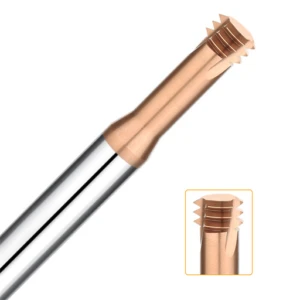
Key Selection Guide: How to Precisely Configure HRC70-Grade Thread Mills for Extreme Hardness (HRC60–HRC70)?
When workpiece hardness crosses HRC60 and approaches HRC70, conventional machining logic fails. The material’s high yield strength prevents heat from escaping through chips, subjecting the tool tip to extreme thermal stress and mechanical shock. Workshop supervisors must realize that tool selection cannot be based on price alone; you must evaluate material composition and micro-geometry. Only by configuring a specialized hrc70 thread mill to address hot hardness and chipping resistance can you reliably cut threads into ultra-hard metals.
Configuring tools of this caliber is a balancing art perfected through countless destructive laboratory cutting tests. No single parameter offers a universal solution for ultra-hard alloys, requiring a fine-tuned combination of substrate, coating, and edge preparation. Below, we deconstruct our manufacturing and tuning logic for these high-end, non-standard tools. Our goal is to help you find the optimal configuration for your workshop when machining high-hardness mold steels or carburized parts.
Substrate Microstructure: Why We Insist on Ultra-Fine-Grain (<0.4μm) Tungsten Carbide Substrates for Machining Hard Metals
Peers often ask why standard carbide tools shatter instantly upon contact with ultra-hard materials. The answer lies in the substrate grain size; conventional tools have larger inter-granular gaps that allow cracks to propagate rapidly under intense, high-frequency vibrations. This leads to catastrophic brittle fracture during demanding operations. Therefore, when manufacturing solid carbide thread mills for hard metals, we insist on ultra-fine or nano-grade substrates with grain sizes under 0.4 microns, delivering hardness exceeding HRA 93.
However, prioritizing hardness alone compromises toughness, which is a critical trade-off we balance during R&D. We fine-tune the cobalt binder content to ensure sufficient impact resistance against the shocks of interrupted cutting while maintaining high wear resistance. At high spindle speeds, this dense microstructural substrate acts as a robust barrier that inhibits micro-crack initiation. Selecting such high-quality substrate material provides the physical foundation for successful ultra-hard thread milling operations.
The Deciding Factor—Coatings: Analyzing the High-Temperature and Oxidation Resistance of Nano-TiAlN vs. AlCrN in Hard-Material Machining
During dry cutting or MQL operations on materials exceeding HRC60, cutting zone temperatures can easily surpass 1,000°C, causing uncoated substrates to suffer thermal failure. We frequently troubleshoot overseas cases where improper coating selection caused tools to burn out within seconds. In practice, we primarily choose between Nano-TiAlN and AlCrN coatings. The aluminum-rich oxide layer formed by Nano-TiAlN at high temperatures provides excellent hot hardness, making it ideal for high-speed hard milling of hardened mold steels.
In contrast, AlCrN coatings offer a lower coefficient of friction and superior oxidation resistance up to 1,100°C. When machining sticky, ultra-hard metals, we recommend AlCrN because it minimizes friction and chip adhesion on the tool surface. Coating choice is never absolute; it must match your machine tool’s spindle speed and cooling conditions. A competent thread mill supplier won’t just push the most expensive option, but will help you identify the balance that prevents thermal damage.
Micro-level Edge Honing: Balancing Sharpness and Rigidity in HRC70 Thread Mills
Many engineers transitioning to hard milling fixate on sharpness, assuming a keener edge ensures easier penetration. However, at HRC65, an overly sharp micro-edge is as fragile as thin ice under impact, leading to micro-chipping that triggers total tool failure. To resolve this, we subject every tooth of our hrc70 thread mill lineup to rigorous passivation and polishing before they leave the factory. This process is known in the industry as edge honing.
The challenge lies in controlling the edge radius at the micron level; excessive honing makes the tool too dull, spiking cutting resistance and causing tool deflection in small, deep holes. Conversely, insufficient honing fails to protect the edge. Drawing on 16 years of data, we fine-tune the micro-edge radius from a few microns to just over ten microns for specific hard-metal conditions. This modifies the micro-geometry to strike a delicate balance between sharp entry and rigid chip resistance.
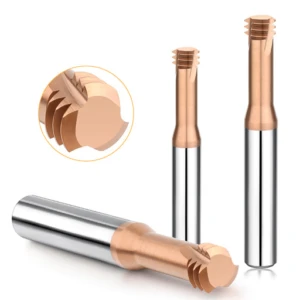
Tackling Metric Thread Milling in Hard Materials: Programming Strategies to Avoid Pitfalls and Practical Parameters
In everyday threading, machining low-to-medium hardness materials is straightforward—you simply input standard parameter charts. However, when venturing into hard metals exceeding HRC60, relying on textbook parameters leads to failure. Having assisted engineers with countless custom component projects, we know that low plastic deformability leaves zero margin for error. Success requires an exceptionally rigid metric thread mill and a programming logic tailored to hard-material cutting physics; otherwise, minute spindle vibrations cause instant tool failure.
Success in hard-material thread milling depends equally on tool quality and the programmer’s mastery of process details. When milling threads into a hard substrate, the design of every entry move and helical interpolation path must be meticulously precise. Instead of discussing abstract theories, we will share practical insights covering chip evacuation control, radial depth of cut allocation, and toolpath optimization. We hope these field-tested strategies help your workshop avoid costly programming pitfalls.
Preventing Tool Deflection: Real-World Data on Multi-Pass Radial Strategies for Metric Thread Mills
Tool deflection is the most common reason for failing thread gauge inspections (Go/No-Go tests) in high-hardness workpieces. Due to the immense resistance encountered with ultra-hard materials, a single-pass strategy causes long-reach metric thread mill tools to flex under radial forces. This results in tapered or ruined threads. While debugging an M10×1.5 deep-hole threading operation on hardened steel for a British manufacturer, we found that their single full-depth pass caused out-of-tolerance dimensions.
To eliminate tool deflection caused by insufficient overhang rigidity, we decisively switched the machining strategy to a multi-pass approach. For materials around HRC62, we recommend splitting the total cutting load into three or four radial passes: roughing at 60%, semi-finishing at 25%, finishing at 15%, and a final zero-infeed spring pass. This progressive radial pass strategy ensures the tool encounters minimal cutting resistance during the finishing stage, guaranteeing consistent thread profile tolerances from entrance to bottom.
Climb Milling or Conventional Milling? Correcting Helical Interpolation Programming Errors for European and American Clients
During technical support visits, we frequently observe experienced CNC programmers falling into cutting direction pitfalls when threading hardened metals. Many habitually apply soft-material strategies, opting to exit the hole by milling upwards from the bottom using conventional milling. However, in hard-material machining, conventional milling causes the cutting edge to undergo intense compression and friction upon engagement. This accelerates mechanical tool wear and generates excessive heat, which is why we insist on climb milling.
The advantage of climb milling is that chip thickness transitions from thick to thin, allowing the edge to engage cleanly while cutting forces gradually decrease. When programming climb milling for helical interpolation, we typically recommend a top-down feed path. This approach aligns with the mechanical characteristics of high-quality thread mills for hard metals during dry cutting. It also utilizes gravity to facilitate the smooth downward discharge of tiny chips, preventing dangerous recutting.
The Blind Hole Chip Evacuation Nightmare: Choosing Between Air Blow and MQL for Hard Metal Machining
When threading hard metals, blind holes are dubbed “tool killers” due to severely constrained space for chip evacuation and heat dissipation. We frequently observe workshops running high-pressure emulsion pumps at maximum capacity, attempting to flush the cutting zone with fluid. However, in ultra-hard material machining, this traditional wet cooling method is counterproductive. Intermittent cutting causes the tool tip to cycle rapidly between extreme heat and cold, creating massive thermal stress that leads to catastrophic edge chipping.
Comparative analyses at client sites indicate that dry air blowing or MQL is the more reliable choice for high-hardness blind holes. A powerful air stream utilizes high-velocity airflow to forcibly eject fine chips from the helical flutes, preventing chip accumulation and recutting risks. If concerns arise regarding thread surface finish during dry cutting, MQL incorporating a vegetable oil mist can be introduced. As a professional thread mill cutter supplier, we always advise balancing lubrication and thermal shock resistance based on your specific hole depth.
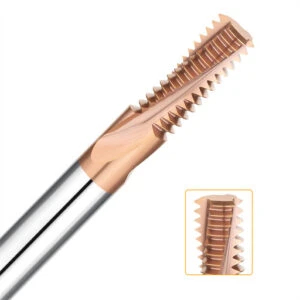
Supply Chain and Cost Reduction: How to Select a Thread Mill Cutter Supplier Capable of Providing In-Depth Technical Support?
In Western industrial manufacturing, procurement costs cannot be judged solely by a tool’s unit price. True cost efficiency must factor in your workshop’s total downtime and scrap rates. When threading ultra-hard materials, partnering with a vendor that lacks in-depth technical support turns your production into a bottomless trial-and-error money pit. Finding a specialized thread mill cutter supplier who truly understands machining and processes is the hidden key to achieving major efficiency gains.
A qualified tooling partner provides massive value through technical services before and after the sale, not just timely deliveries. When your workshop receives a non-standard workpiece hardened up to HRC65, the supplier’s engineers should immediately provide customized cutting speeds and feed paths based on your machine tool rigidity and spindle interface. Evaluating a vendor’s actual R&D strength and responsiveness allows you to select a capable partner who can mitigate critical technical risks.
Say No to “Message Relayers”: Why High-Hardness Threading Requires Direct Access to a Quality Thread Mill Cutter Supplier with Prototyping Capabilities
Relying on intermediaries or trading distributors during an emergency frequently causes communication disasters. When a CNC engineer encounters edge chipping while threading hard metal, a distributor acting merely as a message relayer offers superficial advice that fails to address complex mechanical realities. To solve issues involving extreme hardness, you must deal directly with a thread mill cutter supplier that possesses both in-house manufacturing and rapid prototyping capabilities.
Direct access allows R&D engineers to analyze micro-wear photos and instantly determine if a failure stems from fatigue fracture or thermal overload. More importantly, an actual manufacturer can rapidly adjust non-standard edge parameters, produce prototypes within days, and deliver them to your workshop for on-site validation. In high-hardness machining, seamless collaboration with a dedicated engineering team eliminates the costs of repeated trial-and-error, delivering true cost reduction.
Evaluating Custom Cutting Tools—Does the Supplier Have the R&D Capability for Special Tolerances and Deep-Hole Applications?
When supplying custom tools to sectors like medical device manufacturing, vendors must prioritize R&D expertise regarding extreme length-to-diameter ratios. Deep-hole threading in hard metals is a recognized challenge; when hole depth exceeds 2.5 times the thread diameter, vibration and tool deflection increase exponentially. This operating reality necessitates a specialized, reinforced core diameter in solid carbide thread mills to withstand the extreme radial forces.
Advanced tool geometry design goes far beyond simply altering the cutting diameter or overall length on a blueprint. Engineers utilize Finite Element Analysis (FEA) to simulate stress distribution during hard-substrate cutting and recalculate chip-pocket volume and helix angles. Reviewing a potential partner’s history of past custom projects involving deep holes or special thread profiles will verify if they have the deep R&D expertise required to support your shop floor.

Real-World Case Studies: Solving Hard Metal Machining Challenges for European and American Clients
Perfect laboratory cutting data pales in comparison to the persuasive power of chips flying in real-time on a client’s shop floor. Machining ultra-hard metals is not a theoretical exercise; every adjustment to cutting-edge micro-geometry determines the fate of high-value workpieces. Real-world production is essentially a balancing act between efficiency, tool life, and precision. We share these authentic, line-documented case studies to help industry peers reflect on their own machine rigidity, workholding conditions, and programming habits.
As a team providing technical support to high-end global manufacturers, we have handled projects ranging from automotive panel molds to medical implants. In these demanding environments, we act not merely as tool suppliers, but as process diagnosticians. If you are encountering similar bottlenecks in your thread machining operations, evaluating the two representative examples below may offer practical solutions to your current manufacturing difficulties.
Case Study 1: How a German Mold Maker Reduced Thread Scrap Rates to Zero Using Our HRC70 Thread Mill
A high-end mold manufacturing plant in Stuttgart, Germany, was tasked with machining precision slides made from through-hardened D2 steel at HRC64. The primary challenge lay in machining several deep blind-hole threads within the expensive workpiece. Their process engineers initially attempted to use carbide taps from a leading European brand; however, the taps frequently snapped under torque overload, causing the scrap rate to spike as high as 15% and saddling the workshop with massive sunk costs.
Upon receiving their request for technical assistance, we analyzed the fracture surfaces and recommended discontinuing tapping in favor of our hrc70 thread mill lineup. We optimized the helical interpolation feed path into a four-pass radial step-down strategy and implemented high-pressure dry air blasting for chip evacuation. This interrupted cutting action drastically reduced heat accumulation at the tool tip while the passivated cutting edge successfully withstood the impact forces, reducing their scrap rate to zero.
Case Study 2: Stable Mass Production Solution for High-Precision Metric Thread Mills (US Medical Device Client)
A precision medical component manufacturer based in California faced the challenge of mass-producing high-precision threads on precipitation-hardened stainless steel parts at HRC62. Given the medical industry’s stringent requirements for 6H thread gauge precision and surface roughness, the client encountered severe tool deflection during trial production. The resulting threads exhibited localized taper and slight pitch deviations, rendering them unable to pass automated optical inspection systems.
To ensure consistent precision during mass production, we custom-designed a rigid metric thread mill featuring a short flute length and a robust core diameter. Shortening the flute maximized the tool’s bending rigidity, while our AlCrN nano-coating mitigated the severe material stickiness encountered when machining hardened stainless steel. We also guided their programmers to incorporate a zero-infeed spring pass to eliminate residual elastic deflection, perfectly meeting the high-precision 6H requirements across thousands of parts.