
When machining hardened steel or mold steel at 40+ HRC, we frequently hear the same complaint from the shop floor: “Why do these T-slot cutters keep snapping inside the part without any warning?”
Last month, a long-standing North American client reached out about a production run of 42 HRC alloy steel parts. They expected each carbide T-slot milling cutter to last 20 cycles. Instead, the tools were chipping or snapping by the fifth cycle, scrapping expensive workpieces in the process. Our team analyzed the data and the failed tools overnight. The root cause wasn’t the tool quality—it was a “perfect storm” of immense cutting forces and the choked chip evacuation space inherent to T-slots.
In our 15 years of manufacturing and technical support, we’ve seen this repeatedly. Working with 40+ HRC steel using standard strategies is a gamble you’ll likely lose. If you apply low-carbon steel habits—or prioritize speed while neglecting radial run-out—high costs are inevitable.
As a China T-slot mill cutter manufacturer with deep roots in the industry, we know that consistency at high hardness requires more than just a “good tool.” It’s a systems engineering challenge. It involves balancing tool rigidity, coating stability, and precise parameter tuning.
Are you truly confident that your current chip evacuation and parameters have found that “sweet spot,” or are you just waiting for the next tool to snap?

The Core Pain Point: Why Standard Carbide T-Slot Milling Cutters Fail in 40+ HRC Steel
We’ve observed a consistent trend: tools that perform beautifully in 45# steel often fail miserably the moment the material hits 40+ HRC. This isn’t a coincidence. At this hardness, cutting forces don’t just rise—they skyrocket, accompanied by severe work hardening. We often see standard tools suffer severe plastic deformation after cutting only 100mm. This is a fundamental mismatch between tool geometry and material resistance.
From our experience, “sudden failure” is usually a misunderstanding of cutting physics. At high hardness, the tool tip faces massive radial compression and alternating loads. If your carbide T-slot milling cutter lacks proper edge preparation or has a substrate with too much cobalt (lowered red-hardness), chipping is inevitable. When a tool snaps inside a deep slot, you aren’t just losing a cutter—you’re likely losing the entire workpiece.
The Rigidity Balancing Act: Finding the “Sweet Spot” Between Neck Diameter and Cutting Depth
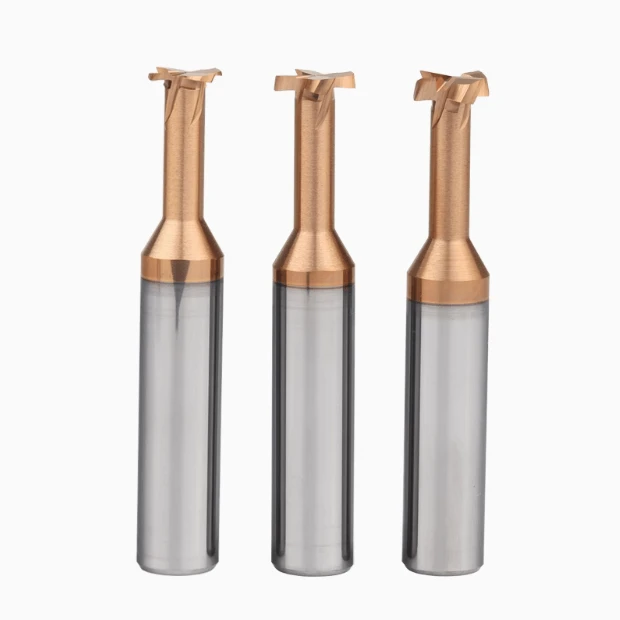
When we help clients customize tool dimensions, the conversation always centers on neck rigidity. T-slot milling cutters have a natural weak point: the neck. In 40+ HRC steel, resistance forces are transmitted from the head to the neck, creating a massive cantilever bending moment. If you chase deep cuts but ignore the neck diameter, you’ll get high-frequency micro-vibrations—chatter that kills the surface finish and the tool.
We often advise clients to make a trade-off: prioritize rigidity over “one-pass” efficiency. Even if it requires more passes, optimizing your T-slot milling cutter sizes is the safer bet. While a thicker neck reduces clearance, it adds vital strength. We aim to keep radial run-out at the neck within 0.01mm. This control is far more effective for tool life than simply cranking up the feed rate.
Thermal Fatigue and Chipping: How Carbide Substrates React to Hardened Steel
In high-hardness alloy steels, many chipping failures are actually caused by thermal fatigue. During interrupted cuts, the edge hits extreme heat upon entry and is “quenched” by coolant upon exit. This rapid thermal cycling creates microscopic cracks in the carbide. For any T-slot milling cutter for steel, these micro-cracks spread quickly under mechanical stress, leading to visible chipping.
We recommend extreme caution with cooling at 40+ HRC. If you cannot provide a stable, high-pressure internal cooling system, “dry cutting” with high-pressure air is often better. It prevents the “thermal shock” caused by inconsistent flood cooling. When selecting tools, we favor sub-micron grain carbides that offer the best balance between hardness and thermal fatigue resistance.
Chip Retention: The #1 Killer in Deep T-Slot Milling
Frankly, over 50% of the breakages we see are caused by “secondary cutting.” Because T-slots are semi-enclosed—narrow at the top, wide at the bottom—chips can’t escape easily. In hardened steel, chips are brittle fragments or rigid spirals. If these stay in the slot and get re-cut by the rotating tool, the instantaneous load can exceed the tool’s strength by several hundred percent.
As a China T-slot mill cutter manufacturer, we optimize helix angles and flute finishes to help chips slide out. But the operator must provide the “push.” Whether you use high-pressure coolant or air, chips must leave the zone the instant they are born. If your strategy has “dead zones,” even the most expensive tool will eventually snap.
Have you ever found yourself caught between needing more chip clearance and needing more tool rigidity? It’s a tough spot, but getting it right is the difference between a profitable run and a scrapped part.

Practical Parameter Optimization: Dialing In Strategies for 40+ HRC Steel
When you’re dialing in a job for materials over 40 HRC, stability is more important than raw speed. Hardened steels are incredibly sensitive to cutting force fluctuations. Even minor vibrations are amplified, hitting the tool’s weakest points. We always tell our technicians to watch the spindle load meter during the first part. If you see fluctuations over 15%, your cutting resistance has likely pushed the system out of equilibrium. You need to stop and re-evaluate your setup’s rigidity immediately.
Through years of optimizing carbide T-slot milling cutters, we’ve learned that “precise entry” is everything. This isn’t just about the machine’s servo response; it’s about understanding how the material handles heat. We don’t recommend blindly following catalog values. Instead, run stepped tests—adjusting in 5% to 10% increments—based on your specific workholding and tool holder clamping force. Keep tweaking until you find that “sweet spot” where you get a clean finish without a massive heat buildup.
The Pitfalls of Feed Rate: Why “Slow” Isn’t Always Safe
Many machinists instinctively lower the feed rate when they hit hard material, thinking it’s the “safe” move. In our experience with 40+ HRC steel, an excessively low feed per tooth is actually a leading cause of chipping. When you feed too slowly, the edge stops “cutting” and starts “rubbing” and “extruding” the material. This friction generates localized heat far beyond normal levels, inducing a work-hardened layer. Your next tooth then hits that even harder surface, causing immediate damage.
When deciding on T-slot milling cutter sizes, ensure your chip thickness is always greater than the cutting edge’s hone radius. If your feed per tooth drops below 0.0008″ (0.02 mm), the tool will likely “slip” or “skate” across the work. We prefer a steady, moderate feed. Use your chips as a diagnostic tool: if they show a healthy pale purple hue and uniform thickness, the heat is leaving with the chip—not soaking into your tool substrate.
Surface Speed (SFM) and Thermal Control: Saving Your Coating
Machining 40+ HRC steel is a battle against heat. We’ve seen expensive coatings delaminate in minutes because the Surface Feet Per Minute (SFM) was too high, pushing the temperature past the coating’s oxidation threshold. For any T-slot milling cutter for steel, we advocate for a “low RPM, steady feed” strategy. This protects advanced AlTiN or silicon-based coatings from thermal failure.
If you see sparks while dry-cutting, your SFM is too high. As engineers, we’d rather sacrifice a bit of cycle time—reducing speed by 15% to keep the coating intact—than deal with a total burnout. Remember: once that coating fails, your carbide substrate is as vulnerable as butter against 40 HRC steel.
Step Machining: Why Pre-Slotting is Non-Negotiable
We never recommend a “one-tool-fits-all” approach for deep T-slots in hard steel. Attempting a full-depth cut with a T-slot cutter is hazardous because it can’t evacuate chips as efficiently as a standard end mill. As a China T-slot mill cutter manufacturer, we advise starting with a high-efficiency end mill to “pre-slot” the path. This creates a machining allowance and a much better environment for the T-slot cutter.
This staged approach creates an “open” space for heat to escape. By pre-cutting, your air blast or coolant can actually reach the cutting zone. We usually leave a unilateral allowance of 0.008″ to 0.020″ (0.2 to 0.5 mm). This drastically reduces the radial load on your spindle and lets you focus on surface finish during the final pass without worrying about chip compaction.
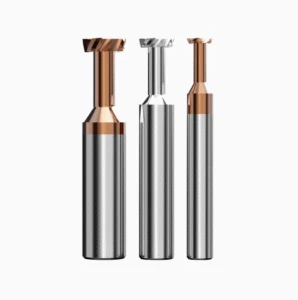
Selection Guide: Choosing the Right T-Slot Milling Cutter Size
When we look at a blueprint for hardened steel, we don’t just look at the slot width; we look at the ratio of slot depth to neck clearance. In the real world of 40+ HRC machining, your selection must account for material springback and tool deflection. Our cardinal rule is: Choose the largest possible neck diameter allowed by the part geometry. In high-hardness jobs, rigidity beats nominal size matching every time.
Check your spindle’s dynamic runout before finalizing your T-slot milling cutter sizes. If your spindle has some wear, choosing a tool at the upper limit of the tolerance is risky. We advise back-calculating your tool tolerances based on the workpiece requirements. This ensures that even under maximum cutting force, tool deflection won’t leave “step marks” on the sidewalls or leave the corners unfinished.
Avoiding Tolerance Traps: Matching Tools to Actual Slot Widths
A common mistake is buying a tool with a nominal width that exactly matches the print. If you try to cut a 10.0mm H7 slot with a 10.0mm tool in 45 HRC steel, vibration and thermal expansion will make it impossible to hold size. We recommend choosing an undersized cutter—usually by 0.008″ to 0.020″ (0.2 to 0.5 mm)—and using a “zig-zag” or reciprocating path. This is the only professional way to guarantee high-precision lateral tolerances.
This undersized approach also solves the chip evacuation problem. Even an extra 0.1mm of clearance helps the coolant flush out those hard, abrasive chips. We’d much rather spend a few extra minutes on a zig-zag toolpath than explain to a client why an entire batch of parts is out of spec due to tool wear or heat expansion.
Overhang Management: Shortening the Neck for Better Finishes
Overhang is the “root of all evil” in milling, especially with hard materials. We tell our field engineers: for every extra millimeter of length, tool tip deflection increases exponentially. In hard steel, this shows up as “chatter” or “tool biting.” If your slot is deep, don’t just grab a long-shank tool. Look for a carbide T-slot milling cutter with a optimized stepped neck to keep the effective length as short as possible.
The fastest way we solve chatter for our clients is by switching to a shorter neck. If the part allows it, a tapered neck design is even better—it boosts torsional rigidity at the root without losing depth. You can’t “sand out” chatter marks in 50 HRC steel. Shortening the overhang to increase damping is the only reliable way to get an impeccable finish.
Custom Coatings: Specialized Formulas from a Leading China T-Slot Mill Cutter Manufacturer
At 50+ HRC, standard coatings often flake off because they can’t handle the thermal expansion mismatch. As a dedicated China T-slot mill cutter manufacturer, we’ve developed a high-silicon coating for these extremes. Under heat, it forms a protective silicon dioxide layer. This acts as a thermal shield for the carbide and provides an incredibly low-friction surface for chips to slide across the rake face.
In field trials on 52 HRC mold steel, this coating extended life by 40% over standard TiAlN. It’s not just about the color of the tool—it’s about the oxidation temperature and bonding strength. When you’re shopping for tools, ask your supplier about these specs. In this arena, the coating is your first and last line of defense.
When you hit a deep groove that demands a long overhang, do you gamble on your parameters, or do you call for a custom-engineered tool designed for the job?
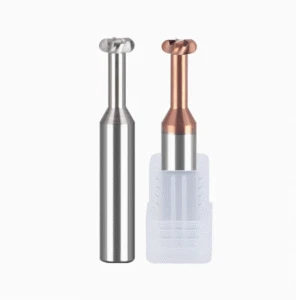
3 “Trade Secrets” (Pro Tips) Gleaned from Years of Technical Support
After years of supporting high-end machine shops in Europe and North America, we’ve found that bottlenecks rarely stem from a lack of machine horsepower. Instead, they come from overlooked “soft details.” When machining materials over 40 HRC, standard protocols might get the job done, but they won’t give you the “lights-out” unattended operation you need for high yields. These tips aren’t in any manual; they were forged through thousands of dollars in broken tools and scrapped parts.
Machining high-hardness steel is a psychological battle. You have to anticipate how stress distributes deep inside a slot and move to mitigate risks before the tool snaps. By mastering fluid dynamics, clamping physics, and spindle load signals, you can achieve a quantum leap in the life of your carbide T-slot milling cutters. Stop listening nervously to the machine and start trustings your process.
Cooling Strategies: Air, Internal Coolant, or MQL for High-Hardness Slots?
When cutting steel over 40 HRC, your cooling choice is a matter of life and death for the tool edge. We once solved a case with 48 HRC mold steel where the client used a high-flow external spray. The tools kept failing due to thermal cracking. Our fix? Switch to high-pressure internal coolant (at least 70 Bar) or turn off the liquid entirely and use high-pressure air.
The reason is simple: inconsistent cooling causes “thermal shock.” The edge swings from hundreds of degrees to room temperature in milliseconds, creating micro-cracks in the carbide. If you need a balance of eco-friendly machining and finish quality, we recommend MQL. It provides lubrication to reduce friction without the thermal shock. However, with T-slot milling cutters for steel, you must ensure the mist actually reaches the bottom of the slot. If you don’t have internal channels, a high-pressure “Cold Air Gun” is your absolute minimum requirement.
Hydraulic vs Shrink Fit: Which Holder Suppresses T-Slot Chatter?
Many think the tool is the only thing that matters, but the tool holder is the “soul” of the system. At 40+ HRC, resonance is your primary enemy. Hydraulic Chucks use internal fluid to provide natural damping, which absorbs high-frequency vibrations. On the other hand, Shrink Fit holders offer incredible accuracy and grip, but they are so rigid they can transmit micro-vibrations back into the spindle, leading to that high-pitched “scream” in thin-walled slots.
We generally recommend a split strategy: use Shrink Fit for heavy roughing where grip strength is king. But for finishing—where you need to kill those last few microns of chatter—Hydraulic holders provide a much better, mirror-like finish. Your choice of T-slot milling cutter sizes shouldn’t be made in a vacuum; you have to consider the holder’s damping and clearance. In hard milling, “toughness” in the system often prevents chipping better than “hardness” alone.
Wear Monitoring: Using Spindle Load as a “Sixth Sense”
Relying on a visual check to see if a tool is worn is often too late in 40+ HRC steel. We use a “Load Variation Early Warning” method. If your spindle current or feed load rises to 110% or 115% of the baseline, your tool has likely hit 0.1mm of flank wear. As a China T-slot mill cutter manufacturer, we know that once you cross this line, friction causes cutting forces to skyrocket. Your tool could snap within seconds.
Use the “Load Monitor” function on your CNC. By setting a hard stop limit, you can force a tool change before catastrophic failure. It might feel like you’re “wasting” a bit of tool life, but you’re saving a 5-figure workpiece and your spindle bearings. Learning to “read” the load curve is a sixth sense that every master machinist should have.
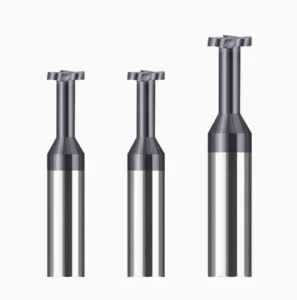
Why Global Machine Shops are Partnering with Specialized Chinese Manufacturers
In the last decade, we’ve seen a massive shift in how the West views “Made in China.” Leading shops no longer come to us just to save on the scrap rate; they come for our innovation in ultra-hard machining. We don’t just take orders; we integrate into our clients’ process chains. Whether it’s optimizing the substrate micro-geometry or fine-tuning nano-composite coatings, we provide a complete package.
The trust comes from the results. When a shop in the US or Europe hits a wall with high-strength alloy steel, they don’t need a glossy brochure. They need a partner who understands “thermal stress cracks.” By constantly refining our production, we’ve brought our carbide T-slot milling cutters to a world-class performance level that rivals any German or Japanese brand.
OEM to Customization: Getting Non-Standard Sizes in Days, Not Months
Standard tools often fail to meet the needs of aerospace or high-precision mold parts. We once had a client who needed a deep, narrow, non-standard slot. No off-the-shelf T-slot milling cutter sizes could do it without severe deflection. If you’re being forced to change your part design because you can’t find a tool with the right neck clearance, it’s time to look at custom options.
By optimizing our grinding and inventory, we’ve cut lead times for custom specs from 8 weeks down to under 15 days. For a modern shop, that speed is the difference between winning a contract and losing it. Instead of “making do” with a standard tool that isn’t quite right, get a tool designed for your specific setup.
Breaking the Stigma: Domestic Substitution for 40–55 HRC Tasks
Some still worry that “cheaper” means “unstable.” But in the 40–55 HRC range, we’ve already proven the technical parity of our tools. If you are mass-producing hardened components and the cost of imported tools is killing your margins, compare our carbide T-slot milling cutters to your current brand. We don’t advocate for “cheap”—we advocate for “optimized.”
In field tests, our tools rival the best from Germany and Japan in chip resistance and hot hardness. Review your tool spend: If you could cut your procurement costs by 30% without slowing down your cycle times, how much more competitive would your shop be? This isn’t just about price; it’s about material science.
Engineer-to-Engineer: Efficient International Procurement
The biggest hurdle in international business isn’t the ocean; it’s the “technical translation.” If you’re tired of explaining “feed per tooth” to a salesperson who doesn’t know a lathe from a mill, you’ll value our approach. Most of our team members are veterans with over 10 years on the floor. We speak the language of 3D drawings and parameter charts.
This peer-to-peer dialogue means we spot risks in minutes. If we see a chip evacuation issue in your 45 HRC part drawing, we’ll tell you before you even place the order. That’s how you shorten a procurement cycle.
As you tackle your next high-hardness project, don’t struggle alone on the shop floor. Send us your drawings or your toughest material specs. Let’s sit down and engineer a better way to cut.