
Just last week, we resolved an urgent request from a long-standing client in Boston. While machining a batch of 7075-T6 aerospace components, he tried to meet a tight deadline by applying the same feed parameters he used for 6061. The result? In less than two hours, his expensive 3 flute milling cutter aluminum suffered a catastrophic blowout. Poor chip evacuation caused the tool to pack with aluminum, snapping the cutter and scrapping two high-value workpieces.
We have witnessed this “tool crash” scenario far too many times over the past 16 years. Many shop owners fall into a common trap: assuming all aluminum alloys behave the same. However, from our perspective as an aluminum milling cutter supplier that develops tools in-house, the “gummy” nature of 6061 and the “high-strength” profile of 7075 are entirely different beasts.
For materials like 6061, which are prone to BUE, a conservative feed rate is your enemy. If your “Feed per Tooth” is too light, the cutting edge “rubs” instead of “shearing.” The friction generates instant heat, causing chips to weld themselves to the flutes. Conversely, 7075 acts more like steel—producing crisp, fractured chips—but it demands much higher impact toughness. In these cases, the geometry of your aluminum roughing milling cutter is the deciding factor between a successful run and a broken tool.
Our goal isn’t to recite textbook formulas. We want to share real-world data from our labs and the aluminum end mill cutter strategies we’ve proven in workshops across North America. Be honest: is your operator still secretly dialing down the Feed Override by 20% just to “play it safe”?
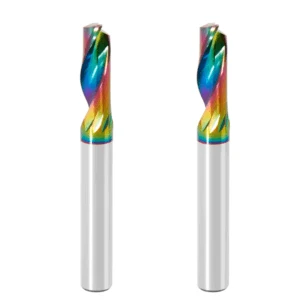
Why the “Stickiness” of 6061 and the “Brittleness” of 7075 Dictate Your Aluminum Milling Cutter Selection Logic
In our shop, we often say, “6061 is like modeling clay, while 7075 is like a piece of hard candy.” This reveals a fundamental difference in material mechanics. 6061 aluminum has high ductility. During high-speed machining, localized heat makes the alloy semi-plastic, causing it to adhere aggressively to the cutting edge. In contrast, 7075—due to its high zinc content—is significantly harder and requires greater cutting forces, yet it produces cleaner, brittle chips. This changes the entire design requirement for your aluminum milling cutter.
When we customize solutions for our B2B clients, the logic is simple: are you “clearing a gummy mess” or “shearing a hard alloy”? For 6061, we prioritize high-polish flutes and clearance to prevent material from “springing back” and squeezing the tool. For 7075, we prioritize edge strength and rigidity. If you use a high-rigidity tool meant for 7075 on a 6061 job, the wide land width will cause friction, heat, and eventual tool failure.
16 Years of Experience Summarized: Identifying the Root Causes of Aluminum End Mill Failure Through Material Physics
Over 16 years, we have analyzed thousands of failed tools. The primary “death” of an aluminum end mill cutter is either chip packing or mechanical fatigue. For 6061-T6, failure usually starts with microscopic adhesion on the secondary edge. Chips build up in the flute until the channel is blocked, causing the tool to snap instantly from the torque surge. This is a chemical affinity issue—the material’s “stickiness” overwhelms the tool’s physical coating.
For aerospace alloys like 7075, the failure mode is different: micro-chipping. Because 7075 has higher shear stress, the tool tip faces intense alternating loads during side milling or slotting. If you ignore fatigue and only focus on high RPMs, the edge will show “fatigue spalling” under a microscope. The material’s yield strength and thermal conductivity are the true factors determining if your tool lasts a full shift or only three hours.
Addressing the Critical Issue of BUE in 6061 Aluminum—How to Adjust Feed Rates
When running 6061, the most dangerous mistake is “skimming”—an overly conservative feed. Operators often reduce the feed per tooth to “protect” a slender tool, but this actually accelerates BUE. Our lab data shows that you should actually increase the feed per tooth (fz) to force the chips to carry the heat away. When the feed rate exceeds the material’s plastic deformation threshold, chips detach cleanly. This is where a 3 flute milling cutter aluminum shines, providing the perfect balance of chip space and tool strength.
We advise clients to aim for chips that are “silvery-white and tightly curled,” not yellow or blackened. If you see fish-scale burrs on the part, you are rubbing the material, not cutting it. In these cases, we often tell our clients to boldly increase the feed override by 10%. You’ll find that the “heavier” cut actually keeps the tool cooler and the flutes cleaner.
Key Variables for Enhancing Surface Finish with Aluminum Milling Cutters When Machining High-Hardness 7075 Aluminum
With 7075, we achieve mirror finishes by controlling the radial depth of cut (Ae) and optimizing step-over. 7075 offers exceptional material consistency, allowing for precise control over tool runout. At the finishing stage, the hurdle isn’t stickiness—it’s micro-vibration. By using an aluminum end mill cutter with a variable helix design, the tool can glide across the surface like a razor, eliminating the harmonic chatter that ruins a finish.
We often tell clients that a 7075 finish is “ground” into existence via stable, high-speed cutting. Because 7075 is brittle, chips fracture the instant they are formed, avoiding the “stringy” mess of 6061. If your spindle is balanced and your tool has the right relief angles, you can often skip the polishing bench entirely. Just remember: feed uniformity is king. Any hesitation during a corner or a lead-out will leave a visible tool mark on your finished 7075 part.

Practical Demonstration: Parameter Differences for High-Efficiency Milling Using 3-Flute Aluminum Cutters
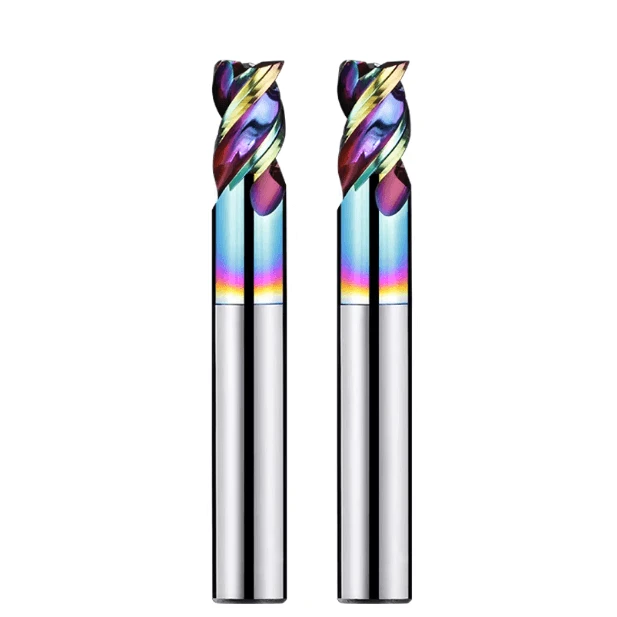
In high-efficiency aluminum machining, the three-flute design is the industry standard for what we call the “golden balance.” Peers often ask us: “Why not use a two-flute for more chip space, or a four-flute for more rigidity?” In our experience, two-flute tools often suffer from dynamic imbalance at high MRR. Conversely, four-flute tools—with their narrower flutes—clog almost instantly when dealing with the long, continuous chips typical of aluminum.
When we run comparative tests for our B2B clients, the efficiency gap is clear. At the same spindle speed, the third cutting edge allows you to increase your table feed by nearly 50% without increasing the chip load (fz). In a high-volume shop, that’s the difference between hitting a deadline and falling behind. However, maximizing this requires a deep understanding of how a 3 flute milling cutter aluminum uses centrifugal force to eject chips during high-speed machining (HSM).
Why We Prioritize 3-Flute Aluminum Cutters with Large Chip Evacuation Spaces for 6061 Roughing
When roughing 6061, we prioritize “throughput” over precision. This material produces long, tough, “noodle-like” chips. If your flutes aren’t deep enough, those chips undergo secondary compression, packing into the tool until it snaps. When we design our aluminum milling cutter lineup, we deliberately increase the relief angle behind the main edge. This gives the chips room to curl and be flushed out by the coolant before they can cause trouble.
We often see “dead” tools sent back to us completely jammed with compacted aluminum. This is almost always the result of using narrow-flute tools for aggressive cuts. We recommend a high-clearance design because it lets you push the radial depth of cut (Ae) much harder. You might sacrifice a tiny bit of absolute edge strength, but in gummy materials like 6061, chip evacuation is your only real insurance policy for tool survival.
Machining 7075 Structural Components—How a 3-Flute Design Maintains Dynamic Balance at High Spindle Speeds
Once you push past 18,000 RPM on a 7075-T6 aerospace bracket, even a milligram of mass imbalance becomes a major problem. Two-flute tools, due to their center-symmetrical geometry, often trigger periodic chatter. We’ve found that the three-flute geometry creates a more stable “support plane” that dampens harmonic resonance. This is a game-changer when milling deep cavity sidewalls, as the 3 flute milling cutter aluminum provides the lateral rigidity needed to prevent tool runout from ruining your surface finish.
Stability is the secret to 7075. With three edges engaging the material sequentially, you get much lower fluctuations in cutting force compared to a two-flute. You can confidently push your spindle limits without worrying about vibrating your bearings to death. Remember: with high-hardness alloys, a robust frequency response is usually more important than the tool’s actual hardness.
The “Golden Ratio” of Feed Rate to SFM: Real-World Data from Our Lab Tests
We’ve “sacrificed” plenty of tool samples in our lab to find the breaking point of these materials. For 6061, we’ve pushed surface speeds (SFM) beyond 2,500, but only if the feed rate kept pace. If your SFM is high and your feed is slow, you’re just generating friction, which leads to tool sticking. For 7075, we usually back off the SFM to the 1,200–1,800 range but crank up the feed per tooth. This “heavy-cutting” approach shears the material effectively before heat can build up in the tool tip.
These aren’t just “catalog numbers”—this is empirical data. For example, if you don’t have high-pressure through-spindle coolant, we suggest proactively dropping your 6061 feed rate by 15%. If your 7075 cut starts sounding sharp and “screamy,” your SFM is too high. Back off the RPM, keep the feed steady, and you’ll likely gain several hours of tool life.
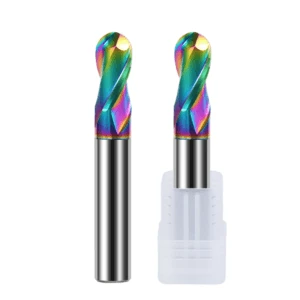
Efficient Chip Evacuation: Performance of Aluminum Roughing Milling Cutters Across Different Aluminum Grades
For roughing, the only metric that matters is the MRR. We see many shops using standard flat-bottom mills for bulk removal, only to struggle with “bird’s nesting” and erratic spindle loads. Our specialized aluminum roughing milling cutter uses a unique edge profile to “divide and conquer,” breaking continuous chips into small fragments. This reduces the contact area between the tool and the chip, which keeps the heat out of your part and in the chip where it belongs.
6061 and 7075 require different roughing philosophies. 6061 needs massive chip gullets to handle plastic deformation, while 7075 needs high-frequency chip-breaking to protect the machine’s rigidity. Choosing the right rougher makes full-slotting feel like a hot knife through butter rather than a struggle against the material.
6061 Aluminum—Feed Control Techniques to Prevent Chip Entanglement During Full-Slotting
When you’re full-slotting (1xD) or plunge milling 6061, a “bird’s nest” of chips around the spindle is your biggest threat. You have to use an aggressive feed per tooth to forcibly interrupt the material’s flow. If you’re too conservative, the chips stretch out like ramen noodles and wrap around everything. We tell our clients: “Increase the feed until the chips become granular.” That is the “sweet spot” where your aluminum roughing milling cutter is actually doing its job.
Also, sync your feed with your coolant. If you boost the feed but your coolant pressure is weak, those broken fragments will sit in the bottom of the slot and get recut. We often program a brief “dwell” or use an intermittent peck-milling strategy to let centrifugal force clear the flutes. When roughing 6061, hesitation is the fastest way to smoke a tool.
7075 Aluminum (Aerospace)—Balancing Axial Depth (Ap) and Feed (Fz)
7075 is a different beast. Because it’s harder, the cutting forces are much higher. If you chase a crazy feed rate (fz), you’ll trigger thermal fatigue and micro-chipping. We prefer a “Deep Ap, Moderate Fz” strategy. By using the full length of the aluminum roughing end mill, you spread the load across the entire flute instead of burying the heat at the tip. This takes advantage of 7075’s natural brittleness to produce clean, crescent-shaped chips.
Watch your load meter. If the curve looks like a jagged sawtooth, your Ap is too deep and you’ve hit resonance. Back off the depth slightly and optimize your SFM to make up the time. With expensive 7075 plate, we prioritize “safe MRR” over “hero parameters.”
Real-World Feedback on Wave-Edge Vibration Suppression
Clients often worry that a wave-edge rougher will leave a terrible finish. But roughing isn’t about the finish—it’s about efficiency. The wave-shaped edge constantly shifts the direction of cutting forces, which physically disrupts harmonic resonance. We recently helped an aerospace client who was struggling with a high-pitched scream while machining large brackets. We swapped their straight-edge tool for our wave-edge aluminum roughing milling cutter, and the noise vanished. Table vibration dropped by over 60%.
These asymmetric designs are a lifesaver for long-reach applications or thin-walled parts where rigidity is low. The “compliant” cut of a wave-edge tool leaves the material in a better state of residual stress for your finishing passes. If you hear that low-frequency hum at 10,000 RPM, don’t just slow down—change your tool geometry. It’s often the only real cure.
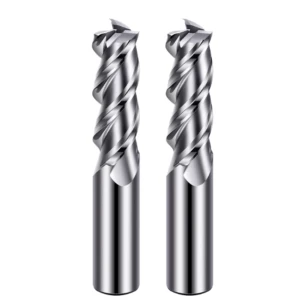
Common Challenges for B2B Clients: Why the Same Tool Performs Differently on Different Machines
In our global technical support experience, we often see a frustrating phenomenon: the exact same batch of tools runs perfectly on Client A’s high-end 5-axis center but suffers from constant edge chipping on Client B’s older 3-axis mill. Most purchasing managers immediately blame tool consistency. However, as manufacturers, we know the real culprit is usually the machine’s dynamic rigidity and spindle resonance.
During HSM, these factors are amplified. For example, backlash in ball screws or worn guide rails can cause the actual path of an aluminum end mill cutter to deviate during high-speed arcs. This creates a momentary spike in “feed per tooth” that is invisible to the eye but clear in the wear patterns on the tool. We always advise clients: before you copy-paste parameters to a different machine, run a basic spindle load test. Don’t assume the machine can handle the same stress just because the code is the same.
Rigidity Strategies for BT40 vs HSK63A Spindles During High-Feed 6061 Machining
When pushing high-feed rates in 6061, your spindle interface is your ceiling. BT40 spindles rely on a tapered fit. At high RPMs, centrifugal force causes the spindle bore to expand slightly. This causes the tool holder to be “sucked” deeper into the spindle—often called “pull-out”—which ruins your axial precision. If you see “witness marks” or chatter on your 6061 parts, check your tool holder clamping first.
In contrast, the HSK63A interface uses dual-face contact, which keeps the tool stable even under thermal expansion. This allows us to push the aluminum milling cutter to its absolute limit. If you’re stuck with a BT40 interface, our advice is to avoid “hero” depths of cut. Instead, use a multi-pass strategy to distribute the radial load. Adapting your strategy to your machine’s limits is much more productive than blaming the age of the equipment.
Solving 7075 Edge Chipping: Our Experience with Feed Override Fine-Tuning
The brittleness of 7075 is a double-edged sword. It breaks chips beautifully, but it’s prone to exit-chipping—those tiny blowouts on the edge of a part that cause an aerospace inspector to scrap the whole lot. We recently worked with a German client who was struggling with this. They tried “sharper” tools, but the chipping remained. Our solution wasn’t a new tool; it was a dynamic change in how they handled the “exit.”
We’ve learned that as an aluminum end mill cutter transitions from a full cut to an air cut, the sudden release of cutting force creates a shockwave. By manually or programmatically using the Feed Override to drop the feed rate by 30% to 50% just as the tool exits the material, you “cushion” the edge. We recommend building this “feed smoothing” into your CAM logic. Maintaining a constant load on the cutting edge is far more important than maintaining a constant speed. That split-second slowdown can save a $5,000 workpiece.
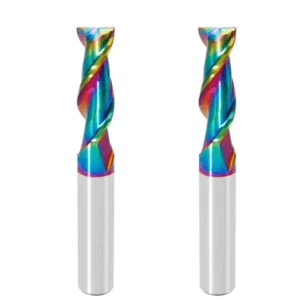
How to Evaluate the Technical Depth of Your Aluminum Milling Cutter Supplier
In B2B procurement, it’s easy to get tunnel vision on unit price. But as a manufacturer with 16 years in the trenches, I believe the true value of an aluminum milling cutter supplier is found at 3:00 AM. When your machine is screaming with high-pitched vibration, can your supplier tell you—right then—if the problem is your RPM, your feed, or your fixture rigidity?
If you’re hitting bottlenecks in 6061 mass production or struggling with 7075 surface finishes, look at your supplier’s track record for “hard cases.” Real support isn’t reading from a catalog; it’s providing actionable advice on your spindle power and coolant pressure. We’ve always said: the tool is just the medium; the engineering solution is our true product.
Can Your Supplier Provide Customized 7075 Parameter Strategies?
7075 does not respond well to “one-size-fits-all” settings. If you’re running high-MRR aerospace jobs with generic data, you’re leaving money on the table. Ask yourself: can your aluminum milling cutter supplier customize a strategy based on your specific thin-walled part or deep-cavity vibration issues?
We dive deep into our clients’ blueprints. If you provide your surface finish requirements and material hardness, we can run simulations to identify resonance points before you ever hit “cycle start.” This customized approach lowers your per-part cost much faster than haggling over a few dollars on the price of a tool. The most expensive tool is the one that forces your line to stop because the parameters were wrong.
Why We Insist on ISO-Standardized Processing Reports
Trust in engineering is built on data. If your parts aren’t dimensionally consistent, check your supplier’s inspection reports. We don’t just check the geometry of our tools; we run actual cutting tests on 6061 and 7075 before the tools leave our facility. We record cutting force curves and tool-tip temperature data so we know exactly how that aluminum milling cutter will behave in your spindle.
This transparent, ISO-standardized data helps you set clear expectations. By comparing wear rates, we can help you predict exactly when a tool will fail. If your yield rates are dropping, this data helps you quickly figure out if the problem is machine thermal drift or natural tool wear.
Supply Chain Responsiveness for High-Volume 6061 Production
In high-volume 6061 shops, tools are the lifeline of the facility. If you’re running multi-shift automation, you need a scientific consumption strategy. A dedicated aluminum milling cutter supplier should use your weekly production volume to help you manage a “safety stock” and offer tool refurbishment programs.
We’ve seen entire lines stop because a shop ran out of a specific $50 tool. If you tell us your expected tool life goals at the start of a project, we can optimize the flute geometry to last longer in 6061, reducing your changeover frequency.
Final Thought: Is your current parameter sheet truly optimized for your 7075 job, or is it just a generic template? If you’re facing complex blueprints or tough materials, let’s have a direct, engineer-to-engineer talk. We’re ready to skip the marketing fluff and help you get that flawless finish your components deserve.