
In the world of graphite machining, there is a common saying: “The money you save on cutting tools today, you will pay back—with interest—in the scrap bin tomorrow.”
This isn’t fear-mongering. It represents the “disasters” we’ve witnessed over the last 16 years on the shop floor. Recently, a long-standing client—a precision automotive mold manufacturer—tried to cut costs. They swapped their reliable garbide diamond end mill cutters for “special-offer” graphite end millls that cost half as much. Less than a week later, their production supervisor called me, sounding utterly defeated.
The problem was classic. On their 30,000 RPM high-speed center, those cheap carbide milling cutters for graphite performed okay for an hour. But during the finishing stage, coating delamination spread like a plague. Dimensions went out of tolerance, edges chipped, and a $200,000 machine spent its time running “air cuts” and swapping broken tools.
As a manufacturer, we know that machining abrasive materials requires a balanced formula: substrate bonding, low cobalt content, and precise CVD diamond thickness. If you are struggling with fluctuating yields or chipping while using a carbide corner milling cutter, this breakdown of the “true cost per part” will resonate with you.
Would you rather spend $100 on a tool that reliably completes 50 parts, or $50 on a “ticking time bomb” that scraps a $2,000 graphite electrode?
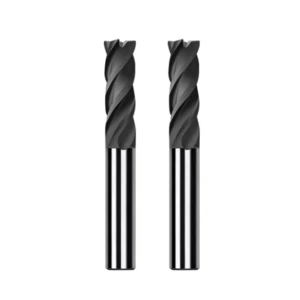
Why Do Cheap Carbide Milling Cutters for Graphite Actually “Steal” Your Profits?
Many shop owners focus solely on the unit price. They overlook the most critical hidden cost: machine downtime. When you buy a cheap carbide milling cutter for graphite to save a few dollars, you are gambling with your machine’s utilization rate. We frequently see low-end tools with poor edge preparation generate excessive heat. This causes graphite dust to adhere to the flutes. This buildup forces you to stop the machine for cleaning, dragging a one-day job into the next morning.
Consistency is another major issue. The dynamic balance on inexpensive tools is often lax. At 30,000 RPM, this is catastrophic. Unstable cutting amplitudes accelerate wear on your spindle bearings. The long-term repair costs for a damaged spindle far exceed any savings from cheap tools. Selecting the wrong tool compromises your production rhythm and the lifespan of your precision equipment.
Case Study: Scrap Rates at a Tier-2 U.S. Aerospace Supplier
Three years ago, an Ohio-based aerospace supplier was racing to finish complex graphite electrodes. Due to lead-time issues with their usual carbide end mill cutter suppliers, they switched to a cheaper alternative. The trial cut looked fine. However, by the tenth workpiece, the edges began to chip. These expensive graphite blanks became scrap, wasting dozens of hours of high-value machine time.
We went on-site to diagnose the failure. The issue wasn’t the operator; it was the tool. After just three hours, the tool geometry had deviated beyond recovery. Graphite is relentless. Without a wear-resistant substrate, the cutting forces fluctuated wildly. In aerospace, where “zero defects” is the standard, even a slight dimensional drift spells total failure for the batch.
Substrate Material and Coating Adhesion: Why Low-End Tools Peel
Why do some diamond-coated tools last a week while others go “bald” in a shift? The secret is the foundation. High-quality carbide diamond end mill cutters must use virgin substrates with extremely low cobalt content. At high temperatures, cobalt acts as a catalyst that causes diamond to turn back into graphite. This causes the coating to peel off in flakes. To save money, budget suppliers often use recycled carbide or standard alloys. It’s like trying to build a house on an unstable foundation of sand.
Proper adhesion depends on interface cleanliness and microscopic grain distribution. Budget suppliers often skip the critical acid-etching process used to remove surface cobalt. Even if the tool looks glossy and black, the coating will crack under high-frequency impact. Once that diamond layer is compromised, the carbide substrate hits the hard graphite and fails instantly.
Corner Radius Precision: Performance Gaps in Carbide Corner Milling Cutters
In finishing internal cavities, we obsess over the corner radius (R-angle) tolerance. A premium carbide corner milling cutter features an extraordinary profile and a smooth transition at the cutting edge. Conversely, low-end cutters often leave “witness marks” or steps where tool paths meet. This creates uneven material for the next stage, leading to chatter and brittle fractures in thin-walled sections.
In our projects, we often use a slight “overcut” strategy for fillet compensation. This requires tools with perfect geometric consistency. Many low-cost suppliers have limited grinding precision; their radii can deviate by more than 0.02 mm within a single batch. These errors are amplified during mold assembly and EDM. For engineers striving for a perfect surface finish, radius precision isn’t just a number—it’s the difference between a finished part and hours of manual polishing.
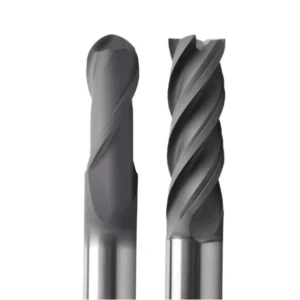
An In-Depth Analysis of the ROI for Premium Carbide Diamond End Mill Cutters
When evaluating tool costs, stop looking at the “purchase price” of a single cutter and start looking at the “output value” of your entire line. The real value of a high-quality tool is its ability to run unattended for hours without failure. While premium tools require a higher initial investment, their durability means the amortized cost per part is significantly lower than budget alternatives.
True ROI is found in predictability. With top-tier tooling, you can forecast exactly how many tolerance-compliant parts a machine will produce in a 48-hour run. This control reduces overtime and eliminates the risk of late-delivery penalties. For an engineer, this holistic view of cost savings is where real profit is made.
CVD Diamond Coating: The Variable That Dictates Tool Life
Graphite machining is a war of attrition between the cutting edge and abrasive dust. In this battle, CVD diamond crystals are your only shield. Through empirical testing, we’ve found that the best carbide milling cutter performance comes from a coating thickness strictly controlled between 10 and 15 microns.
In the coating world, “thicker” isn’t always “better.” The goal is to balance edge sharpness with resistance to spalling. If the thickness is uneven, cutting forces concentrate on weak points, leading to premature chipping. We combine this with flawless edge-honing (passivation) to ensure heat dissipates efficiently. We don’t just want a “black shell”—we want an unbreakable bond between the diamond and the substrate.
Saving Machine-Hours: Boosting Feed Rates by 30%
In a shop with high hourly rates, every minute saved is pure profit. We recently ran a head-to-head test: a premium carbide diamond end mill cutter versus a standard tool. Thanks to superior rigidity and chip evacuation, we increased the feed rate by over 30%. A roughing operation that previously took 60 minutes was finished in under 45.
This creates a compounding effect. Saving 30% of your cutting time means you can fit more workpieces into a single shift, diluting your costs for electricity and overhead. Don’t fixate on a $10 price difference between tools; look at your machine’s hourly rate. A high-performance tool effectively pays for itself within the first hour of operation.
Maintaining Dimensional Consistency without Manual Offsets
Few things frustrate an operator more than measuring parts and adjusting tool offsets every hour. When you work with high-quality carbide end mill cutter suppliers, you get a linear, predictable wear curve. You can set a fixed offset and let the machine run for 12+ hours without intervention.
Low-end tools wear out abruptly. One part is perfect; the next is undersized because the tip collapsed. This unpredictable wear is a “silent killer” of batches. The ideal machining state is “Set it, start it, and go home.” Achieving that requires a tool that maintains dimensional stability over the long haul.
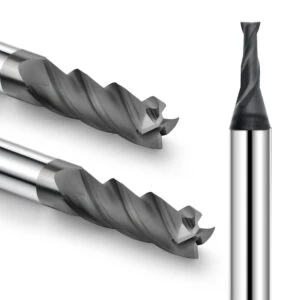
Selecting Carbide Corner Milling Cutter Specs for Complex Graphite
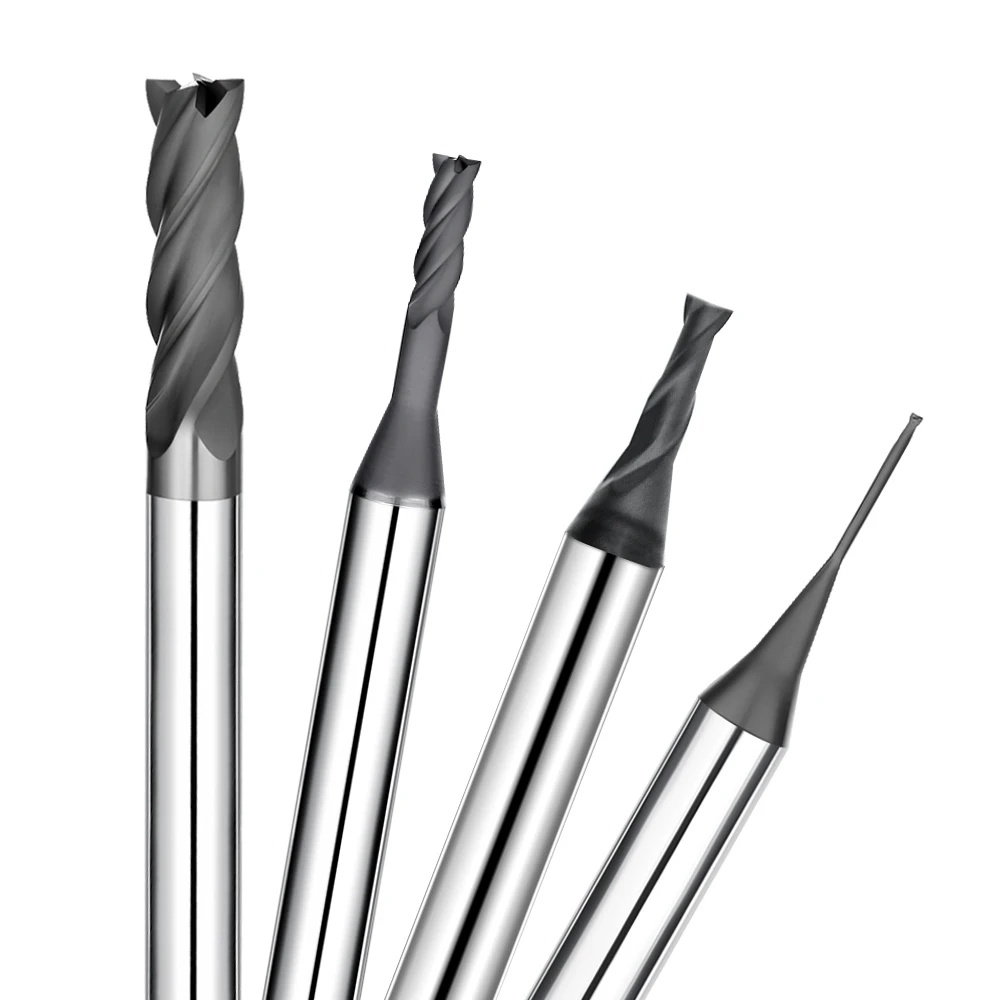
For thin-walled electrodes or deep cavities, a “one-tool-fits-all” approach is a recipe for failure. Graphite machining isn’t just about hardness; it’s about dust control. When selecting a carbide corner milling cutter, we prioritize the ratio of flute length to shank diameter. If the overhang is too long, micro-vibrations will cause a fatigue fracture before the tool even gets dull.
Core diameter is another critical detail. For deep, narrow slots, choose a tool with ample chip space over one with a high flute count. Graphite chips are voluminous. If they aren’t carried away by airflow, they undergo “secondary cutting,” which scratches the surface. We always sacrifice a bit of edge thickness to gain smoother evacuation channels.
Clearance Design: Stopping Clogged Flutes and Broken Tools
Dust accumulation is the #1 cause of sudden carbide milling cutter failure. Most breakages aren’t caused by high cutting forces, but by flutes clogging, which causes a massive torque surge. To solve this, we optimize the helix angle and use mirror-polished flute surfaces. This allows graphite dust to slide out like it’s on ice.
We also recommend a tapered relief (neck) design rather than a straight shank. This provides much better radial rigidity. If you hear a high-pitched whistling in a deep cavity, your dust evacuation is failing. In that moment, a better relief structure is much more effective than simply slowing down the spindle.
Protecting Edges: Corner Radius Optimization for Brittle Graphite
Graphite is brittle and can crumble like a biscuit at the part edges. To prevent this, we maximize the corner radius whenever the blueprint allows. A radius doesn’t just protect the tool tip; it converts outward tensile stress into inward compressive stress. This is the secret to stopping edge spalling.
If you must machine a sharp square shoulder, use a “multi-stage” strategy:
-
Use a large-radius tool to clear the corner.
-
Leave 0.05 mm of stock.
-
Finish with a small-radius tool for a light skim pass.
This extra step is the best insurance against scrapping a high-value mold. The corner radius is your “shock absorber” for the workpiece.
Parameters for High-Precision Success
Don’t just copy the manufacturer’s catalog—those numbers are for ideal conditions. For fine-grained isostatic graphite, we use the “High, Moderate, Shallow” rule:
-
Spindle Speed: Above 25,000 RPM.
-
Feed per Tooth: 0.03 mm to 0.08 mm.
-
Radial Depth (Ae): Shallow, to keep forces below the cracking threshold.
Always use a high-pressure air assist. Never use cutting fluids; they turn graphite dust into an “abrasive paste” that will eat your tools. Let the sound guide you—a crisp, steady tone is the sound of a perfect balance between efficiency and tool life.
Is your team still fighting tolerances every hour? It might be time to look at the tool in their hands.
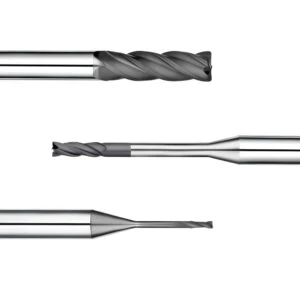
Identifying Reliable Carbide End Mill Cutter Suppliers: What to Look for Beyond Price?
When seeking partners, many procurement professionals fall into the “specifications trap.” They pore over data sheets but overlook the manufacturer’s “soft capabilities.” The true core competence of a high-quality carbide end mill cutter supplier isn’t sales volume—it’s their understanding of the actual machining floor.
A cutting tool is more than just metal and coating; it is a distillation of engineering expertise. If a supplier only talks about price and can’t explain their tool’s dynamic balance at 30,000 RPM, your communication costs will skyrocket later. We also evaluate supply chain transparency. Where do they get their carbide substrates? What brand of CVD furnace do they use? An ideal partner keeps pace with your equipment; your tools should never be the bottleneck when you upgrade to higher-precision machines.
Supplier Testing: Do They Understand Graphite Cutting Forces?
Graphite machining is unique because it doesn’t produce chips that reveal performance. A competent supplier must have a state-of-the-art cutting lab. When we evaluate a new carbide milling cutter, we always ask for cutting force waveform charts across different graphite grades.
If a supplier cannot provide quantitative data correlating power consumption with tool wear, their “high performance” claims are just anecdotes. In the real world, we deal with sudden spikes in cutting forces that cause chipping. A knowledgeable supplier analyzes residual marks to diagnose the root cause—whether it’s a hard point in the material or a poorly designed tool relief angle. This data-driven approach distinguishes a professional manufacturer from a mere trading company.
Batch Consistency: Preventing the Production Nightmare
On the shop floor, the greatest fear isn’t one bad tool—it’s inconsistency. We’ve seen factories provide perfect samples, only for their quality control to collapse during bulk supply. Inconsistency is fatal to automated lines. You cannot recalibrate parameters for every single tool. A tiny fluctuation in the substrate can turn an unattended shift into a scene of scrapped parts.
We value a supplier’s process capability (CpK index). A mature manufacturer conducts rigorous measurements after every grinding operation to keep geometric deviations within the micron range. Batch consistency reflects management investment. Manufacturers who invest in high-end inspection equipment save you countless hours of troubleshooting. In our industry, predictability is more valuable than sporadic high performance.
Technical Support: Rapid Solutions for Abnormal Wear
Shop conditions change instantly. Parameters that worked yesterday might fail today due to humidity or material batch variations. You don’t need a PDF manual; you need an engineer who answers the phone. The best support for carbide milling cutters isn’t a refund—it’s a diagnosis that pinpoints root causes like spindle runout or a bad tool path.
Our team uses high-magnification microscopy for remote diagnostics to keep clients on schedule. If a supplier transfers your call three times to find an expert, your machine sits idle. A great supplier is an extension of your own technical department. They should work alongside you with experimental data to debug new processes. Price wars can’t buy that kind of synergy.
The CNC Engineer’s Logic for Graphite Milling Cutter Procurement
As a frontline engineer, how should you measure a tool’s value? Procurement shouldn’t be about “cost-saving” alone; it’s about balancing “risk mitigation” with “efficiency.” In graphite, wear is inevitable. But if that wear is predictable, you are controlling production instead of “fighting fires.”
Our logic is simple: First, consider the workpiece value. Second, look at the machine’s hourly rate. Only then look at the tool’s unit price. If you are finishing a high-precision electrode after 40 hours of machining, a stable carbide milling cutter is your insurance policy. High-quality tools liberate you from tedious offset adjustments so you can focus on process optimization.
Build Your Own “Cost Per Part” Model
Stop looking only at total monthly spend. Establish a “Cost Per Part” model. This shouldn’t just be Price ÷ Lifespan. It must include the machine’s hourly rate, setup time, and scrap risk. Using a carbide diamond end mill cutter to cut cycle time by 10% often saves more money than the tool itself costs.
If you track downtime caused by tool failure for one week, you’ll see the truth. If a cheap tool causes two unscheduled stops and a re-inspection, its cost has effectively doubled. You only command authority over your production line when you can quantify the actual tooling cost per graphite workpiece.
Why Premium Carbide is the Only Safe Choice
In aerospace, medical, or semiconductor machining, we never advise taking risks. The material and machine time costs are too high. A single chip from a low-quality carbide milling cutter for graphite can scrap a part worth thousands of dollars. In “zero-error” scenarios, micron-level tolerance and elite coating adhesion are your final safeguards.
If you are machining complex mold electrodes with ultra-thin walls, ask yourself: Does my carbide corner milling cutter have the consistency for this? Choosing proven products from top-tier suppliers provides “peace of mind.” It allows you to hit the “Start” button and focus on technical planning rather than hovering anxiously by the machine.
Every machining environment is unique. If you’re struggling with vibration, chipping, or new materials, let’s talk. Bring us your specific conditions, drawings, or photos of failed tools. We’ll apply physical principles to deconstruct the problem and find a tailored solution.
Are you buying a cutting tool, or are you investing in the stability of your entire production line?