
All too often, after hours of debating with clients in North America and Europe over Zoom, we realize we are all agonizing over the same issues. It’s usually a mere 0.05mm deviation in geometry or the frustrating struggle to shave just 15 seconds off a cycle time.
Just last month, we finished a project for a long-standing client in Boston. As a Tier 2 aerospace supplier, they were struggling with a batch of HRC55 hardened steel parts. Because the parts had thin walls and deep cavities, their local carbide flat end mill cutters just weren’t cutting it. During operations, the tools either produced an ear-piercing chatter or left a side-wall finish as rough as a “washboard.”
We see this scenario constantly in our technical support logs. Many Western engineers are used to flipping through massive tooling catalogs, trying to “force-fit” a solution from thousands of standard models. But they often overlook one fact: when material hardness exceeds HRC55, or when you’re clearing corners on complex surfaces, an off-the-shelf tool cannot match the specific rigidity of your machine or the nuances of your cutting path.
This is why our focus as China CNC milling cutter manufacturers has shifted. We’ve moved beyond just selling products to delivering specialized custom CNC milling cutter services. Standard models are no longer enough to solve today’s machining anxieties. The real breakthrough lies in reverse-engineering a tool specifically calibrated to your machine’s power, spindle speed, and even the specific R-angle compensation of a ball nose CNC milling cutter.
By applying variable helix angles and asymmetrical edges to our CNC HRC55 milling cutter tools, we don’t just see minor improvements. We often see productivity double. Everyone wants lower unit costs, but can you really find a competitive edge in a cutthroat market by just flipping through a standard catalog?
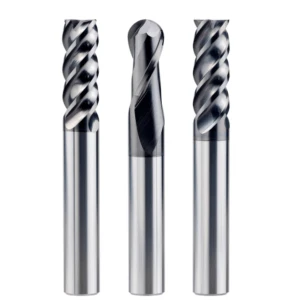
Addressing Machining Pain Points: How We Are Redefining the Role of China’s CNC Milling Cutter Manufacturers
After 15 years on the shop floor, I’ve learned one fundamental truth: the machine tool is the skeleton, but the cutting tool is the soul. In the past, many Western shops viewed China CNC milling cutter manufacturers as “low-cost alternatives.” That landscape has changed. Today, clients don’t come to us just to save a few dollars; they come to us because their standard tools fail on complex orders. We have evolved into an “embedded technical department” for our clients, helping them kill the bottlenecks that stall their production.
This shift comes from our deep involvement in the actual machining environment. When we evaluate a tool, we look past the basic geometry. We look at resonance characteristics on specific 5-axis machines. We don’t just exchange emails to confirm an SKU number. Instead, we analyze your cutting load curves to fine-tune substrate toughness and coating composition. This collaborative model—focusing on pain points rather than transactions—is our core advantage. It allows us to bypass the “brand premium” of big names and deliver direct value to high-end workshops.
Beyond “Machining-to-Print”: The Logic Behind Custom Tooling for Complex Conditions
In real-world projects, clients often send a CAD drawing for a quote, but after we look at their setup, we frequently recommend a total overhaul of their tool selection. For example, if you are milling deep cavities in stainless steel, a standard cnc milling cutter might be the right size, but the excessive length-to-diameter ratio will cause “withdrawal marks.” Our principle is simple: analyze the process first, then build the tool. We tailor the chip evacuation and micro-edge preparation based on your coolant type and even your spindle’s clamping force.
This custom approach is more than just adjusting length. For a client making titanium medical implants, we developed a bespoke carbide flat end mill cutter with an asymmetrical tooth pitch. Even though the machining path stayed the same, we killed the high-frequency vibration by changing how the tool engaged the material. The best tool isn’t the one with the best specs on paper; it’s the one that lets your operators sleep soundly without worrying about a midnight tool break. This pace of iteration—driven by “field feedback”—is something rigid multinational brands can’t replicate.
A 15-Year Retrospective: Why Standardized CNC Milling Cutters Often Fail High-End Workshops
Looking back at 15 years in this industry, I’ve seen a harsh reality: standardized cnc milling cutters are products of compromise. To make a tool that cuts aluminum, steel, and stainless, manufacturers have to play it safe with cutting angles and edge strength. But in a B2B environment where every second counts, “universal” usually means “mediocre.” If your spindle load is only at 40% but the chatter has already started, that standard tool is forcing your machine to underperform.
High-end workshops need the maximum MRR. Standard off-the-shelf tools often lack the tolerance range or coating consistency to handle long periods of high-speed, heavy-load cutting. My analysis shows that many shops reduce their feed rates just to accommodate standard tools—that is a massive waste of money. That is why we push for small-batch, customized trials. We want to find the specific geometry that extracts that final 20% of performance from your machine. Generic products get the job done, but custom technical solutions generate the profit.
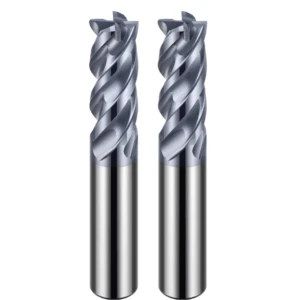
Conquering High-Hardness Materials: Real-World Case Studies of Our CNC HRC55 Milling Cutter Tools
When machining materials over HRC50, the atmosphere in the shop usually gets tense. We understand that cutting hardened steel isn’t just about machine rigidity; it is the ultimate test of a tool’s red hardness and impact resistance. In our experience, many shops in Europe and North America struggle with tool chipping and severe vibration when handling hardened mold steels.
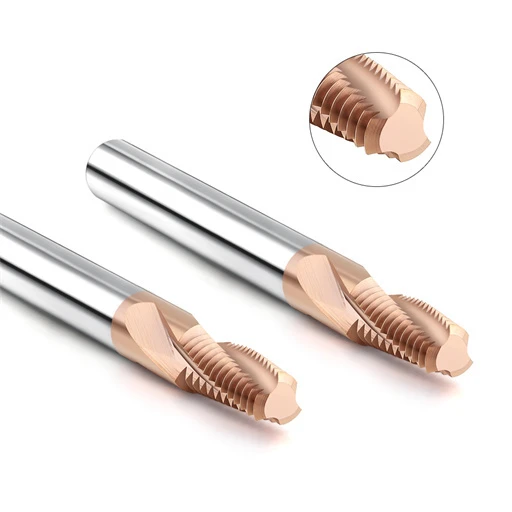
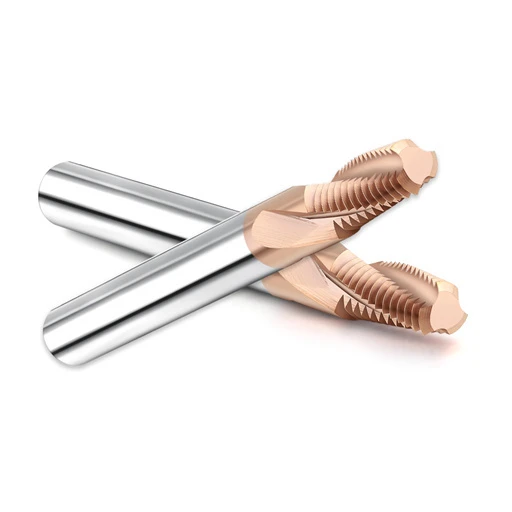
To solve this, we developed a range of CNC HRC55 milling cutter tools that go beyond just looking good on a spec sheet. These tools are designed to keep their edge even under the extreme heat of dry-cutting.
We recently handled a finishing project for an automotive body panel mold with a uniform hardness of HRC54-56. Traditional tools failed here because heat buildup would cause the tool tip to anneal. Our solution used a finer-grained carbide substrate and multi-layer composite coatings to balance wear resistance with toughness. In field tests, these optimized tools delivered a surface finish consistency that general-purpose tools simply couldn’t match. This success is why we continue to specialize in the high-hardness sector.
Tailored for Heat-Treated Mold Steels: Eliminating Vibration with Variable Helix Angles
High-frequency vibration is a nightmare for any process engineer working with heat-treated mold steel. That piercing screech doesn’t just mean a ruined surface; it means your spindle bearings are taking a beating. Through our experiments, we found that resonance usually happens when every cutting edge hits the workpiece at the exact same frequency.
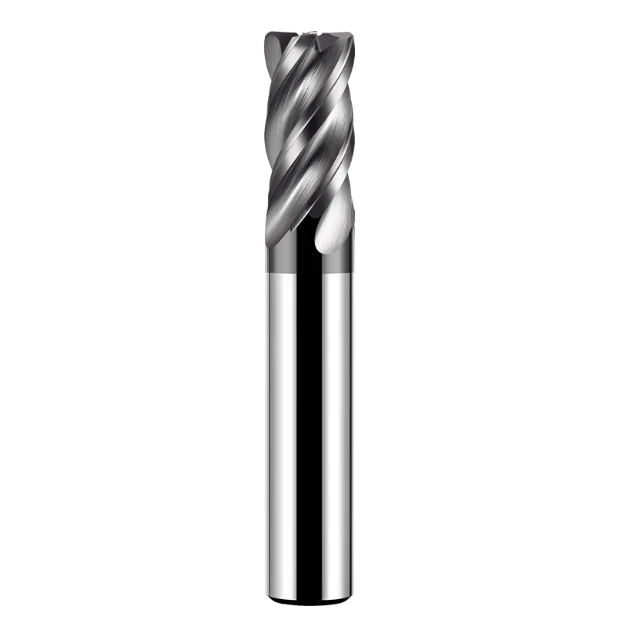
To break this cycle, we designed our CNC HRC55 milling cutter tools with variable helix angles and asymmetrical tooth spacing. This design shifts the direction and frequency of cutting forces, making the process “silent.”
If you observe the vibration amplitude on an oscilloscope, you’ll see the peaks flatten out. This is a game-changer for deep cavity sidewalls, allowing you to increase the radial depth of cut (Ae) without sacrificing precision. This geometric intervention is the most direct way to boost efficiency, so your operators don’t have to hover over the feed rate override knob all day.
The 40% Tool Life Boost: Optimizing Coating Adhesion and Substrate Toughness
People often ask us: how do you actually get a 40% increase in tool life? The hardest part isn’t making a coating hard; it’s making it stay on. In an HRC55 environment, tip temperatures are extreme. If the thermal expansion doesn’t match between the coating and substrate, the coating peels off like fish scales.
We use an optimized pre-treatment to create a microscopic “anchoring effect,” keeping the coating stable under extreme stress. We also fine-tune the substrate toughness by choosing a moderate cobalt (Co) content with a perfectly uniform grain distribution.
This balance between toughness and hardness isn’t just a lab theory. We calculated this 40% improvement on-site at customer facilities by measuring the actual cost per part. For us, this balance is the core artistry of manufacturing high-end tools.

Balancing Precision and Efficiency: Design Strategies for Customized Carbide Flat End Mills
In daily production, the question is always the same: “Can we double the cutting speed and still hold a 0.01mm perpendicularity tolerance?” Finding that “golden ratio” between carbide rigidity and chip evacuation space is the key.
For every carbide flat end mill cutter we design, we avoid maximizing just one parameter. If the tool is too hard, it chips under high loads. If the flutes are too deep for better chip flow, the core gets thin, and tool deflection (push-back) ruins your precision.
After testing countless core-to-flute ratios, we’ve found that for high metal removal rates (MRR), it’s better to sacrifice a little flute depth for core rigidity. This allows you to push the feed rate per tooth higher. A great custom tool should sound solid and substantial at high speeds, not like a high-pitched whine. That stability is the secret to long-term precision.
Side Milling vs. Slotting: Custom Corner Radii and Flute Geometries
Many engineers overlook how much the corner radius (R-angle) contributes to tool tip strength. In full-width slotting, the heat and stress are massive. A perfectly sharp 90-degree corner is almost guaranteed to chip.
That’s why we often recommend a minute protective chamfer or a small R-angle for custom carbide flat end mill cutters. This tiny change disperses the forces, moving stress away from the sharp tip and toward the side edges. It significantly extends tool life in tough conditions.
The flutes are another balancing act. For side milling, we keep flutes shallower to support the side edges. For deep slots, we polish the flute curvature to use centrifugal force to sling hot chips away. If your chips look like a perfect “6” with uniform color, your flute geometry is perfectly synced with your parameters.
Case Study: Solving Deformation in Thin-Walled Medical Parts
Last year, we helped a medical device maker machining aluminum thin-walled parts (1.2mm thick). Their standard carbide flat end mill cutters were causing severe deformation and high scrap rates. The root cause was excessive cutting force and poor heat dissipation.
Instead of an expensive new cooling system, we reground specialized tools with a large rake angle and a unique relief design. By increasing the rake angle, we changed the action from “pushing” to “shearing,” cutting radial force significantly.
We also applied a micro-honing treatment to keep the edges sharp but stable. The result? Cutting forces dropped by 30%, elastic recovery was controlled, and the acceptance rate jumped to over 98%. In precision machining, fine-tuning geometry is often much cheaper and more effective than upgrading your hardware.
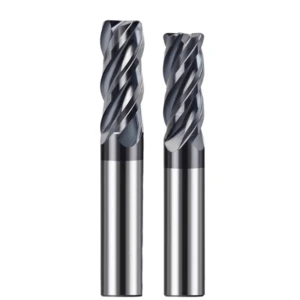
Complex Surface Machining: Meticulous Detail Control in Custom Ball Nose CNC Milling Cutters
When machining complex surfaces—like impellers or turbine blades—even the slightest radial run-out leaves permanent marks. These projects demand everything from a ball nose CNC milling cutter. Because the cutting speed at the very tip is effectively zero, it puts extreme pressure on the coating’s wear resistance and the tool’s micro-geometry. In our experience, standard ball nose cutters often chip or suffer from chip adhesion during 5-axis machining. This usually happens because standard chip flutes are too conservative to clear debris at high feed rates.
Our focus on customization is based on one fact: success in complex surfaces is measured in microns. We redesign the arc precision and the center cutting symmetry to match your specific strategy, whether it’s streamline or Z-level machining. We believe a top-tier ball nose tool should maintain smooth, consistent torque across its entire surface, with zero vibration as it hits the center axis. This level of detail is how we help our clients win in the aerospace and precision mold sectors.
Step-over vs. Surface Finish: Custom Geometries for Aerospace Clients
Aerospace parts have zero margin for error when it comes to fatigue strength. Even a tiny tool mark can become a stress concentration point. In our consultations, we see engineers constantly struggling to balance step-over distance with residual cusp height. To improve surface quality without killing your cycle time, we developed a specialized helix angle for our ball nose CNC milling cutter. This makes the cut feel like a “smooth glide” instead of a “violent impact.”
By fine-tuning the transition radius between the tip and the side edge, we’ve successfully reduced residual ridge height. This allows you to increase your step-over distance without losing surface quality, significantly shortening your cycle time. This isn’t just software tweaking; it’s rooted in physical cutting models. We believe the tool should adapt to the material’s deformation, not the other way around.
Solving Match Lines: Practical Run-out Control in Custom Tooling
“Match lines” (or witness marks) are a major pain point in contoured finishing, especially during tool changes. In our technical support, we’ve found that the fix isn’t in the software—it’s in the run-out control. If your ball nose CNC milling cutter deviates by more than 0.005 mm, its high-speed trajectory becomes an ellipse. This creates the tiny steps you see at tool-change junctions.
To kill this problem at the source, we use strict presetting standards and specialized precision grinding at the tool-holder interface. For high-precision matching, we recommend our custom long-shank cutters paired with shrink-fit holders. This combination keeps total run-out within an extremely tight range. We once helped an aircraft engine casing manufacturer eliminate “match shadows” simply by reducing cutting-edge symmetry error to the micron level. In precision manufacturing, an obsession with absolute concentricity is the only way to eliminate witness marks.
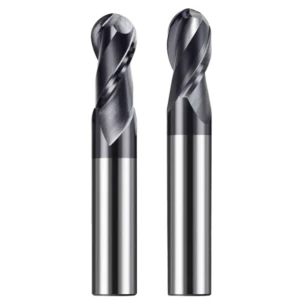
Engineers Talking to Engineers: Why Customization is the Key to Alleviating Global Supply Chain Anxiety
Let’s step away from the technical specs and talk about what really matters: stability. In today’s global market, we all feel the pressure of “precision anxiety” and tight deadlines. When you’re looking at a 5-axis machine that generates thousands of dollars an hour, your biggest fear isn’t the price of the tool—it’s a standard tool failing at 2:00 AM or a delivery delay that stops your line. We believe the role of China CNC milling cutter manufacturers is changing. Customization has turned the “buy-and-forget” trade into a real technical partnership.
If you’re fighting to lower per-piece costs or trying to machine a new composite, step outside the “standard catalog” mindset. The real value of a custom service isn’t just a weird-shaped tool; it’s an exclusive competitive advantage. While your competitors struggle with generic tools, you’re hitting faster speeds and better consistency with a solution optimized for your specific shop. That is your best defense against market volatility.
Shortening R&D Cycles: Direct Engineer-to-Engineer Consultation
In precision manufacturing, time is money. With big, traditional manufacturers, just getting a technical drawing confirmed can take two weeks. Our process is a closed loop: our engineers talk directly to yours. If you’re developing a new aerospace part or medical device and aren’t sure which cnc milling cutter to use for a deep cavity, just send us your DXF/STEP files or a rough sketch. Based on your spindle power and fixture rigidity, we’ll give you a full proposal with geometry and path strategy recommendations.
We compress the timeline from “concept” to “real-world test” to the absolute minimum. Our lab constantly simulates extreme conditions—from CNC HRC55 milling cutter tools to specialized ball nose end mills. If you’re unhappy with your current efficiency, don’t just tweak the data sheet. Let’s review your entire process. Most issues like chatter or chipping can be fixed at the source: the tool design stage.
Long-Term Perspective: Continuous Support from Professional China CNC Milling Cutter Manufacturers
The delivery of the tool is just the start. As a qualified supplier, our value shows in the stability of your ten-thousandth part. If you see unexpected wear during a mass-production run or if a new machine sounds “off” with your carbide flat end mill cutter, call us. Send us photos of the worn tools. That “scrap” is the most authentic data we have for the next iteration.
True partnership is about refining strategies together. If you’re worried about tool life or upgrading your platform, share your parameters with us. We don’t have a “magic tool” for everything, but we pledge that as your needs evolve, our technical support will evolve with them. In this field, the people who solve the hardest problems together are the ones who truly qualify as peers.