
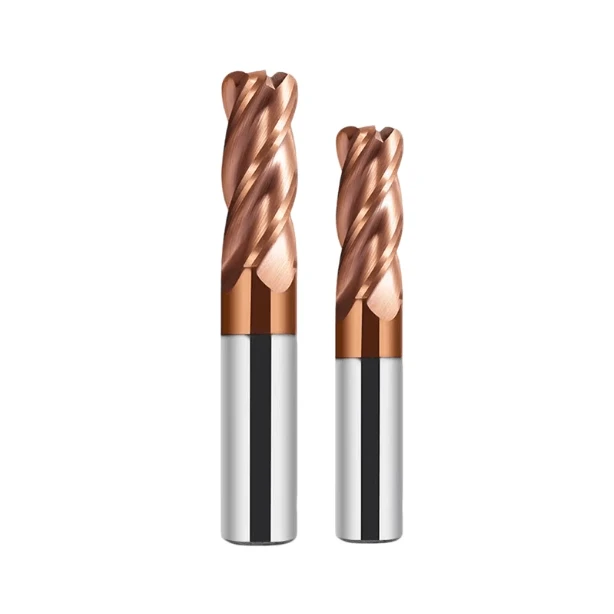
As an engineer who has spent 16 years honing my craft in the tool shop, I know that finishing operations for the electronics and semiconductor sectors are more than just machining—they are a psychological battle. We are fighting against micron-level tolerances and the intense internal stresses of hardened materials. Our clients often demand a mirror finish on HRC65 steel while maintaining absolute consistency in the corner radius of the bull nose end mill cutter.
Last year, we handled a classic case for a Tier 1 medical/semi supplier. They were struggling with severe “step marks” and dimensional drift in semiconductor package molds. After only 12 hours of run-time, the corner radius on their existing tools would wear down, ruining the cavity floor. This wasn’t just a tool life issue; it was a failure to balance the effective cutting speed at the radius with the tool coating’s oxidation resistance.
During our on-site support, we realized many engineers overlook the delicate interplay between stock allowance and radial step-over when using a bull mill cutter for hardened steel. For electronics molds where an Ra 0.1 finish is non-negotiable, we developed a specific solution: optimized edge reinforcement on our HRC65 bull mill cutter paired with high-stability shrink-fit holders. This combination finally killed the harmonic vibrations that typically ruin high-speed finishing.
As a bull mill cutter manufacturer, we don’t just follow formulas. We’ve sacrificed hundreds of tools in the lab to master the details that matter—from R-angle tolerance to thermal compensation.
In your quest for the perfect surface finish, have you ever spent a sleepless night agonizing over a 0.005mm deviation in your tool’s corner radius?
The “Precision Anxiety” in Semiconductor Molds—Why Choose a Bull Nose End Mill?
In semiconductor mold making, “precision” isn’t a number on a blueprint—it’s the heartbeat of your spindle. We often see clients struggle with standard ball-nose mills for corner clearing or flat end mills that chatter in tight angles on 60 HRC steel. This “precision anxiety” usually comes from a mismatch between tool geometry and material resistance. For electronic components, where floor flatness and seamless sidewall transitions are critical, the bull nose end mill cutter is almost always the optimal choice for balancing efficiency and surface integrity.
We recently supported a shop making precision leadframe molds. They insisted on square-nose mills to get a flat floor, but the tool tips kept snapping due to high-frequency vibration. We recommended switching to a bull-nose geometry. The improvement wasn’t just about speed—it was about stability. The radius transition distributes axial forces and prevents heat from “pooling” at the tip, which is inevitable with square-nose tools in hardened steel.
Mastering HRC60+ Steel—Rigidity and Edge Performance
When you are milling HRC65 steel, the action is less about shearing and more about high-pressure scraping. This puts immense stress on the tool’s substrate. Through iterative testing, we found that a composite coating over an ultra-fine-grain substrate (less than 0.4μm) is the only way to prevent microscopic core fractures during long, uninterrupted finish cycles.
True rigidity doesn’t just come from your tool holder; it starts at the cutting edge. For hard milling, we subject our edges to a micron-level honing process. It might seem like we are sacrificing “sharpness,” but in reality, this prevents micro-chipping. It ensures the cavity floor looks like a mirror rather than showing “tear marks” under a microscope.
Practical Strategies for Corner Stock Control
Semiconductor package molds are unforgiving. If your R-corner has even 0.01mm of excess stock, you’ll see resin flash or molding defects later. We always advise a semi-finishing pass with a dedicated bull mill cutter for hardened steel to establish a perfectly uniform allowance for the final finish. If the stock is uneven, the finishing tool will deflect when it hits the corners, instantly ruining your precision.
We prefer a composite toolpath strategy: pairing “Constant Z” levels with spiral motions. By keeping the radial depth of cut (Ae) consistent, the tool stays under a constant load. We’ve found that keeping residual stock between 5% and 8% of the tool’s corner radius minimizes runout and maximizes surface consistency. This is a rule written in the “blood” of scrapped parts.
Avoiding the Chipping Trap: The Structural Advantage of the Bull Nose
Why do square-nose mills always chip without warning during corner picking? Mechanically, a sharp 90-degree corner is a massive stress concentrator. The moment it hits hard steel, the entire impact load is focused on one microscopic point. As a bull mill cutter manufacturer, we design our tools to turn that point load into tangentially distributed pressure along an arc.
In our tests on deep cavity corners, the lateral resistance on a bull nose was roughly 30% lower than a square-nose tool. This mechanical advantage allows you to push cutting speeds higher with confidence. For automated shops running 24/7, trading away a tiny bit of theoretical corner sharpness for the massive reliability of a bull-nose tool is simply the smarter way to manage production.
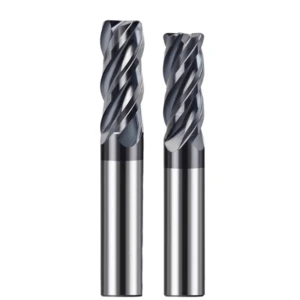
Practical Parameters for Hardened Steel: Managing the Service Life of Bull Mill Cutters for Hardened Steel
When machining mold steels exceeding 50 HRC, tool life management is an art of balancing heat and friction. We’ve seen many shops fall into the trap of thinking “higher RPM is always better” for a bull mill cutter for hardened steel. In reality, hard milling failure is rarely about abrasive wear; it’s about the cutting zone temperature exceeding the coating’s oxidation threshold. We prefer to control the cutting arc by fine-tuning the radial depth of cut (Ae). This gives the cutting edge enough “air-cooling” time between rotations, which is far more effective at extending tool life than simply dropping the spindle speed.
In one project involving heat-treated cold-stamping dies, we noticed massive tool life variability. Our data analysis showed the culprit was inconsistent coolant timing and “choppy” tool paths. For high-hardness jobs, we advocate “stability over speed.” We monitor minute torque fluctuations to catch edge dulling before it causes a failure. While this empirical approach isn’t as “fancy” as high-end sensors, it’s the most practical way to protect an expensive workpiece on a busy shop floor.
How We Eliminate “Step Marks” by Optimizing the Feed Rate of HRC65 Bull Mill Cutters
Step marks—those frustrating ridges where tool paths meet—are the bane of precision finishing. This is especially true when using an HRC65 bull mill cutter, where even a tiny shift in cutting resistance leaves a “scar.” These marks usually happen during tool entry or exit due to minute edge deflection. To stop this, we use a helical entry combined with “variable feed control.” We manually reduce the feed per tooth by 15% as the tool approaches the path junction.
We focus on the direction of the resultant cutting force rather than just raw speed. During the final pass, we often sacrifice efficiency for a “polishing-style cut” by using a tiny feed rate relative to the edge radius. The secret to a seamless finish isn’t just a sharp tool; it’s using parameter compensation to counteract the physical displacement of the spindle at high speeds.
Surface Finish in Electronic Components: Dry Cutting vs Atomized Cooling?
In the electronics industry, the “Wet vs. Dry” debate is constant. For hardened steel components, we almost always advocate for atomized cooling—a mix of high-velocity cold air and MQL. Why? Because thermal shock from liquid coolant often causes micro-chipping. Atomization clears away the fine “dust-like” chips that stick to the bull mill cutter while keeping the coating temperature stable.
There are exceptions, of course. If you are machining a deep, confined cavity where chips can’t escape, dry cutting can lead to “built-up edge” (BUE) that scratches the surface. In these cases, we advise increasing the air pressure to aggressively “blow” debris out. Remember: cooling isn’t just about temperature; it’s about creating a clean micro-environment for the cut. That is the logic that dictates your Ra value.
Thermal Rise and Dimensional Compensation for Round-Nose Tools
In High-Speed Machining (HSM), spindle growth is a “silent killer.” When running over 20,000 RPM, axial thermal expansion can reach 0.02 mm—enough to scrap a semiconductor component. As a bull mill cutter manufacturer, we design tools with specific flute geometries to minimize heat transfer, but on-site compensation is still mandatory.
We always “warm up” the tool for ten minutes under no-load before the final finish cycle. We also use the tool-setter to check thermal compensation every hour, especially with small-diameter round-nose tools. This level of respect for thermal physics is what separates a master machinist from a basic operator.
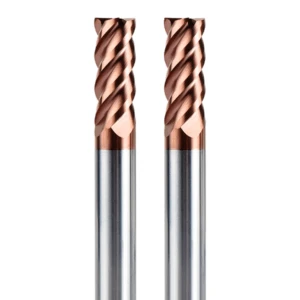
A Customer’s Guide: How to Identify a Qualified Bull Mill Cutter Manufacturer
Vetting a supplier is often harder than picking cutting parameters. As a bull mill cutter manufacturer, we often hear from Western clients that “sample tools worked great, but the production batch is inconsistent.” A truly qualified manufacturer is defined by their reverence for microscopic tolerances and their closed-loop inspection, not just the number of machines in their shop.
During a virtual audit or visit, look at their grinding wheel balancing protocols and raw material traceability. A chipped edge is often decided at the bar stock selection phase, long before it hits a machine. A manufacturer who understands your pain will ask about your material’s heat-treat status instead of just quoting prices. That technical dialogue is the foundation of a real B2B partnership.
Our Standards for R-Corner Symmetry in HRC65 Bull Mill Cutters
When milling HRC65 steel, R-corner symmetry determines your tool’s lifespan. Many low-cost tools have “steps” or distortions where the arc meets the side edge. If the R-angle is asymmetrical, one cutting edge bears too much load, causing vibration and visible striations on your part.
To prevent this, we subject our HRC65 bull mill cutter batches to 200x magnification inspections. We hold a radius tolerance of ±0.005 mm. This isn’t for aesthetics—it ensures cutting forces are perfectly balanced across all flutes. If your dimensions are drifting, check your tool’s R-corner consistency before you start chasing ghosts in your machine parameters.
Coating Adhesion: It’s About More Than Just AlTiN
Most clients just ask for AlTiN, but in hard milling, that’s just the baseline. For high-end B2B work, we focus on nano-layered structures and interfacial adhesion. If the coating “peels,” the substrate softens instantly under the heat of a bull mill cutter. We use pre-coating edge honing and plasma cleaning to ensure the coating survives the friction of hard steel.
We favor PVD composite coatings for their oxidation resistance. For precision exports, we invest 20% more in coating quality to prevent sudden tool delamination. A high-quality coating has a deep, matte texture under light—if it looks like a cheap, shiny metallic toy, it’s probably a low-quality or “refurbished” tool.
Batch Consistency: Why You Must Stick to One Brand for Finishing
Our advice for the finishing phase is simple: “If a tool works, don’t switch suppliers.” Even two great bull nose end mill cutter manufacturers will have slight differences in grinding wheel grit or programming logic. This might not matter for roughing, but for a semiconductor mold with a ±0.002 mm tolerance, it’s enough to force a complete re-adjustment of your offsets.
Consistency equals productivity. We’ve seen clients try to save a few dollars mid-project, only to end up with inconsistent finishes and assembly failures. Our goal as a supplier is “seamless replacement”—when you install a new tool, it should perform exactly like the last one without any program changes. That is the ultimate test of a manufacturer’s workflow.
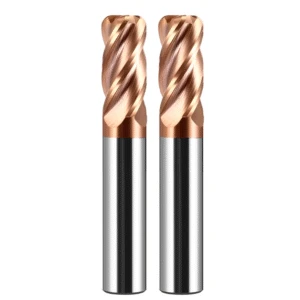
On the Shop Floor: Three Secrets to Enhancing Surface Quality in Semiconductor Components
In semiconductor machining, the bottleneck for surface quality is rarely the machine tool itself. Usually, it’s about how well the engineer leverages the micro-geometry of the cutting tool. Semiconductor parts often feature thin walls, deep cavities, and tight corners—features that make standard flat or ball-nose mills prone to stress concentration. We’ve found that the strategic use of a bull nose end mill cutter does more than just prevent chipping; it physically reshapes the cutting force distribution to yield a silky-smooth finish.
If you are struggling with “tool deflection” in aluminum or stainless steel parts, try looking at the problem through the lens of force dynamics. Specifically, evaluate how your bull nose mill performs during the transition from side milling to bottom milling. If you see subtle chatter marks in the corners, you’ve found the clue needed to resolve your surface consistency issues.
Secret #1: Leveraging R-Corner Geometry for Seamless Transitions
In semiconductor molds or vacuum chambers, the junction between the wall and the floor is a high-risk area for “dwell marks” or overcutting. Using the R-corner of a bull nose end mill cutter to execute arc-based entries and exits mitigates the shock load as the tool changes trajectory. If you are running constant-Z finish paths, try fine-tuning the “Corner Smoothing” in your CAM software. This ensures the tool maintains constant contact as it tangentially engages the wall.
The logic is simple: use the R-corner curvature to absorb radial forces. Stability is highest when the remaining side-wall stock is proportional to the corner radius. If you still see “step marks” at the bottom, your R-value and toolpath strategy might be mismatched. Often, a mere 0.2mm difference in radius can transform your surface quality.
Secret #2: Calculating the Effective Cutting Diameter for Hardened Steel
Many pros make a serious error when machining hardened steel: they use the tool’s nominal diameter to calculate spindle speed (Vc). But when using a bull mill cutter for shallow finishing, the “effective diameter”—the part actually touching the metal—is much smaller than the nominal size. If you are skimming hard materials (HRC50+), you must use the Pythagorean theorem to find the true surface speed at the contact point.
If your calculation is wrong, your surface speed will be too low. This causes the tool to “extrude” the metal rather than “cut” it, leading to built-up edge (BUE) and surface “blackening.” Always determine your axial depth (Ap) first, then back-calculate the true diameter. If you find these calculations tedious, or you’re unsure about parameters for materials like NAK80 or S136, we can provide a reference sheet based on our own shop floor data.
Secret #3: Balancing Spindle Speed and Vibration Suppression
In High-Speed Machining (HSM), vibration is the enemy. Every bull mill cutter has a “resonance exclusion zone” based on its overhang length and the spindle speed. If you’re using a long-reach tool for deep cavities, try disrupting the resonant frequency by slightly adjusting your feed rate or employing variable-frequency techniques. Sometimes, dropping the RPM by just 10% can actually result in a smoother finish by avoiding the critical resonance point.
Clamping precision is also vital. If you see unstable roughness above 10,000 RPM, check the run-out on your hydraulic or shrink-fit holders. To get the most out of a high-quality round-nose cutter, you need a high-rigidity clamping system. If you’ve hit a performance bottleneck with thin-walled parts, let’s collaborate. We can explore how to kill vibration at the source—whether through adjusting rake angles or implementing a variable-pitch design.