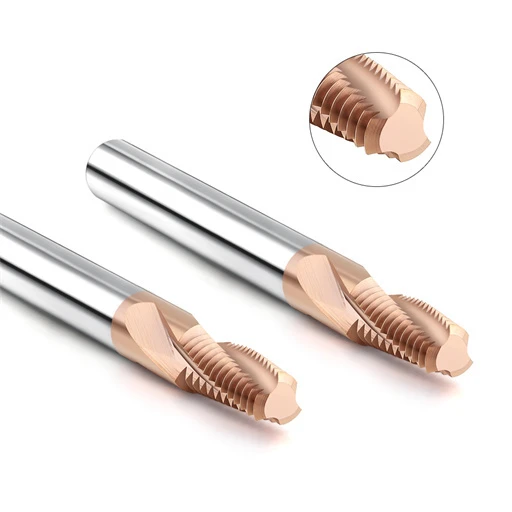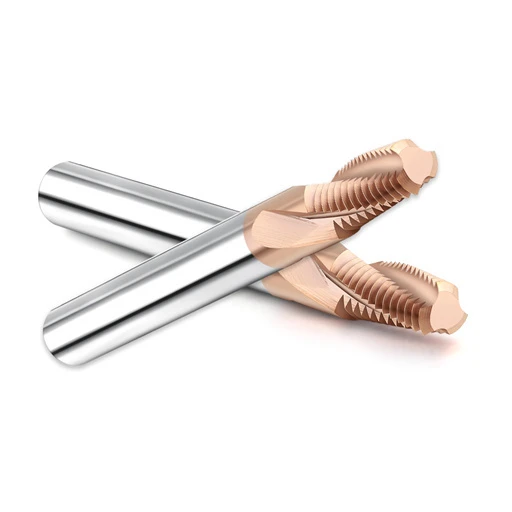


Last week, a medium-sized mold shop in Germany sent us an urgent SOS. They were using HRC55 square end mills to machine precision S136 steel molds but couldn’t hit the required surface finish. Even worse, they were seeing constant micro-chipping on the cutting edges. Their first instinct was to blame the end mill suppliers for inconsistent coating quality.
However, after we analyzed their machine data and on-site footage, the truth came out. The tools were fine. The culprit was system rigidity—a factor that is consistently underestimated in high-precision shops.
In my 16 years in this industry, I’ve seen this exact scenario play out hundreds of times. When shops source end mills for steel, they obsess over hardness, coatings, and feeds and speeds. But they forget that at 20,000 RPM, even a 0.01mm deflection turns “high-precision” work into a total disaster.
For us as manufacturers, grinding a high-quality carbide end mill is only half the battle. The real test is ensuring that tool stays stable under high-load conditions. This stability isn’t just about the tool’s core thickness; it depends on spindle clamping force, holder grip, and overhang control. When cutting hard materials, any loss of rigidity is amplified exponentially. If you don’t fix the rigidity, even the most expensive end mill becomes an overpriced consumable.
In the world of hard steel machining, rigidity equals efficiency and tool life. As engineers on the front lines, we aren’t just fighting metal hardness—we are fighting invisible, minute deformations.
Are there premium cutters in your shop right now failing to deliver because of subtle, undetected vibrations?
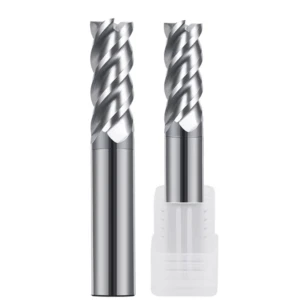
Insights from the “Catastrophic Failure” Scenes: Three Fatal Flaws of Steel-Cutting End Mills Caused by Insufficient Rigidity
When we deal with Tier 1 suppliers in North America and Europe, the worst news isn’t a price dispute—it’s a “catastrophic failure” video from the floor. When a five-axis machine shrieks and scraps a five-figure workpiece, it halts the entire production line. My experience shows that the vast majority of complaints regarding end mills for steel trace back to one thing: poor rigidity.
Many operators assume that a stable machine tool makes the process foolproof. In reality, every link from the spindle head to the cutting edge transmits stress. We once helped a US client who was snapping tools in alloy steel. They were using our top-tier carbide end mill line, but the system rigidity was ignored. Under load, those expensive tools behaved like flimsy plastic rods. We have to prevent this at the logical level before the spindle even starts.
Resonance (Chatter) Is More Than Just an Unpleasant Sound: How It Instantly Destroys an HRC55 Square End Mill
When machining hardened steel with an HRC55 square end mill, resonance creates a sound that will make any engineer cringes. This vibration subjects the tool to thousands of “micro-impacts” per second. Because carbide is hard but brittle, this irregular loading peels off the coating and chips the edge. Your mirror finish instantly turns into a rough, rippled mess.
If you hear chatter, don’t just reflexively lower the RPM. Often, the better move is to adjust the feed per tooth or change the Depth of Cut (DoC) to find a “sweet spot” away from the machine’s resonance frequency. Protecting the edge isn’t about avoiding force; it’s about making that force stable and continuous. If the tool tip is “dancing” on the workpiece, even the best carbide end mill will fail.
Cumulative Errors from Radial Runout: Why Your End Mill Wears Unevenly
If your carbide end mill shows heavy wear on just one or two flutes while the others look new, you have a radial runout problem. In precision mold making, we often find toolholder systems with minute eccentricities. A few microns of deviation might seem small, but at high speeds, centrifugal force pushes that specific edge far beyond its design limits.
Our lab tests show that for every 0.01mm increase in runout, tool life drops by 50% or more. While we take pride in the precision of our end mill manufacturing, the concentricity of your clamping system is the prerequisite for success. If you see regular “stripes” on your surface finish, don’t blame the tool yet. Check your collet or shrink-fit holder for fatigue.
Avoiding “Noodle-Style” Machining: The Exponential Impact of the L/D Ratio
In deep-cavity work, we often see operators use long-reach tools for heavy cuts. We call this “noodle-style” machining. You must understand that tool deflection is proportional to the cube of the overhang length. Extending a carbide end mill by just a few millimeters causes its rigidity to plummet exponentially.
If a long overhang is unavoidable, you must drastically reduce your radial depth of cut (Ae) to survive. We’ve solved countless breakage issues by recommending tapered-neck designs or layered machining strategies. Don’t try to defy the laws of physics. Keeping your tool within its stable overhang range is the only way to achieve “respectable” machining.

Enhancing Carbide End Mill Rigidity in Hard Steel Machining Through Process Optimization
Testing tool life in a sterile lab is one thing; solving real-world problems amidst the oil mist and noise of a busy workshop is another. We know that even a high-performance carbide end mill can’t realize more than 30% of its potential without a logical machining process. After visiting hundreds of sites, we’ve found that the key to rigidity often isn’t buying more expensive machines—it’s fine-tuning the overlooked process details.
We view machining as a holistic mechanical system. Every change—from clamping strategies to cutting paths—reflects directly in the spindle load and surface finish. When cutting high-hardness materials, we don’t use brute force. Instead, we optimize force vectors to minimize deformation. The insights below represent the “shop floor logic” we’ve distilled from years of tackling the toughest projects.
Overhang Control for HRC55 Square End Mills: The “1mm” Rule for Stability
When machining hardened mold steel, we always tell our clients: “If you can shorten the overhang by 1mm, do it.” For an HRC55 square end mill, the substrate is incredibly hard but inherently brittle. We once ran a test on a precision project: reducing the tool’s overhang by less than 2mm completely eliminated chatter marks and boosted tool life by nearly 30%.
This isn’t magic; it’s basic physics. A cutting tool acts like a cantilever beam. The shorter the overhang, the better it resists lateral forces. This prevents the edge from “giving way” against hard steel. We recommend prioritizing minimum overhang during programming, even if it means extra time adjusting fixtures. When you weigh that time against a snapped tool or a scrapped part, the investment is a no-brainer.
The Art of Toolholder Selection: Why Shrink-Fit is Our Standard for Steel
In high-end North American shops, shrink-fit toolholders are the gold standard for end mills for steel. While high-force collet chucks are fine for roughing, they can’t match the 360-degree uniform clamping and near-zero runout of shrink-fit technology. This method effectively fuses the tool to the spindle, maximizing both static and dynamic rigidity.
When troubleshooting deep-hole milling, we often notice that switching to shrink-fit turns a dull, muffled thud into a crisp, uniform ring. That sound tells you every cutting edge is sharing the load equally. Shrink-fit holders require a higher initial investment and tight shank tolerances, but if you want a perfect surface finish and predictable tool life, that “rigid connection” is essential.
The Synergy of Climb Milling and Rigidity: Using Physics to Protect the End Mill
We are staunch advocates of climb milling, especially when using a carbide end mill on high-resistance steel. Mechanically, climb milling starts with a thick chip that tapers down. This creates a force vector that “pushes” the tool into the workpiece rather than “lifting” it away.
This directional difference significantly reduces elastic deflection when the tool engages the material. We’ve found that climb milling also suppresses work hardening. However, your machine must have zero backlash in the lead screw to prevent the tool from “digging in.” By reducing lateral thrust, you are simply using physics to take the burden off your tool. You know it’s working when you see chips curling away like perfect commas rather than being crushed into dust.

The Foundational Role of Manufacturing: What to Look for in End Mill Suppliers
As a specialist with 16 years on the floor, I believe a tool’s rigidity is decided the moment it leaves the grinding machine. Many buyers are distracted by glossy brochures or colorful coatings. But the real performance of a carbide end mill comes from manufacturing details invisible to the naked eye. Rigidity starts with raw material selection and microscopic edge geometry.
Top-tier shops focus on a supplier’s consistency. If runout exceeds tolerances in just 1% of a batch, it can ruin an automated line. When evaluating end mills suppliers, we look at grinding pressure, coolant filtration, and wheel dressing frequency. These “hidden” factors determine if your tool will deliver stable performance or collapse halfway through a tough job.
The Secrets of Substrate Materials: Why We Insist on Ultra-Fine Micrograin Carbide
In the carbide world, grain size is everything. When machining hardened steel, standard substrates often fail to balance hardness and toughness. We insist on an ultra-fine grain substrate (0.4μm to 0.6μm). Finer grains mean a denser molecular structure with fewer internal defects. This gives the tool a much higher elastic modulus when facing intense lateral loads.
Why do “bargain” tools look identical but snap instantly? It’s usually the cobalt binder distribution. If the grains aren’t fine enough, cobalt “pools” into weak points. We pay a 20% premium for high-density substrates because that microscopic rigidity is the final line of defense against catastrophic tool failure.
Balancing Core Thickness and Flute Space: The Essence of Tool Design
Designing a high-performance carbide end mill is an exercise in “addition and subtraction.” Core thickness determines the tool’s bending rigidity. If you enlarge the flutes too much for chip evacuation, the core becomes thin and flexible like a willow branch. Conversely, an oversized core leaves no room for chips, leading to jams and breakage.
We prefer a tapered core design. This reinforces the shank area for rigidity while maintaining chip capacity at the tip. This balance absorbs vibration, making the cut look and sound smooth. When you inspect a tool, check if the ratio of flute depth to core thickness is scientifically balanced. Exceptional design is always a trade-off between strength and flow.
Cutting Edge Honing: Preventing Brittle Fracture at Entry
Why do brand-new end mills for steel sometimes chip on the very first cut? Often, they are too “sharp.” Under a microscope, a freshly ground edge is a row of tiny serrations. When they hit hard steel, these weak points crumble instantly. We solve this with precise passivation (honing) before coating. We polish the razor edge into a microscopic, rounded radius (R-edge).
Honing significantly boosts the microscopic rigidity of the edge. While it might seem less “sharp,” a rounded edge excels at distributing heat and mechanical stress. It prevents the coating from flaking off. When choosing tools for hard steel, use a loupe to check the wear pattern. Tools with proper passivation show a smooth, uniform wear band—the hallmark of stable process engineering.

A Master Machinist’s Diagnostic Notes: How to Verify Your Rigidity in Real-Time
In the shop, we say the best sensors are an engineer’s eyes and ears. Modern machines have load monitors and sensors, but when cutting hard metals, we rely on subtle cues to catch risks early. You don’t need to wait for the final inspection to know if your rigidity is up to par. Within the first few minutes, the “vitality” of the system tells the story. These diagnostic methods are the result of 16 years of manufacturing and tuning experience—an intuitive take on mechanical equilibrium.
When we walk into an unfamiliar shop, we first watch the machine’s dynamic feedback. If a carbide end mill is running right, the chip trajectory and vibration frequency create a harmonious rhythm. Even the machine’s safety glass will have a steady, predictable vibration. If there’s a bottleneck in rigidity, the system feels “off.” As a decision-maker, you must interpret these signals: do you push through, or stop to optimize the setup? Here are three “guarded secrets” for a rapid diagnosis.
H3: Reading Chip Morphology: What the Informants Are Telling You
When processing hard mold steels, chips are your most direct informants. For an HRC55 square end mill performing roughing or side-milling, the ideal chip is uniform in color, compact, and elastic. It should curl naturally as it absorbs heat. This tells you the tool is effectively shearing the material rather than skidding or brute-forcing its way through. If the chips look like fine, powdery dust or show inconsistent colors, your cutting edge is likely micro-vibrating due to poor rigidity.
We once analyzed an H13 steel project where the chips suddenly became fragmented with heavy burrs. Under high magnification, we saw that the tool was undergoing radial deflection. This meant each flute was taking a different chip load, causing massive heat spikes. Remember: chips should carry away heat, not fragments of your cutting edge. If the morphology looks wrong, check your tool overhang immediately. Your structural support has likely reached its limit.
H3: Listening to the Cut: Identifying the “Screams” of Insufficient Rigidity
If you spend enough time in a shop, you learn the “mood” of the machine. A rigid carbide end mill makes a steady, low-pitched “hushing” or “swishing” sound. This indicates the system is operating within a stable resonance range. However, if the system lacks rigidity—especially in deep slots—you’ll hear a sharp, piercing shriek. That is chatter. It is the sound of your tool bouncing off the workpiece at high frequency. Every shriek is the sound of your tool life being flushed away.
When we consult with North American shops, we tell them to listen for frequency shifts during feed rate adjustments. If that metallic shriek persists no matter how you tweak the spindle speed, the dynamic rigidity of your tool holder is likely at fault. In these cases, switching to a different end mill brand won’t help. You need to check the clamping force or the cleanliness of the spindle taper. Stable machining should be “quiet”—purity of sound reflects the reliability of your process.
H3: Surface Texture Analysis: Identifying Radial Deflection Through Tool-Path Marks
Your final line of defense is the surface of the workpiece. Even with a brand-new carbide end mill, a lack of rigidity leaves an “imprint.” Look for “steps” or ridges where tool passes transition, or irregular vibration marks on the sidewalls. This is flexural deformation—deflection. When the tool can’t withstand the radial cutting forces, it deflects outward, drifting from its programmed path.
We often detect these undulations simply by running a finger over the part. In high-precision work, even a 0.005mm deviation can ruin your finishing stock allocation. If you see a “fish-scale” pattern or texture lines that abruptly change direction, your tool is undergoing unstable elastic deformation. Don’t just slow down the feed; step back and reinforce the rigidity of the entire system. Surface defects are usually just the tip of the iceberg.
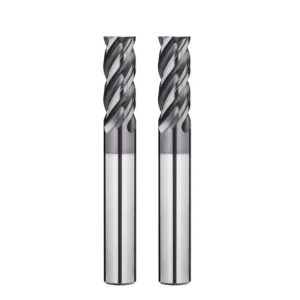
Rigidity Isn’t Bought—It’s Built
After 16 years of tool manufacturing, our most profound realization is this: no premium cutter can work miracles in a weak system. Rigidity is the cumulative result of a thousand tiny decisions. It’s the ultra-fine-grain substrate we select as end mills suppliers, and it’s the 1mm of overhang you decide to reduce at the machine. These details are the backbone of your production. Upgrading to a better carbide end mill to mask a shaky setup is a recipe for diminishing returns.
True stability comes from a reverence for mechanics and keen observation. We know the anxiety of balancing speed and precision. Rigidity is a closed loop: it starts with our refinement of core thickness and ends with your choices at the CNC control panel.
-
Are your HRC55 square end mills micro-chipping? Re-evaluate your overhang—there is likely room to tighten the setup.
-
Is your surface finish falling short in high-speed steel milling? Try shrink-fit holders or re-calculate the radial load in your climb milling paths.
-
Overwhelmed by supplier specs? Look past the catalogs. Focus on the micro-reinforcement of the edges and the consistency of the substrate.
Every machine, drawing, and material is unique. There is no “magic” formula. We invite you to reach out with your working conditions, drawings, or troublesome materials. Often, the solution is a subtle adjustment to force analysis. Let’s talk technical details and find that stability that defines engineering excellence.