
As a veteran with 15 years of hands-on experience in both tool manufacturing and on the machining floor, I’ve seen it all. We frequently receive distress emails from aerospace clients in Europe and North America. The subject lines are usually short, but the cost is massive: “We can’t boost efficiency for Ti-6Al-4V; our tool life is literally burning money.”
Last month, we resolved a classic case. A German aerospace supplier was machining titanium structural parts. They used solid carbide milling cutters rated for 10 parts, but the tools suffered catastrophic chipping by the third part. This highlights the biggest trap in titanium machining: low thermal conductivity. It turns the cutting zone into a furnace. Roughly 90% of the heat stays at the tool tip instead of leaving with the chips.
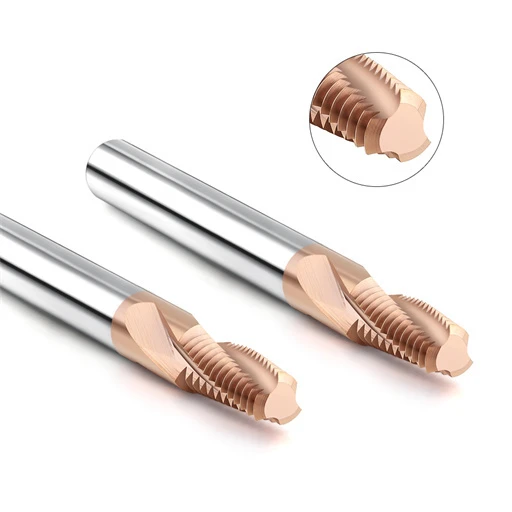
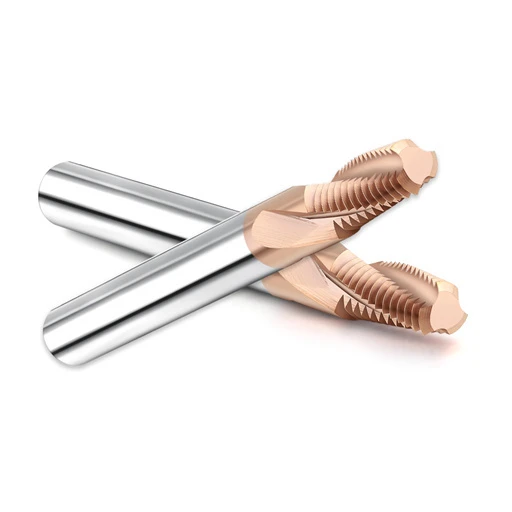
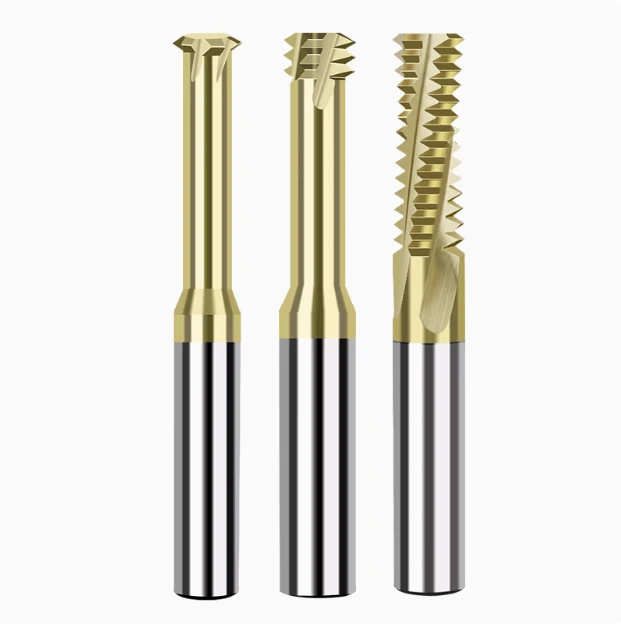
In our projects, we see peers obsess over precision but ignore “heat dissipation architecture.” Without heat removal, even the best substrate fails. We aren’t here to recite textbooks. We’re here to discuss how we design carbide thread mills and high-performance cutters with specific geometries and internal cooling to aggressively “chill” the tool tip. For us, tool life optimization is a strategic battle fought over every micron of the cutting edge.
When facing titanium—a material that is both sticky and scorching hot—will you just dial down your parameters to scrape by, or are you ready to unlock your machine’s true potential?
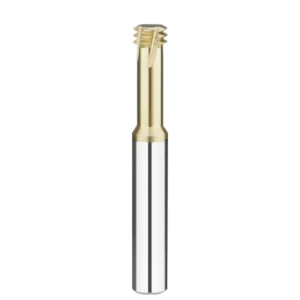
Why Traditional Carbide Milling Cutters Fail in Titanium (Our Field Observations)
Our lab is often piled high with “gruesome” failed tools returned by customers. Most users blame lack of impact resistance. However, 15 years in the field tells us the root cause is usually heat, not force. If you use standard carbide milling cutters on titanium, the tool doesn’t just wear—it burns. While titanium stays strong at high temperatures, the tool substrate succumbs to relentless thermal stress.
We once studied a facility machining aircraft engine parts. The client found the tool tip annealed (lost its hardness) far faster than expected. This proved that without a design tailored for titanium’s low tolerance, fine-tuning parameters is just treating the symptoms. In traditional machining, chips carry heat away. In titanium, that physical law is broken. We must fundamentally re-evaluate milling cutter types for these extreme conditions.
The “Heat Trap” Effect: Low Thermal Conductivity of Titanium Alloys
If you are used to machining aluminum or steel, you know chips carry away over 70% of the heat. With Ti-6Al-4V, that doesn’t happen. Titanium’s low thermal conductivity traps heat like a snare, surging it back into the cutting edge. This “heat trap” causes temperatures at the edge of a carbide milling cutter to skyrocket to over 800°C in seconds.
Once you hit that threshold, the cobalt binder in the carbide softens. This isn’t simple wear; it’s structural failure. Those brilliant sparks you see through the window are a warning: your tool is losing its hardness. Our first goal in technical support is always to check if the heat dissipation pathways are blocked. Heat accumulates faster than you think.
Chemical Affinity: When High Temperatures Lead to Tool-Workpiece Welding
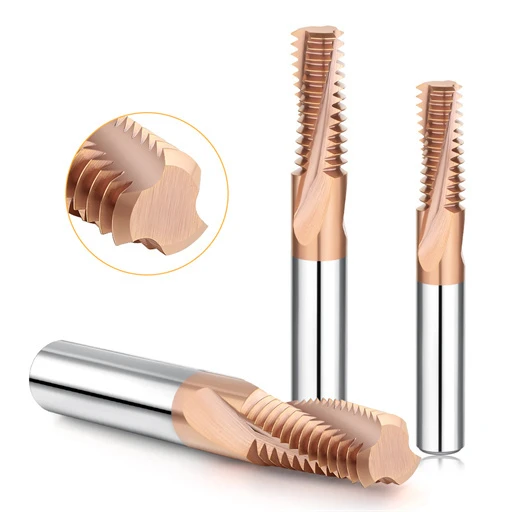
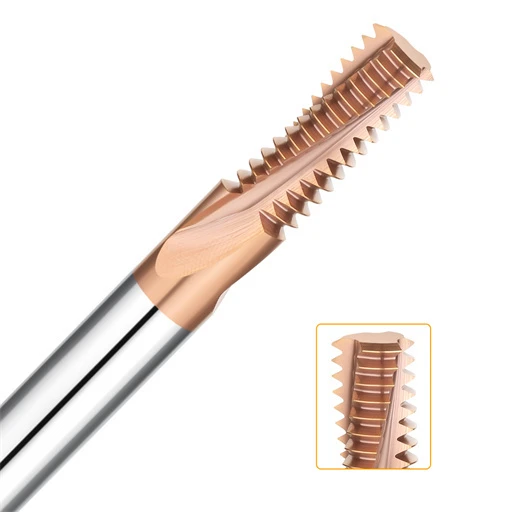
We also frequently see a nasty version of BUE. Titanium is chemically reactive at high temperatures. It loves to “weld” itself onto the cutting edges of carbide thread milling cutters. This micro-welding destroys the coating and eventually tears away the substrate—a process called “flaking.”
This is worst when machining threads or small holes. We recently analyzed failed thread mills for a medical device maker. Under the microscope, the teeth were packed with re-solidified titanium. Our conclusion? Without chemical inertness or anti-stick coatings, no tool survives. You must re-evaluate the lubrication in your chip evacuation channels.
How Radial Engagement Directly Impacts Heat Accumulation
Many operators use a large radial depth of cut (Ae) to chase efficiency. In titanium, that’s a recipe for disaster. Our tests show that radial engagement dictates how long the tool stays in contact with the workpiece. If the arc of engagement is too large, the tool has no time to “breathe” or dissipate heat in the air or coolant.
We recommend “shallow radial cuts and deep axial cuts.” This minimizes the time the edge spends in the cut and maximizes its time cooling down. It might look like you’re taking smaller bites, but by increasing speed and feed, your overall removal rate becomes much more stable. Have you ever tried reducing the depth of cut to save a tip, only to find the heat still got through?

Design Features of the Best Milling Cutters for Titanium Heat Management
In our shop, we have a saying: “Tool geometry is your best heat sink.” You can’t expect standard tools to handle titanium. A high-caliber carbide milling cutter must be engineered as a precision thermal exchange system. We design it to interrupt the heat path by changing how the edge hits the workpiece.
We once helped a client machining impellers. Their tool tips were turning purple even at the lowest settings. We found that symmetrical designs at high speeds create periodic impacts that concentrate heat. By switching to an asymmetrical structure, we dropped the cutting zone temperature by nearly 150°C. Minute design details make or break thermal management.
Differential Pitch and Variable Helix: Breaking Resonance and Reducing Heat Spikes
Look closely at our high-performance cutters. You’ll notice the tooth spacing is unequal. This Differential Pitch is our secret weapon against harmonic vibration. Vibration doesn’t just ruin the finish; it makes the edge slam into the workpiece, creating “heat spikes.” Our variable helix design ensures each edge enters the material at a different angle, breaking physical resonance.
This makes the cut remarkably smooth. When you eliminate resonance, you prevent explosive heat spikes. Our tests show this asymmetrical structure significantly extends “red hardness” (high-temperature durability). It’s harder for us to manufacture, but it saves you a fortune in tool-change downtime.
Optimized Core Diameter: Balancing Tool Rigidity with Efficient Chip Evacuation
Designing for titanium is a constant trade-off: do we want a thick core for strength, or a thin core for chip space? Titanium chips are tough and hot. If the core is too large, chips clog the flutes and generate secondary friction heat. If the core is too thin, the tool deflects—leading to chatter.
We use an optimized parabolic core design. This gives the cutter rigidity at the base but provides massive chip room at the tip. The logic is simple: the faster chips leave, the more heat they take with them. If hot chips stay in the flutes for more than one rotation, that heat goes right back into the tool body.
Large Rake Angles and Polished Flutes: Reducing Friction Before Heat Starts
The best way to manage heat is to stop it at the source. We use larger rake angles than conventional tools. A sharp edge slices titanium like a scalpel. A dull blade crushes it. Crushing creates massive heat; shearing does not. We’ve proven this through countless simulations.
Finally, we mirror-polish our flutes. For carbide thread milling cutters, a low friction coefficient is vital. A rough flute acts like sandpaper; a polished flute acts like an ice rink. Heat-laden chips are flung away the moment they hit the tool. Which do you value more: a tool that looks “shiny,” or one that delivers silky-smooth chip evacuation in the cut?

Advanced Coating Technologies: The Shield for Your Carbide Milling Cutter
At our coating center, we often call the coating a tool’s “body armor.” But in titanium machining, this thin film is more than just a hard shell; it’s a precision thermal barrier. Based on our work with aerospace engine manufacturers, we’ve seen that even the best carbide milling cutters fail without a targeted coating. Without it, the substrate undergoes thermal softening from the extreme heat in the cutting zone, leading to immediate edge collapse.
We have invested heavily in researching the reactions between coatings and titanium. Many standard tools fail because the coating delaminates—it peels off—after just minutes due to a mismatch in thermal expansion. To combat this, we prioritize composite coatings with superior adhesion. The goal isn’t aesthetics; it’s about building a physical wall that blocks heat from penetrating the tool’s core. For any milling cutter type, the right coating strategy often decides the profit margin of the entire batch.
AlTiN vs TiAlSiN: Which Coating Actually Survives 800°C+ Environments?
Clients always ask: “Should I stick with classic AlTiN or move to the new TiAlSiN?” Our data shows that while AlTiN is a workhorse for steel, its protection drops off sharply above 750°C. For a milling cutter for titanium, we strongly recommend TiAlSiN.
The secret is the silicon. It forms a dense, amorphous silicon dioxide layer on the surface. This film stays stable even past 800°C, effectively blocking oxygen from eating into the tool. Our long-term monitoring confirms that TiAlSiN-coated tools show much higher oxidation resistance in high-pressure cutting. Yes, it costs more, but when you’re working with expensive titanium, you recoup that investment quickly through reduced downtime.
The Role of Nano-Layered Coatings in Dissipating Heat Away from the Substrate
Single-layer coatings often develop “through-cracks” from the constant thermal shock of titanium. We solve this with nano-layered structures—stacking dozens of ultra-thin films with different properties. In our carbide milling cutters, the interface between these layers stops cracks from spreading. More importantly, it changes how heat moves.
Instead of heat diving vertically into the carbide, this design forces it to dissipate laterally along the surface. In tests for a medical implant client, we found that nano-coatings reduced heat penetration into the substrate by 30%. This “heat diversion” is the secret to maintaining the “red hardness” of the cutting edge. Have you ever checked a failed tool and found the substrate blackened while the coating looked fine? That’s a heat penetration failure.
Why Coating Smoothness is Just as Critical as Hardness for Titanium
Too many people obsess over hardness and ignore surface morphology. In our shop, smoothness is just as important for heat management. Titanium is “sticky.” If your coating has microscopic droplets or grit, those spots become seeds for chip adhesion. Once the titanium sticks, friction heat grows exponentially, ruining the profile of your carbide thread milling cutter.
We post-treat every high-end tool to strip away microscopic protrusions. A mirror-smooth surface lets chips glide away like a skater on ice. By reducing frictional work, we stop heat at the source. If you look at a polished chip flute under a microscope, you’ll see why our tools don’t “scream” during a cut—the chips are evacuating effortlessly.
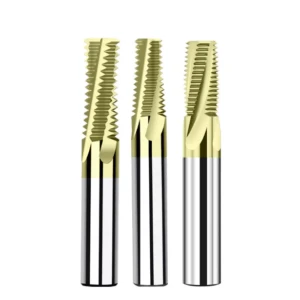
Through-Tool Coolant Strategies: The Most Direct Heat Dissipation Method
Roughly 30% of the titanium failures we see are solved simply by changing the cooling method. Relying on external nozzles is risky; at high speeds, the “air curtain” around the tool deflects the fluid. The coolant never even touches the cutting zone. That is why we integrate internal cooling into our high-end carbide milling cutters. It’s not just about moving fluid; it’s about using fluid dynamics to “flush” heat away.
We once worked on an aerospace casing project with narrow, deep grooves. With external cooling, chips rubbed the bottom of the grooves and sent heat straight back into the spindle. By switching to an internal system, we injected coolant directly onto the contact surface. This broke the thermal equilibrium instantly. For complex milling cutter types, a smart internal coolant design is more effective than any RPM increase.
Axial vs Radial Internal Coolant Outlets: Getting Fluid to the Shear Zone
We often debate with technical leads: axial or radial discharge? For drilling or blind holes, axial is king because it pushes chips up and out. But for side milling or contouring titanium, we prefer radial (side-facing) outlets on our milling cutters for titanium. This allows the fluid to follow the tool’s rotation and wedge itself directly into the shear zone.
This ensures every tooth is lubricated and cooled before it hits the material. Our tests show that radial delivery can drop edge temperatures by an extra 20% compared to axial in side milling. These design trade-offs are what separate an “okay” tool from an exceptional one.
High-Pressure Coolant (HPC): How 70 Bar Changes the Tool Life Game
If you have a 70 Bar (1,000 PSI) system, your perception of titanium machining will change. Low-pressure cooling just “bathes” the part; High-Pressure Coolant (HPC) breaks barriers. When fluid jets through the tiny nozzles of a carbide milling cutter at that pressure, it shatters the steam layer and hits the metal surface directly.
This pressure fractures tough titanium chips and ejects them instantly. In one landing gear project, we kept all parameters the same but boosted pressure from 20 to 70 Bar. The tool life nearly doubled. This “hydrodynamic lubrication” is an advantage no coating can match. Is your current pressure high enough to punch through the thermal barrier?
Dry Machining vs MQL: Lessons Learned from Aerospace Client Projects
We usually insist on wet machining for titanium, but we have explored MQL and dry cutting for specific projects. Dry cutting titanium sounds like suicide, but with the right carbide thread milling cutters and vibration technology, it can prevent micro-cracks from thermal shock. Sometimes the “quench” of cold fluid on a hot tool causes more harm than good.
MQL works great for finishing. It uses a fine oil mist to kill friction before heat starts. However, I’ll be honest: if you’re roughing out a lot of material, you need the “flood” of high-pressure wet cooling. We make our calls based on heat removal efficiency. Will you “drown” the heat with high-flow liquid or “suppress” the friction with a precise mist?
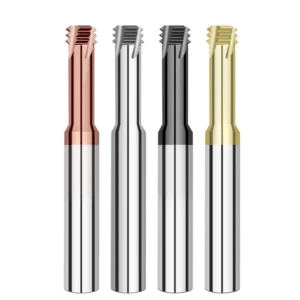
Machining Strategies to Maximize Heat Dissipation in Carbide Milling Cutters
When tackling the thermal challenges of titanium alloys, we know a high-quality tool isn’t enough. We frequently visit customer workshops and find that premature tool failure is rarely about tool quality. Instead, it’s about inappropriate machining strategies. If a cutting edge stays engaged for too long, even the advanced coatings on your carbide milling cutters will be “cooked.” We don’t just sell tools; we provide the “cutting tactics” to evacuate heat.
We once supported a high-volume titanium fastener project. The client tried to control heat by reducing spindle speed—a move that tanked their efficiency. We recommended a toolpath shift: moving from a brute-force approach to a more sophisticated feed logic. This ensured heat was expelled with the flying chips rather than accumulating in the tool body. When using different milling cutter types, strategic flexibility decides whether you finish the part or destroy the tool.
Trochoidal Milling (High-Speed Machining): Using a Small Arc of Contact to Cool the Edge
In our handbook, Trochoidal Milling is the “ace strategy” for deep slots in titanium. This method uses a circular trajectory to drastically reduce the contact angle—the arc of engagement—between the tool and the workpiece. In a trochoidal operation, the cutting edge of your milling cutter for titanium touches the material for only a split second. For the rest of the cycle, it passes through open air and coolant. This “cut-and-rest” rhythm is key to preventing thermal fatigue.
We tested this on a 5-axis center: traditional slotting discolored the tool tip in under a minute. Trochoidal milling—even with triple the depth of cut—allowed the tool to keep its original metallic luster. This strategy lets us significantly increase cutting speeds because each tooth has ample “breathing room” to dissipate heat. It requires fast processing and specialized CAM software, but it is the most efficient approach available today.
Climb Milling vs Conventional Milling: Controlling Chip Thickness to Dissipate Heat
When it comes to titanium, our philosophy is simple: always use climb milling. During climb milling, the edge enters the material at the thickest point and exits at the thinnest. This “thick-to-thin” action ensures most of the heat is carried away the moment the chip forms. With a high-quality carbide milling cutter, climb milling significantly reduces the frictional load on the edge.
Conventional milling, by contrast, starts at zero thickness and rubs its way into the material. This causes severe friction and heat spikes before the tool even fully bites. We’ve seen clients use conventional milling to avoid “tool dragging” on older machines, only to have the tip fracture from friction. Unless your machine has zero rigidity, always prioritize climb milling to safeguard the cutting zone. Have you noticed that chips from climb milling are often darker? That’s because they’ve successfully carried away more thermal energy.
Adjusting Step-Over (ae) to Maintain Constant Chip Load and Lower Tool Temperature
Controlling radial step-over (ae) is our primary dial for regulating “temperature.” When optimizing a carbide thread milling cutter or a large end mill, we watch the effective cutting arc closely. If the radial depth is too high, heat has no chance to escape. We recommend a smaller ae value paired with a higher feed rate. This “thin-and-fast” strategy ensures a constant chip load without excessive compression.
In a medical joint project, we reduced the radial depth to less than 10% of the tool diameter while increasing spindle speed. The result? Efficiency jumped 25% and tool life extended by 40%. This works because small step-overs leverage the “chip thinning” principle, preventing heat from lingering at the interface. This balance requires a machine with a fast dynamic response, but the thermal stability it provides is unparalleled. When temperatures rise, do you dare reduce your depth of cut to gain faster cycle times?
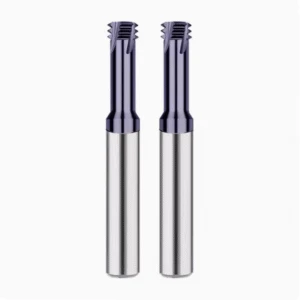
Real-World Case Study: 40% Tool Life Increase for an Aerospace Client
Our engineering team believes theoretical designs must be validated where the chips fly. Discussing heat dissipation in a lab isn’t enough; we prefer solving real-world “messes.” This case involves an aerospace supplier processing expensive structural parts. In titanium machining, a tool failure isn’t just a lost carbide milling cutter—it’s a scrapped workpiece. We understand that pressure.
We didn’t just push more expensive tools. Instead, we looked at the entire process chain to re-evaluate thermal energy flow. By analyzing failure residues and reverse-engineering the parameters, we found the right balance of efficiency and thermal load. This field-tested validation proves it: for titanium, stability comes from integrating geometry, coatings, and cooling strategies.
The Problem: Catastrophic Tool Failure in Deep Pocket Milling of Ti-6Al-4V
The client’s challenge was extreme: deep-pocket slotting in Ti-6Al-4V where the axial depth exceeded 3x the tool diameter (3D). Because the evacuation path was so long, hot chips were being re-cut at the bottom of the slot. As we’ve discussed with the “heat trap” effect, heat builds up fast in enclosed cavities. Their 4-flute cutter was suffering catastrophic edge chipping in under 15 minutes.
This thermal damage forced operators to halt production constantly for inspections. We observed that the coolant couldn’t penetrate the air barrier created by the high-speed rotation. The edges were essentially “dry cutting” in a furnace. If your tools fracture unexpectedly even after you reduce the feed rate, you need to re-evaluate your chip evacuation strategy.
The Solution: Switching to 5-Flute Carbide Thread Milling Cutters with Targeted Coolant
We broke convention here. We upgraded from a 4-flute to a 5-flute design with an unequal helix. Crucially, we borrowed a concept from our carbide thread milling cutters: targeted coolant nozzles. While this increased the cutting frequency, the unequal pitch dampened the resonance pulses. Most importantly, we adjusted the internal coolant channels. Instead of spraying aimlessly, the coolant now projects in a conical fan pattern that blankets the interface between the edge and the workpiece.
We also refined the toolpath to use a shallow radial depth and a deep axial depth. If you are machining deep slots in titanium, consider increasing the flute count to dissipate the thermal load. However, the flutes must be mirror-polished. If they aren’t, the increased pressure from more chips will just create new heat. We transformed “brute-force cutting” into a “high-frequency, cool-cutting” process.
The Result: Stable Production with Consistent Surface Finish and Lower Thermal Stress
The results were definitive: tool life increased by over 40%, and the surface finish achieved Ra 0.8 or better—eliminating the need for secondary polishing. Thermal monitoring showed the workpiece temperature stayed within a safe range, removing the risk of heat-induced deformation.
This is what we strive for: using meticulous heat control to bring predictability to the shop floor. If you are struggling with a titanium project or need a carbide milling cutter solution that can handle high-intensity tasks, we’d love to help. Whether you have complex blueprints or a tricky material grade, we can find the balance. Do you have operational data to share? Let’s find a breakthrough together through smarter tool geometry.