
Last week, a Tier 2 supplier in Germany—a long-time vendor to aerospace giants—called us. Their Chief Engineer was frustrated. His team was processing deep-cavity structural parts made from Grade 5 Titanium (Ti-6Al-4V). They had already burned through carbide milling cutters from three different suppliers. The results were disastrous: edges chipped within two hours, or the surface finish “crashed” during final passes. Their scrap rate was skyrocketing.
This scenario is all too familiar. In 15 years of tool manufacturing and on-site support, we’ve learned that the real pain point isn’t buying tools—it’s finding a milling cutter for titanium that survives an 8-hour shift. The low thermal conductivity and work-hardening of Grade 5 Titanium amplify any tiny flaw in a tool’s coating or geometry.
As veterans in this sector, we are more than just a wholesale CNC milling cutter supplier. We are engineers who get on the shop floor with calipers and vibration analyzers. We know that for our US and European clients, the true value of milling cutter tools isn’t the price tag; it’s the certainty that the tool runs “right out of the box.” In 2026, with parts becoming more complex and thin-walled, that reliability is non-negotiable.
Based on a thousand cutting trials and field feedback, we’ve selected five carbide tools that actually hold up. Whether you are side milling or running high-efficiency trochoidal paths, these tools dictate your uptime.
In this industry, we all know the math: what costs more—the tool, or the machine sitting idle all day?
Why We Insist on Specialized Carbide Milling Cutters for Grade 5 Titanium
In our workshop trials, we once tried machining a block of Grade 5 titanium with general-purpose tools meant for stainless steel. It was a failure. In less than ten minutes, the tool tip “annealed.” It softened because it couldn’t dissipate the heat generated by the chips. Titanium is “sticky.” The heat stays at the cutting zone and travels back into the tool. Without a specialized carbide milling cutter, the bond between the substrate and coating disintegrates instantly. We’ve seen too many spindles stop because someone tried to use a “universal” tool. In 2026, that is a production disaster.
Tool stability is our priority. When you’re cutting Ti-6Al-4V—an expensive aerospace staple—the part cost is staggering. Risking a $5,000 part to save $50 on a tool makes no sense. Using a dedicated milling cutter for titanium is your insurance policy. It ensures the cutting edge keeps its geometric rigidity, even when the material refuses to let the heat go.
Insights from Western Clients: The High Failure Rate of General-Purpose Milling Cutters
Last year, we helped a U.S. client troubleshoot a massive scrap rate. To simplify inventory, they had standardized on “all-in-one” milling cutter tools. Under the microscope, the problem was clear: severe “notch wear” along the edges. General-purpose tools compromise on edge reinforcement and flute geometry to stay “versatile.” On Grade 5 titanium, those compromises are fatal. They cause cutting forces to fluctuate, inducing chatter marks and making tolerance control impossible.
Then there is chip morphology. General-purpose tools often produce long, bird-nesting chips in titanium. These tangles wrap around the tool and block the coolant from hitting the cutting zone. This heat buildup causes the cutter to snap deep inside the part. We tell our clients: “universal” tools are just “universally mediocre” for titanium. They cannot handle the aggressive cycle times required in modern trochoidal milling.
Selection Logic for Substrates Based on Titanium Grade 5 Properties
As a wholesale CNC milling cutter supplier, we screen our tungsten carbide substrates at the source. Titanium demands a contradiction: the tool must be hard enough to resist abrasion but tough enough to handle heavy impacts. We skip cheap, coarse-grained substrates. Instead, we use ultra-fine-grained carbides with 10% to 12% cobalt. This specific blend ensures the edge stays sharp without catastrophic chipping, even under the high-stress environment of Grade 5 machining.
We even adjust the substrate based on the part’s wall thickness. For thin-walled aerospace components, we sacrifice a bit of hardness for better vibration dampening. This prevents harmonic “ringing” from chipping the teeth. To us, selecting a substrate isn’t about reading a datasheet. It’s about verifying that the microstructure survives hundreds of impact cycles. That fundamental material choice is what allows our tools to “go the distance” on Grade 5 titanium.
In-Depth Analysis: Top 5 Specialized Milling Cutters for Titanium Alloys
In the shop, we have a saying: “There is no universal tool—only the right tool for the job.” When you’re dealing with Grade 5 titanium, trying to use one cutter for everything from roughing to finishing is a fast way to burn through your budget. Based on years of supporting aerospace and medical clients, we know that segmenting your tasks and matching them to specific tool geometries is the only way to hit high yield rates.
The five tools below are our “workhorses” for overcoming titanium bottlenecks. These aren’t theoretical suggestions; they are the exact solutions we use to solve edge chipping, vibration, and dimensional drift in the field. Matching your milling cutter for titanium to your specific depth of cut and part geometry transforms a grueling process into a smooth, profitable operation.
The Heavy Lifter: Large Helix, Unequal-Pitch Carbide Milling Cutters
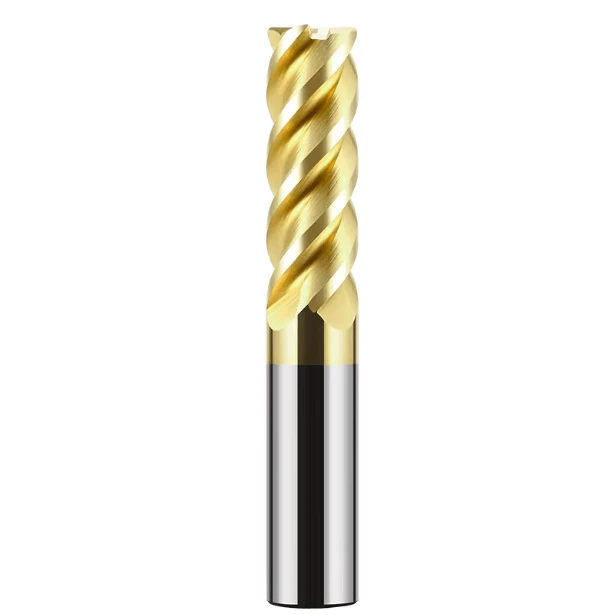
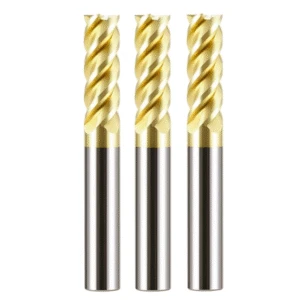
When you are hogging out material from a solid titanium billet, chip evacuation and vibration resistance are your biggest hurdles. We developed the unequal-pitch design specifically to kill the harmonic vibrations that Grade 5 titanium loves to trigger. By disrupting the rhythm of the teeth hitting the material, this carbide milling cutter suppresses chatter even under heavy loads. You will hear the difference immediately—the cutting sound is deeper and more stable, meaning you can push your feed rates higher with confidence.
Our tests show that a large helix angle (38° to 42°) is the sweet spot for pulling heat away from the part and into the chips. If you are focused on a high Q-value (Metal Removal Rate), this tool is your best bet for deep axial cuts. Just ensure your machine has the rigidity to match; on a “light” machine, the unequal spacing can cause balance issues—something we always double-check with our clients during technical setups.
The Finishing Pro: High-Precision Bull Nose Milling Cutters
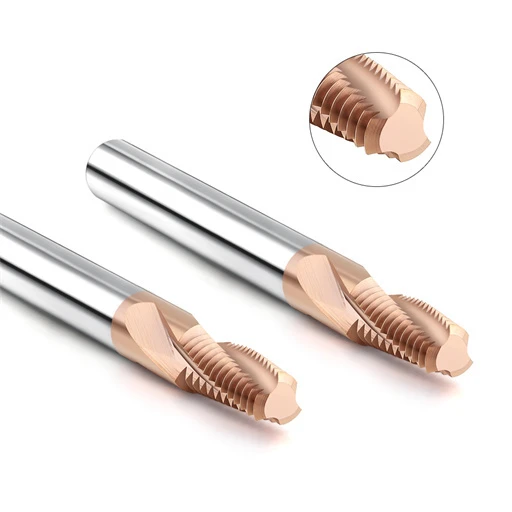
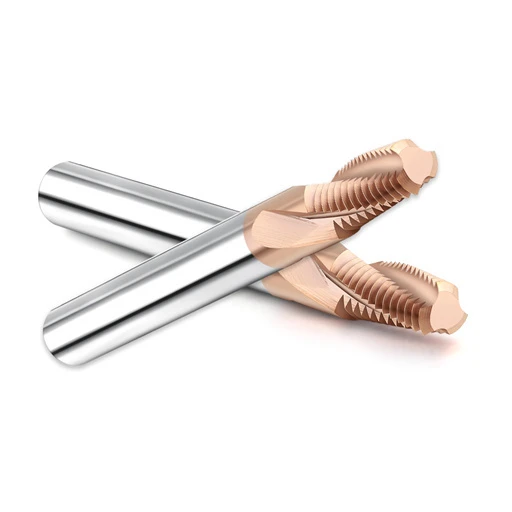
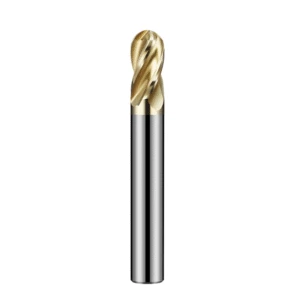
For complex 3D work like impellers or orthopedic implants, we almost always move to a bull nose milling cutter with a corner radius (R-angle). Flat-bottom mills tend to concentrate heat at the sharp corners, leading to micro-chipping. The bull nose geometry, however, disperses that force across the radius, significantly extending tool life. We recently optimized an implant project where switching to a radiused edge improved the surface finish by a full grade while doubling the parts-per-tool count.
The real-world advantage here is lateral feed. A bull nose cutter leaves a lower residual cusp height than a ball-nose mill at the same step-over. This means you can often eliminate extra finishing passes. In titanium, constant cutting force is everything. Unlike ball mills, where the center speed drops to zero, a bull nose maintains a consistent cutting velocity for that mirror-like finish your clients expect.
The HEM Specialist: High-Rigidity, Long-Flute Cutters for Titanium
If you are running High-Efficiency Machining (HEM) or trochoidal paths, short-flute tools won’t cut it. We designed this specialized milling cutter for titanium for the “small radial, large axial” strategy. By using a trochoidal toolpath, you engage the entire length of the cutting edge. This spreads the wear across the tool rather than killing the tip, and it keeps the heat confined to a very localized area.
The logic here is frequency over depth. To keep a long cutting edge from deflecting under high-speed impacts, we’ve beefed up the core diameter. You sacrifice a little chip room, but the gain in rigidity is massive for deep slots. If you haven’t tried a high-rigidity long-flute tool for trochoidal milling yet, you’re likely leaving 30% of your machine’s potential on the table.
The Micro-Medical Expert: Ultra-Fine Grain Carbide Milling Cutters
Machining micro-parts (under 3mm) in titanium is a different beast. Standard carbide is too brittle. For these applications, we use a substrate with a nanoscale grain structure. At this scale, even a tiny internal void in the metal can cause the whole edge to collapse. We’ve seen this in Swiss watch shops: under a microscope, a sub-par tool looks like a jagged saw blade before it even touches the part.
For micro-work, we focus on “honing” or edge passivation. Don’t be fooled into thinking sharper is always better. In Grade 5 titanium, an overly sharp micro-edge is fragile. We use precise micro-blasting to create a microscopic protective land. This ensures the edge doesn’t “shatter” the moment it hits the hard titanium skin. In the world of carbide milling cutter tools, these small details separate the pros from the amateurs.
The “Thermal Black Hole” Solution: Internal Cooling Bull Nose Cutters
If you are cutting at the bottom of a deep cavity where your coolant spray can’t reach, you are essentially “dry machining,” which is suicide in titanium. Our bull nose cutters with central internal cooling channels are built for these blind spots. By forcing high-pressure coolant directly to the cutting zone, we achieve instant cooling and use hydraulic pressure to blast chips out of the hole.
As a wholesale CNC milling cutter supplier, we’ll be honest: internal coolant tools cost more upfront. But in Grade 5 titanium, the cost of one snapped tool or a scrapped part far outweighs that premium. Our data shows that internal cooling can jump tool life by 40% in confined spaces. In titanium machining, whoever controls the temperature wins the job.
Engineer’s Notes: How to Evaluate Your Wholesale CNC Milling Cutter Supplier Like an Expert
With sixteen years in tool manufacturing, I’ve seen a harsh reality: glossy brochures often “fall apart” when they hit the spindle to cut Grade 5 titanium. As a manufacturer dealing directly with B2B clients, I believe you shouldn’t judge a wholesale CNC milling cutter supplier by the size of their factory. Judge them by how they handle the invisible details. A professional supplier should talk to you about residual stress, substrate porosity, and coating adhesion—not just recite marketing platitudes.
We always advise on-site inspections of quality control. In titanium machining, a minute tool defect is magnified exponentially. An expert supplier invests heavily in microscopic edge preparation. They know that only a tool that looks perfect under a microscope can deliver the cycle times you need. This rigor is the fundamental logic behind an efficient production line.
Extending Tool Life through Precise Coating Uniformity
In our lab, we found that 70% of premature failures in Grade 5 titanium come from coating spallation. Often, it isn’t the coating material that fails—it’s the lack of uniformity. When making a milling cutter for titanium, the nanometer-thick coating must be consistent across complex flutes and radii. If it’s too thick at the edge, the tool becomes brittle and chips instantly. If it’s too thin, the heat from the titanium alloy burns through the “armor” and destroys the carbide substrate.
To solve this, we use PVD technology with strict control over rotation frequency in the chamber. This ensures the coating adheres like a form-fitting suit of armor. Pro tip: Check the refraction colors of your tools under a bright light. If the color intensity varies across the tool or between batches, the coating is inconsistent. That variation means the tool won’t handle thermal shock evenly.
Three Technical Metrics That Can’t Be Faked
As a seasoned wholesale CNC milling cutter supplier, I look for three metrics that define tool quality:
-
Radial Run-out: For multi-flute cutters, uneven load distribution across the flutes is the fastest way to trigger chatter in titanium.
-
R-value (Edge Passivation): We use automated optical systems to ensure consistent edge rounding. This determines if you’ll face BUE in the first few minutes of cutting.
-
Cobalt-Phase Distribution: The uniformity of cobalt in the substrate dictates the tool’s fatigue strength under high-frequency impacts.
If a supplier can’t provide inspection reports or sidesteps these specs, their tools will likely be inconsistent. We perform 100% inspection or high-ratio sampling to ensure these metrics stay within tolerance. In heavy manufacturing, data speaks louder than promises.
Why Consistency Trumps “Spectacular” One-Time Performance
The most dreaded scenario in a shop isn’t a mediocre tool—it’s an inconsistent one. If your first carbide milling cutter finishes 50 parts but the second fails after 5, your production schedule is in chaos. For Lean Manufacturing, a tool that consistently hits 30 parts every time is better. Consistency means predictable costs and the security to run unattended.
Consistency is what separates second-rate shops from professional manufacturers. When we provide high-volume tools to our Western clients, we lock down raw material batches and process parameters. Whether you buy in January or the following March, the feedback from the machine remains the same. This stability reduces setup time and scrap rates, which is far more valuable than a marginal increase in top-end cutting speed.

Practical Strategies for Boosting Carbide Milling Cutter Efficiency
Our long-term collaboration with aerospace clients in the US and Europe shows that their primary concern isn’t unit price—it’s “risk resilience.” Boosting titanium efficiency isn’t just about cranking up the RPM; it’s a balance of mechanical equilibrium and thermal management. If your tool costs exceed 30% of your profit margin, your carbide milling cutter is likely running outside its optimal window.
Sometimes, the best strategy is to “advance by retreating.” By optimizing paths and angles, a 10% reduction in speed can lead to a 20% increase in total output by cutting down tool changes. In 2026, we focus on the entire chain: machine rigidity, workholding, and tool selection.
Bull Nose vs Ball Nose: The Efficiency Champion for Grade 5 Titanium
Many shops instinctively use a ball nose for slopes and contours. However, our tests show a critical flaw: the cutting speed at the very center of a ball nose is nearly zero. In “sticky” Grade 5 titanium, this causes catastrophic material adhesion. If you are finishing large areas, switch to a bull nose milling cutter of the same diameter. The R-angle maintains a constant surface speed, which prevents uneven heat distribution.
The bull nose is also structurally sturdier. In high-strength titanium, the slender tip of a ball nose deflects easily, causing chatter. If you use a bull nose for constant-height contouring, you’ll get a more consistent finish and better chip resistance. For curved surfaces where a ball nose isn’t mandatory, the bull nose is your overlooked efficiency champion.
Fine-Tuning Parameters: The “Sweet Spot”
Product manuals provide a “safe baseline,” but real-world titanium machining has a specific “sweet spot.” If you hear abnormal noise during deep-slotting, try increasing the feed per tooth (Fz) by 15% and reducing the cutting speed (Vc) by 10%. It sounds counterintuitive, but thicker chips actually carry more heat away from the cutting edge.
Also, look at your entry path. If you are still using a straight-line plunge, switch to a helical or ramp-in entry. This minimizes the impact load. Our data shows that smooth entry strategies reduce first-pass tool failure by over 30%. Watch your load meter—if it’s jumping, there’s room to optimize.
How to Stop Notch Wear
Notch wear is the “killer” that occurs at the depth-of-cut (Ap) line, where the tool rubs against the work-hardened surface of the titanium. If your carbide milling cutter always fails at the same spot, adopt a “variable depth of cut” strategy. By shifting the axial depth between passes, you move the wear zone along the edge, preventing a single stress point from snapping the tool.
Finally, check your coolant jet. High-pressure coolant must be directed exactly at the wear interface to flush away BUE. Don’t rely on trial-and-error for complex parts. If you share your drawings and material heat-treat status with us, we can help optimize the tool geometry and process path. The best tools are only as good as the logic behind the machining process.