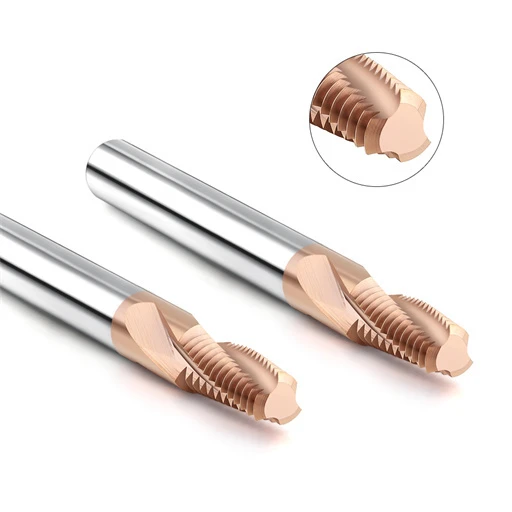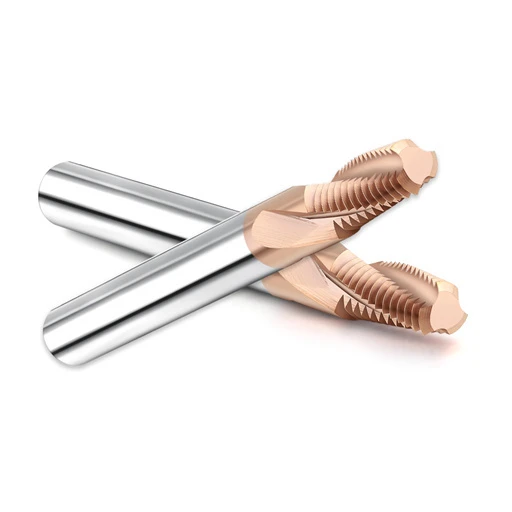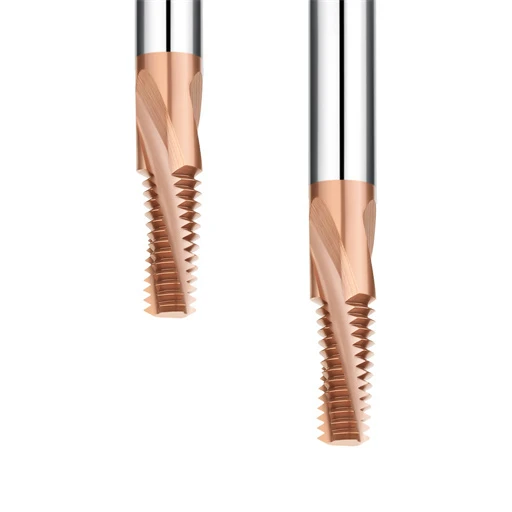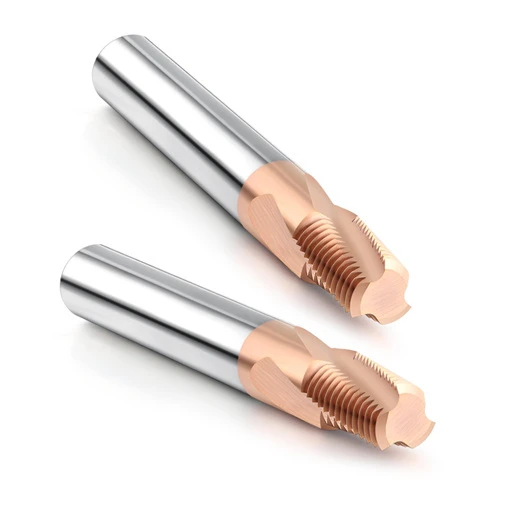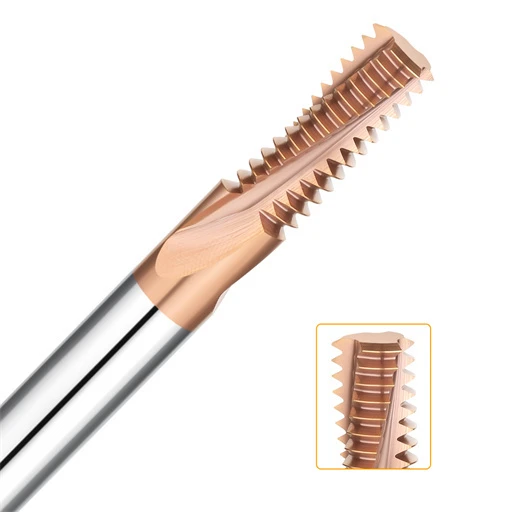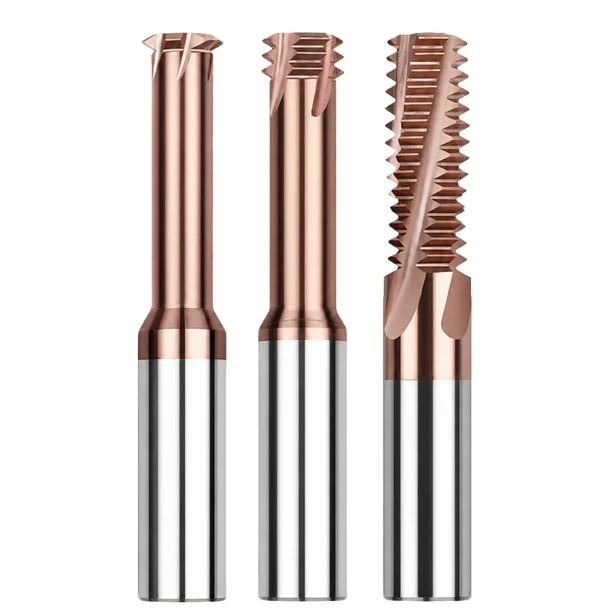


Last month, a client in Stuttgart, Germany, sent an urgent email regarding a batch of newly purchased carbide thread milling cutters used on high-pressure valve bodies made of 42CrMo4 steel. The machine operators were frustrated because the “Go” thread gauge would jam after entering only two threads, even though the surface finish appeared flawless.
As engineers with over 15 years of experience spanning cutting tool R&D and hands-on CNC workshop operations, we have encountered this scenario countless times. This is a classic case we frequently see in real-world steel thread milling projects. Many peers transitioning from traditional taps fall into a common trap: assuming that if the programming code is correct and the tool shows no obvious wear, the resulting threads must be within tolerance.
The reality is far more complex. When machining high-hardness pre-hardened steel (such as applications requiring an HRC55 thread milling cutter) or tapered American pipe threads (using an NPT thread milling cutter), factors like high tensile strength, cutting heat, and tool holder clamping rigidity directly impact microscopic quality. Whether producing small-batch prototypes or managing high-volume production lines using wholesale thread milling cutters, a robust re-inspection and defect diagnosis process is your ultimate safeguard.
If we simply scrap workpieces based on gauge results without investigating the root causes of dimensional deviations—such as tool radius compensation errors, tool deflection, and coating wear—we will forever rely on guesswork. When a Go/No-Go gauge “sounds the alarm” on a steel part, can you instantly tell whether the issue is tool deflection, a thread flank angle error, or malformed threads at the bottom of a blind hole?
Thread Gauge Inspection: Teaching Western Clients to Use Gauges to Troubleshoot Carbide Thread Milling Cutter Deflection
When communicating with technical supervisors across Europe and the US, we notice that many veteran machinists experience frustration during gauge inspections. Accustomed to the straightforward nature of traditional forming taps, they often assume a carbide thread milling cutter is undersized when the gauge binds. However, our experience shows that even carbide’s high rigidity cannot entirely eliminate minute deflection caused by cutting resistance in high-tensile steel.
To resolve this, we always advise workshops not to view thread gauges merely as tools for passing or failing parts, but as sensors for diagnosing cutting conditions. Due to the material’s elastic modulus, steel parts exhibit specific resistance characteristics during 3-axis helical interpolation. Our task is to use standardized gauge inspection to identify deformations caused by insufficient system rigidity, then apply precise compensation within the CNC system.
Go/No-Go Gauge Stuck Halfway? The Truth About Tool Deflection in Medium-Carbon Steel Machining
While supporting a Midwestern US client machining 4140 steel valve bodies, the Go gauge screwed in for three turns, then jammed halfway down. Yet, the tool presetter showed absolutely no issues with the tool’s pitch diameter. After troubleshooting at the machine, we confirmed the cause was classic radial tool deflection common to thread milling cutters for steels. As the cutter advances deeper into the hole, increasing overhang causes the tool tip to experience lateral cutting forces, making the bottom pitch diameter smaller than the opening.
To address this taper issue, we strongly advise against altering the machine’s global coordinates, which makes the opening too loose and leaves the bottom out of tolerance. Our solution is to incorporate a “Spring Pass” command into the macro program or CAM software to run the tool along the same path without adding feed. This cleanup pass removes the material missed due to the tool’s elastic recovery, allowing the gauge to slide smoothly to the bottom.
Insights on Fine-Tuning Pitch Diameter for HRC55 Thread Milling in Hardened Steel
Machining pre-hardened mold steel with hardness levels between HRC50 and HRC55 is a challenging task for any workshop. A Swedish mold manufacturer encountered this when using an hrc55 thread milling cutter on automotive stamping dies, where the high yield strength prevented the Go gauge from entering. Under these conditions, the carbide substrate undergoes intense, high-pressure contact, which can cause the pitch diameter to fail or the tool coating to flake off from thermal shock.
When dealing with out-of-tolerance thread dimensions in such hard steels, we rely on a micro-incremental compensation method. After verifying the machine spindle’s dynamic balance and holder clamping force, we instruct operators to gradually reduce the tool wear compensation value in the CNC system by increments of 0.005mm. Refining the thread profile through multiple trial cuts prevents aggressive adjustments from distorting the thread half-angle or chipping the cutting edge.
Why the “Three-Wire Method” is Essential for First-Article Inspection of Wholesale Thread Milling Cutters
As a tool manufacturer, we conduct rigorous 100% inspections using optical measuring systems on all bulk orders before shipment. However, when overseas machine shops deploy these wholesale thread milling cutters into high-intensity production lines, we insist that their QC departments use the three-wire method during first-article inspection. This is because factory inspection data reflects only the tool’s inherent geometry, whereas the first-article inspection reveals the integrated system dimension under real workshop conditions.
The strength of the three-wire measurement method lies in its immunity to interference from minor burrs on the thread surface or distortions in the profile angle. It provides the most accurate reflection of the groove depth actually cut into the steel workpiece. Comparing this data against standard parameters allows operators to predict the tool’s cutting performance on their specific equipment, establishing a solid baseline for wear compensation before high-volume machining.
Sealing Surfaces and Special Threads: Our Practical Leak-Prevention Standards for Inspecting NPT Thread Milling Cutters
In pipeline and hydraulic valve production, sealing thread inspection operates on a completely different level than standard mechanical joints. We often see fluid control clients whose parts pass smoothly with a standard plug gauge, yet experience oil seepage along the thread flanks at 20 MPa pressure tests. When using an npt thread milling cutter to machine these 1:16 tapered threads, inspection must go beyond verifying pitch diameter to ensure a perfect metal-to-metal interference seal.
Standard thread inspection methods only show localized cross-sectional data and fail to assess the continuity of the profile across the entire tapered surface. Therefore, we encourage clients to employ multiple practical standards for cross-verification during quality control. This proactive approach allows shops to completely eliminate potential leak risks—such as those caused by minute machine interpolation lags or irregularities in the tool path—before assembly.
NPT Thread Milling Cutter Taper and Profile: Preventing Assembly Leaks Using L1/L3 Step Gauges
We once assisted a Texas oilfield equipment builder using an npt thread milling cutter on thick-walled steel pipe fittings. The shop floor reported that while parts passed standard L1 plug gauge inspection at the hand-tight plane, actual assembly suffered a 5% failure rate during high-pressure airtightness tests. We recommended a combined approach using the L3 plug gauge, which reaches three threads deeper, and discovered that insufficient system rigidity made the deeper threads deviate into a loose “trumpet” shape.
Relying solely on the L1 gauge is insufficient for tapered pipe threads; you must compare the turn variation between L1 and L3 plug gauges. If the step depth difference deviates from standard values, it indicates thread taper distortion that cannot be fixed later by applying PTFE tape or sealant. To correct this, we make minute slope adjustments to the Z-axis toolpath’s lead-in radius and lead-out point in the CNC program, ensuring every turn fits the taper perfectly.
Observing Defects in the First and Last Threads of Steel Pipe Fittings Using an Optical Comparator
In mass production—especially with blind-hole fittings with limited tool clearance—the first and last threads are the weakest links for leak prevention. When using a steel thread cutter on high-toughness carbon steel, improper lead-in arc paths often flatten the tip of the first thread or leave residual chips that crush the final thread profile during retraction. These microscopic defects are nearly impossible to feel with standard plug gauges but create easy pathways for high-pressure fluid leaks.
Our standard diagnostic procedure for elusive leaks is to section the workpiece longitudinally via wire EDM and examine the profile under an optical comparator at 20x magnification. This projection clearly reveals the actual profile cut into the steel; comparing it against a standard template instantly shows if the first thread transition is smooth or if the final thread has burrs. Identifying these imperfections allows us to adjust tool entry angles in the program or fine-tune the cutting edge rake angle to fix defects at the source.
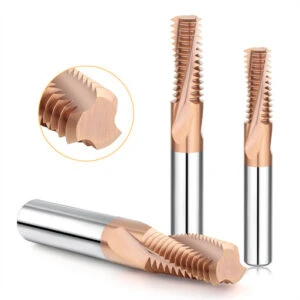
Surface Roughness and Microscopic Defects: Diagnosing Steel Thread Cutter Damage via Chips and Thread Surfaces
During routine shop floor walk-throughs, we often joke that chips and workpiece surfaces are the machine tool’s “skin” and “vital signs.” Many engineers focus exclusively on whether the thread passes the gauge, completely overlooking subtle features like faint burrs or a dull sheen on the thread flanks. When using a steel thread cutter on tough alloy or hardened steel, any minor edge wear, micro-chipping, or thermal annealing shows up immediately in the surface roughness.
Based on our experience diagnosing shop floor defects, analyzing thread flank patterns with a high-magnification loupe and evaluating chip morphology matches the accuracy of expensive laboratory testing. Cutting steel generates intense shear heat; when the cutting edge dulls, material deformation shifts from clean shearing to forceful extrusion. In this scenario, we observe microscopic defects to deduce if the system’s thermodynamic balance is disrupted, allowing us to intervene before total tool failure.
Preventing Thread Surface “Tearing”: Inferring Carbide Thread Milling Cutter Coating Wear from Flank Finish
We recently helped a British transmission manufacturer resolve a troublesome defect where internal threads in 30CrMnSiA high-strength structural steel felt rough to the touch despite passing gauge checks. We removed the active carbide thread milling cutter and examined it under an inspection microscope, discovering that the coating on the flank face had completely delaminated, causing minor plastic deformation on the substrate. This direct metal-on-metal contact from coating failure was the root cause of the surface tearing.
When carbide side-cutting edges machine steel, the coating (like TiAlN or AlCrN) acts as both a thermal barrier and a friction reducer to ensure smooth chip evacuation. If you notice the thread sidewall finish becoming dull or rough—even if dimensions remain within tolerance—your tool is signaling that its coating life has expired. We recommend replacing the tool early or reducing the linear cutting speed by 10–15% rather than trying to squeeze out the last few parts and risking a scrapped component.
The Risk of BUE at the Bottom of Blind Holes in Steel: Detecting and Preventing Thread Irregularities and Chipping on the Final Threads
Blind-hole threading is notoriously difficult, especially when machining low-carbon or mild steels that are highly prone to adhesion. An Italian client processing hydraulic cylinder bases noticed that thread quality at the opening was perfect, but the final two or three threads at the bottom consistently showed incomplete profiles and occasional chipping. By observing chip evacuation on-site, we concluded that a BUE was forming on the tool tips at the bottom of the hole.
As thread milling cutters for steels reach the deep bottom of a blind hole, the cutting zone experiences extreme heat and pressure, while internal coolant cannot effectively clear the restricted space. This causes tiny steel chips to cold-weld to the tool tip, forming a built-up edge that alters the original rake angle and deforms the bottom threads. When the tool retracts rapidly, this BUE breaks off, often pulling a chunk out of the carbide tip; we eliminate this risk by recommending a stepped feed or a 0.2-second dwell to blast chips away with air.
Shop-Floor Practice: Our Three-Step Fine-Tuning Method for Machine Operators
All diagnostic results from thread gauge inspections must ultimately be translated into specific adjustments at the CNC control panel. Through years of providing on-site technical support to Western shops, we notice that even veteran engineers face temptation to take shortcuts like altering global coordinate systems when threads fall out of tolerance. These crude adjustments often introduce new geometric errors, disrupting the dimensional relationships of other critical workpiece features.
To address this, we developed a standardized fine-tuning process for steel thread milling based on machine kinematics and material mechanics. We encourage our peers to evaluate this approach against their own workshop’s machine rigidity and setup conditions to integrate it into their quality inspection SOPs. This method relies on data-driven control to tame every micron-level deviation encountered when using a steel thread cutter on demanding materials.
Step 1: Correctly Adjusting Tool Radius Compensation (Wear Offset) in the CNC System Based on Gauge Feedback
When inspection reveals that the “Go” gauge binds while the “No-Go” gauge indicates an oversized pitch diameter, the safest point for fine-tuning is the tool radius wear offset. If you are processing standard carbon steel and find the threads are too tight, you can input a negative wear offset value like -0.01mm. This prompts the machine to shift the path of your carbide thread milling cutter slightly outward during the G41 cutter compensation command without changing the initial geometry setting.
We frequently emphasize to operators that wear offset adjustments must follow the principle of incremental, minute changes rather than aggressive adjustments. After each adjustment to the wear offset value, run a single-block test cut and re-measure with your Go/No-Go gauges to ensure the pitch diameter shifts linearly. This rational approach to machine setup helps you avoid scrapping expensive workpieces due to accidental over-cutting caused by blind guesswork.
Step 2: Using the “Spring Pass” Technique on HRC55 Pre-hardened Steel to Eliminate Interference
Modifying offsets alone does not always resolve the issue of carbide tool deflection under heavy radial cutting forces. If you are using an hrc55 thread milling cutter on hardened mold steel or struggling with chatter in deep holes, try commanding the machine to re-trace the original path without altering the radius compensation. When machining high-hardness steel, the material’s yield strength causes the entire system to deform under load, leaving a minute amount of un-cut material behind.
The beauty of the spring pass technique lies in the fact that it introduces no additional depth of cut or thermal load. Instead, it leverages the tool’s natural elastic recovery to cleanly shave off the residual material left behind by previous cutter deflection. Customer feedback indicates that adding one or two cleanup passes allows a tight gauge to pass smoothly, improves flank surface finish, and removes work-hardened layers to extend tool life.
Step 3: Ensuring Absolute Zero Consistency with a Tool Setter When Replacing Thread Milling Cutters in High-Volume Production
In large-scale manufacturing, production bottlenecks frequently occur during tool-change transitions due to part-to-part variation. If you are managing a high-volume project that requires frequent replacement of wholesale thread milling cutters, you must establish a rigorous control process for zero-point drift using precise tool setters. Although our factory maintains tight profile tolerances, dynamic balance can be disrupted by spindle thermal expansion during high-speed operation or minute manual clamping variations.
After installing a new tool, we recommend measuring the static axial length and radial radius while also verifying dynamic radial runout using a test indicator. If the initial parts differ from those processed before the tool change, consider clamping torque or thermal displacement before questioning tool quality. For complex projects involving an npt thread milling cutter with strict sealing requirements, we welcome you to share your operating conditions, drawings, and material grades so we can collaborate on optimal process solutions.