
To be honest, in the medical device world, the phone call we dread most isn’t about a part being out of tolerance. It’s the email from a client saying: “Micro-cracks, invisible to the naked eye, were detected during validation. We’re returning the entire batch.”
A while back, we helped a long-standing client—a Western manufacturer of orthopedic implants—solve a nightmare involving 316L stainless steel bone plates. Their side-milling efficiency was hitting a wall, and tool life was all over the place. They were using standard, off-the-shelf 4 flutes end mill for stainless steel, but as soon as they pushed the feed rate, the material’s “stickiness” and work-hardening kicked in. The edges chipped instantly. We see this all the time: shops trying to tackle medical-grade alloys with general-purpose carbide CNC end mills, only to end up with high scrap rates and dead spindles.
As a carbide end mill for stainless steel supplier with fifteen years in the medical sector, we know the secret isn’t just “cutting fast”—it’s “cutting stably.” Medical components often involve thin walls and strict surface finish requirements. If your milling cutter for stainless steel doesn’t mitigate the heat-affected zone (HAZ), residual stresses will ruin the part before it even hits inspection.
In that project, we “tamed” the 316L by fine-tuning the unequal-helix geometry of our square milling cutter and applying a specialized nano-layered coating. This experience reminded us that in medical manufacturing, there is zero margin for error.
Have you ever felt that despair? You’ve optimized every parameter, only to scrap a high-value workpiece on the final pass because of tool vibration?
Conquering Work Hardening in Medical-Grade Stainless Steel: How We Select Substrates and Coatings for Carbide CNC End Mills
When machining 316L or 17-4PH, work hardening is the “invisible killer.” When cutting forces spike or tools wear out, many guys immediately drop the RPM. In our experience, that’s often the wrong move. We focus on the microscopic interaction instead. By optimizing the chip evacuation and edge reinforcement of our carbide CNC end mills, we ensure the flutes cut under the hardened layer rather than rubbing against it.
The key isn’t just tool hardness; it’s the thermal compatibility between the coating and the substrate. Especially in dry cutting or MQL, we prioritize nano-layered coatings. These act as a thermal barrier, keeping the heat out of the tool’s core. Yes, these tools cost more to make, but they save our clients a fortune by eliminating the residual surface stress that fails parts during QC.
Anti-Adhesion Performance of Carbide CNC End Mills in 316L Implant Machining
316L is incredibly “gummy.” In bone plate production, we often see flutes get choked with BUE. This kills chip evacuation. To fix this, we apply a high-angle polishing treatment to the flutes of our carbide CNC end mills. This drastically lowers the friction coefficient. Instead of “welding” themselves to the edge under heat, those noodle-like stainless chips slide right out.
We also keep a tight grip on edge preparation—specifically the passivation radius. We hold this in the micron range. If the edge is too sharp, it chips on entry; too blunt, and it just rubs the material. For complex medical cavities, using specialized low-affinity coatings prevents “witness marks” caused by tool changes. In medical implants, where biocompatibility is everything, a seamless finish is non-negotiable.
Why the tight tolerances of medical components preclude the use of inexpensive carbide substrates?
During R&D, some shops try to save money with generic carbide tools. They always come back to us eventually. The reason is simple: cheap substrates have uneven cobalt distribution and large grain sizes. In precision medical work, a radial runout of just 0.005mm at the tip can cause a total failure after just fifty parts because the substrate gives up under thermal fatigue.
We exclusively use high-density, nanocrystalline substrates for every square milling cutter we produce for the medical field. This ensures the tool stays rigid under high heat. Medical tolerances are often measured in microns. We’ve seen cheap tools lose their “shape” halfway through a run, leading to hole misalignment or slot widths that are out of spec. Choosing a high-quality carbide end mill for stainless steel supplier isn’t just about wear resistance; it’s about having the reliability to sleep soundly during a 12-hour unattended shift. Consistency is where the real value lies.

4-Flute End Mills for Stainless Steel: An Efficient Machining Solution for Medical Orthopedic Instruments
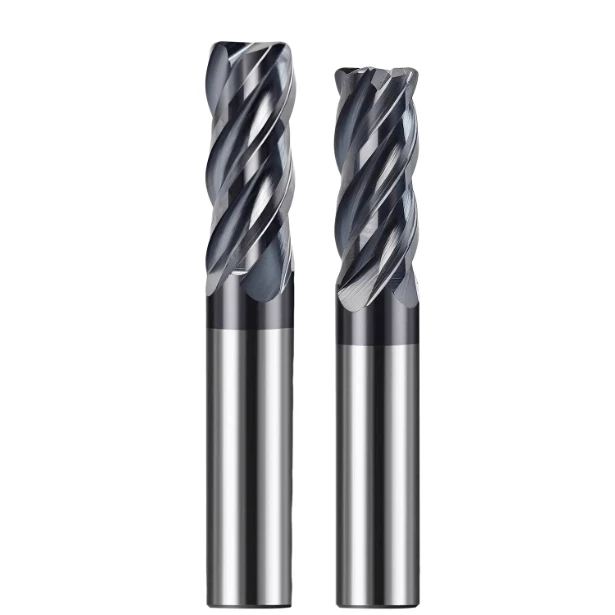
In medical orthopedic shops, the relationship between efficiency and surface quality is rarely linear. When you’re running high-volume bone screws or complex joint prostheses, the challenge is maximizing feed rates without sacrificing the surface finish. While 3-flute tools offer more chip room, we’ve found that the added rigidity of a 4 flutes end mill for stainless steel is decisive for tough alloys. This extra core strength keeps the tool trajectory stable, even during high-speed trochoidal milling.
In practice, we favor an unequal-pitch design. By disrupting the cutting frequency, we effectively kill high-frequency chatter. This is a game-changer for medical components with high length-to-diameter ratios, as it eliminates the vibration patterns that ruin part aesthetics. While 4-flute tools require tighter calculations for chip clearance, the boost in stability and edge sharpness is a necessary investment to meet rigorous orthopedic inspection standards.
Why We Insist on 4-Flute End Mills for Stainless Steel When Machining Bone Plates
Bone plate machining involves heavy side milling and contouring. Because these plates are so thin, structural deformation from cutting forces is our biggest headache. We insist on using a 4 flutes end mill for stainless steel primarily for its superior core strength. This prevents “walking” or deflection during high-speed orbital passes. When you’re milling 2mm to 4mm thin sheets of titanium or stainless, that rigid support ensures edge perpendicularity and eliminates the need for expensive rework.
Furthermore, our data from thousands of bone plates shows that 4-flute geometry dissipates thermal loads more evenly. Under medical-grade lubrication, this tooth distribution keeps the load per edge constant, which prevents micro-chipping from thermal fatigue. We’d rather refine our retraction paths in the CAM software than sacrifice precision for chip space. In the orthopedic world, a single vibration scratch can turn a high-value part into scrap.
Resolving the Conflict Between Vibration and Chip Evacuation in 17-4PH Surgical Instruments
17-4PH stainless is notoriously hard after solution treatment. When machining forceps or hemostats, the hardest part is balancing chip evacuation with stability. We once dealt with a severe resonance issue on a precision surgical scissor project. We solved the “choking” problem in deep cavities by using custom carbide CNC end mills and optimizing the ratio between the helix angle and flute geometry. Instead of chasing max chip volume, we tuned the parameters to produce fine, curled chips that evacuate smoothly without packing.
Deep, narrow cavities in surgical tools are unforgiving. If your tool lacks rigidity, vibration will destroy the finish and fatigue your tool holder. Our practical advice to clients is often to trade a bit of feed rate for a more stable cutting state—especially during simultaneous multi-axis moves on functional surfaces. By controlling force fluctuations, we make 17-4PH “docile,” ensuring the final jaw-alignment precision reaches world-class standards.
Precision Slot Machining and Corner Finishing: The Application of Square Milling Cutters in Surgical Robot Components
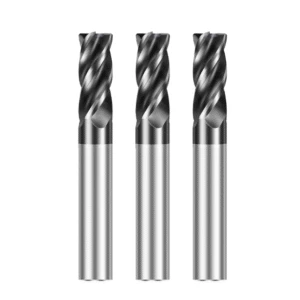
In surgical robot transmission assemblies, slot fit determines the responsiveness and backlash of the entire robotic arm. We recently machined a batch of stainless sliders where the slot perpendicularity had to be nearly perfect. In these cases, radial rigidity is the only thing that matters. If your tangential forces are uneven, a standard tool will deflect, creating a “tapered” slot where the bottom is narrower than the top. In robotic assembly, that’s a total failure.
To hit these specs, we use a reinforced core for our square milling cutter, trading some chip space for a higher section modulus. We always recommend a “layered trochoidal” strategy rather than trying to hit full depth in one pass. By reducing the contact area on each pass, we minimize the deflection caused by cutting resistance. It might take slightly longer per cycle, but it’s much faster than manually compensating for dimensional errors or scrapping parts.
How Square Milling Cutters Maintain 0.01mm Perpendicularity at High Aspect Ratios
When you’re dealing with slots 5x or 8x deeper than the tool diameter, maintaining a 0.01mm tolerance is a delicate balancing act. We tell our junior engineers: don’t blindly follow the speeds and feeds in the catalog. For deep surgical robot slots, we typically use a square milling cutter with a tapered-neck. This uses the rigidity of the shank to support the flexibility of the tip. We’ve seen a tiny 0.5-degree taper provide a qualitative leap in vibration resistance.
Path optimization is the other half of the battle. In the finishing stage, we leave a tiny allowance and use climb milling to push the cutting forces toward the workpiece’s fixed reference. In a recent actuator housing project, this technique allowed us to hold perpendicularity on a 20mm deep slot to within 0.008mm. That level of detail is what makes “silky-smooth” robotic movement possible.
Expertise in Micro-Edge Treatment for Square Milling Cutters Under High-Gloss Requirements
In medical manufacturing, “clean” isn’t just about Ra values; it’s about the micro-texture. Any residual tool marks are potential breeding grounds for bacteria. For high-gloss finishes, we subject our carbide CNC end mills to secondary fine-polishing. Unlike standard sandblasting, we use a suspension polishing technique that removes micro-cracks from the initial grinding stage. This makes the tool “scrape” rather than “tear,” creating a mirror-like reflectivity.
We’ve learned that obsessive edge sharpness can be a trap. An edge that is too sharp will deform the second it hits high-toughness stainless. Instead, we design a minuscule, polished negative chamfer. This acts as a physical barrier that stabilizes heat and prevents thermal stress from leaving oxidation marks on the part. Feedback from our European and North American clients shows that tools with this micro-treatment produce parts with significantly better corrosion resistance—a must-have for clinical settings.
Establishing a Stable Medical Supply Chain: Finding a Qualified Supplier of Carbide End Mills for Stainless Steel
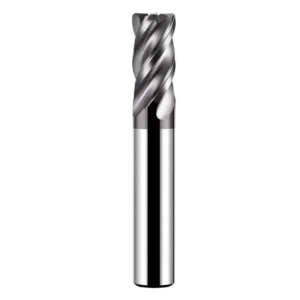
In medical device manufacturing, supply chain stability keeps production managers awake more than the unit price of a tool. We’ve seen many shops in North America and Europe switch suppliers to save a few dollars, only to pay a massive price during the validation phase. Stainless steel machining is incredibly sensitive to thermal stress; therefore, a qualified partner must offer process certainty, not just a piece of carbide. We believe true stability comes from end-to-end monitoring—from raw material purity to precise coating thickness control.
When vetting partners, prioritize their grasp of medical regulatory standards. For example: do their residual coolants or packaging materials meet your cleanliness specs for implant-grade parts? As a specialized carbide end mill for stainless steel supplier, we know this isn’t just a technical detail—it’s a compliance requirement. The best suppliers provide complete batch traceability and wear-prediction models. These are the pillars that allow a shop to become a true “Lighthouse Factory.”
Why Batch Consistency is the Lifeline of Medical Manufacturing
In this industry, “surprises” are the enemy. Imagine validating a complex 5-axis process for surgical forceps, only to have a new batch of tools—with a tiny micron-level deviation in the hone radius—start leaving burrs on every part. Under strict medical quality systems, that inconsistency triggers a total re-validation. Our mission is to eliminate that variable. We ensure the tools you buy in January perform exactly like the ones you buy in December, with identical cutting force and heat signatures.
We run sample cutting tests on every batch, monitoring torque fluctuations in 316L stainless. We’d rather scrap a sub-optimal batch at our factory than let a customer risk a failure. Machining stainless steel is a battle against vibration; batch inconsistency is usually what breaks the equilibrium. Pushing for absolute consistency is the only way to keep a medical line running with “tedious” but profitable efficiency.
Technical Support: Optimizing Cycle Times for Stainless Surgical Scalpel Handles
Often, customers don’t just want a new tool; they want to find the three minutes lost in their cycle time. For high-volume scalpel handle projects, we go deep—analyzing chip morphology and coolant nozzle positioning. By pairing specialized carbide CNC end mills with dynamic milling paths, we’ve helped clients cut roughing cycles by as much as 35%. This isn’t just about cranking the spindle speed; it’s about ensuring the tool maintains a constant load to unlock the machine’s full potential.
Real technical support isn’t just a phone call with recommended parameters. It’s about solving complex problems on the floor. For deep-cavity handles, we might fine-tune the helix angle to balance axial pull forces based on your specific fixturing. This level of engagement prevents premature tool failure caused by weak process planning. For shops chasing the lowest cycle times, this real-time feedback loop is the true benchmark of a manufacturer’s caliber.
Addressing Pain Points: Insights from Our Technical Reports for Western Clients
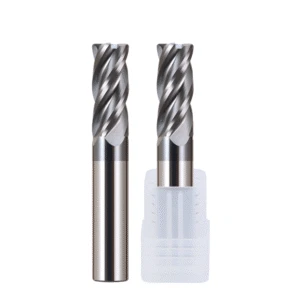
Whether a shop is in Chicago or Stuttgart, the challenge remains the same: how to achieve consistency in stainless steel without killing the surface finish. In our technical reports, we look beyond cutting parameters; we analyze the correlation between tool force and the fatigue life of the component. Our front-line data shows that the solution usually isn’t more machine horsepower—it’s the control of those few microns at the cutting edge.
If your 304 or 316L parts are failing inspection due to micro-cracks or heat-affected zones (HAZ), your cutting load is likely too concentrated. We’ve found that optimizing the tool path to disperse thermal stress is far more effective than buying a more expensive machine. We turn every failed case study into a standardized technical spec. This “science of failure” helps our clients stay stable during rigorous FDA or CE audits.
Eliminating Burrs: Optimizing Geometry for Specialized Milling Cutters
For minimally invasive surgical tools, the cost of deburring can exceed the cost of machining. Plus, manual deburring often leads to dimensional errors. The root cause of burrs is plastic deformation at the end of the cut. If you see “flag-like” burrs on your edges, the axial rake and helix angle ratio is likely off. We use an unequal helix design to change the direction of chip evacuation, creating a clean, crisp fracture exactly when the milling cutter for stainless steel exits the cut.
Optimizing angles is about the finish, not just the speed. We once helped an endoscope manufacturer by fine-tuning a relief angle by just two degrees. Combined with an edge-strengthening treatment, we eliminated the electrolytic polishing step entirely. If you’re still deburring by hand, look at your tool geometry. Have you sacrificed sharpness for rigidity? Finding that balance is what separates industrial automation from a manual workshop.
Extending Tool Life in Oil-Free and MQL Environments
To meet cleanliness standards, many medical shops are moving to dry cutting or MQL. This is “operating without a safety net.” The thermal shock to carbide CNC end mills is immense. Our data shows that switching from emulsion to MQL causes 17-4PH tool-tip temperatures to spike. If you’re making this transition, watch for coating spalling—it’s the first sign of thermal fatigue.
In oil-free environments, coating density and substrate thermal conductivity matter more than simple wear resistance. We once customized tool holders with thermal dissipation channels for a client, narrowing tool-life variation to within 5%. If you’re seeing premature tool failure in deep cavities, let’s talk. Often, a minor tweak to the coating or the step-over strategy can solve a problem that has plagued your shop for weeks.
Is your current machining center stuck at an insurmountable point on its tool-wear curve?