
Last autumn, a German client specializing in precision die-casting molds for top-tier automotive brands approached us. They were struggling with mold cavities hardened to HRC 62–65. Their previous supplier’s tools lasted under two hours, and insufficient rigidity caused tool deflection when clearing deep corners. During a video call, their engineering director stated a hard truth: “We don’t just need a cheap invoice; we need batch consistency. Cutting well with the first tool isn’t the achievement—it’s when the thousandth tool performs exactly like the first that we trust you with our brand name.”
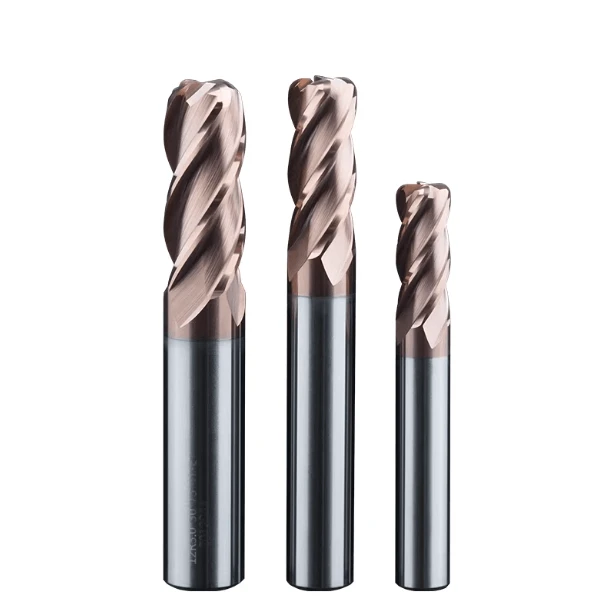
This rigorous demand for tool consistency is a core pain point we have repeatedly solved throughout our decade-plus experience in R&D for hardened steel applications. As a specialized hrc65 end mills manufacturer, we know that standard off-the-shelf tools quickly fail under extreme mechanical stress and thermal shock. When overseas brands look for premium oem/odm services for end mill bits for hardened steel, they look beyond unit prices. They look for micro-grain substrates, variable helix angles, and the engineering expertise required to build a rigid hrc65 4 flutes long neck end mill for deep-cavity hard milling.
Instead of dry textbook formulas, we want to share the practical geometric parameters we have mastered using Walter 5-axis grinders, Zoller inspection systems, and custom PVD coatings. We will also discuss how our high-finish finishing end mills help clients eliminate costly EDM processes entirely. In an aggressive global supply chain, a price war is a race to the bottom. Do you really want your clients paying for machine downtime just because of poor coating adhesion?

Meeting the Rigorous Demands of European and American Clients for HRC65 End Mill Consistency
In hard milling, a machine operator’s biggest nightmare isn’t short tool life, but inconsistent tool life. When milling hardened mold steel up to HRC65, the cutting zone endures massive mechanical stress and searing heat. Under these extreme conditions, even a microscopic deviation in tool geometry can leave catastrophic scratches on a flawless workpiece. When Western buyers evaluate a manufacturer, they look at tools running continuously for a dozen hours, knowing that any slight material defect will trigger sudden, costly failures on the shop floor.
To eliminate this uncertainty in mass production, we push our manufacturing tolerances far beyond traditional toolmaking limits. Every step—from raw carbide rod selection and cutting-edge honing to the exact deposition rates of PVD coatings—runs on ultra-strict control loops. Achieving long-term stability when machining high-hardness parts requires strategic trade-offs across the entire production chain. We willingly sacrifice a fraction of peak initial cutting speed to guarantee that every batch of hrc65 end mills delivers identical, predictable performance.
From Rods to Coatings: Practical Quality Control to Avoid the “First Tool Works Great, Second Tool Chips” Scenario
If you have ever seen a tool perform flawlessly only for the next identical piece to chip within thirty minutes, the root cause started at the raw material stage. When machining high-hardness materials, we maintain obsessive quality standards regarding the grain size and cobalt distribution of our tungsten carbide. Standard tools often utilize sub-micron substrates for general-purpose versatility. However, high-hardness machining demands ultra-fine grains specifically in the 0.2 to 0.4-micron range to prevent localized stress concentration.
Any microscopic clustering of hard phases or carbon porosity within the substrate acts as a structural flaw, causing the tool to shatter instantly under heavy cutting loads. We also exercise strict control over thermal residual stresses generated during the grinding process. Without precise stress-relief heat treatment after edge grinding, internal forces compound with external cutting loads. By conducting random metallurgical inspections and hardness gradient tests on every batch, we ensure our end mill bits for hardened steel resist premature micro-chipping.
Why, as an HRC65 End Mill Manufacturer, We Insist on European Fully Automated 5-Axis Grinders and Micron-Level Inspection
A common saying in our workshop is: “Poor equipment cannot produce a consistent, high-end tool.” As an established hrc65 end mills manufacturer serving premium overseas markets, we rely on high-precision European 5-axis CNC grinders from Walter and Anca because of their exceptional thermal stability. During continuous grinding operations lasting tens of hours, machine spindles and guideways generate friction heat. Without a top-tier thermal compensation system, the tool’s outer diameter and helix angle experience micron-level drift.
Beyond premium grinding equipment, our digital inspection protocols serve as a critical quality safeguard. Before leaving our factory, every single tool in our precision finishing lines undergoes a comprehensive, micron-level inspection using Zoller non-contact optical measuring machines. We rigorously verify radial runout, core thickness tolerance, and flank symmetry. If the height difference between cutting edges exceeds two microns, one edge will bear double the load during high-hardness cutting, triggering rapid, catastrophic tool wear.
Addressing North American Brand Pain Points: Coating Adhesion and Edge Preparation for Interrupted Cutting of High-Hardness Steel
North American clients frequently send blueprints featuring demanding interrupted cutting conditions, such as keyways, internal splines, or complex stepped pockets. As the tool rotates at high speeds, repeatedly entering and exiting hardened steel, the cutting edge suffers intense mechanical impacts and rapid thermal cycling. If the cutting edge is too sharp, it quickly chips under these massive impact forces. Conversely, applying a nano-coating directly to a razor-sharp edge creates stress concentration points that cause large-scale delamination.
To overcome this challenge, we implement specialized edge passivation and preparation processes. Before the tools enter the PVD furnace, we use precision blasting or drag finishing to engineer a specific micro-radius or chamfer on the cutting edge. This step makes the edge slightly rounded, significantly enhancing its impact resistance. By pairing this geometry with a silicon-rich AlTiSiN ultra-heat-resistant nanocomposite coating, we achieve an unbreakable metallurgical bond, ensuring our specialized finishing end mills cut cleanly without peeling.
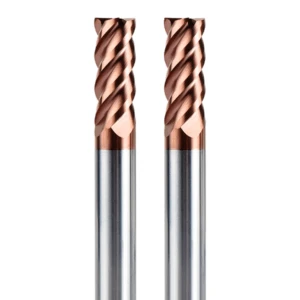
Customizing HRC65 4-Flute Long-Neck End Mills for High-Precision Cavity Machining
Clearing corners in deep slots and narrow cavities of hardened mold steels is a constant battle for any machine shop. When dealing with materials up to HRC65 and using long-reach tools that extend dozens of millimeters, you quickly hit physical limits. The excessive tool overhang drastically slashes rigidity, triggering the shop floor’s most hated nightmares: tool deflection and localized chatter. These intense vibrations ruin the surface finish and can completely shatter a fragile cutting edge within seconds due to cyclic stress.
As tool manufacturers with extensive floor experience, we know standard tools stand no chance in deep, high-hardness cavities. To solve these real-world challenges, we completely rebuild the tool’s geometry, rebalancing the core thickness, chip flutes, and neck transition zones. By customizing the overhang taper, we help machine shops suppress the structural chatter common in high-hardness cutting. Our rigid, engineered hrc65 4 flutes long neck end mill setups keep harmonic vibrations well within a controllable range.
Non-Standard Customization of Overhang and Neck Taper: Our Expertise in Anti-Vibration Clearance Design for Precision Mold Corner Clearing
When machining dead corners or narrow slots in deep cavities, the mold’s geometry dictates your tool overhang, leaving engineers zero room to maneuver. Based on the physics of cantilever beams, tool deflection increases with the cube of the overhang length. This means even a tiny increase in reach causes a catastrophic drop in rigidity at the tool tip. Whenever we receive a request for a custom hrc65 4 flutes long neck end mill, we never rush into grinding; we first model the workpiece structure to replace straight necks with tapered ones wherever possible.
This specialized tapered neck design significantly increases the section modulus at the tool’s base, neutralizing micro-vibrations at the source. In many real-world mold-clearing scenarios, we advise clients to modify their toolpaths to accommodate just a 0.5-degree neck taper. We understand that under the extreme conditions of cutting high-hardness steel, this subtle geometric choice determines whether the cutting edge glides smoothly through a tight corner or snaps instantly due to severe deflection.
Optimizing Core Parameters and Chip-Holding Capacity for 4-Flute Long-Neck End Mills in Deep-Slot Machining of HRC65 Hardened Mold Steel
In hard milling narrow, deep slots, choosing the right tool involves a tough trade-off between tooth density and chip evacuation space. While machinists prefer multi-flute tools for higher feed rates, traditional four-flute designs used at deep depths suffer from insufficient chip space. This traps chips at the slot bottom, leading to recutting, chip jamming, and sudden tool breakage. To keep the high rigidity of a four-flute design while fixing this flaw, we apply precise, micron-level adjustments to the core diameter and flute capacity.
Based on the actual radial and axial depth of cut (Ae/Ap) reported by our clients, we apply an asymmetric polishing treatment to the flute interiors. This ensures that the fine, granular chips generated during high-hardness cutting are rapidly blown out of the slot by air blasts or atomized coolant. This geometric trade-off requires slightly reducing the absolute core thickness of our end mill bits for hardened steel, but field feedback proves that smoother chip evacuation is far more effective at preventing catastrophic breakage than raw rigidity alone.
Customization Case Study (Western Europe): Minimizing Tool Deflection During Long-Neck, Deep-Cavity Milling via Precise Diameter Control
Last year, a precision mold manufacturer in Western Europe contacted us regarding a critical issue during a 12-hour deep-cavity finishing operation on a hardened mold. Unavoidable tool deflection during the long axial cut caused a verticality error exceeding 0.015 mm, scrapping the high-precision injection mold. The client was highly anxious; lowering the feed rates yielded no results and actually worsened tool wear due to increased friction.
To solve this common machining challenge, we redesigned a specialized finishing tool for their specific application. We tightened the outer diameter tolerance and concentricity to within ±2 μm and fine-tuned the radial relief angle of the cutting edge. This ensured exceptional sharpness when cutting HRC65 materials, drastically reducing radial cutting forces. By implementing this load-reduction strategy through our custom finishing end mills, the client reduced wall deflection to under 5 microns without changing their toolpaths.
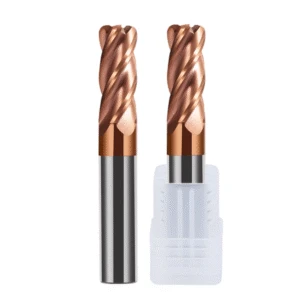
Demand for Custom Geometry in High-Finish End Mills from Premium Western Brands
When dealing with high-end medical equipment and precision optical mold sectors, finishing requirements transcend standard micron-level precision, pushing into nanometer-level surface roughness ($Ra$). For these brands, any slight tool mark or texture irregularity left on hardened steel requires hours of manual benchwork, or worse, scraps the entire mold. Consequently, when searching for an experienced ODM partner, these companies look far beyond standard catalog specification sheets; they inspect the micro-geometry of the cutting tools to find specialized solutions that eliminate surface imperfections.
Achieving a near-mirror finish on hardened steel requires tool geometry tailored to the client’s specific machine rigidity, spindle speeds, and material hardness. As an established hrc65 end mills manufacturer, we know that simply sharpening the cutting edge is not the answer. Success hinges on achieving a precise mechanical balance between the rake angle, relief angle, helix angle, and land width. During grinding, we use real-world cutting force data to give these finishing tools a unique geometric configuration that locks in superior surface quality.
Beyond Mirror Finishes—Suppressing Chatter in Finishing Operations via Irregular Edge Spacing
When precision-milling the flat surfaces or sidewalls of high-hardness cavities, operators are often plagued by fine streaks or chatter marks during the final passes. Traditional tools with uniform tooth spacing engage the workpiece at constant time intervals, making them highly susceptible to periodic cutting-force resonance. To disrupt this resonance cycle at the source, we employ staggered designs featuring unequal pitch and variable helix angles when engineering our private-label hrc65 end mills for overseas brands.
This irregular edge spacing ensures that as each cutting edge contacts the hardened steel, the cutting frequency and force vectors constantly shift. This dynamic variation effectively breaks up and dissipates resonance energy before it can accumulate into chatter. This design poses immense programming challenges on our five-axis grinders during the wheel-dressing and sharpening phases, as any calculation error overloads a single edge. However, judging by the mirror finishes achieved across thousands of machine shops, this trade-off is absolutely worth it.
Geometric Compensation for Flank Wear Effects on Dimensional Accuracy During Precision Milling of HRC 60–65 Materials
During prolonged, high-speed precision milling of hardened mold steel (HRC 60–65), carbide cutting edges endure intense friction. Over time, minor flank wear is inevitable, creating a narrow wear band along the cutting edge. Less-experienced tool manufacturers often overlook this factor when producing large-volume orders. Consequently, when customers machine complex, continuous surfaces, this progressive flank wear causes a sharp rise in cutting resistance, leading to dimensional drift in the final stages of the mold.
To extend tool life while maintaining high precision, we apply specific geometric modifications, such as dual relief angles and radiused relief, to our end mill bits for hardened steel. By accounting for the material’s elastic recovery, we precisely tailor the primary relief angle and the width of the land margin. This ensures the cutting edge retains optimal cutting elasticity even after minor wear occurs, preventing the excessive friction, heat, and deflection caused by an increased contact area.
Meeting Extreme Conditions: Custom-Engineered Finishing Milling Cutters for Dry Cutting/Air-Blast Applications
Modern, eco-friendly manufacturing philosophies in Europe and North America are driving workshops away from traditional flood coolants for high-hardness finishing. Instead, they adopt dry cutting with cold air blasts or MQL to avoid thermal shock. At cutting zone temperatures exceeding 1,000°C, liquid coolants cause severe thermal cycling, leading to micro-cracking in the carbide substrate. This places exceptionally rigorous demands on the red hardness of tools like our hrc65 4 flutes long neck end mill series.
To address these extreme dry operating conditions, we rely on adaptive geometry adjustments alongside advanced coating technology. We increase the negative rake angle to enhance the structural integrity of the cutting edge against high impact. Simultaneously, we employ a composite AlTiSiN nano-coating rich in silicon and titanium; under high heat, this coating forms a dense, protective amorphous layer on the tool surface. This thermal barrier insulates the substrate, ensuring cutting heat is carried away entirely by the airflow along with the chips.
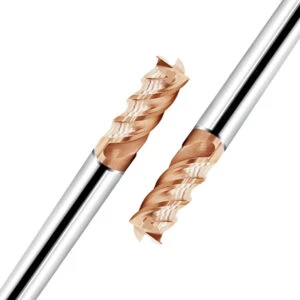
How Much Communication Cost Can You Save by Choosing an HRC65 End Mill Manufacturer That Speaks the Language of Engineers?
In the B2B tooling supply chain, many Western procurement managers face a frustrating reality: due to time zones and non-technical middlemen, a simple cutting-edge modification takes days to relay to production. Hard milling HRC65 steel leaves zero room for error; any misunderstanding regarding rake angles, edge honing, or neck tolerances leads to shattered tools. Partnering with a manufacturer that possesses genuine technical expertise offers value far beyond standard products. An expert partner instantly grasps your machining intent, preventing costly failures during initial product development.
With over a decade of experience handling thousands of custom projects, we know true efficiency stems from direct shop-floor alignment. When building specialized tools for ultra-hard workpieces, a knowledgeable hrc65 end mills manufacturer will ask precise questions about spindle rigidity, clamping methods, and actual radial/axial depths of cut ($Ae/Ap$). If your workshop is draining energy on convoluted communication channels or non-standard prototypes that fail to match your machining parameters, consider your current supply chain: are you wasting precious time on unnecessary “message relaying”?
Say No to “Telephone Game” Communication: Our R&D Engineers Connect Directly with Your Overseas Workshop
The difference between a partner who understands the shop floor and one who does not is immense. General sales representatives often mechanically record blueprint dimensions without grasping the actual cutting dynamics behind those numbers. If you are adjusting processes for difficult-to-machine hardened parts or encountering abnormal chipping due to uneven material hardness, our frontline R&D engineers can connect directly with your team. We won’t fob you off with standard catalog specs; instead, we recalculate variable helix angles and flank wear allowances based on your machine’s dynamic response.
Through this direct, peer-to-peer technical dialogue, complex geometric corrections can be finalized in minutes. For instance, regarding the high-performance finishing end mills needed for your high-hardness applications, we will ask whether your CAM strategy favors trochoidal milling or high-speed hard milling. This real-world feedback allows us to precisely tune the micro-geometry of each cutting edge on our 5-axis grinding machines before production. This approach eliminates cross-border technical misunderstandings and ensures the tools delivered to your machinists are ready to run right out of the box.
From Blueprint Evaluation to Initial Prototyping: A Rapid Engineering Workflow for Custom End Mills for Hardened Steel
Transforming a custom blueprint into a physical tool capable of stable, on-site cutting requires a rapid, rigorous engineering validation process. Blueprints from Western clients often specify only the workpiece’s final geometry; designing a high-rigidity clearance structure relies entirely on our assessment of physical limits. If you are working with new, high-alloy ultra-hard molds or seeking a custom hrc65 4 flutes long neck end mill to clear deep corners, simply send us your operating conditions, existing prints, and material grades for an in-depth pre-diagnosis.
Our custom prototyping process employs quantitative control from the moment we receive your files. First, we use software to simulate structural interference and deflection, adjusting the flute-to-chip-space ratio. Next, we grind the first sample on a European 5-axis machine, using precision non-contact optical instruments to lock in radial runout and core thickness tolerances. If you need custom end mill bits for hardened steel that perfectly suit your workshop’s extreme machining conditions, share your parameters with us, and let’s develop a geometrically balanced design together.