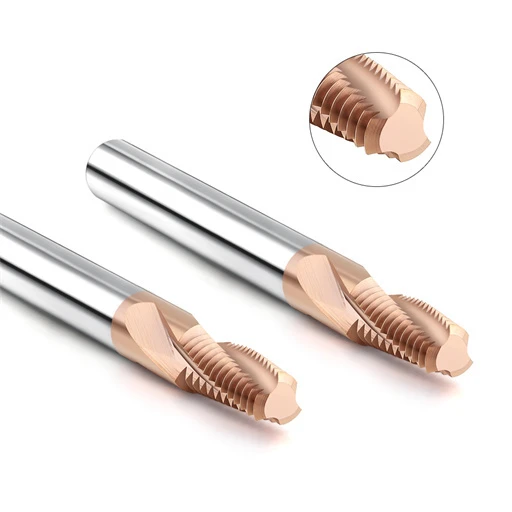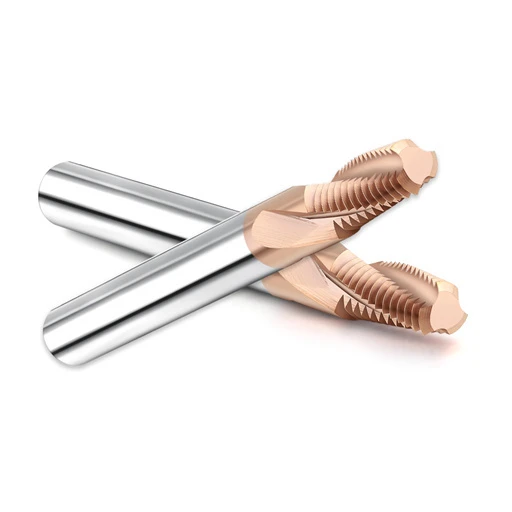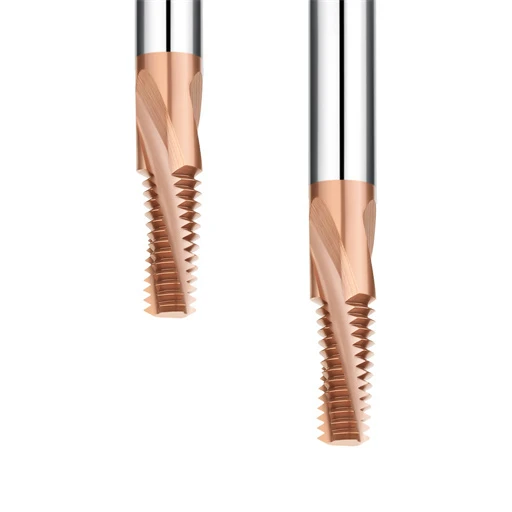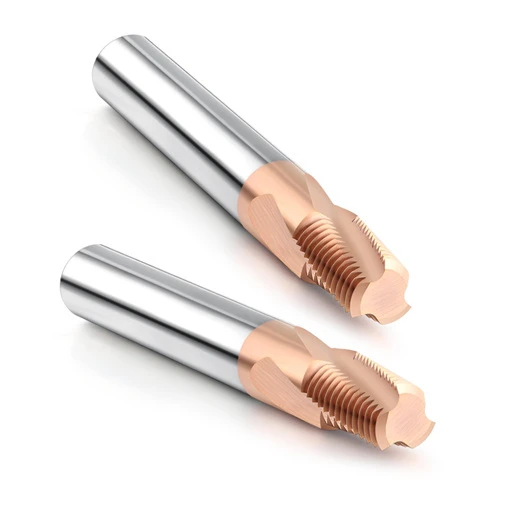

Last month, a long-standing Tier 1 automotive mold client from North America reached out for urgent assistance. Their CNC machining center was rushing to produce a batch of D2 mold steel inserts heat-treated to HRC62. Due to an engineering change, they needed to urgently drill a series of deep holes into these hardened workpieces.
The result was entirely predictable. The workshop burned through an entire box of imported solid carbide drill bits—marketed as “ultra-hard”—in no time. On average, each bit suffered catastrophic edge chipping or snapped inside the hole after fewer than two holes, leaving the shop supervisor furious.
This is by no means an isolated incident. In our 16 years of providing technical support to machining clients across the US and Europe, we have seen this “hardened steel drilling nightmare” play out repeatedly.
When faced with this, many guys immediately complain about substrate hardness, wrong coatings, or scramble to find new china carbide drill bit suppliers. However, our real-world shop data shows the problem usually lies in a microscopic geometric parameter that is easily overlooked: the point angle.
When machining ordinary carbon steel, a standard 118° or universal 135° point angle serves you well. But when dealing with high-hardness materials, unless the point angle design, chisel edge grind, and flute geometry are specifically reinforced, even the most expensive super hard drill bits are doomed to fail.
To overcome high-hardness machining, simply pursuing compressive strength isn’t enough; you must optimize the point angle to redistribute radial and axial cutting forces, protecting the vulnerable drill tip.
If you are currently struggling to machine hardened metal in the HRC60–HRC65 range—watching your spindle current spike and tools fail—have you considered that the issue might simply be a difference of a few degrees in the point angle of your carbide hrc65 drill bits?
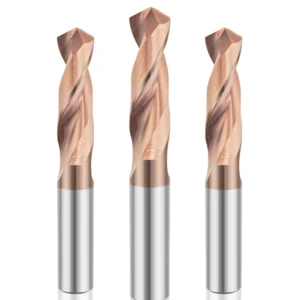
Why is the traditional 118° point angle a “disaster” for machining hardened metal?
To many novice process engineers, the 118° point angle appears to be the universal golden angle for standard drill bits. Indeed, when machining untreated AISI 1045 steel, ordinary cast iron, or aluminum alloys, this angle provides a satisfying axial entry feel and smooth chip evacuation. However, applying this traditional geometry directly to a through-hardened workpiece exceeding HRC60 turns this standard angle into a shop-floor nightmare.
When designing drill bits for hardened metal, we must consider the distribution of forces acting on the cutting edge. The traditional 118° point angle results in a relatively long main cutting edge, meaning the outer corners must withstand immense cutting force per unit area. Furthermore, the shallower point angle limits the material volume available to dissipate heat at the tip, causing rapid thermal softening of the cutting edge.
Fatal flaws of the 118° point angle when drilling hardened metal: Premature corner wear and chipping
If we examine the cutting process at the micron level, we find that when a 118° drill bit contacts a hardened workpiece, the outer corners suffer catastrophic impact first. Because the point angle is relatively shallow, the wedge angle at the drill’s periphery is structurally weaker. When cutting hardened metal, the outer corners must perform the cutting action while withstanding intense friction against the hole wall.
This complex stress state easily triggers microscopic deformation, causing the coating to flake off and escalating into irreversible abrasive wear. Once the outer edges wear prematurely, radial runout intensifies, causing cutting forces to skew to one side. Because a 118° drill tip lacks the rigidity to suppress high-frequency vibration, these hardened metal drill bits often fail from sudden chipping triggered by stress concentration.
16 Years of Shop-Floor Experience: A Hard-Learned Lesson with Heat-Treated Die Steel (HRC 60+)
Over a decade ago, our team provided technical support to a Western client manufacturing large stamping dies. We needed to machine a series of dowel holes in a batch of heat-treated Cr12MoV die steel at HRC62. Due to a lack of on-site experience at the time, we opted for standard drill bits with conventional point angles.
The moment the machine began its feed, the spindle load gauge spiked to its limit. Accompanied by a piercing screech, the drill bit’s outer cutting corners were ground flat after penetrating less than 3 millimeters, turning the hole opening blue from frictional heat. We ultimately had to use EDM to clear the holes, delaying delivery by three days and wasting several expensive super hard drill bits.
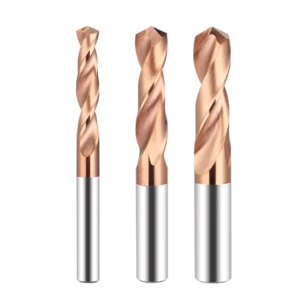
Conquering HRC65 Hardness: Why We Insist on Designing Carbide HRC65 Drill Bits with 135°/140° Point Angles
When workpiece hardness skyrockets to HRC65, metal cutting shifts to a “hard-on-hard” extrusion process under immense pressure. Under these extreme conditions, we must discard conventional machining assumptions. Through years of R&D and on-site testing, we ultimately settled on a wide point angle design of 135° to 140° to balance cutting resistance against the tool’s geometric limits.
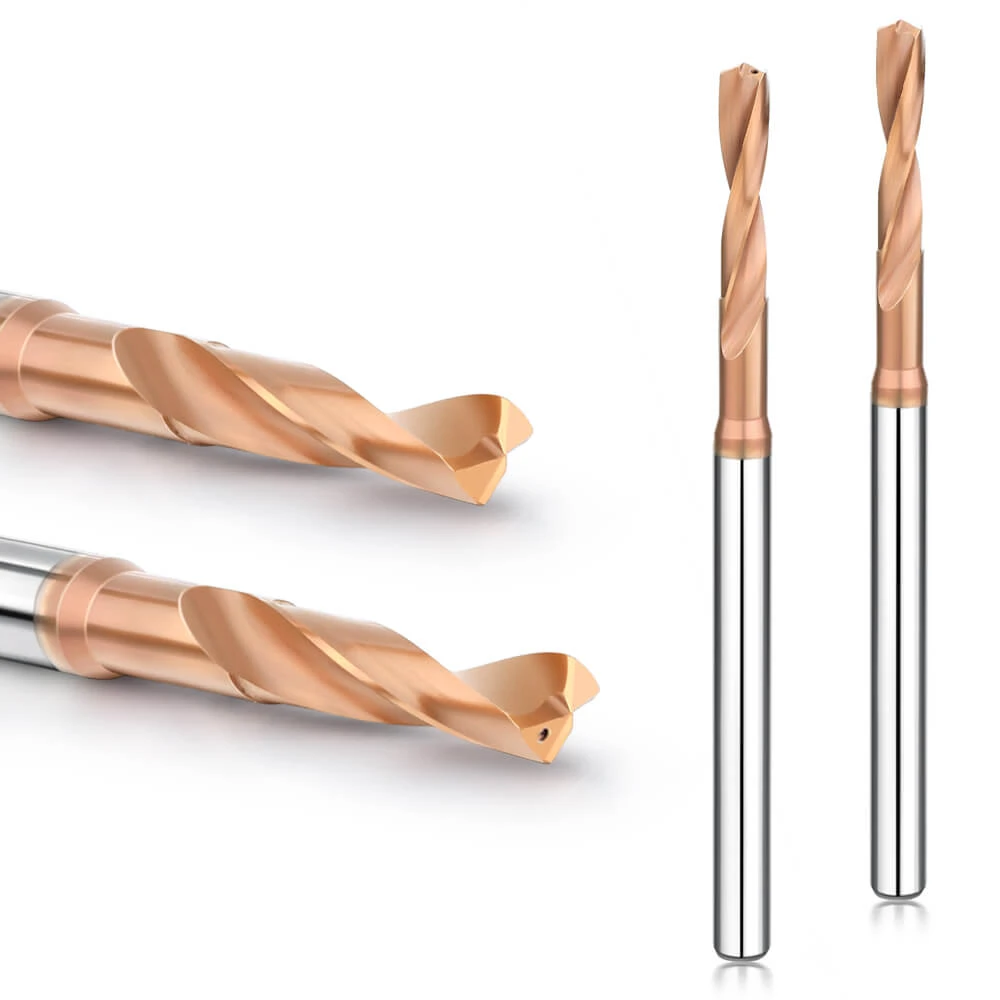
The core logic lies in altering how cutting forces are distributed across the cutting edge. Increasing the point angle to 140° flattens the drill tip profile, allowing massive radial cutting forces to transmit evenly backward to the rigid tool body rather than concentrating on the vulnerable edges. This flat profile is the key factor enabling carbide hrc65 drill bits to maintain edge integrity and prevent chipping in heat-treated steels.
H3: How Increasing the Point Angle Effectively Shortens Cutting Edge Length and Enhances Tip Rigidity in Super-Hard Drill Bits
From a geometric mechanics perspective, for a fixed hole diameter, a larger point angle results in a shorter effective length for the main cutting edge. While some machinists question this rationale, practical machining demonstrates that a shorter edge reduces the load-bearing area engaged in cutting. This directly lowers heat accumulation at individual cutting points while providing greater material thickness at the tip for robust support.
This structural modification plays a decisive role in enhancing tip rigidity for super hard drill bits. During continuous cutting, a robust tool tip withstands higher feed rates per revolution without fracturing from stress concentration. Our long-term observation of chip morphology reveals that a shortened cutting edge forces hardened metal into shorter, brittle C-shaped chips, significantly reducing frictional loads within the flutes.
Performance of the 140° Point Angle in Reducing Axial Cutting Force and Preventing “Breakout” at the Exit
In deep-hole or through-hole machining, the moment of breakthrough is often a massive headache for process engineers. With traditional 118° drills, the deep conical geometry means the thinning metal layer at the bottom cannot withstand the immense axial thrust. This frequently causes brittle spalling around the hole exit—a phenomenon known as breakout that immediately scraps expensive aerospace components or high-precision molds.
Switching to a 140° point angle changes this dynamic by converting the axial cutting force into radially outward shearing forces just before breakthrough. Feedback data from CNC machining center spindles shows that the axial load transition during the exit phase is far smoother. The tool effectively “scrapes” across the bottom metal, suppressing breakout and ensuring that your drill bits for hardened metal leave a clean exit with excellent dimensional tolerances.
The 140° Drill with S-Shaped Chisel Edge: Practical Self-Centering Advantages Without Pilot Drilling
However, a wide point angle increases the length of the chisel edge, making the drill prone to radial “walking” upon initial contact. To address this issue, we incorporate a specialized S-shaped chisel edge grinding process into our 140° design. By modifying the micro-geometry, the chisel edge is ground from a negative rake angle into a sharp cutting edge with a slight positive rake angle, fundamentally improving penetration.
In actual CNC operations, this S-shaped chisel edge design demonstrates exceptional self-centering capabilities. Even when encountering hard surfaces exceeding HRC60, it bites into the material instantly like a nail, eliminating the need for spotting drills. This saves valuable cycle time and avoids the secondary work-hardening caused by spotting drills, ensuring maximum stability for these super hard drill bits.
-白底主图3-300x300.webp)
Feedback from European and American Engineers: Process Optimization for Hardened Metal Drill Bits in CNC Machining Centers
Through extensive technical support, we frequently engage in in-depth discussions with workshop supervisors in Europe and the US. We have found that even with near-perfect geometric parameters, a tool’s full value cannot be realized without process-level optimization. Particularly on highly rigid machining centers, integrating machine performance with wide-point-angle cutting characteristics is a challenge any team striving for efficiency must overcome.
According to feedback from western customers, machine dynamic rigidity and spindle runout are absolutely critical when using drill bits for hardened metal. If your hydraulic or shrink-fit holder exhibits radial runout exceeding 0.02 mm, the force-distribution advantages of the 140° design are instantly negated. Therefore, when assisting customers with on-site optimization, we always prioritize checking spindle alignment and clamping rigidity first.
Choosing Between High-Pressure Through-Coolant and Minimum Quantity Lubrication (MQL) for 140° Point Angle Drills
When machining holes past HRC60, extreme heat in the cutting zone is your most formidable enemy. Western engineers often fall into two camps regarding cooling: high-pressure internal coolant or Minimum Quantity Lubrication (MQL). If your machine tool supports internal coolant exceeding 70 bar, it is undoubtedly the preferred choice because the powerful pressure forcefully flushes hard, tiny chips out via the evacuation flutes.
However, on CNC equipment incapable of delivering ultra-high-pressure internal cooling, low-pressure coolant can cause thermal fatigue, triggering micro-cracks in the carbide. In such cases, we often recommend MQL technology to our customers. By precisely mixing compressed air with a minute amount of vegetable oil, MQL provides excellent lubrication that effectively reduces friction between the workpiece and the outer edge of our carbide hrc65 drill bits.
Real-World Case Study: Avoiding the “Work Hardening” Effect When Drilling Hardened Surfaces by Adjusting Feed Rates
Last year, an aerospace component manufacturer in Ohio encountered a bottleneck while using our tools. Fearing tool breakage on a heat-treated alloy steel, operators arbitrarily reduced the feed rate per revolution by 50%. Paradoxically, this caused the drill to wear out faster, and the cutting edge suffered severe thermal damage after penetrating less than two millimeters, leading the customer to suspect a quality issue.
Our team analyzed their CNC program and immediately identified the problem as a classic “work hardening” trap. When high-hardness metal is compressed, an extremely hard cold-worked layer forms on the surface. If the feed rate is too low, the cutting edge merely rubs ineffectively against this layer, making the surface even harder; by restoring the feed rate to our recommended value, these hardened metal drill bits bit directly into the softer base material, tripling their tool life.
-白底主图2-300x300.webp)
How to Customize and Source High-Precision, High-Hardness Drill Bits from Chinese Carbide Drill Bit Suppliers?
Faced with complex global supply chains, many workshop supervisors use price as their sole benchmark. Consequently, the tools they purchase suffer from catastrophic edge chipping after running for only a few minutes on CNC machining centers. If you are scouring the globe for reliable china carbide drill bit suppliers capable of consistently delivering tools for HRC60+ applications, it is time to upgrade your technical evaluation criteria.
True supply chain strength lies in the details that often go unseen on the shop floor. From initial powder metallurgy sintering to final precision grinding on 5-axis CNC grinders, even a microscopic deviation can drastically shorten your tool life. We always encourage overseas engineers to evaluate a supplier’s process control capabilities against actual workshop conditions, ensuring you secure a partner who can genuinely solve your high-hardness machining bottlenecks.
Evaluating Substrate Materials from Chinese Carbide Drill Bit Suppliers: Identifying Nano-grain Carbide
When a drill bit cuts hardened tool steel, the grain size of the cemented carbide substrate directly determines the cutting edge’s resistance to chipping. If you are comparing material specifications from different suppliers, focus heavily on whether the grain size meets the “nano-grain” or ultra-fine grain standard. Traditional coarse-grained materials may offer high hardness, but their grain boundaries easily fracture under extreme cutting pressures.
During raw material quality inspections at our factory, we use high-magnification metallographic microscopes to examine the uniformity of the cobalt (Co) phase distribution. Ultrafine-grained carbide utilizes a nanoscale structure to boost compressive hardness while maintaining the exceptional fracture toughness required by carbide hrc65 drill bits. When vetting china carbide drill bit suppliers, always request hard data on the substrate’s fracture toughness (K1C value) and transverse rupture strength instead of relying on verbal promises.
Beyond Point Angles—Customizing AlCrN/Nano-composite Coatings for High-Hardness Machining with Chinese Suppliers
Once geometric parameters like the 140° point angle are optimized, the coating serves as the final line of defense for your tool tip. If you are facing thermal softening of the cutting edge or severe frictional wear caused by extreme cutting heat, consider requesting a specialized surface treatment solution. While traditional TiAlN coatings often fail due to oxidation at cutting temperatures exceeding 800°C, advanced AlCrN or nano-composite coatings offer a superior alternative.
These advanced coatings boast incredible red hardness and high oxidation resistance under heavy loads. During continuous machining, a dense protective aluminum oxide film forms on the coating surface, effectively blocking heat transfer to the carbide substrate. By discussing coating thickness and adhesion strength with a manufacturer’s technical team, you can easily deploy drill bits for hardened metal with a wear-resistant skin tailored to your exact coolant setup.
Avoid Blind Trial and Error: Establishing Tool Life Test Standards Before Bulk Purchasing Super Hard Drill Bits
Any tool marketed for superior performance must ultimately prove its worth through quantifiable data gathered on your shop floor. If you are considering switching tool brands to optimize your cost per hole, you should establish a rigorous tool life testing protocol to avoid making costly decisions based on guesswork. When providing sample cutting tools to Western B2B clients, we always emphasize recording the wear curve during continuous, realistic machining cycles.
A professional tool-life test requires tracking key parameters such as spindle current, holes drilled per minute, and exit burr size. By comparing the time taken and total holes completed before the tool reaches a flank wear (Vb Max) of 0.2mm under constant parameters, you can precisely calculate the actual ROI for these super hard drill bits.
Every factory operates under unique conditions, meaning slight variations in material heat treatment or machine rigidity can lead to vastly different tool performance. If you are currently grappling with frequent tool breakage, severe work hardening, or non-standard hole specs, please feel free to consult our engineering team. You can share your specific machining conditions, workpiece drawings, or material grades, and we can work together to tailor a high-performance solution for your shop.