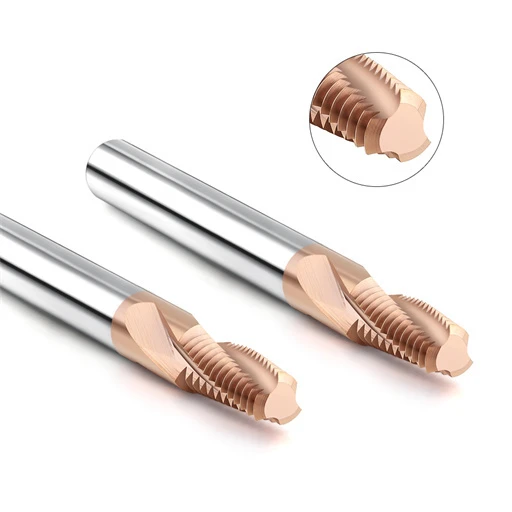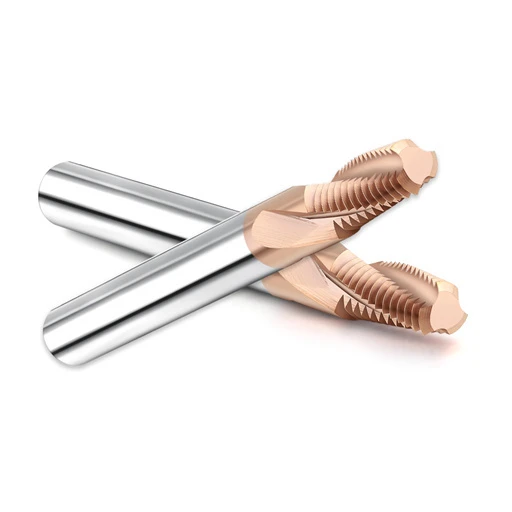

In our daily work with shop supervisors in the US and Europe, we constantly hear the same frustration: “We’re roughing H13 mold steel at 54 HRC. Using a standard 4-flute flat-end mill, the tool tip chips before we even finish half a cavity, and the spindle load spikes alarmingly.”
As CNC cutting tool engineers with over 15 years of shop-floor experience, we know this headache all too well. It is a classic issue we solve week after week.
Many shops try to simplify their inventory by using a single “carbide end mill for hardened steel” for both roughing and finishing. They assume a hard-material rating means a tool can do it all. However, in heavy-duty hard milling, extreme shear forces and blazing temperatures will quickly destroy a standard flat-end mill’s fragile corners.
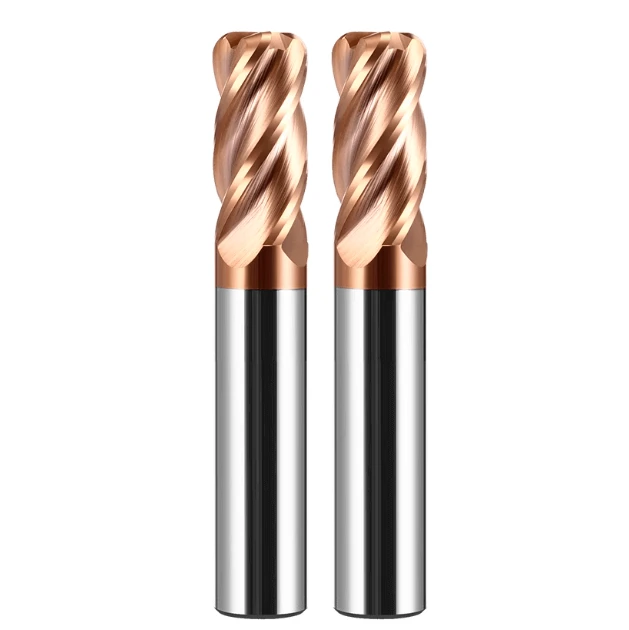
This is the exact bottleneck we address when auditing customer processes. Standard 4-flute geometries are compromises meant for general-purpose work. For roughing steels over 50 HRC, you absolutely need a dedicated 4 flute solid carbide roughing end mills that offers maximum rigidity, optimized chip gullets, and high impact resistance.
For complex cavities, you should also pair it with high-performance solid carbide corner radius end mills to share the cutting load. Relying solely on a basic solid carbide end mill cutter drives up your tooling costs and drags down cycle times. Are you ready to stop bleeding profits on tool wear and find out how specialized roughing cutters can save your shop floor budget?

Insights from 16 Years in the Field: Why Do Standard Flat-Bottom End Mills Often Fail Instantly When Roughing Hardened Steel?
Over 16 years of on-site troubleshooting in Western shops, we have seen countless machining disasters. When dealing with hardened D2, H13, or S136, operators often grab a generic flat-bottom tool from the crib for convenience. Within minutes, a piercing shriek echoes from the enclosure, followed by a chipped tip and a ruined workpiece. This instant failure in hard milling is never an accident.
Our field tests show these failures stem from a mismatch between cutting geometry and material yield strength. Above 50 HRC, steel resists deformation intensely, concentrating massive stress right at the sharp corners of a standard solid carbide end mill cutter. Attempting to hit high metal removal rates (MRR) with a general-purpose tool simply defies the laws of physics.
A Common Misconception in Western Workshops: Attempting to Use a Single “Carbide End Mill for Hardened Steel” for Both Roughing and Finishing
We frequently meet engineering managers who try to run a lean tool crib by using one universal carbide end mill for hardened steel for both roughing and finishing. Their logic seems sound: buy a high-end tool and let it handle everything. However, from a tool-making perspective, this “one-size-fits-all” approach ends up costing a fortune in premature tool wear.
Finishing tools feature highly honed, micro-chamfered edges designed for flawless surfaces, leaving little room for heavy chip evacuation. Roughing demands high feeds and aggressive material removal, while finishing requires high speeds and light cuts. Forcing one tool to do both yields terrible roughing efficiency and leaves you with a ruined edge that destroys your final part finish.
Analysis of Core Pain Points: Thermal Shock and Edge Chipping Mechanisms Under High Cutting Forces in Hardened Steel (>50 HRC)
Milling hardened steel above 50 HRC generates localized temperatures up to 1000°C. As a standard solid carbide end mill cutter rotates, each tooth endures a brutal thermal cycle: expanding as it cuts, then instantly contracting as it exits the material. This rapid thermal fatigue creates microscopic cracks along the carbide substrate.
Worse yet, hardened steel chips are needle-like and highly resistant to curling. When these hot, abrasive chips pack into the flutes, the tool recuts them, causing sudden mechanical shock. Combined with thermal cracking, this forces the tool corners to spall and chip away, which is why microscope analysis of failed tools reveals thermal stress fractures rather than normal abrasive wear.

The Robust Geometric Design of 4-Flute Solid Carbide Roughing End Mills: What Makes Them So Powerful?
If you have ever tried to rough hardened mold steel (exceeding 55 HRC) with a standard flat-end mill, you likely remember the tool snapping due to extreme cutting resistance. For these stubborn materials, standard geometries simply fail. That is why we always recommend specialized 4 flute solid carbide roughing end mills for heavy cavity stripping. The strength of these tools does not come from marketing claims, but from specialized geometries engineered to survive extreme torque.
Through continuous in-house grinding and spindle tests, we found that general-purpose cutters cannot balance impact resistance with chip clearance on hardened steel. Dedicated roughing mills solve this by using high-rigidity flute profiles and reinforced edge preparation to distribute cutting forces across the tool body. This specialized design not only withstands intense mechanical resistance but also cushions your CNC spindle and tool holder from destructive harmonics during heavy cuts.
The Secret Lies in the Cutting Edge: How the Wave-Edge Breaks Chips and Reduces Cutting Resistance by Over 30%
Look at our specialized roughing cutters under a microscope, and you will see the cutting edge is not smooth, but wavy and undulating. Machinists often ask us: “Won’t this ruined profile compromise the wall finish?” Remember, this step is purely about fast metal removal. The genius of this wave-edge design lies in its ability to split wide, tough chips into tiny, segmented needles that easily clear out via air blast.
In heavy-duty hard milling, this chip-splitting mechanism is a complete game-changer. Our dynamometer testing proves that the wavy profile reduces instantaneous cutting forces by over 30%. Because the chips are broken early, they do not pack inside the flutes or cause secondary cutting. This prevents catastrophic friction heat and allows a high-quality carbide end mill for hardened steel to run at aggressive feed rates without chipping.
The Decisive Role of Core Thickness and Variable Helix Designs in Suppressing Chatter During Hard Milling
Harmonic chatter is a constant nightmare in hard milling, acting as the leading cause of premature tool fatigue. To tackle this head-on, we increase the core diameter of our roughing cutters to 60%–65% of the tool’s outer diameter. While this slightly reduces the flute depth, it massively boosts torsional stiffness. This extra muscle prevents the tool from deflecting sideways when hitting scale or hard spots.
But a thick core alone is not enough, so we engineered variable helix angles and unequal index spacing into our solid carbide end mill cutter lineup. Symmetrical flutes hit the material at a fixed frequency, generating resonant chatter; our variable helix disrupts this physical cycle by changing the timing of each edge engagement. The difference is immediate: the piercing metallic shriek of the cut transforms into a smooth, steady hum.
Why 4- Flute Solid Carbide Roughing End Mills Are the Ultimate Solution for High Metal Removal Rates (MRR)
When you need to hog out hundreds of cubic inches of hardened tool steel, slow machining is a profit killer. Many shops, fearing a catastrophic break, run ultra-shallow cuts and agonizingly slow feeds, dragging out cycle times. We consistently prove to clients that 4 flute solid carbide roughing end mills offer the safest, most efficient path to high MRR without risking your workpiece.
Compared to 2- or 3-flute tools, a 4-flute setup provides more active cutting edges, allowing much faster table feeds at the same spindle speed. Conversely, compared to 6- or 8-flute finishing cutters, our 4-flute rougher features much deeper chip gullets to handle the massive volume of hot chips generated by heavy dynamic toolpaths. It is the perfect sweet spot of rigidity, edge count, and chip clearance.
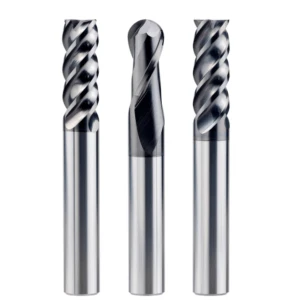
Real-World Case Study: Standard 4-Flute Tools vs. Specialized Roughing Mills—A Comparison of Tool Life and Efficiency on D2/H13 (52–58 HRC)
In the tooling business, blueprints and formulas mean nothing until they survive on a real CNC machine. This is especially true when milling notoriously abrasive D2 and H13 mold steels hardened to 52–58 HRC. Packed with chromium, molybdenum, and vanadium, these alloys are brutal on cutting tools. We love using real-world performance data to show cost-sensitive clients the massive productivity gap between general-purpose and dedicated roughing tools.
In our field tests, we do not just compare two different tool shapes; we compare two entirely different machining philosophies. Standard 4-flute flat-end mills, with their sharp edges and uniform flutes, wear out rapidly under the continuous pounding of hardened steel. Meanwhile, specialized roughers distribute cutting loads beautifully, proving far more resilient to impact and thermal cracking. Let’s look at a head-to-head test from a customer shop in Ohio.
Case Study 1: Rapid Wear and Spindle Overload Experienced by an Ohio Client Using Standard Solid Carbide End Mills
Last year, a major automotive die shop in Ohio reached out to us. They were roughing deep pockets in H13 die-casting molds (54 HRC) using a popular, generic solid carbide end mill cutter. Because the tool lacked specialized geometry, the programmer had to use extremely timid parameters to avoid a snap: axial depth (Ap) was held to just 0.2 mm, running with a slow feed and a horrible high-pitched squeal.
Even with such caution, the spindle load meter constantly spiked above 85%, and the machine vibrated severely. We inspected their worn tools under a shop microscope and found massive micro-chipping and thermal breakdown along the flank faces after just 30 minutes of cut time. The resulting friction spike forced constant operator interventions and tool changes, putting their mold delivery schedule weeks behind.
Case Study 2: Comparison of Cutting Parameters, Machining Time, and Tool Life After Switching to 4-Flute Solid Carbide Roughing End Mills
We analyzed their setup and recommended swapping those generic tools for our 4 flute solid carbide roughing end mills featuring chip-breaking geometry. We loaded a fresh tool into their Haas VMC, programmed a dynamic trochoidal path, and set aggressive parameters: Ap at 2.0 mm, Ae at 0.8 mm, Vc at 80 m/min, and Fz at 0.08 mm/tooth. The difference on the first pass was night and day.
Thanks to the rougher’s wave-edge chip-breaking action, the spindle load dropped to a quiet, stable 45%. The performance metrics spoke for themselves: cavity cycle time dropped from 4.5 hours to just 1.2 hours—a 4x jump in productivity. Best of all, tool life shot up from a fragile 30 minutes to a reliable 2.5 hours of continuous cut time. This massive leap was purely the result of optimized geometry.
The Cost Equation: How Reduced Cycle Time Offsets the Purchase Cost of Specialized Tools
Procurement managers often hesitate when they see that specialized carbide end mill for hardened steel options cost 20% to 30% more than generic tools. However, we always urge shops to look at the total cost per part. Shop rate for a CNC machine and operator in the US easily runs $80 to $120 per hour. By saving 3.3 hours of machine time per mold cavity, we saved this client nearly $300 in overhead per part.
Additionally, reducing tool changes from once every 30 minutes to once every 2.5 hours slashed non-productive downtime by over 80%. It also spared their expensive spindles and ball screws from heavy vibrational wear. Even with a slightly higher upfront price, the specialized roughing mill paid for its premium within the first hour of cutting. Focus on the cost per part, not the tool price, to find the true bargain.
How to Transition Seamlessly from Roughing to Semi-Finishing?
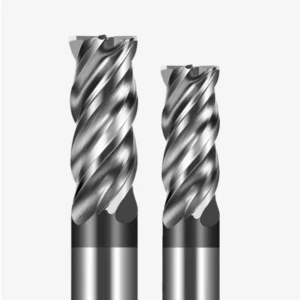
After dynamic roughing, many programmers are eager to jump straight to finishing. However, experienced machinists know that the stock remaining on cavity walls is highly uneven. If a finishing cutter hits these irregular material “steps,” the sudden load spike will cause instant chipping or leave ugly witness marks on your mold. Establishing a smooth transition phase is the only way to guarantee a high-quality, high-hardness mold cavity.
In our process setups, the core goal of semi-finishing is “stock homogenization.” By running a high-rigidity solid carbide end mill cutter with optimized edge prep, we shave down those heavy steps, leaving a uniform 0.1 mm to 0.15 mm skin for the final pass. This step ensures a constant-load environment for your finishing tools, which is the absolute secret to achieving a flawless mirror finish without manual polishing.
Why We Recommend Solid Carbide Corner Radius End Mills for Stock Removal After Roughing
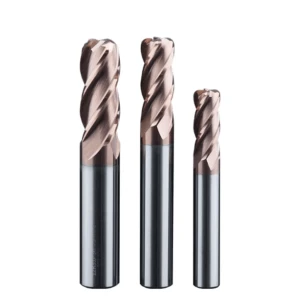
Heavy roughing leaves massive, staircase-like stock in the right-angle transitions and deep cavity corners. If you send a standard square-end mill to clear these areas, the sharp corners of the tool will get choked by converging radial forces. This is why we highly recommend using specialized solid carbide corner radius end mills (often called bull-nose end mill cutters) to clear this leftover stock safely.
From a mechanics standpoint, a corner radius (R-angle) redirects concentrated radial stress into more stable, axial cutting forces. In our custom programs, running a bull-nose mill for rest-machining ensures smoother chip evacuation and a highly stable scraping action when slicing through uneven steps. This design is exceptionally effective on hardened steel above 50 HRC, keeping your tool tips intact.
Protecting the Tool Tip: How Corner Radii Disperse Cutting Stress During Hardened Steel Corner Cleanup
If you inspect failed tools in your shop, you will find that over 90% of failures on square-end cutters happen right at the sharp, fragile corner. During rest milling—where the radial engagement spikes instantly—sharp corners simply cannot handle the thermal and mechanical shock. Upgrading to a specialized carbide end mill for hardened steel with a robust corner radius eliminates this physical vulnerability.
Our test data proves that adding a corner radius slashes the stress concentration factor by several times. The intense shear forces are distributed across a larger, curved cutting edge rather than a single point, preventing local heat buildup. This simple geometric shift drastically reduces micro-chipping during interrupted cuts, showing that a smart R-angle selection is the ultimate tool-saving art.
Pitfall Guide: 3 Fatal Errors When Using Roughing End Mills for Hardened Steel on the Shop Floor
Over 16 years of auditing shops across the US and Europe, we have seen premium tooling ruined by simple operational mistakes. During heavy-duty roughing of high-hardness steels, methods that work perfectly on aluminum or soft steels will ruin high-performance tools in seconds. We believe in providing both top-tier tools and the field-tested know-how to keep them running.
In hard milling, you are fighting extreme cutting forces and thermal cycles with zero room for error. A single mistake in your coolant setup, toolpath entry, or workholding will shatter a solid carbide end mill cutter instantly. To protect your setup and keep your machines running, let’s break down the three most destructive mistakes we regularly spot on the shop floor.
Error 1: Thermal Cracking Caused by Indiscriminate Use of Coolant (Flood Coolant)
Many machinists reflexively flood the cutting zone with coolant when things get hot. However, when roughing steel above 50 HRC, dumping water-soluble coolant on the tool is the fastest way to kill it. During hard milling, the cutting edge heats up to 900℃ in the cut and cools rapidly in the air, creating a brutal thermal shock cycle that triggers micro-cracks in the carbide.
We have inspected hundreds of carbide end mill for hardened steel units ruined by thermal cracking, which causes the cutting edge to flake off in chunks. In our own testing, dry cutting with a high-pressure air blast or Minimum Quantity Lubrication (MQL) is the superior choice. The strong air blast clears hot chips instantly, preventing recutting without exposing the tool to thermal fatigue.
Error 2: Poor path planning in Trochoidal Milling leads to instant tool failure
Modern CAM packages push trochoidal milling (dynamic milling) to maximize metal removal rates by using full axial depth and small step-overs. However, many junior programmers forget to optimize feed rates when the tool enters narrow slots, tight pockets, or sharp internal corners. Without adaptive feed control, the tool’s arc of engagement spikes, causing cutting forces to jump exponentially.
We often see high-dollar 4 flute solid carbide roughing end mills snap instantly when plunging into unoptimized corner pathways. To prevent this, always enable “corner deceleration” and “adaptive step-over” functions in your CAM software when cutting hardened materials. Keeping your engagement angle constant is the only way to achieve the long tool life these specialized roughers are designed to deliver.
Error 3: Insufficient tool holder clamping rigidity and excessive spindle runout
Shops will spend top dollar on high-end cutters but run them in cheap, worn-out collets. During hard roughing, intense cutting forces amplify even the tiniest vibration in your setup. If you run a high-load toolpath in a standard ER collet, the holder lacks the torsional stiffness to prevent the tool from vibrating, which can even cause the cutter to pull out axially.
Worse still is radial runout; if your spindle-and-holder assembly has over 0.01 mm of runout, your cutting loads become extremely uneven. One or two flutes will bear the entire impact, causing heavy chatter and rapid chipping. For hardened steel, we strongly advise using shrink-fit or high-precision hydraulic holders to keep total runout under 0.005 mm, protecting your solid carbide corner radius end mills from failure.
Finding a High Quality Source: How to Evaluate the Manufacturing Capabilities of a Solid Carbide End Mill Factory?
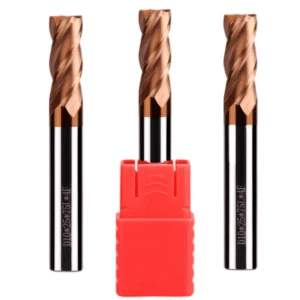
When talking to shop managers, one question always comes up: “Why do identical-looking tools perform so differently on our machines?” As a dedicated solid carbide end mill cutter factory, we know that high-performance tools cannot be built on glossy catalog promises. Real tool life depends entirely on a manufacturer’s machinery, raw material quality, coating consistency, and grinding expertise.
Under the brutal conditions of hard milling, any slight quality variation is instantly exposed when cutting steels above 55 HRC. If your shop is struggling with inconsistent surface finishes or erratic tool life, it is time to evaluate your supplier’s manufacturing standards. A top-tier factory does more than sell tools—they provide the engineering depth to optimize your specific machining setup.
Controlling Raw Materials: Precision Guaranteed by Micrograin Carbide Rods and Imported 5-Axis Grinders
For a high-performance carbide end mill for hardened steel, performance limits are set by the microstructure of the raw carbide rod. We use only premium sub-micron or nano-grain tungsten carbide substrates to ensure the perfect blend of hardness, edge toughness, and transverse rupture strength. Coarse-grained, cheap rods will always suffer from premature micro-chipping under high-load hard milling.
To turn premium raw stock into high-performance tools, we grind all of our hard-milling cutters on imported 5-axis CNC grinders like Walter and ANCA. By combining ultra-precise in-process wheel probing with strict temperature controls, we keep edge serration and runout to micron-level tolerances. If you are machining high-tolerance molds, you will immediately see the difference in tool life and part accuracy.
How Is the Nano-Coating (AlCrN/TiSiN) Process for High-Hardness Steel Inspected In-Process?
In dry hard milling, a quality coating acts as body armor against cutting temperatures that top 900℃. While cheap coatings oxidize and flake away under these conditions, our custom-formulated TiSiN and AlCrN nano-coatings create a dense, thermal-barrier layer on the tool. This barrier is what keeps the substrate of our 4 flute solid carbide roughing end mills from softening during heavy-duty dynamic cuts.
However, true coating quality goes far deeper than a flashy surface color. In our factory, we run every batch through automated scratch testers, nanoindenters, and high-mag microscopes to verify critical thickness uniformity and adhesion. If you are dealing with premature coating flaking on your current tools, ask your supplier for their physical coating test reports to verify their quality controls.
How We Provide Customized Technical Support to Overseas Clients as a Professional Solid Carbide End Mill Manufacturer
As an established solid carbide end mill cutter factory, we know that every machine shop faces unique challenges. A standard tool catalog cannot solve every complex setup, and switching from D2 to S136—or running a long-reach setup—often requires subtle geometry tweaks. In these situations, having direct, rapid technical support and custom-tailored tooling options from your manufacturer is a massive competitive advantage.
We do not just sell products; we work alongside engineers to solve tough machining bottlenecks. If you are currently struggling with heavy vibrations, rapid tool wear, or challenging superalloys, we invite you to share your part drawings, material specs, and spindle data with us. Together, we can customize the perfect flute geometries and corner radii to help you reclaim lost cycle times and boost shop-floor productivity.